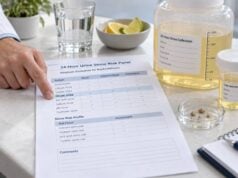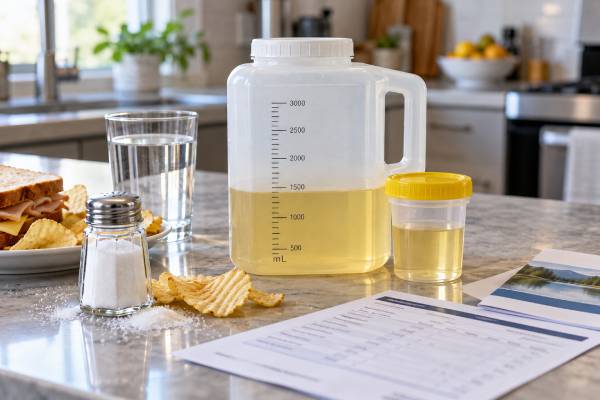
A urine sodium test estimates how much sodium your kidneys excrete, usually over 24 hours. In kidney stone prevention, it is useful because most ingested sodium eventually appears in urine, so a 24-hour value can reveal high salt intake more objectively than a food diary. High sodium matters especially for calcium stone formers: as the kidneys excrete more sodium, urinary calcium often rises too, increasing calcium oxalate and calcium phosphate supersaturation. The result is not a direct stone diagnosis, and one day can be affected by restaurant meals, sweating, exercise, diuretics, and incomplete collection. It should be interpreted with urine calcium, volume, citrate, oxalate, phosphorus, pH, and stone composition. Current kidney stone nutrition guidance commonly recommends keeping sodium intake below about 100 mmol, or 2,300 mg of sodium, per day for people with calcium-based stones. The most useful approach is to use urine sodium as feedback, identify major food sources, and repeat testing after practical diet changes.
- About 100 mmol of sodium equals 2,300 mg; this is a common daily intake target for calcium stone prevention.
- High urine sodium often means high dietary salt exposure and can drive urinary calcium higher.
- A 24-hour urine collection is more useful than a spot urine sodium for estimating ordinary daily intake.
- Restaurant food, processed food, sauces, cured meats, packaged snacks, and breads can contribute more sodium than table salt.
- A lower urine sodium is most useful when it also lowers urine calcium and calcium stone supersaturation.
Table of Contents
- What urine sodium measures
- Ranges, units, and sodium conversions
- How sodium increases calcium stone risk
- What high and low urine sodium mean
- How to lower urine sodium in real life
- Collection and interpretation errors
- Follow-up and treatment decisions
What urine sodium measures
Sodium is the main positively charged mineral in extracellular fluid. The kidneys adjust sodium excretion from hour to hour to maintain blood volume and electrolyte balance. Over a complete day, urinary sodium is closely related to the amount of sodium absorbed from food, although sweat and other non-urine losses can modify the relationship.
For kidney stone evaluation, a 24-hour urine sodium is usually more informative than a spot measurement. A random sample may look high after a salty meal and low after several hours without food, while a full-day collection captures the total exposure more realistically.
Urine sodium is usually measured as part of a broader kidney stone prevention test panel. That matters because sodium is not a stone mineral in most common stones. Its main effect is indirect: high sodium intake changes kidney calcium handling and can make more calcium spill into urine.
The result also gives practical dietary feedback. People often underestimate sodium because much of it is built into food before it reaches the table. A person who rarely uses a salt shaker can still have high urine sodium from sandwiches, deli meat, cheese, bread, frozen meals, restaurant food, soups, sauces, and convenience foods.
Urine sodium is therefore both a physiologic marker and a behavior marker. If the value falls after dietary changes and urine calcium falls with it, the test shows that the change is having the intended metabolic effect.
Ranges, units, and sodium conversions
Urine sodium is commonly reported in mmol/day or mEq/day. For sodium, mmol and mEq are numerically the same. One mmol of sodium equals about 23 mg, so:
- 100 mmol/day ≈ 2,300 mg sodium/day;
- 150 mmol/day ≈ 3,450 mg sodium/day; and
- 200 mmol/day ≈ 4,600 mg sodium/day.
Current CARI kidney stone nutrition guidance recommends less than 100 mmol, or 2,300 mg, of sodium per day for people with calcium-based stones. European guidance expresses a similar concept as limiting salt, or sodium chloride, to about 4–5 g/day. Note that salt and sodium are not the same number: 2,300 mg of sodium is roughly 5.8 g of table salt.
Some older stone-risk tables list urine sodium below 200 mmol/day as a reference value. That should not be confused with an ideal prevention target. A value of 180 mmol/day may fall below an older laboratory cutoff yet still represent enough sodium to worsen hypercalciuria in a susceptible person.
| Urine sodium | Approximate sodium equivalent | Practical interpretation |
|---|---|---|
| Below 100 mmol/day | Below 2,300 mg/day | Common prevention target if collection is complete |
| 100–150 mmol/day | 2,300–3,450 mg/day | Moderate intake; may still raise urine calcium in some people |
| Above 150–200 mmol/day | Above 3,450–4,600 mg/day | Often suggests substantial sodium exposure |
These are not diagnostic categories. Heavy sweating, hot weather, endurance exercise, edema treatment, diuretics, and incomplete urine collection can change the relationship between dietary intake and urinary excretion.
How sodium increases calcium stone risk
The kidneys handle sodium and calcium in linked ways. When dietary sodium intake rises, the kidney excretes more sodium, and urinary calcium often increases at the same time. This can raise calcium oxalate and calcium phosphate supersaturation.
Current CARI guidance notes that sodium intake above 2,300 mg/day is associated with an increase in urine calcium, and controlled diet studies show that sodium reduction can substantially lower 24-hour urine calcium. That makes sodium restriction especially important for people with hypercalciuria, meaning high urinary calcium.
A high urine sodium result is therefore most meaningful when paired with a urine calcium test. If both are high, reducing sodium may lower calcium without reducing dietary calcium. That distinction is important because a low-calcium diet can paradoxically increase oxalate absorption and worsen calcium oxalate stone risk.
Sodium may also affect citrate. High sodium intake can be associated with lower urinary citrate in some people, removing part of the urine’s natural defense against calcium crystal growth. The combined pattern—high sodium, high calcium, and low citrate—can be particularly unfavorable.
Urine volume remains another major factor. High sodium can increase thirst, but it does not guarantee adequate urine output. If someone eats salty food and still produces only 1.3 L of urine, calcium and oxalate remain highly concentrated. The urine volume result therefore needs to be reviewed at the same time.
Sodium restriction can also improve the effectiveness of thiazide-type medications used for hypercalciuria. When sodium intake remains high, the calcium-lowering effect of these medicines may be reduced. This is one reason clinicians often ask for a repeat 24-hour urine after both medication and dietary changes.
What high and low urine sodium mean
A high 24-hour urine sodium most commonly reflects high sodium intake. It can be a useful reality check when the diet history sounds low-salt but the urine suggests otherwise. Hidden sodium is common, especially in restaurant meals and packaged foods.
High urine sodium does not prove that sodium caused a kidney stone. It is a modifiable risk factor that becomes more persuasive when urine calcium is also high or calcium supersaturation falls after sodium reduction.
Other causes of high urinary sodium include certain diuretic effects, recovery from fluid retention, high fluid and sodium intake, and some endocrine or kidney conditions. In most stable outpatients undergoing stone testing, diet is the main explanation.
A low urine sodium can reflect a genuinely low-sodium diet, but it can also result from incomplete urine collection, low food intake, dehydration with strong kidney sodium conservation, heavy sweating, vomiting, diarrhea, or medications. Very low urine sodium is often interpreted differently in hospitalized or acutely ill patients than in a stable stone-prevention evaluation.
The full collection helps distinguish these possibilities. If sodium, creatinine, potassium, urea nitrogen, and total volume are all unexpectedly low, the sample may be incomplete or the person may have eaten very little. If sodium is low but creatinine and other solutes look plausible, the diet change may be real.
A single low result should not lead to progressively stricter sodium restriction without reason. Sodium is essential, and people with certain medical conditions, heavy sweat losses, low blood pressure, or specific medications may need individualized advice. The kidney stone target should fit the whole health picture.
Urine sodium also has a useful relationship with blood pressure. High dietary sodium can raise blood pressure in salt-sensitive people, so reducing excess sodium may benefit both cardiovascular health and calcium stone prevention. That overlap makes sodium one of the few stone-risk factors where a single dietary change can support more than one health goal.
How to lower urine sodium in real life
The most effective sodium reduction usually comes from changing food sources, not from counting every grain of salt. Roughly 10–20% of sodium intake in many modern diets comes from discretionary salt added at the table or during cooking; the rest is often already present in processed and prepared foods.
High-yield changes include:
- Compare nutrition labels. Similar breads, soups, sauces, and frozen meals can differ by hundreds of milligrams per serving.
- Reduce processed meats. Bacon, sausage, deli meats, jerky, and cured meats are concentrated sodium sources.
- Watch condiments. Soy sauce, bottled dressings, seasoning blends, bouillon, ketchup, and restaurant sauces can add large amounts quickly.
- Choose less processed staples. Fresh meat, fish, eggs, beans, rice, potatoes, vegetables, fruit, plain yogurt, and home-cooked grains make sodium easier to control.
- Ask for sauces and dressings on the side when eating out. Restaurant sodium can exceed a full day’s target in one meal.
- Keep normal dietary calcium. Do not substitute sodium reduction with unnecessary dairy restriction. Calcium at meals helps bind oxalate in the gut.
A practical target is often easier to reach gradually. Someone excreting 220 mmol/day does not need a perfect 90 mmol/day collection immediately to show progress. A drop to 150 mmol/day may already reduce urine calcium, and the next collection can guide further changes.
Reading labels becomes easier once sodium is converted into a daily budget. If the goal is about 2,300 mg/day, a meal containing 1,200 mg uses more than half the day’s allowance before snacks, sauces, and other meals are counted. Foods advertised as “reduced sodium” can still contain substantial amounts; the comparison with the regular product matters more than the marketing term. Serving size matters too. A soup label may list 650 mg per serving while the container actually contains two servings.
Home cooking gives more control, but “natural” does not always mean low sodium. Cheese, cottage cheese, tortillas, breads, canned beans, pickles, olives, smoked fish, and seasoning packets can all contribute meaningfully. Rinsing canned beans or vegetables can reduce some surface sodium, while choosing no-salt-added versions lowers it further. Flavor can come from herbs, spices, citrus, vinegar, garlic, ginger, and chile rather than relying on salt-heavy blends.
Potassium-rich whole foods, fruits, and vegetables can support a healthier overall pattern and may improve citrate, but salt substitutes containing potassium are not appropriate for everyone. People with chronic kidney disease or medications that raise blood potassium should ask a clinician before using potassium chloride salt substitutes.
The goal is not a bland or nutritionally narrow diet. It is a sustainable eating pattern that brings urine sodium and calcium down without creating new problems.
Collection and interpretation errors
A 24-hour urine sodium is only as good as the collection. Missing a few daytime voids can reduce the result substantially. Adding the first morning urine at the wrong time or collecting for 28 hours instead of 24 can push the number upward.
Follow the laboratory’s start and finish instructions. In many protocols, you discard the first morning void, record the time, collect every void afterward, and finish by collecting the first morning urine at the same time the next day. Store the container as directed.
The day chosen also matters. If you usually cook at home but collect on a day with pizza, takeout, and restaurant dinner, the urine may capture an unusually high exposure. Conversely, eating an intentionally low-sodium “test diet” can make the result look better than normal. Initial testing should usually reflect ordinary life.
Sweat losses can make urine sodium underestimate dietary intake. This matters during hot weather, heavy outdoor work, long endurance exercise, or sauna use. The body loses sodium through sweat instead of urine, so a person can consume substantial sodium while excreting less in the collection.
A 24-hour urine sodium test may also be used outside stone care to estimate salt intake or evaluate electrolyte balance. The interpretation changes with the clinical question, so the same number should not be judged by one universal cutoff.
Follow-up and treatment decisions
The most useful follow-up question is: Did lowering sodium improve the rest of the stone profile? A successful intervention often produces lower urine sodium, lower urine calcium, and reduced calcium oxalate or calcium phosphate supersaturation.
If the sodium number improves but the rest of the profile does not, that still provides useful information. It means the diet change was real, but another factor may be dominating stone risk. Conversely, a modest sodium reduction that produces a large fall in urine calcium can show that the kidneys are particularly sodium-sensitive. This is why repeat testing turns a general recommendation into individualized feedback.
Many clinicians repeat a 24-hour urine about 8–12 weeks after starting a major diet or medication change. Two baseline collections may also be useful because sodium intake varies from day to day. Once the profile is stable, testing can be spaced farther apart.
If urine sodium remains high despite serious effort, a dietitian can help identify sources that are easy to miss. Food logs become more useful when they are compared with the objective urine value. A person who records “healthy sandwich and soup” may discover that the bread, turkey, cheese, mustard, and canned soup together supplied far more sodium than expected.
If urine sodium falls but urine calcium stays high, sodium was probably not the only driver of hypercalciuria. The clinician may then evaluate idiopathic hypercalciuria, parathyroid disease, vitamin D exposure, or other causes and consider medication when appropriate.
If both sodium and calcium improve but stones continue, review oxalate, citrate, pH, urine volume, stone composition, and urine supersaturation. Prevention is most effective when treatment follows the full metabolic pattern rather than one dietary number.
A high urine sodium result is therefore not a reason for guilt or extreme restriction. It is actionable feedback. Used correctly, it can identify a modifiable cause of high urinary calcium and provide a measurable way to confirm that dietary changes are working across ordinary meals, workdays, restaurant meals, exercise, hot weather, travel, medication changes, and seasonal shifts in fluid intake and sweat loss over time, while keeping the rest of the metabolic stone profile visible rather than focusing on sodium alone during follow-up.
References
- Nutrition therapy for the prevention of kidney stones – CARI Guidelines 2025 (Guideline)
- Metabolic evaluation for prevention of kidney stones – CARI Guidelines 2025 (Guideline)
- Diagnosis and risk factors of kidney stones – CARI Guidelines 2025 (Guideline)
- Metabolic Evaluation and Recurrence Prevention for Urinary Stone Patients: An EAU Guidelines Update 2024 (Review)
- 24-Hour Urinary Chemistries and Kidney Stone Risk 2024
Disclaimer
This article provides general information about urine sodium in kidney stone prevention and is not individualized medical or dietary advice. Sodium targets may need adjustment for kidney disease, heart failure, low blood pressure, heavy sweat losses, medications, or other medical conditions. Discuss major sodium restriction or salt substitutes with a qualified clinician when these issues apply.