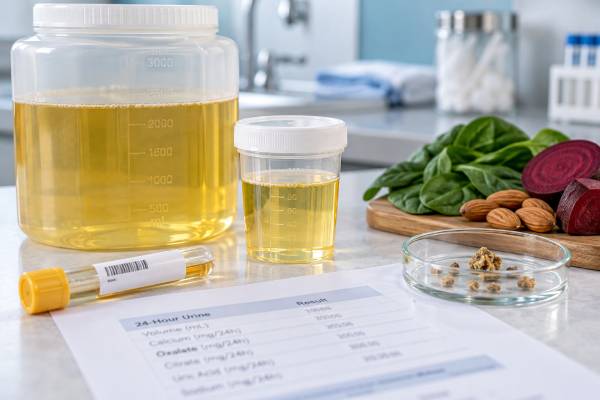
A urine oxalate test measures how much oxalate your body excretes into urine, usually over 24 hours. It is one of the most useful tests for people who form calcium oxalate stones because oxalate combines with calcium to create the most common kidney stone mineral. A high result can come from diet, low calcium intake, intestinal malabsorption, high-dose vitamin C, or rare genetic disorders that cause the liver to overproduce oxalate. The number needs context: a modestly elevated value has a very different meaning from an extreme result, and the effect on stone risk depends on urine calcium, citrate, volume, and calcium oxalate supersaturation. Collection quality matters too. The best test reflects your ordinary eating and drinking pattern rather than a temporarily “perfect” kidney stone diet. When high oxalate is confirmed, treatment usually focuses on the cause instead of simply avoiding every food that contains oxalate.
- Urine oxalate below about 40–45 mg/day is commonly considered within range, but laboratories use different cutoffs.
- Oxalate above about 45 mg/day raises calcium oxalate stone risk; values above 90–100 mg/day deserve evaluation for severe enteric or primary hyperoxaluria.
- Normal dietary calcium is protective because calcium binds oxalate in the gut and reduces absorption.
- High-dose vitamin C supplements can raise urine oxalate because vitamin C is metabolized to oxalate.
- A high result should be interpreted with urine calcium, citrate, volume, pH, and calcium oxalate supersaturation.
Table of Contents
- What the urine oxalate test measures
- Ranges, collection, and preparation
- What high urine oxalate means
- Common causes of hyperoxaluria
- How oxalate changes calcium oxalate stone risk
- How to lower urine oxalate safely
- Follow-up testing and when more evaluation matters
What the urine oxalate test measures
Oxalate is a small organic acid that comes from two main sources: food and normal metabolism inside the body. The kidneys remove much of the oxalate that reaches the bloodstream. A 24-hour urine oxalate test therefore shows how much oxalate was excreted across an entire day.
The test matters because oxalate readily binds calcium. When urine contains enough calcium and oxalate in a concentrated environment, calcium oxalate can become supersaturated, meaning more of the compound is dissolved than the urine can comfortably keep in solution. Crystals can then nucleate, grow, and aggregate into stones.
A clinician may order urine oxalate after a first high-risk stone, recurrent stones, calcium oxalate stone analysis, nephrocalcinosis, bowel disease or surgery, or an unusually young age at stone formation. It is usually included in a 24-hour urine stone risk profile rather than performed alone.
The rest of that profile is important. Calcium oxalate risk rises when high oxalate occurs with one or more of the following:
- high urine calcium;
- low urine volume;
- low urine citrate;
- high sodium intake that drives calcium excretion; or
- high calculated calcium oxalate supersaturation.
A person can have only mildly elevated oxalate but still have substantial stone risk if urine is very concentrated. Conversely, a modest oxalate elevation may be less concerning when urine volume is high and calcium and supersaturation are low.
A spot urine oxalate-to-creatinine ratio can be useful in selected situations, especially in children, but a 24-hour collection is generally preferred in adult stone evaluation. It captures daily excretion and allows oxalate to be interpreted with all the other urine components measured over the same period.
Ranges, collection, and preparation
A common adult reference point is less than 40–45 mg of oxalate per 24 hours, roughly 0.45–0.5 mmol/day. Current European guidance flags values above 0.5 mmol/day as suspicious for enteric hyperoxaluria and values above 1.0 mmol/day as suspicious for primary hyperoxaluria. Many U.S. clinical references use greater than 45 mg/day as a practical definition of hyperoxaluria and consider values above roughly 90–100 mg/day unusually high.
These numbers are not interchangeable with a diagnosis. Laboratories differ in analytical method, units, reference population, and collection preservatives. Always use the range printed on the report and ask how the value fits your stone history.
For a 24-hour collection, the usual process is to discard the first morning urine, collect every void for the next 24 hours, and include the first morning void the following day at the finish time. Some kits contain acid or other preservatives, so the laboratory’s instructions take priority. Missing urine can make oxalate look falsely low; collecting too long can make it look falsely high.
Do not intentionally starve yourself of oxalate for the test unless your clinician specifically asks for a controlled diet. The goal of an initial metabolic evaluation is usually to see what your urine looks like under usual conditions. Likewise, do not suddenly drink several extra liters of water only for collection day. That can change volume and supersaturation enough to hide the pattern that exists during ordinary life.
Creatinine is often measured to help assess whether the collection seems complete. If several urine values look implausibly low or the recorded time is wrong, a repeat test may be more trustworthy. A guide to 24-hour urine collection technique can help reduce common collection errors.
| Approximate result | How it is commonly viewed | Typical next question |
|---|---|---|
| Below 40–45 mg/day | Usually within common adult reference ranges | Are other stone risks still elevated? |
| About 45–90 mg/day | Mild to moderate hyperoxaluria | Diet, calcium intake, vitamin C, bowel disease? |
| Above 90–100 mg/day | Marked hyperoxaluria | Enteric or primary hyperoxaluria, severe intake, collection validity? |
What high urine oxalate means
High urine oxalate is called hyperoxaluria. It means the kidneys excreted more oxalate than expected during the collection. The finding matters because even relatively small changes in urine oxalate can meaningfully alter calcium oxalate supersaturation.
Mild hyperoxaluria is common among calcium oxalate stone formers and often reflects several small influences rather than a single disease. For example, someone may eat spinach smoothies, take a 1,000 mg vitamin C supplement, consume little calcium at breakfast and lunch, and drink less water during work. Each factor can push the urine in the wrong direction.
Marked hyperoxaluria deserves more attention. Very high values can occur when fat malabsorption leaves calcium bound to fatty acids instead of oxalate. Free oxalate then remains available for absorption in the colon. This is called enteric hyperoxaluria and can occur after some bariatric procedures, extensive small-bowel disease or resection, chronic pancreatitis, cystic fibrosis, or other causes of fat malabsorption.
Rarely, severe hyperoxaluria comes from a genetic disorder called primary hyperoxaluria, in which liver enzyme defects cause excessive endogenous oxalate production. These conditions can present with recurrent stones at a young age, nephrocalcinosis, declining kidney function, or extremely high urine oxalate. Modern genetic and biochemical testing can distinguish these disorders, and specific RNA-based therapies are now available for some forms.
High urine oxalate does not prove that a person’s stone is calcium oxalate. Stone composition should be confirmed when possible. A kidney stone analysis is particularly useful because calcium phosphate, uric acid, cystine, and struvite stones require different emphasis in prevention.
Common causes of hyperoxaluria
The cause of high urine oxalate usually falls into one of three groups: increased dietary exposure, increased intestinal absorption, or increased internal production.
Dietary contributors include frequent large portions of very high-oxalate foods. Spinach is a classic example, but beets, rhubarb, some nuts, cocoa, and certain teas can also contribute. The amount matters. A modest serving of a nutritious food is different from a daily concentrated smoothie or powder that delivers a large oxalate load in minutes.
Low calcium intake can paradoxically raise urinary oxalate. Calcium in food binds oxalate inside the intestine and forms a complex that is poorly absorbed. When calcium intake is very low—or when calcium-containing foods are eaten at a different time from high-oxalate foods—more free oxalate may reach the bloodstream and urine. This is why a blanket “avoid calcium because stones contain calcium” strategy is often counterproductive.
Vitamin C supplements can also matter because ascorbic acid is metabolized to oxalate. Risk rises with large supplemental doses. Current nutrition guidance for stone formers advises avoiding excessive vitamin C; some kidney stone guidelines recommend limiting supplemental doses above 500 mg/day, while older studies often identify 1,000 mg/day or more as a clear concern.
Enteric hyperoxaluria should be considered when high oxalate occurs with chronic diarrhea, steatorrhea, inflammatory bowel disease, pancreatic insufficiency, short bowel, or a malabsorptive bariatric procedure. These patients often have several linked stone risks: higher oxalate absorption, lower urine volume, and lower citrate because of gastrointestinal alkali loss.
Primary hyperoxaluria is much rarer but important not to miss. Red flags include childhood or young-adult stones, nephrocalcinosis, strong family history, recurrent stones despite standard prevention, very high urinary oxalate, or kidney dysfunction that seems disproportionate to ordinary stone disease.
Finally, collection problems can mimic abnormal physiology. Overcollection or a day with unusually extreme diet can produce a result that does not represent the person’s normal exposure. That is one reason a repeat collection is often helpful before major treatment decisions.
How oxalate changes calcium oxalate stone risk
Oxalate is powerful because calcium oxalate supersaturation depends on both oxalate and calcium concentrations. Raising either side can increase the probability that crystals form. Urine concentration magnifies the effect: the same daily amount of oxalate produces a higher concentration in 1.2 L of urine than in 2.5 L.
Citrate helps counter this process by binding calcium and inhibiting crystal growth and aggregation. Magnesium can also bind oxalate and may have a modest inhibitory role. Sodium affects the system indirectly because high sodium intake can increase urinary calcium. For this reason, a high oxalate result should prompt a review of urine calcium, urine citrate, sodium, and volume rather than an isolated focus on food lists.
Recent observational research supports a graded relationship: higher urinary oxalate is associated with greater likelihood of stone formation, without a clean biological line where risk suddenly switches from “safe” to “dangerous.” That means a result of 44 mg/day is not magically risk-free while 46 mg/day is hazardous. The entire profile and trend matter.
Calculated calcium oxalate supersaturation can be especially useful because it combines concentration, ionic interactions, pH-related chemistry, and other factors into an estimate of the urine’s tendency to crystallize calcium oxalate. A falling supersaturation after treatment is often more meaningful than moving one number by a few units.
This is also why treatment should be proportionate. Mild dietary hyperoxaluria may respond to calcium-with-meal timing and removal of one major source. Severe enteric hyperoxaluria may require a low-fat strategy, calcium supplementation with meals, more intensive fluid planning, and specialist care. Primary hyperoxaluria requires disease-specific evaluation and treatment rather than a standard diet sheet.
How to lower urine oxalate safely
The goal is usually not to eliminate oxalate from the diet. Oxalate occurs in many plant foods, and overly restrictive diets can reduce fiber, potassium, magnesium, and overall diet quality. Current CARI guidance specifically recommends against a generalized low-oxalate diet for all calcium oxalate stone formers. A targeted approach is more practical.
Start with the highest-yield changes:
- Maintain normal dietary calcium. For many adults, that means roughly 1,000–1,200 mg/day, mainly from food unless a clinician recommends supplements. Pair calcium-containing foods with meals that contain oxalate.
- Remove unusually concentrated oxalate sources. Daily spinach smoothies, large nut portions, or concentrated powders can matter more than occasional moderate servings.
- Stop unnecessary high-dose vitamin C. Review multivitamins, immune products, powders, and separate vitamin C tablets.
- Increase urine volume. Many guidelines target at least 2.0–2.5 L of urine daily; current CARI guidance recommends 2.5 L or more for most stone formers.
- Reduce excess sodium. Lower sodium can reduce urinary calcium and therefore lower calcium oxalate supersaturation even if oxalate changes only modestly.
- Treat malabsorption when present. Enteric hyperoxaluria may require a clinician or dietitian to coordinate fat intake, calcium timing, hydration, and the underlying gastrointestinal disease.
Calcium supplements can be useful in selected enteric hyperoxaluria cases because calcium taken with meals binds oxalate in the gut. Timing matters: calcium taken between meals may not provide the same oxalate-binding benefit. Magnesium may also bind oxalate, but routine supplementation is not a replacement for established prevention measures.
A dietitian experienced in kidney stone disease can often find a less restrictive plan than a generic “low oxalate” list. The aim is to lower urine oxalate while preserving nutrition and making the strategy sustainable.
A low urine oxalate result usually does not require treatment. It can reflect modest dietary oxalate exposure, effective binding of oxalate in the intestine, or a well-collected day with balanced meals. It should still be interpreted with the rest of the profile. A person can form calcium oxalate stones with urine oxalate in the reference range if urine calcium is high, urine volume is low, citrate is low, or other conditions raise supersaturation. In other words, “normal oxalate” does not rule out calcium oxalate stone disease.
It is also useful to separate dietary oxalate from urinary oxalate. Food labels rarely list oxalate, databases disagree about exact amounts, and cooking method can change content. Urinary testing bypasses much of that uncertainty by showing the net result of intake, absorption, internal production, and kidney excretion. This is why a person who eats several foods labeled “high oxalate” may still have a normal urine result, while someone with malabsorption can have high urine oxalate without an obviously extreme diet.
The practical target is therefore not a perfect food score. It is a urine profile that reduces calcium oxalate supersaturation while keeping the diet nutritionally adequate. That often means repeating the test after a focused change and using the new result to decide whether more restriction is actually necessary.
Follow-up testing and when more evaluation matters
After a meaningful diet or medication change, repeat 24-hour urine testing can show whether oxalate actually fell and whether another variable changed unexpectedly. For example, a person who cuts many plant foods may lower oxalate slightly but also lower citrate and potassium, producing little improvement in overall supersaturation. Objective follow-up prevents that kind of guesswork.
Many stone programs repeat urine testing within roughly 8–12 weeks after starting targeted prevention, then less often once values are stable. Two baseline collections may also be recommended because day-to-day variation can be substantial. Follow-up should review the urine supersaturation results as well as the individual oxalate value.
More urgent or specialist evaluation is appropriate when urine oxalate is very high, especially if there is:
- childhood or early adult onset of stones;
- nephrocalcinosis;
- recurrent stones despite good fluid and diet measures;
- chronic diarrhea or known malabsorption;
- a history of intestinal bypass or major bowel resection;
- progressive loss of kidney function; or
- a family history suggesting inherited stone disease.
High urine oxalate is a treatable risk factor, but the correct treatment depends on why it is high. The most useful approach is to confirm the result, identify the source, protect normal dietary calcium, increase urine volume, and track whether calcium oxalate supersaturation improves.
References
- Metabolic evaluation for prevention of kidney stones – CARI Guidelines 2025 (Guideline)
- Nutrition therapy for the prevention of kidney stones – CARI Guidelines 2025 (Guideline)
- Metabolic Evaluation and Recurrence Prevention for Urinary Stone Patients: An EAU Guidelines Update 2024 (Review)
- 24-Hour Urinary Chemistries and Kidney Stone Risk 2024
- Hyperoxaluria: Diagnosis and Treatment 2025 (Review)
Disclaimer
This article is for general education and does not diagnose hyperoxaluria or prescribe a kidney stone diet. Urine oxalate reference ranges, treatment targets, and the need for genetic or gastrointestinal testing depend on the laboratory, kidney function, stone type, and clinical history. Seek specialist advice for very high oxalate, recurrent early-onset stones, nephrocalcinosis, or declining kidney function.