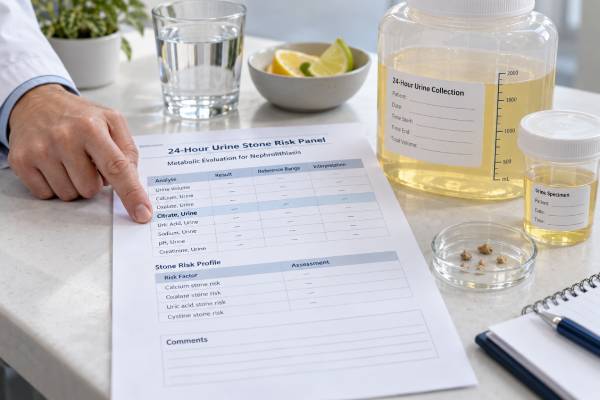
A urine citrate test measures citrate excreted in the urine and helps identify hypocitraturia, a common and treatable risk factor for calcium kidney stones. Citrate protects against stones by binding calcium and reducing the amount available to form calcium oxalate or calcium phosphate crystals. It also interferes with crystal growth and aggregation. The most useful measurement for recurrent stone prevention is usually part of a 24-hour urine profile, because citrate should be interpreted with urine calcium, oxalate, volume, pH, sodium, and supersaturation. A low value is not a diagnosis by itself. Citrate can fall with metabolic acidosis, chronic diarrhea, low potassium, high dietary acid load, distal renal tubular acidosis, and certain medicines. Treatment often includes dietary changes or potassium citrate, but the urine pH response matters because excessive alkalinization can increase calcium phosphate risk. The goal is therefore not simply to make citrate “high,” but to improve the overall urine chemistry safely.
- Low urine citrate is called hypocitraturia: it removes an important natural inhibitor of calcium stone formation.
- Reference limits vary: European guidance lists low citrate below about 1.7 mmol/day in men and 1.9 mmol/day in women, while individual laboratories may use different mg/day ranges.
- Citrate must be read with urine pH: low citrate with acidic urine suggests a different pattern from low citrate with persistently alkaline urine.
- Common causes include chronic diarrhea, metabolic acidosis, low potassium, high animal-protein intake, distal renal tubular acidosis, and some medications.
- Potassium citrate can raise both urine citrate and urine pH: follow-up testing is important so calcium phosphate supersaturation does not rise excessively.
Table of Contents
- What urine citrate does
- What low urine citrate means
- Common causes of hypocitraturia
- How citrate is interpreted with other stone markers
- 24-hour urine collection and testing
- Ways to raise urine citrate and lower stone risk
- Follow-up, cautions, and common mistakes
What urine citrate does
Citrate is a small organic molecule produced in normal metabolism and filtered by the kidneys. In urine, it acts as a stone inhibitor. Its most important effect is binding free calcium, which lowers the amount of calcium available to combine with oxalate or phosphate. Citrate also reduces crystal growth and aggregation, making it harder for tiny crystals to become clinically important stones.
That protective effect explains why two people with the same urine calcium can have different stone risk. A patient with high calcium and abundant citrate may have a lower calcium oxalate supersaturation than a patient whose calcium is only moderately high but citrate is very low.
Urinary citrate is closely connected to the body’s acid-base balance. When the body is relatively acid-loaded, the kidney reabsorbs and metabolizes more citrate rather than allowing it to pass into urine. Urine citrate therefore tends to fall during metabolic acidosis, potassium depletion, chronic gastrointestinal bicarbonate loss, and some high-acid dietary patterns.
Citrate is especially relevant to calcium oxalate and calcium phosphate stones. A urine calcium test shows how much calcium is being excreted, while citrate helps show how much natural inhibition is present. The two numbers are more useful together than separately.
Citrate also matters in uric acid stone treatment because potassium citrate can raise urine pH. In that setting, the therapeutic purpose may be alkalinization as much as correction of low citrate.
What low urine citrate means
Hypocitraturia means urine citrate is lower than expected. There is no single universal cutoff because reference ranges differ by laboratory, sex, body size, diet, and clinical purpose.
European urolithiasis guidance lists hypocitraturia below about 1.7 mmol/day in men and 1.9 mmol/day in women. These correspond to roughly 327 mg/day and 365 mg/day, respectively. Specialized laboratories may use different reference limits. For example, Litholink’s current adult ranges use higher sex-specific lower limits, so a result should always be compared with the range printed by the laboratory that performed the test.
More importantly, citrate behaves as a continuous risk factor. A patient whose value is slightly above a cutoff can still benefit from a higher citrate level if calcium oxalate supersaturation remains high, while a borderline low value may be less concerning if calcium, oxalate, and supersaturation are low and urine volume is excellent.
The urine supersaturation test helps answer the practical question: is the low citrate actually contributing to a chemical environment that favors stone formation?
Low citrate can also be a clue to another disorder. If it occurs with low blood bicarbonate and chronic diarrhea, gastrointestinal alkali loss may be the cause. If it occurs with alkaline urine, low potassium, nephrocalcinosis, or calcium phosphate stones, distal renal tubular acidosis deserves consideration. If the patient takes topiramate or another carbonic anhydrase inhibitor, the medication itself may explain the pattern.
Why units and laboratory ranges can look different
Urine citrate may be reported in milligrams per 24 hours, millimoles per 24 hours, milligrams per gram of creatinine, or another laboratory-specific format. Those numbers are not interchangeable without conversion, and a spot urine citrate-to-creatinine ratio is not the same test as total 24-hour citrate excretion. The reference interval also depends on the analytical method and the population used by the laboratory. For that reason, copying a cutoff from a different report can create a false impression that a result is normal or abnormal.
The clinical target may also differ from the laboratory’s statistical reference range. A laboratory range describes how the test is categorized, while stone prevention asks whether the overall chemistry is sufficiently protective for that particular patient. Someone with recurrent calcium oxalate stones, high urine calcium, and persistently elevated supersaturation may need more citrate protection even if the printed result is barely inside the reference interval. Conversely, a modestly low value may not be the dominant problem when urine volume is very high and calcium oxalate supersaturation is already low. This is why trends on the same laboratory method are often more informative than a single isolated number.
Common causes of hypocitraturia
Hypocitraturia often reflects how the kidney responds to acid-base and potassium balance rather than a lack of citrate in food alone.
Chronic diarrhea and gastrointestinal alkali loss
Persistent diarrhea can cause bicarbonate and potassium loss. The resulting systemic acid load encourages the kidney to reclaim citrate, lowering urinary excretion. These patients may also have low urine volume from fluid loss and high oxalate if intestinal fat malabsorption is present, creating several stone risks at once.
High dietary acid load
Diets very high in animal protein and low in fruits and vegetables can increase net acid production. In susceptible people, this can lower urine citrate and urine pH. The effect varies substantially between individuals, which is why the 24-hour urine result is more useful than assuming a certain diet always causes hypocitraturia.
Low potassium
Potassium depletion promotes intracellular acidosis in kidney cells and can reduce citrate excretion. Causes include diuretics, gastrointestinal losses, laxative use, and inadequate intake. Serum potassium and the medication list are relevant when citrate is unexpectedly low.
Distal renal tubular acidosis
Distal renal tubular acidosis impairs urinary acidification. Paradoxically, the urine may remain inappropriately alkaline while systemic acid retention drives citrate low. The combination of high urine pH, hypocitraturia, hypercalciuria, and calcium phosphate stones is a classic clue. A dedicated urine pH evaluation helps distinguish this pattern from simple dietary hypocitraturia.
Medications
Topiramate and other carbonic anhydrase inhibitors can cause bicarbonate loss, raise urine pH, and reduce citrate. This is particularly important because the resulting chemistry favors calcium phosphate stones. Medication-associated hypocitraturia should be discussed with the prescribing clinician rather than treated by stopping a drug abruptly.
Other conditions
Chronic kidney disease, starvation or ketogenic dietary patterns, high sodium intake, and other metabolic disorders may influence citrate. Some patients have persistent hypocitraturia without an obvious secondary cause.
How citrate is interpreted with other stone markers
A citrate value becomes clinically meaningful when it is placed beside the rest of the stone-risk profile.
| Pattern | What it may suggest |
|---|---|
| Low citrate + high urine calcium | Less inhibition plus more calcium available for calcium stone formation |
| Low citrate + high oxalate | Strong calcium oxalate risk, especially if urine volume is low |
| Low citrate + low urine pH | Possible high acid load, diarrhea, or metabolic syndrome-related pattern |
| Low citrate + high urine pH | Consider distal renal tubular acidosis, carbonic anhydrase inhibitor use, or calcium phosphate risk |
| Low citrate + low urine volume | Reduced inhibition combined with concentrated urine |
The urine oxalate result is particularly important in calcium oxalate disease. Small rises in oxalate can have a large effect on calcium oxalate supersaturation, so correcting citrate while leaving oxalate and volume unchanged may not fully control risk.
Urine pH also changes how citrate treatment should be used. Raising citrate with potassium citrate usually raises pH. That is helpful for acidic urine and uric acid risk but can increase calcium phosphate supersaturation when pH becomes too high. The goal is to improve the overall profile, not maximize one number without regard to another.
Recent research also supports viewing citrate as a continuum rather than a binary normal/abnormal marker. The same citrate level may carry different meaning depending on calcium excretion, urine volume, systemic acid-base status, and stone composition.
The citrate-to-calcium relationship can be clinically useful even when neither number looks extreme. More urinary calcium increases the amount of inhibitor needed to keep calcium salts from crystallizing, while very low calcium may make a borderline citrate result less important. Some laboratories and clinicians therefore look beyond a simple citrate cutoff and consider ratios or supersaturation calculations. Those tools are not interchangeable across laboratories, but the principle is consistent: citrate should be interpreted in relation to the amount of calcium it is helping to keep in solution.
24-hour urine collection and testing
For recurrent or high-risk stone formers, citrate is usually measured in a 24-hour urine collection. The test captures total daily excretion and allows simultaneous measurement of calcium, oxalate, sodium, uric acid, pH, creatinine, and volume.
The collection should usually reflect ordinary eating and drinking habits unless the clinician gives different instructions. Deliberately changing the diet or drinking unusually large amounts of water can make the baseline result less representative.
A typical 24-hour collection starts by discarding the first urine at the recorded start time. Every void after that is collected, including the final urine at the same time the next day. Missing urine makes the total citrate value falsely low and may also lower calcium, oxalate, sodium, and volume.
Creatinine excretion helps assess collection completeness. If the creatinine amount is unexpectedly low for the patient’s body size or differs greatly between two samples, the clinician may question whether all urine was collected.
Two baseline collections may be used because citrate and other markers vary from day to day. A restaurant meal, diarrhea episode, heavy exercise, unusual sodium intake, or medication timing can shift results. The 24-hour urine citrate test is therefore best interpreted as part of a repeated metabolic picture when recurrence risk is high.
Testing during an acute stone attack, severe vomiting, dehydration, or major temporary diet change is less useful for long-term prevention. The goal is to capture the chemistry the patient lives with most of the time.
Ways to raise urine citrate and lower stone risk
Treatment depends on why citrate is low and what type of stone is being prevented.
Potassium citrate
Potassium citrate is the most direct pharmacologic treatment for clinically important hypocitraturia. It supplies alkali, reduces the kidney’s drive to reclaim citrate, increases urinary citrate, and usually raises urine pH. It is also used to alkalinize urine in uric acid and cystine stone disease.
The dose is individualized. Serum potassium and kidney function matter because potassium-containing therapy can be unsafe in patients prone to hyperkalemia. The urine response is checked because some patients need dose adjustment and others may develop an undesirably high pH.
Potassium citrate versus sodium alkali
When alkali therapy is needed for a calcium stone former, potassium citrate is often preferred because it raises citrate without adding a sodium load. Sodium citrate or sodium bicarbonate can alkalinize urine, but additional sodium may increase urinary calcium in susceptible patients and can work against sodium-reduction goals. There are situations in which a clinician may choose a sodium-based alkali, such as intolerance of potassium products or a specific electrolyte problem, but the choice should account for blood pressure, kidney function, serum potassium, urine sodium, and the patient’s stone composition.
The response should be measured rather than assumed. A useful follow-up asks whether citrate increased, whether urine pH stayed in an appropriate range, and whether calcium oxalate or calcium phosphate supersaturation improved. If serum potassium is a concern, blood testing may be needed soon after treatment begins or after the dose changes. Extended-release tablets, liquid preparations, and dosing schedules can produce different tolerability, so adherence is part of interpreting an apparently poor biochemical response.
Diet rich in fruits and vegetables
Fruits and vegetables generally provide alkali precursors and potassium and can raise citrate in some people while lowering dietary acid load. This is one reason balanced plant-rich diets are often encouraged in stone prevention.
Citrus foods contain citrate, but not all citrus products have the same effect. Citric acid in lemonade is not metabolically equivalent to potassium citrate. Some beverages provide citrate but little alkali, while others contain substantial sugar or sodium. Dietary citrus can be useful for selected patients but should not be assumed to replace prescribed potassium citrate when hypocitraturia is severe.
Reduce excessive animal protein and sodium
Moderating very high animal-protein intake can lower acid load and may improve citrate. Reducing excessive sodium can also improve calcium stone risk, particularly when urine calcium is high. These changes are more useful when they address abnormalities actually present on the 24-hour urine profile.
Treat the underlying disorder
Chronic diarrhea, potassium depletion, distal renal tubular acidosis, or medication-induced bicarbonate loss needs targeted management. Simply giving citrate without recognizing the cause may leave important medical issues untreated.
Adequate urine volume remains essential. Even a large increase in citrate may not fully offset the effect of very concentrated urine. A urine volume target should therefore accompany citrate-focused prevention.
Follow-up, cautions, and common mistakes
Follow-up testing confirms whether the chosen intervention improved the chemistry. A useful repeat panel checks citrate, pH, calcium, oxalate, volume, sodium, potassium-related safety labs when appropriate, and supersaturation.
European guidance suggests repeat 24-hour urine testing around 8–12 weeks after starting pharmacologic prevention, then periodic monitoring once values are stable. The schedule is individualized according to stone burden, recurrence, kidney function, and treatment intensity.
The main cautions include:
- Over-alkalinization: very high urine pH can increase calcium phosphate supersaturation, especially in patients already prone to calcium phosphate stones.
- Hyperkalemia risk: potassium citrate requires caution in significant kidney impairment and in people taking medicines that raise serum potassium.
- Treating the number instead of the cause: chronic diarrhea, distal renal tubular acidosis, or a medication effect deserves direct attention.
- Assuming citrus juice equals prescription citrate: citrate content and alkali delivery vary widely among beverages.
- Ignoring collection quality: an incomplete 24-hour sample can make citrate appear falsely low.
- Focusing on citrate alone: calcium, oxalate, urine volume, and pH may remain the dominant risk factors even after citrate improves.
A change should be judged by the whole urine profile. If citrate rises from 250 to 500 mg/day but pH climbs enough to raise calcium phosphate supersaturation, the plan may need adjustment. If citrate rises and calcium oxalate supersaturation falls substantially, the biochemical response is more clearly favorable.
A low citrate result is therefore best viewed as a modifiable part of stone chemistry rather than a stand-alone disease. Identifying why citrate is low, correcting the cause when possible, and confirming the effect with repeat urine testing gives the result its real preventive value.
References
- Citrate and calcium kidney stones. 2025 (Review)
- Metabolic Evaluation and Recurrence Prevention – EAU Guidelines on Urolithiasis – Uroweb 2026 (Guideline)
- Metabolic evaluation for prevention of kidney stones – CARI Guidelines 2025 (Guideline)
- Pharmacologic treatment of kidney stones: Current medication and pH monitoring 2023 (Review)
- 24-Hour Urinary Chemistries and Kidney Stone Risk 2024
Disclaimer
This article is for general education and does not diagnose hypocitraturia or provide an individualized potassium citrate dose. Urine citrate must be interpreted with kidney function, serum potassium, urine pH, calcium, oxalate, volume, supersaturation, and stone composition. Seek urgent medical care for a stone accompanied by fever, inability to urinate, severe uncontrolled pain, or persistent vomiting.