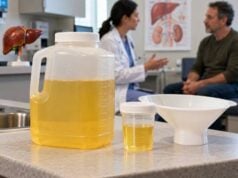
A 24-hour urine metanephrines test measures metanephrine and normetanephrine, breakdown products of the catecholamines epinephrine and norepinephrine. It is used mainly to look for pheochromocytoma and paraganglioma, rare neuroendocrine tumors that can produce excess catecholamines. These tumors may cause episodes of high blood pressure, pounding heartbeat, sweating, headache, tremor, or anxiety-like symptoms, but some are discovered incidentally on imaging or through genetic screening. Metanephrines are better screening markers than urine catecholamines alone because tumors continuously convert catecholamines into these metabolites, even between symptomatic “spells.” A high result does not automatically mean a tumor is present. Medications, physiologic stress, collection problems, and some illnesses can create false-positive or borderline results. The degree and pattern of elevation matter, as does the reason the test was ordered. When results are clearly abnormal, clinicians usually confirm the biochemical finding and then use imaging and other testing to locate and characterize a possible tumor.
- The test measures fractionated urinary metanephrine and normetanephrine over 24 hours to screen for catecholamine-producing pheochromocytoma or paraganglioma.
- Marked elevations are more concerning than small borderline increases; mild results often need repeat testing under carefully controlled conditions.
- Plasma free metanephrines and 24-hour urine fractionated metanephrines are both established biochemical tests, with the best choice depending on clinical context and collection conditions.
- Tricyclic antidepressants, labetalol, sotalol, other drugs, acute illness, stress, and collection errors can affect results; medicines should never be stopped without medical guidance.
- A normal test makes a catecholamine-producing tumor less likely, but very high clinical suspicion, hereditary risk, or certain tumor types may still justify specialist follow-up.
Table of Contents
- What 24-Hour Urine Metanephrines Measure
- Why the Test Is Ordered
- How to Interpret High, Borderline, and Normal Results
- Medications, Stress, and Other Causes of False Results
- How to Collect a 24-Hour Urine Sample
- Urine Metanephrines vs Plasma Metanephrines
- What Happens After an Abnormal Result
What 24-Hour Urine Metanephrines Measure
The adrenal glands sit above the kidneys and produce several hormones. The inner portion, the adrenal medulla, makes catecholamines—mainly epinephrine and norepinephrine. Sympathetic nerves also release norepinephrine. The body continually breaks these chemicals down, producing metanephrine from epinephrine and normetanephrine from norepinephrine.
Pheochromocytomas arise from adrenal chromaffin cells. Closely related tumors called paragangliomas arise from extra-adrenal paraganglia. Together they are often abbreviated PPGL. Some PPGLs release large amounts of catecholamines, while others produce smaller or more variable amounts.
The advantage of metanephrines is that tumor cells form these metabolites continuously inside the tumor. Catecholamine release itself can be episodic. Someone may therefore have a normal catecholamine level between attacks, while metanephrine production remains elevated. This is why modern biochemical evaluation favors plasma free metanephrines or urinary fractionated metanephrines over an isolated catecholamine measurement.
“Fractionated” means the laboratory reports the components separately, usually metanephrine and normetanephrine, and may also report a total. Some advanced panels include 3-methoxytyramine, a dopamine metabolite that can add information for selected tumors.
A 24-hour urine catecholamines test can still have a role, but it is generally not the preferred stand-alone first-line screen for PPGL. The metabolite pattern usually provides a more sensitive biochemical signal.
The test does not show where a tumor is located, whether a mass is benign or metastatic, or which genetic cause may be present. It answers a narrower question: is catecholamine metabolism abnormal enough to suggest that a PPGL should be investigated further?
Why the Test Is Ordered
Testing is usually considered when the probability of PPGL is high enough that a reliable biochemical screen is useful. Because these tumors are rare, broad testing of people with nonspecific symptoms can produce more false positives than true positives.
Reasons a clinician may order 24-hour urine metanephrines include:
- episodes of severe or difficult-to-control high blood pressure;
- spells of pounding or rapid heartbeat, sweating, headache, tremor, pallor, or panic-like symptoms;
- an adrenal mass discovered on CT or MRI when hormone evaluation is appropriate;
- a personal or family history of pheochromocytoma or paraganglioma;
- a hereditary syndrome or pathogenic genetic variant associated with PPGL;
- follow-up after treatment of a known tumor; or
- a previous plasma metanephrine result that needs confirmation or clarification.
Symptoms alone are not specific. Migraine, panic attacks, arrhythmias, hyperthyroidism, medication effects, sleep apnea, hypoglycemia, and many other conditions can resemble catecholamine excess. The test therefore works best when the pretest probability and collection method are considered before the sample is taken.
An adrenal mass also does not automatically imply pheochromocytoma. Adrenal nodules are common, especially with age, and many are nonfunctioning adenomas. Hormonal testing is used to determine whether a mass is producing excess hormones. Depending on the clinical situation, evaluation may also include a 24-hour urine cortisol test or other adrenal hormone tests.
PPGL can occur at any age, but hereditary disease is especially important because a substantial proportion of these tumors have a genetic basis. Once a tumor is confirmed, genetic counseling and testing are often discussed because the result can affect surveillance, family screening, and tumor-risk assessment.
How to Interpret High, Borderline, and Normal Results
Urine metanephrine reference intervals vary with laboratory method, age, sex, and sometimes blood pressure status. The report’s own reference limits should be used rather than a generic online range. Liquid chromatography–tandem mass spectrometry (LC-MS/MS) is widely used because it separates analytes well and reduces some analytical interferences.
The magnitude of elevation is often more informative than a simple high/normal flag. A result several times the upper reference limit is much more suspicious for PPGL than a value only slightly above the cutoff. Mild elevations are common in people without tumors and often require a careful search for medications, stressors, or collection problems before imaging is ordered.
One current laboratory notes that total urinary metanephrines above 1,300 mcg/24 hours, roughly twice its upper limit for hypertensive adults, warrant further clinical investigation. That number is method- and laboratory-specific, not a universal diagnostic threshold. The individual metanephrine and normetanephrine fractions can also be important even when the total does not cross the same line.
A useful way to think about results is:
| Result pattern | Typical interpretation |
|---|---|
| Clearly marked elevation | PPGL becomes much more likely; specialist evaluation and imaging are often appropriate after biochemical review |
| Mild or borderline elevation | False-positive causes are common; repeat testing or an alternative metanephrine test may be needed |
| One fraction elevated | Pattern may reflect the tumor’s catecholamine biology, but drugs and physiologic factors must still be considered |
| Normal result with low-to-moderate suspicion | A catecholamine-producing PPGL becomes unlikely |
| Normal result with strong hereditary or imaging suspicion | Specialist review may still be needed because small, nonsecretory, or biochemically atypical tumors can occur |
A “positive” metanephrine result is not a cancer diagnosis. PPGLs vary in behavior, and modern classification recognizes that these tumors have metastatic potential that cannot be determined solely by a urine test. Biochemical results are combined with imaging, pathology, genetics, and follow-up.
The pattern of the two major metabolites can sometimes provide clues. A predominantly elevated metanephrine level reflects epinephrine metabolism and is often associated with adrenal tumors that produce epinephrine. A predominantly elevated normetanephrine level reflects norepinephrine metabolism and can occur with adrenal or extra-adrenal tumors. These patterns are not specific enough to locate a tumor by themselves, but they may help an endocrinologist interpret imaging and decide whether additional markers are useful.
Timing also matters when comparing repeated results. Metanephrine output can vary with treatment, illness, and collection quality. A small change from one 24-hour collection to another does not necessarily mean that a tumor has grown or shrunk. For surveillance after treatment, clinicians usually look for a consistent trend using the same or a comparable laboratory method and consider the result alongside symptoms and imaging.
Medications, Stress, and Other Causes of False Results
Borderline elevations deserve careful review because catecholamine biology is sensitive to stress and medication effects. A technically accurate laboratory result can still be biologically misleading if the person was acutely ill or taking an interfering drug.
Medications reported by laboratories as important potential interferents include tricyclic antidepressants, labetalol, and sotalol. Other agents that raise sympathetic activity, affect norepinephrine metabolism or reuptake, or interfere with a specific assay may also alter results. Withdrawal from certain drugs can produce a catecholamine surge as well.
Do not stop prescription medicines on your own. If a drug may interfere, the clinician must weigh the risk of holding it against the value of cleaner testing. In some cases, the safest choice is to test while treatment continues and interpret the result with that limitation. In others, a specialist may arrange a medically supervised pause or choose another test.
Other factors that can increase metanephrines or complicate interpretation include:
- severe pain or acute illness;
- major psychological or physical stress;
- strenuous exercise around the collection period;
- obstructive sleep apnea and other causes of increased sympathetic activity;
- stimulant or sympathomimetic exposure;
- nicotine and some dietary factors, depending on the analyte and assay; and
- incomplete, overlong, or otherwise inaccurate urine collection.
For urine testing, a complete collection can sometimes smooth out short-term variation, but it creates its own vulnerability: every void must be captured for the full timed period. A falsely low total can result from missed urine, while collecting for longer than 24 hours can raise total excretion.
The laboratory’s preparation sheet should take priority over generic advice. Restrictions differ according to whether only metanephrine and normetanephrine are measured or whether the panel also includes catecholamines or 3-methoxytyramine.
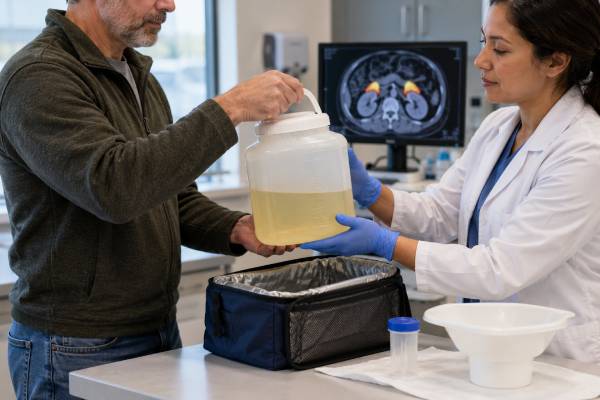
How to Collect a 24-Hour Urine Sample
The collection usually spans exactly 24 hours. Some laboratories provide a container with acid or another preservative already present or instruct the patient to add preservative at the beginning. Handle these containers carefully and follow the laboratory’s safety instructions.
A typical process is:
- Choose the start time. In the morning, empty your bladder into the toilet and record that time. Do not save that first urine.
- Collect every urine sample after the start time. Save daytime, evening, nighttime, and early-morning urine in the provided container or approved transfer container.
- Store the container as directed. Requirements differ by laboratory and preservative.
- Finish exactly 24 hours later. At the same clock time the next morning, urinate and add that final specimen to the collection.
- Return the sample with the required information. Total urine volume and collection duration are often required for calculation of daily excretion.
Some laboratories prefer a complete 24-hour collection particularly when blood pressure or symptoms are episodic. If feasible, they may advise beginning the collection around the onset of a typical spell, but this is laboratory-specific and should not replace the written instructions.
If you miss a void, spill a substantial amount, or collect for the wrong duration, contact the laboratory. A 24-hour urine collection error can produce a misleading total and may require restarting the test.
Do not deliberately provoke symptoms by changing medicines, consuming stimulants, exercising intensely, or altering salt or fluid intake. The goal is safe, interpretable testing under the conditions recommended by the care team.
Urine Metanephrines vs Plasma Metanephrines
Both plasma free metanephrines and 24-hour urinary fractionated metanephrines are established tests for PPGL. The better choice depends on the patient, the reason for screening, and whether proper sampling conditions can be achieved.
Plasma testing has excellent sensitivity, particularly when blood is drawn under controlled conditions after the patient has rested fully supine. It can be especially useful for people with a strong clinical suspicion, hereditary risk, or an incidental adrenal mass where detecting a small tumor matters. The challenge is that posture, stress, and inadequate rest can increase false-positive results.
A 24-hour urine collection avoids the need for one carefully timed blood draw and integrates excretion over a full day. It may be useful as an initial test in some lower-risk settings or to confirm a mildly abnormal plasma result. Its main weakness is collection accuracy: missing urine or collecting outside the exact window directly changes the reported amount per day.
Neither method is universally superior in every situation. Modern expert reviews emphasize matching the test to the clinical context and controlling preanalytical conditions. If one method gives a borderline result that does not fit the clinical picture, repeating it under better conditions or using the other method can be more informative than jumping immediately to imaging.
The choice can also be practical. A person who cannot reliably collect every void for 24 hours may get a more dependable answer from a carefully prepared plasma test. Conversely, someone who cannot remain comfortably supine for a controlled blood draw may be better suited to urine testing. Kidney function, age, hospitalization, and local laboratory expertise can influence the plan. The same reference interval should not be transferred from one method to another because plasma and urine assays measure different specimen types and use different decision limits. For that reason, results should be compared with the limits printed by the laboratory that performed the test.
Urinary catecholamines and vanillylmandelic acid are older approaches and generally offer less diagnostic performance than metanephrines. They may still be used in selected situations, but they should not be assumed to be interchangeable with fractionated metanephrines.
What Happens After an Abnormal Result
Follow-up is based on the degree of elevation and the underlying probability of PPGL. Mild abnormalities often lead to review and repetition; marked abnormalities can justify moving more quickly toward tumor localization.
A typical sequence may include:
- confirming that the collection was complete and performed under appropriate conditions;
- reviewing prescription drugs, over-the-counter products, stimulants, nicotine, acute illness, sleep apnea, and recent stress;
- repeating urine metanephrines or obtaining properly collected plasma free metanephrines;
- consulting endocrinology when results remain abnormal or suspicion is high;
- obtaining CT or MRI to locate an adrenal or extra-adrenal tumor after convincing biochemical evidence; and
- considering functional imaging, genetic testing, and additional biochemical markers in selected patients.
Imaging usually follows biochemical evidence rather than preceding it when the only concern is symptoms. This reduces the chance of finding an unrelated incidental mass and then attributing symptoms to it incorrectly. The sequence can differ when a mass has already been discovered or when a patient has a high-risk genetic syndrome.
If a pheochromocytoma or sympathetic paraganglioma is confirmed, treatment planning requires careful control of catecholamine effects before surgery or other therapy. These tumors can cause dangerous blood pressure and heart-rate changes, so management belongs with an experienced multidisciplinary team.
Seek urgent medical attention for severe chest pain, fainting, neurologic symptoms, extreme blood pressure with concerning symptoms, or a sudden severe headache unlike usual headaches. A urine test should never delay emergency assessment of a possible hypertensive crisis, heart problem, or stroke.
For most people undergoing screening, the practical message is simpler: a clearly normal, properly collected result is reassuring; a borderline result usually needs context and confirmation; and a strongly elevated result deserves prompt specialist evaluation rather than self-interpretation from a reference range alone.
References
- Catecholamines and Metanephrines: Quantification in the Diagnosis of Pheochromocytoma and Paraganglioma, Considerations and Critical Issues 2026 (Review)
- Advances in laboratory diagnostic studies of pheochromocytoma and paraganglioma. 2026 (Review)
- Biochemical Assessment of Pheochromocytoma and Paraganglioma. 2023 (Review)
- Diagnosis and Management of Pheochromocytomas and Paragangliomas: A Guide for the Clinician 2023 (Review)
- METAF – Overview: Metanephrines, Fractionated, 24 Hour, Urine 2026
Disclaimer
This article provides general education about 24-hour urine metanephrines and does not diagnose or exclude pheochromocytoma or paraganglioma for an individual. Reference limits, medication restrictions, and collection requirements vary by laboratory, and prescription medicines should not be stopped without medical supervision. Seek urgent care for severe symptoms such as chest pain, fainting, stroke-like symptoms, or a hypertensive emergency.