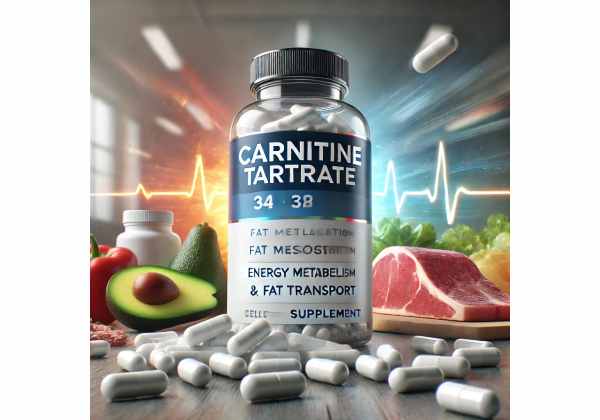
Carnitine tartrate is easy to misunderstand because it sits between two worlds. In sports nutrition, it is usually marketed for recovery and fatigue. In brain health discussions, it is sometimes grouped with other carnitine forms and given broader cognitive claims than the evidence really supports. That gap matters. Carnitine plays a real role in mitochondrial energy production, and the tartrate form can be a practical way to deliver L-carnitine. But that does not automatically mean it works as a nootropic or mood supplement in everyday use. The strongest case for carnitine tartrate is more specific: it may help certain people who are dealing with low carnitine status, heavy physical stress, or fatigue-related strain, while the direct evidence for sharper memory, better focus, or improved mood is much thinner. This article explains what carnitine tartrate is, how it may affect the brain indirectly, where the research looks promising, how dosing is usually approached, and what safety issues deserve close attention.
Table of Contents
- What carnitine tartrate is
- What the brain evidence shows
- Energy, fatigue, and mental performance
- Who might actually benefit
- Dosage, forms, and timing
- Safety, side effects, and interactions
What carnitine tartrate is
Carnitine tartrate, often sold as L-carnitine L-tartrate, is a supplemental form of L-carnitine bound to tartaric acid. The key functional part is L-carnitine, a compound involved in moving long-chain fatty acids into mitochondria so they can be oxidized for energy. That role matters to both body and brain because cells with high energy demand depend on efficient mitochondrial function. The brain does not burn fat in the same way skeletal muscle does, but it is still highly sensitive to mitochondrial stress, poor metabolic flexibility, and the buildup of damaging byproducts.
One useful starting point is that healthy people do not usually need carnitine as an essential nutrient in the way they need vitamin C or iron. The body can synthesize enough carnitine for most healthy adults, and food also contributes. Animal foods provide the richest dietary sources, while strict vegetarian or vegan patterns provide much less. Even so, lower intake does not automatically mean deficiency because endogenous synthesis helps close the gap.
What makes carnitine tartrate interesting is not that it is uniquely “for the brain,” but that it is one of the practical delivery forms used in supplements. That is important because many readers confuse it with acetyl-L-carnitine. They are related, but they are not interchangeable. Acetyl-L-carnitine is the form more often discussed in direct cognitive and neuropsychiatric research. Carnitine tartrate is more commonly used in products aimed at recovery, fatigue, and performance. If someone wants to compare these categories, acetyl-L-carnitine is usually the more relevant reference point for purely brain-centered claims.
Mechanistically, carnitine helps maintain mitochondrial energy flow, supports the handling of acyl groups, and helps prevent the buildup of certain metabolites that can interfere with cellular function. These are meaningful biochemical roles. They are also the reason carnitine attracts interest in conditions linked with metabolic stress, insulin resistance, fatigue, frailty, and neurodegeneration. Still, that biochemical importance should not be confused with proof that a carnitine tartrate supplement will noticeably improve memory, concentration, or mood in a healthy person.
A fair summary is that carnitine tartrate is best understood as a functional L-carnitine delivery form with stronger roots in energy metabolism and recovery than in classic nootropic use. That framing helps keep expectations realistic. It also prevents a common mistake: assuming that every carnitine form has the same evidence base, the same brain access, and the same practical use case.
What the brain evidence shows
The evidence for carnitine tartrate and brain health is mixed, and the most important point is also the easiest to miss: the direct clinical evidence for this exact form in cognition and mental wellness is limited. Carnitine as a broader category has been studied in neurological and psychiatric settings, but that literature often combines different forms or focuses more heavily on acetyl-L-carnitine than on carnitine tartrate. As a result, broad statements like “carnitine improves brain function” are usually less precise than they sound.
A balanced reading of the literature suggests three main takeaways. First, carnitine biology is relevant to brain health. Mitochondrial function, oxidative stress control, metabolic flexibility, and cellular energy balance all matter in aging, fatigue, and neurodegenerative disease. Second, some neurological or psychiatric conditions may show benefit from carnitine-based interventions, especially in contexts involving metabolic dysfunction or high physiological stress. Third, that does not translate into strong proof that carnitine tartrate is a reliable cognitive enhancer for healthy adults.
This distinction is especially important for search intent. Many people looking up carnitine tartrate want to know whether it helps focus, memory, mental energy, or mood. Right now, the answer is not a strong yes. It is closer to this: there is a plausible rationale, some encouraging disease-specific or fatigue-related findings, and not enough direct evidence to market it as a dependable nootropic. A recent systematic review of L-carnitine across psychiatric and neurological conditions found potentially favorable effects in some disorders, including certain neurological settings, but also noted relatively limited efficacy in depression, ADHD, chronic fatigue syndrome, and several other conditions. That is a much more restrained picture than supplement marketing often suggests.
Another reason for caution is form-specific overreach. Carnitine tartrate is often pulled into broader conversations about “brain supplements” because it belongs to the carnitine family. But family resemblance is not the same as interchangeable evidence. When people want fast, obvious improvements in studying, work output, or mental sharpness, they are really asking about the evidence for nootropics, not about a molecule’s theoretical importance to mitochondria.
So where does that leave carnitine tartrate? It leaves it in a middle ground. It is not an empty ingredient with no biological relevance. It is also not a proven all-purpose brain booster. The most honest claim is that it may support mental wellness indirectly by helping energy metabolism, recovery, and fatigue-related resilience in some people, while the evidence for direct gains in cognition or mood remains too limited to justify exaggerated promises.
Energy, fatigue, and mental performance
If carnitine tartrate has a realistic mental-wellness angle, it is probably through fatigue rather than through direct enhancement of memory or intelligence. That is a meaningful distinction. Mental performance often drops when physical recovery is poor, sleep is inconsistent, training load is high, or metabolic stress is building. In those situations, a supplement that improves recovery and reduces fatigue can have indirect cognitive value even if it is not acting like a classic nootropic.
This is where carnitine tartrate looks most interesting. Human trials of L-carnitine tartrate have shown improvements in exercise recovery, soreness, and fatigue-related outcomes after several weeks of use. That does not mean the supplement is “for the brain” in a narrow sense. It means it may help preserve energy availability and reduce the strain that can spill over into mental performance. Anyone who has experienced reduced concentration, irritability, or low motivation during periods of heavy physical stress already knows how tightly physical and mental fatigue can overlap.
The mechanism here is plausible. Carnitine supports mitochondrial handling of long-chain fatty acids and helps buffer acyl groups, which can matter when cells are under heavy energy demand. It may also support antioxidant defenses and modulate inflammatory signaling in some contexts. Those processes are relevant because inflammation, poor recovery, and energy disruption can all contribute to feeling mentally flat, slow, or less resilient.
Still, the practical effect is likely to be subtle and context dependent. Carnitine tartrate is not a stimulant. It does not work like caffeine, and it does not usually create a dramatic same-day shift in alertness. Its best-case use is more gradual. Someone recovering from repeated hard training, dealing with fatigue-prone periods, or struggling with energy dips tied to metabolic strain may notice better resilience over time. Someone who is sleep deprived, chronically stressed, sedentary, and hoping for a quick concentration hack probably will not.
That is why the question is not only “Does it help the brain?” but also “What kind of problem is driving the mental slowdown?” If the real issue is fragmented sleep, blood sugar instability, overtraining, or poor recovery, carnitine tartrate may have a rational role as part of a broader plan. If the issue is attention fragmentation, anxiety, or untreated depression, it is much less likely to be the answer. In those cases, understanding problems such as afternoon crashes and brain fog can be more useful than adding another supplement too quickly.
In short, carnitine tartrate is best viewed as a recovery and fatigue-support tool with possible indirect mental benefits. That is a narrower claim than “improves cognition,” but it is also more defensible and more helpful for real-world decision making.
Who might actually benefit
Carnitine tartrate is most likely to make sense for people whose mental and physical symptoms overlap. That includes adults under heavy training load, people dealing with recurring recovery problems, and some individuals whose fatigue appears linked with metabolic strain rather than with primary psychiatric illness. In these cases, the supplement may fit a pattern rather than target a single symptom. The person is not only tired in the body or only tired in the mind. They feel less resilient across both.
People with low dietary carnitine intake sometimes wonder whether they should supplement automatically. The answer is usually no. Lower intake is not the same as low tissue status, and healthy bodies can synthesize carnitine. But some individuals with restrictive diets, illness-related low intake, kidney disease, malabsorption, or other medical issues may need a more personalized discussion with a clinician. That is where self-experimentation becomes less appropriate and medical context becomes more important.
There may also be a reasonable use case for adults who notice that poor metabolic health seems to affect their focus, mental stamina, or exercise tolerance. Carnitine has been studied in insulin resistance and glucose-related settings, and improving metabolic efficiency can sometimes help both physical and mental function. But again, the supplement is not the center of the story. If someone has signs of insulin resistance and brain health strain, the real work usually involves sleep, diet quality, movement, and medical follow-up, not just adding carnitine tartrate.
Who is less likely to benefit? Healthy adults chasing a fast nootropic effect. Students wanting a sharper exam-day brain. People hoping it will work like a mood stabilizer, antidepressant, or anti-anxiety agent. The evidence simply is not strong enough for those expectations. In those situations, carnitine tartrate often ends up being part of an overbuilt supplement stack aimed at solving a problem that may actually need better sleep, lower alcohol intake, less caffeine volatility, or a proper evaluation for attention or mood symptoms.
It also makes less sense when the goal is specifically neurological support in aging or direct cholinergic support. In those conversations, other compounds or approaches may be more directly studied. Even then, supplementation should stay grounded. The smartest use of carnitine tartrate is usually selective, not automatic. It is most reasonable when there is a clear rationale tied to fatigue, recovery, metabolic strain, or suspected low carnitine status, and least reasonable when it is used as a generic fix for every form of “brain fog.”
Dosage, forms, and timing
In practice, most people encounter carnitine tartrate in capsules, tablets, powders, or mixed performance products. Dosing can be confusing because labels may describe the salt form, the total serving size, or the amount of elemental L-carnitine. That matters. In one commonly cited example, 3 g per day of L-carnitine tartrate provides about 2 g of elemental L-carnitine. If you are comparing products or reading research, it helps to check whether the number refers to total carnitine tartrate or the L-carnitine delivered by that salt.
A practical dosing range for many supplements is 1 to 3 g per day of carnitine tartrate, often taken in one or two divided servings. Research in recovery and fatigue settings commonly lands within that zone rather than using extremely high doses. That does not mean more is better. Carnitine absorption from supplements is fairly limited, and official health-professional guidance notes that supplemental L-carnitine absorption is much lower than absorption from food. Because of that, doubling the dose does not guarantee a proportional increase in benefit.
Timing is less critical than consistency, but the context of use matters. People using carnitine tartrate for training-related recovery often take it daily rather than only around workouts. That makes sense because most studies showing recovery-related effects rely on repeated supplementation over weeks, not on a single acute dose. If your main goal is gradual support for recovery or fatigue resilience, a steady daily schedule is more rational than occasional use.
It is also worth avoiding a common labeling trap. Many “energy” products pair carnitine tartrate with caffeine, stimulants, and multiple other ingredients. That makes it hard to judge what is doing what. If you want a clean trial, it is better to use a straightforward single-ingredient product first. The same logic applies if you are also considering mitochondrial or recovery-oriented supplements such as CoQ10. Adding several compounds at once makes it much harder to tell whether anything is helping.
A simple approach works best:
- Pick a clearly labeled product from a reputable brand.
- Start at the lower end of the dosing range.
- Use it consistently for a defined period, such as several weeks.
- Track a small number of outcomes, like recovery, soreness, energy stability, or mental fatigue.
- Stop if there is no meaningful benefit.
That approach is less exciting than aggressive supplement stacking, but it is much better for real decision making.
Safety, side effects, and interactions
Carnitine tartrate is generally regarded as fairly well tolerated in healthy adults when used in common supplemental ranges, but “generally well tolerated” should not be confused with “worth taking without thought.” The most common problems are gastrointestinal. Nausea, vomiting, abdominal cramps, diarrhea, and a fishy body odor become more likely as intake rises. Official guidance notes that doses around 3 g per day or higher can cause these effects, which is one reason higher-dose self-experimentation is not automatically smarter.
There are also a few groups that deserve extra caution. People with seizure disorders should not assume carnitine supplements are harmless because higher intakes have been linked with seizures in susceptible individuals. People with kidney disease, especially those with uremia, also need individualized advice rather than casual supplement use. Those taking anticonvulsants such as valproic acid, phenobarbital, phenytoin, or carbamazepine should pay attention as well, because these medications can affect carnitine status and complicate the picture.
One of the more debated safety topics is TMAO, a compound produced when gut bacteria metabolize some unabsorbed carnitine. Some long-term supplementation research has found increased fasting TMAO levels, and the possible cardiovascular implications are still being studied. This does not prove that carnitine tartrate is dangerous for the average user, but it does argue against treating long-term high-dose use as obviously benign. The science here is not settled enough for panic, yet it is also not weak enough to ignore.
Another practical safety point is expectation management. Carnitine tartrate is sometimes bundled into stimulant-heavy products marketed for fat loss, training drive, or mental energy. In those cases, side effects may come from the stack rather than the carnitine itself. That is another reason to test it on its own before combining it with compounds that already affect sleep, anxiety, or heart rate. People who are already pushing focus with aggressive supplement mixes should step back and read more broadly about caffeine, focus, anxiety, and sleep before assuming one more ingredient will improve the result.
The safest bottom line is straightforward. Carnitine tartrate may be a reasonable supplement for selected goals, especially recovery and fatigue-related use, but it is not a casual cure-all. If you have kidney disease, seizure history, complex medication use, pregnancy, breastfeeding, or persistent mental or neurological symptoms, speak with a clinician before using it. The better the context, the better the decision.
References
- Carnitine – Health Professional Fact Sheet 2023 (Official Fact Sheet). ([Office of Dietary Supplements][1])
- L-Carnitine in the Treatment of Psychiatric and Neurological Manifestations: A Systematic Review – PMC 2024 (Systematic Review). ([PMC][2])
- Carnitine derivatives beyond fatigue: an update – PMC 2023 (Review). ([PMC][3])
- l-carnitine: Nutrition, pathology, and health benefits – PMC 2022 (Review). ([PMC][4])
- L-Carnitine Tartrate Supplementation for 5 Weeks Improves Exercise Recovery in Men and Women: A Randomized, Double-Blind, Placebo-Controlled Trial – PMC 2021 (RCT). ([PMC][5])
Disclaimer
This article is for educational purposes only and is not medical advice. Carnitine tartrate can interact with underlying health conditions, may cause side effects at higher doses, and may not be appropriate for people with kidney disease, seizure disorders, pregnancy, breastfeeding, or complex medication use. Supplements should not replace diagnosis, prescribed treatment, psychotherapy, or urgent medical care. Speak with a qualified clinician before starting carnitine tartrate if you have ongoing fatigue, mood changes, brain fog, neurological symptoms, or any chronic medical condition.
If you found this article useful, please share it on Facebook, X, or your preferred platform.