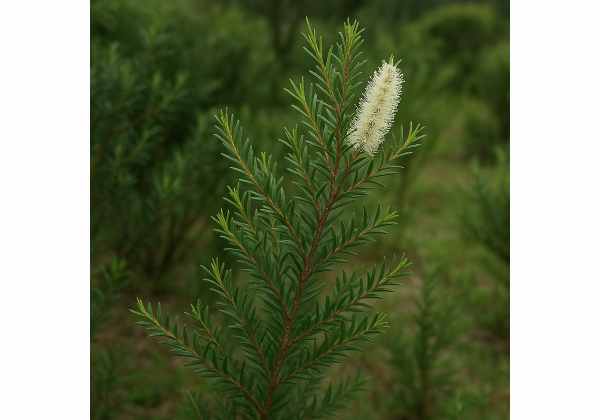
Tea tree, botanically known as Melaleuca alternifolia, is an Australian plant best known not as a brewed herb but as the source of tea tree oil, a concentrated essential oil distilled from its leaves and branch tips. For decades, it has held a strong reputation for skin care, scalp care, and antimicrobial support. That reputation is not entirely hype, but it does need context. Tea tree oil shows credible topical potential for concerns such as acne, dandruff, mild fungal skin problems, and some oral-care applications, yet the strongest evidence remains concentrated in a limited number of uses rather than across every claim made online.
What makes tea tree especially distinctive is its chemistry. The oil contains terpinen-4-ol and other aromatic compounds with antimicrobial and anti-inflammatory activity, but those same compounds can also irritate sensitive skin when the oil is overused or poorly stored. That balance defines tea tree’s real value. Used thoughtfully, it can be a practical botanical tool. Used carelessly, especially by mouth or at high concentration, it can cause harm. The most helpful way to understand tea tree is as a targeted topical active, not a cure-all.
Key Insights
- Tea tree oil may help reduce acne lesions and calm oily, blemish-prone skin when used topically in well-formulated products.
- It can support scalp care and dandruff control, especially in shampoos around 5%.
- A practical topical range is about 0.5% to 5%, depending on the body area and product type.
- People with fragrance allergy, eczema flares, reactive skin, or a history of contact dermatitis should avoid undiluted use.
Table of Contents
- What Tea Tree Is and Why It Remains Popular
- Key Ingredients and Medicinal Properties of Tea Tree
- Potential Health Benefits and What the Evidence Supports
- Tea Tree for Acne, Scalp Issues, and Minor Skin Concerns
- Other Uses in Mouth Care, Foot Care, and Targeted Topicals
- Dosage, Dilution, Timing, and Best-Practice Use
- Safety, Side Effects, Interactions, and Who Should Avoid It
What Tea Tree Is and Why It Remains Popular
Tea tree comes from Melaleuca alternifolia, a small tree native to Australia and part of the myrtle family. Its medicinal identity comes almost entirely from the essential oil produced by steam distillation of the leaves and terminal branches. This is important, because many readers assume tea tree is a tea herb that can be safely brewed or swallowed. In reality, tea tree’s best-supported uses are external. It belongs in the category of targeted topical botanicals rather than general wellness beverages or oral supplements.
Its reputation began with traditional use by First Nations Australians, who used the plant for wound and skin-related purposes long before modern commercial products existed. Over time, tea tree oil became popular worldwide in antiseptic washes, spot treatments, shampoos, mouth rinses, foot sprays, and household products. Part of its appeal is that it bridges natural care and practical function. It smells medicinal, feels active, and has real laboratory evidence behind its antimicrobial behavior. That combination makes it more convincing to consumers than many gentler aromatic oils.
Still, tea tree’s popularity has also created confusion. Many products suggest it can handle nearly every skin problem, fungal issue, scalp complaint, and household cleaning task. That is where clarity matters. Tea tree oil may be useful for specific topical applications, but it is not automatically the best first choice for every rash, every blemish, or every sore patch of skin. It also does not work equally well in every form. A properly diluted gel, shampoo, or mouth rinse is very different from undiluted oil dropped directly on the skin.
Another point that deserves attention is quality. Tea tree oil is not a single unchanging substance. Its chemistry varies with source, freshness, storage, and formulation. Better products usually contain fresh oil with a clear botanical name, sensible dilution, and stable packaging. Old or oxidized oil is more likely to irritate the skin and trigger allergic reactions. That is one reason tea tree can seem excellent for one person and harsh for another.
Tea tree remains popular because it sits at the crossroads of three things people want: visible action, natural positioning, and broad availability. But its real strength comes from disciplined use. The most helpful mindset is not “tea tree fixes everything.” It is “tea tree can be very useful when the problem is right, the formula is right, and the dose is right.” That framing makes the rest of the article easier to understand.
Key Ingredients and Medicinal Properties of Tea Tree
Tea tree oil’s medicinal reputation is rooted in its chemical profile. The most important compound is terpinen-4-ol, which is widely regarded as the key bioactive component behind much of the oil’s antimicrobial and anti-inflammatory activity. Other significant constituents include gamma-terpinene, alpha-terpinene, alpha-terpineol, terpinolene, and smaller amounts of 1,8-cineole and related compounds. Together, these create an oil that is chemically complex, highly aromatic, and pharmacologically more interesting than a simple fragrance ingredient.
Terpinen-4-ol matters because it appears to play a central role in the oil’s activity against bacteria, fungi, and inflammatory signaling pathways. That helps explain why tea tree shows such strong interest in acne, dandruff, foot care, and other skin-related settings. But no single compound tells the full story. Tea tree works as a chemical ensemble. The whole oil behaves differently from isolated terpinen-4-ol alone, and formulation quality changes how well the oil performs and how well the skin tolerates it.
The main medicinal properties usually associated with tea tree oil are:
- Antimicrobial activity against a range of bacteria and fungi in laboratory settings
- Mild anti-inflammatory activity that may help reduce visible redness and irritation in some topical uses
- Deodorizing action, partly because it alters the microbial environment on the skin
- Sebum-balancing and scalp-freshening effects in cleansers and shampoos
- Adjunctive support in certain oral-care and hygiene products
These properties are real, but they are often overstated. Antimicrobial activity in a lab dish does not automatically guarantee strong clinical results on human skin. Concentration, contact time, carrier system, and skin barrier condition all matter. A wash-off shampoo may help dandruff without being useful for acne. A spot gel may work for blemishes but be too harsh for full-face daily use.
One feature that often goes unmentioned is the role of 1,8-cineole. Higher levels of this constituent can make tea tree oil feel sharper and more irritating for some people. That is why product standards and storage practices matter. In practical terms, a high-quality oil is not just potent. It is also balanced and predictable.
Tea tree is often compared with other strong topical botanicals. In a skin-care routine, it tends to play a more active and antimicrobial role than witch hazel as an astringent topical, which is more about toning and surface oil control. Tea tree is less about “tightening” and more about targeted action.
The most useful takeaway is that tea tree is not a general soothing oil in the way a bland emollient is. It is an active botanical. That makes it potentially effective, but it also means it deserves the same respect people would give any concentrated topical treatment. Its medicinal properties are real, yet they work best when matched carefully to the right use.
Potential Health Benefits and What the Evidence Supports
Tea tree oil has one of the better evidence bases among widely sold essential oils, but the evidence is still narrower than many marketing claims suggest. The most honest reading of the research is that tea tree has promising and sometimes useful topical applications, while most benefits remain condition-specific and formulation-dependent.
The clearest area of interest is skin. Tea tree oil has been studied for acne, seborrheic conditions, and other mild infectious or inflammatory skin concerns. Some research suggests it may reduce acne lesion counts and severity, though evidence quality is mixed and the effect is not strong enough to present tea tree as a universal replacement for standard acne therapy. It appears more accurate to call it a helpful option for mild to moderate cases, especially in people who prefer botanical topicals or cannot tolerate some harsher products.
Scalp use is another credible area. Tea tree shampoos, particularly around 5%, have shown benefit for dandruff symptoms such as itch, greasiness, and visible flaking. That probably reflects a combination of antifungal action, anti-inflammatory effects, and improved scalp cleansing rather than one single mechanism.
Oral-care research is also more serious than many people realize. Low-concentration mouthwashes and periodontal gels containing tea tree oil have shown some potential for plaque control and gingival inflammation, especially as adjuncts rather than stand-alone replacements for standard care. That does not mean people should improvise with straight oil in water. It means properly formulated professional or consumer products may have a place in oral hygiene.
Other possible benefits include:
- Support for athlete’s foot and other superficial fungal problems
- Possible benefit in certain decolonization protocols for skin bacteria
- Adjunctive use in Demodex-related eyelid hygiene, though evidence remains uncertain
- Mild deodorizing support in underarm and foot products
At the same time, it is important to resist the temptation to overgeneralize. Tea tree is not strongly proven for chronic eczema, psoriasis, deep fungal nail disease, serious wounds, major infections, or systemic inflammatory illness. Some of these uses are plausible, and some have scattered trial data, but none justify casual cure-all language.
A sensible benefit hierarchy looks like this:
- Most convincing: topical skin and scalp support in specific products
- Moderately supported: selected oral-care and hygiene uses in formulated rinses and gels
- Possible but less certain: eyelid, fungal, and decolonization uses
- Not established: oral ingestion or broad internal health claims
This middle position is what makes tea tree interesting. It is more evidence-based than many trendy oils, but it is still not equivalent to a prescription drug. Readers looking for a simpler soothing companion to a tea tree routine often do better when they pair it with barrier-friendly care such as aloe vera for post-irritation skin support rather than layering multiple strong actives at once.
So yes, tea tree has real health benefits. The key is to describe them as targeted, topical, and modestly supported, not magical. That is where the evidence is strongest and where users are most likely to benefit.
Tea Tree for Acne, Scalp Issues, and Minor Skin Concerns
This is where tea tree earns most of its reputation. For acne-prone skin, tea tree is usually used in gels, serums, cleansers, or spot treatments. Its appeal comes from a useful combination: it can target the microbial and inflammatory side of blemishes without being exactly the same as benzoyl peroxide or antibiotic creams. Some people prefer it because it feels more natural or because it may be less drying than stronger acne agents. Others find it irritating, especially if they use high concentrations or stack it with acids, retinoids, or harsh scrubs.
For acne, the best role for tea tree is supportive rather than heroic. It is most suitable for mild to moderate acne, occasional inflamed spots, or oily skin that tolerates active botanicals fairly well. It is not a good strategy for severe cystic acne, hormonally driven breakouts, or highly reactive skin. A well-made 2.5% to 5% gel can be useful, while undiluted oil is much more likely to cause irritation than improvement.
For dandruff and oily scalp issues, tea tree performs well in rinse-off products. A 5% shampoo has shown meaningful benefit in itchiness, greasiness, and overall dandruff severity. This makes sense because dandruff often involves both scalp inflammation and yeast imbalance. Tea tree shampoos can help address both without requiring a leave-on oil. In fact, many users do better with a shampoo than with a concentrated scalp serum, especially if their scalp is already irritated.
Tea tree is also used for smaller skin concerns such as:
- localized blemishes,
- razor bumps,
- minor superficial fungal patches,
- odor-prone feet,
- and occasional inflamed follicles.
These uses can be reasonable, but technique matters. Applying too much too often often backfires. Tea tree should be used on intact skin, in limited areas, and in formulas designed for the intended site. The face, scalp, and feet all tolerate actives differently.
A few practical rules improve outcomes:
- Use spot-style application on the face rather than blanket full-face saturation.
- Prefer shampoos and rinse-off products for scalp issues.
- Stop if stinging, burning, or swelling develops.
- Do not confuse short-term tingling with proof that it is “working.”
Another good principle is to build in a gentler counterweight. People using tea tree for blemishes or scalp buildup often benefit from a carrier or companion product such as jojoba oil as a lighter carrier option or a plain moisturizer that supports the barrier instead of stripping it.
Tea tree is most effective when treated as a precise tool. It is not meant to flood the skin with intensity. It is meant to target a specific issue with enough strength to help and not so much that it becomes the problem itself.
Other Uses in Mouth Care, Foot Care, and Targeted Topicals
Beyond acne and scalp care, tea tree appears in a surprisingly broad range of products. Some of these uses are fairly sensible. Others drift into overreach. The best way to understand the difference is to ask whether the product is formulated for a specific body site, whether that use has at least some clinical support, and whether the exposure is topical rather than internal.
Mouth care is a good example of a specialized but legitimate use. Low-concentration tea tree mouthwashes and periodontal gels have been studied for plaque and gingival inflammation. The results suggest possible benefit, especially as an adjunct to standard dental cleaning rather than a substitute for brushing, flossing, or professional care. This is one of the clearest reasons not to treat tea tree like a household DIY ingredient. A professional mouthwash at 0.2% is not the same thing as putting drops of essential oil into water at home. One is a formulation. The other is a risk.
Foot care is another natural fit. Tea tree is commonly used in foot sprays, washes, creams, and powders aimed at odor, dampness, and minor fungal problems. It is well suited to this role because the feet often tolerate stronger topicals better than the face. Still, “better tolerated” does not mean limitless. Tea tree is not a stand-alone treatment for severe nail fungus or diabetic foot complications.
Other targeted topical uses include:
- body washes for breakout-prone shoulders and back,
- underarm deodorant blends,
- post-workout cleansing products,
- and carefully formulated eyelid wipes in niche settings.
The eyelid area deserves special caution. While tea tree and terpinen-4-ol are sometimes used in products aimed at Demodex-related lid hygiene, the margin for irritation is narrow. That is not a home-mixing project.
Tea tree also appears in household cleaning and air-freshening products because of its smell and antimicrobial image. These uses may be practical for surface cleaning, but they should not be confused with human health benefits. A cleaner that contains tea tree oil is still a cleaner, not a medicinal therapy.
The more popular tea tree becomes, the more it gets bundled with other strong botanicals. This can be helpful or excessive. For example, pairing it with eucalyptus-type aromatic support may make sense in cleansing products, but stacking multiple essential oils on irritated skin often raises the risk of dermatitis rather than the benefit.
In everyday life, the best “other uses” are still narrow and site-specific: mouth care in proper formulations, foot care for mild odor or superficial fungal discomfort, and targeted hygiene products. That is a strong enough list on its own. Tea tree does not need wild promises to justify its place in a well-designed routine.
Dosage, Dilution, Timing, and Best-Practice Use
With tea tree, dosage usually means dilution rather than milligrams swallowed. That is because the oil is intended for topical use. The most useful dosing guidance is based on concentration, body area, product type, and duration.
A practical dilution framework looks like this:
- Face and very sensitive areas: about 0.5% to 1%
- General body use: about 1% to 2%
- Short-term spot treatment on limited areas: about 2% to 5%
- Scalp shampoos: often around 5% in rinse-off formulas
- Mouth rinses: only in professionally made low-concentration products, often around 0.2% in studied settings
These numbers matter because people often underestimate how strong essential oils are. Even a few extra drops can change tolerability significantly. A well-formulated low concentration often works better than a stronger, messy, irritating application.
Timing also depends on the goal. For acne, once-daily use is usually a sensible starting point. For dandruff shampoos, daily or several-times-weekly use may be appropriate depending on the formula. For spot care, short courses of several days to two weeks make more sense than endless daily use. If the product is helping, the skin or scalp should begin to look calmer fairly quickly. If it is not helping after reasonable use, increasing the dose is often the wrong move.
Best-practice use includes a few simple habits:
- Start with the lowest effective concentration.
- Patch test before regular use.
- Use rinse-off formats for the scalp when possible.
- Apply only to intact skin unless a clinician recommends otherwise.
- Store the oil tightly closed and away from heat and light.
- Reassess after one to two weeks rather than using it indefinitely.
Carrier choice matters as well. If you are diluting tea tree yourself, lighter carriers often perform better than heavy ones for acne-prone skin. That is one reason many people prefer jojoba as a carrier for active facial oils over richer oils that may feel greasy.
A few common dosing mistakes are worth avoiding:
- using neat oil directly on the face,
- applying it several times a day because the smell makes it feel effective,
- using expired or oxidized oil,
- and treating wash-off and leave-on products as if they were equivalent.
Tea tree works best with restraint. A modest dose used consistently in the right format often outperforms a stronger dose used impulsively. That principle holds whether the product is a spot gel, scalp shampoo, foot spray, or oral rinse. Tea tree is an active, not a volume game.
Safety, Side Effects, Interactions, and Who Should Avoid It
Tea tree oil is safer than many people think when used correctly, and less harmless than many people assume when used casually. The biggest safety rule is also the simplest: do not swallow it. Tea tree oil is for external use. Oral ingestion can cause serious neurologic and gastrointestinal symptoms, including confusion, poor coordination, and even coma in poisoning cases. That alone separates tea tree from true culinary herbs.
Topical side effects are more common and more relevant to daily users. The main ones are:
- stinging,
- burning,
- redness,
- dryness,
- peeling,
- and allergic contact dermatitis.
These reactions become more likely at higher concentrations, on damaged skin, or when the oil has oxidized through poor storage. Oxidized tea tree oil is a well-known problem because exposure to air and light can create more sensitizing compounds over time. This is why old bottles tucked into a hot bathroom cabinet are a bad idea.
The people most likely to need caution are:
- anyone with fragrance allergy,
- people with eczema or a damaged skin barrier,
- those with a history of allergic contact dermatitis,
- individuals using multiple topical acne drugs at once,
- and young children, especially around the mouth or on large skin areas.
Pets also deserve a mention. Tea tree oil can be especially risky around animals, particularly cats and small dogs, when concentrated products are used improperly.
Interaction risks are usually practical rather than systemic. Tea tree can intensify irritation when combined with benzoyl peroxide, retinoids, salicylic acid, strong exfoliants, or alcohol-heavy toners. That does not mean combinations are impossible. It means they should be structured carefully instead of piled on all at once.
Pregnancy and breastfeeding require balanced language. Topical tea tree products appear to be tolerated by many users, but concentrated essential oil use still calls for caution, especially in large amounts or on compromised skin. When there is any uncertainty, simpler and less fragranced products are the safer path.
One more safety point is often missed: tea tree should not delay proper care. A painful abscess, widespread fungal infection, severe acne, infected wound, or stubborn scalp disease should not be managed with home essential-oil experiments alone. Tea tree can be supportive in mild cases. It should not become a substitute for diagnosis.
In the end, tea tree is safest when it is diluted, fresh, site-appropriate, and used for a clear reason. The people who get the most benefit are usually the ones who treat it less like a miracle oil and more like a potent botanical that deserves respect.
References
- Australian Tea Tree (Melaleuca alternifolia) oil: an updated review of antimicrobial and other medicinal properties 2025 (Review)
- Efficacy and safety of Melaleuca alternifolia (tea tree) oil for human health-A systematic review of randomized controlled trials 2023 (Systematic Review)
- Tea Tree Oil: Properties and the Therapeutic Approach to Acne-A Review 2023 (Review)
- Treatment of dandruff with 5% tea tree oil shampoo 2002 (Randomized Clinical Trial)
- A review of the toxicity of Melaleuca alternifolia (tea tree) oil 2006 (Review)
Disclaimer
This article is for educational purposes only and is not medical advice, diagnosis, or treatment. Tea tree oil is a concentrated topical botanical, not a safe oral remedy. Benefits depend on the condition, the concentration, the formula, and your individual skin tolerance. If you have severe acne, eczema, asthma-like reactions to fragrances, a spreading skin infection, eye symptoms, or questions about use during pregnancy, breastfeeding, or childhood, speak with a qualified healthcare professional before using tea tree medicinally.
If this guide was helpful, please share it on Facebook, X, or your preferred platform so more readers can find practical, evidence-aware information on tea tree.