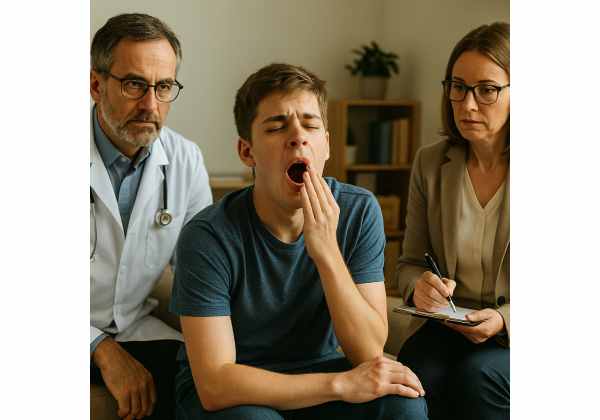
Kleine-Levin syndrome is a rare sleep and neuropsychiatric condition in which a person has repeated episodes of extreme sleepiness, unusually long sleep, and changes in thinking, mood, perception, or behavior. Between episodes, many people return close to their usual level of alertness and functioning, which can make the condition confusing for families, schools, employers, and even clinicians who do not often see it.
The condition most often begins during adolescence, but it can occur outside the teenage years. Because episodes may involve sleeping most of the day, acting unlike oneself, eating changes, sexual disinhibition, irritability, confusion, or dreamlike feelings of unreality, Kleine-Levin syndrome can be mistaken for several psychiatric, neurological, sleep, or substance-related problems. Understanding the pattern of episodes is often the key to recognizing why the condition is different from everyday tiredness, depression, narcolepsy, or ordinary sleep deprivation.
Key points about Kleine-Levin syndrome:
- KLS is marked by recurring episodes of severe hypersomnolence, often with much longer sleep than usual.
- During episodes, people may seem confused, apathetic, irritable, disinhibited, emotionally flat, unusually hungry, or detached from reality.
- The person is often much closer to their usual self between episodes, especially in the earlier years of the condition.
- KLS is commonly confused with narcolepsy, depression, bipolar disorder, substance effects, seizure disorders, and other causes of excessive sleepiness.
- Professional evaluation matters when episodes are recurrent, prolonged, unsafe, associated with major behavior changes, or accompanied by new neurological or psychiatric symptoms.
Table of Contents
- What Kleine-Levin Syndrome Is
- Symptoms and Signs During Episodes
- Episode Pattern and Course Over Time
- Causes and Possible Mechanisms
- Risk Factors and Common Triggers
- Conditions That Can Look Like KLS
- Diagnostic Context and Clinical Evaluation
- Effects, Complications, and Urgent Red Flags
What Kleine-Levin Syndrome Is
Kleine-Levin syndrome, often shortened to KLS, is best understood as a recurrent disorder of hypersomnolence with temporary changes in cognition, perception, mood, and behavior. The defining feature is not simply being tired; it is a pattern of distinct episodes in which the person sleeps far more than usual and behaves or thinks differently from their baseline.
KLS is classified among central disorders of hypersomnolence, meaning the problem is related to sleep-wake regulation rather than to poor motivation or ordinary fatigue. During an episode, a person may sleep for much of the day and may be difficult to wake. When awake, they may feel foggy, detached, slowed down, unusually hungry, emotionally distant, irritable, or unable to function normally. In many cases, they return to a much more typical state between episodes.
This episodic pattern is one of the most important clues. Someone with chronic insomnia, chronic depression, untreated sleep apnea, or ongoing sleep deprivation may feel tired most days. In KLS, symptoms usually appear in attacks that last days to weeks and are separated by periods of relative recovery. That does not mean every person feels perfectly normal between episodes, but the contrast between “episode” and “usual self” is often striking.
The condition is rare, which is one reason diagnosis may be delayed. A teenager who suddenly sleeps most of the day may first be thought to have depression, substance use, a viral illness, school avoidance, or a behavioral problem. Adults may be evaluated for neurological disease, psychiatric illness, medication effects, shift-work sleep disruption, or other sleep disorders. KLS should not be assumed from one episode of heavy sleep, but repeated episodes with the right pattern deserve careful evaluation.
KLS is sometimes called “Sleeping Beauty syndrome,” but that nickname can be misleading. It may sound harmless or whimsical, while the real condition can seriously disrupt school, work, relationships, independence, safety, and emotional well-being. Many people also have symptoms beyond sleep, including altered perception, derealization, apathy, compulsive eating, irritability, or sexual disinhibition. These features can be distressing and may be remembered poorly afterward.
KLS also differs from narcolepsy symptoms in an important way. Narcolepsy usually causes ongoing daytime sleepiness and sleep attacks across ordinary days, while KLS tends to cause discrete episodes of prolonged sleep and altered behavior with better functioning between episodes. This distinction is not always obvious without a detailed timeline.
Symptoms and Signs During Episodes
The core symptom of Kleine-Levin syndrome is recurrent severe sleepiness with prolonged sleep, but the associated mental and behavioral changes are often what make the condition clinically distinctive. During an episode, the person may seem like a markedly different version of themselves.
Sleep may dominate the day. Some people sleep 15 to 20 hours or more in a 24-hour period, waking only briefly to eat, drink, use the bathroom, or respond to others. When awakened, they may be slow, confused, irritable, or eager to return to sleep. Forced awakening can sometimes provoke agitation, especially when the person feels overwhelmed or disoriented.
Cognitive symptoms are common. A person may have trouble concentrating, following conversations, remembering what happened, making decisions, or understanding time. Speech may become slower or less organized. They may seem “not fully there,” answer briefly, or appear detached from their surroundings.
Perceptual changes can be especially unsettling. Some people describe the world as dreamlike, unreal, distant, slowed, distorted, or emotionally flat. This can overlap with experiences often described as derealization or depersonalization. A separate discussion of depersonalization and derealization may help explain the language people use for these sensations, but in KLS the timing within sleepiness episodes is a key clue.
Behavioral and emotional changes vary. Some people become apathetic and withdrawn. Others become irritable, impulsive, childlike, unusually blunt, anxious, depressed, or socially disinhibited. Hyperphagia, or unusually increased eating, is well known in KLS, but not everyone has it. Some people may eat compulsively, crave sweets or specific foods, or eat in ways that are very unlike their usual pattern. Less commonly, appetite may decrease instead.
Sexual disinhibition or hypersexuality can occur, particularly in males, but it is not required for the diagnosis and should be discussed carefully. It may involve inappropriate comments, increased sexual preoccupation, or behavior that is out of character. Because this symptom can be embarrassing or distressing, families may underreport it unless clinicians ask in a respectful, matter-of-fact way.
| Feature | How it may appear | Why it matters |
|---|---|---|
| Extreme sleepiness | Sleeping most of the day, difficult to wake, rapid return to sleep | This is the central feature of KLS episodes |
| Cognitive change | Confusion, poor attention, memory gaps, slow responses | Helps distinguish KLS from ordinary tiredness |
| Altered perception | Dreamlike, unreal, detached, or distorted surroundings | Often reported as derealization or a trance-like state |
| Apathy or mood change | Withdrawal, flat affect, irritability, anxiety, low mood | May lead to confusion with depression or other psychiatric conditions |
| Disinhibited behavior | Compulsive eating, impulsive actions, sexual disinhibition, blunt comments | Can create safety, social, and family concerns |
No single associated symptom appears in every person. The most important pattern is recurrent prolonged sleepiness plus a noticeable change in cognition, perception, mood, or behavior during episodes.
Episode Pattern and Course Over Time
KLS usually unfolds as repeated episodes that last for days to weeks, with substantial improvement between episodes. The timing, frequency, and severity can vary widely from person to person, but the relapsing-remitting pattern is central to the condition.
A typical episode may begin abruptly. Some people notice a short warning period, such as overwhelming fatigue, headache, flu-like feelings, irritability, or a sense that an episode is starting. Others seem to enter the episode with little warning. Symptoms often build quickly, and the first day or two may be particularly striking.
Episodes are commonly described as lasting from a few days to several weeks. Diagnostic criteria often refer to episodes lasting at least two days and up to several weeks. Some reports describe longer or atypical episodes, but unusually prolonged symptoms should make clinicians consider whether another condition is present or whether KLS is occurring alongside another problem.
Between episodes, many people regain normal or near-normal alertness, mood, cognition, and behavior. This does not mean the condition has no effect between attacks. A person may feel embarrassed by what happened, anxious about the next episode, behind in school or work, or worried about being misunderstood. Families may also become hypervigilant for early signs.
The course often begins in adolescence. Males are affected more often than females, although females can clearly develop KLS and may be underrecognized. Some cases begin in childhood or adulthood. Because adolescence is also a common period for mood disorders, substance experimentation, irregular sleep schedules, and school stress, the early episodes may be misattributed.
Over years, episodes may become less frequent or less intense for many people. Still, the time course is unpredictable. Some people have long gaps between episodes. Others have repeated disruptions within a year. Even when the overall outlook is favorable, the condition can affect major developmental milestones, education, work reliability, driving safety, and social confidence.
Memory for episodes may be incomplete. A person may recall fragments, dreamlike impressions, or little at all. This can make outside observations important. Parents, partners, roommates, teachers, or close friends may notice changes that the person cannot describe accurately afterward.
The episodic pattern also helps distinguish KLS from problems that are continuous or daily. Chronic poor sleep, delayed sleep-wake phase, long-term depression, ongoing substance use, or untreated medical illness may cause persistent fatigue or sleepiness. KLS is more suspicious when there are repeated, time-limited episodes of extreme sleepiness and altered behavior, separated by a clear return toward baseline.
Causes and Possible Mechanisms
The exact cause of Kleine-Levin syndrome is unknown. Current evidence points toward disrupted brain systems that regulate sleep, arousal, appetite, emotion, perception, and behavior, but no single confirmed cause explains all cases.
Several brain regions have been discussed in KLS research, including the hypothalamus, thalamus, frontal regions, temporal regions, and networks involved in arousal and perception. The hypothalamus is of interest because it helps regulate sleep-wake timing, appetite, body temperature, and hormonal rhythms. The thalamus is important for arousal and sensory integration. Frontal and temporal networks may relate to decision-making, inhibition, memory, emotional tone, and altered perception.
This does not mean routine brain imaging always shows a clear abnormality. In many people with KLS, standard tests may be normal between episodes. Some functional imaging studies have reported differences in activity or blood flow in certain brain regions, but these findings are not yet a simple diagnostic marker. KLS remains a clinical diagnosis supported by a careful history and by excluding other explanations.
Immune or inflammatory mechanisms have also been considered. Many people report a preceding infection or flu-like illness before the first episode or before some recurrences. This has led researchers to ask whether infection may trigger an abnormal immune response in susceptible individuals. However, the evidence is not strong enough to say that KLS is simply an autoimmune disease, and no single infection explains most cases.
Neurochemical changes are another possibility. Systems involving dopamine, serotonin, orexin-hypocretin, and other arousal-related pathways have been studied because they influence sleep, motivation, appetite, and behavior. Findings have been inconsistent, and KLS does not fit neatly into the same biological pattern as narcolepsy.
Genetics may play a role in some cases, but most people with KLS do not have a clear family history. Rare familial cases have been reported, and some genetic or immune markers have been explored. At present, there is no routine genetic test that can confirm KLS.
The condition also illustrates how closely sleep and mental state are connected. Severe disruption in sleep-wake regulation can affect attention, mood, impulse control, and perception. For broader context, the relationship between sleep and brain function helps explain why a sleep disorder can look psychiatric, neurological, or behavioral all at once.
KLS should not be blamed on laziness, poor character, weak willpower, or normal teenage sleep habits. At the same time, because its exact biology remains uncertain, clinicians must stay open to other causes when symptoms are atypical, progressive, continuous, or accompanied by new neurological findings.
Risk Factors and Common Triggers
The strongest recognized risk pattern for KLS is onset during adolescence, especially in males, but the condition can affect people outside this group. Risk factors describe who is more likely to develop the condition; triggers describe events that may precede an episode in someone who is susceptible.
Adolescence is the most common time of onset. Many people have their first episode in the teenage years, often during a period when sleep schedules, school demands, infections, and emotional stress are already common. Because teenagers may sleep late or appear withdrawn for many reasons, the abnormal severity and episodic nature of KLS can be missed.
Male sex is another recognized pattern. Males are diagnosed more often than females, though the gap may partly reflect underrecognition in females or differences in how symptoms are reported. Females with KLS may have prominent mood changes, apathy, altered perception, or hypersomnolence without the more stereotyped symptoms that some clinicians expect.
Reported triggers include infections, fever, sleep deprivation, alcohol use, physical exertion, stress, travel, head injury, and, in some cases, substance exposure. These events do not prove causation. Many people experience infections or sleep loss without developing KLS. In KLS, the trigger may act more like a stressor on an already vulnerable sleep-wake system.
Sleep deprivation deserves special caution because it can both mimic and potentially precipitate severe sleepiness. A person who has missed sleep for several nights may appear confused, emotionally unstable, or unable to function. However, ordinary sleep deprivation symptoms usually improve after adequate recovery sleep and do not typically produce repeated multi-day episodes with the full KLS pattern.
Head injury is another important consideration. If excessive sleepiness begins after a concussion or other head trauma, clinicians may need to consider post-concussion symptoms, seizure activity, structural brain injury, medication effects, or other neurological explanations before assigning symptoms to KLS. The same is true when symptoms begin after a new medication, recreational drug use, or withdrawal from substances.
Hormonal and reproductive factors have been discussed in some reports, including cases with menstrual-related patterns, but these appear uncommon and require careful differentiation from other sleep, mood, endocrine, or neurological conditions.
It is also possible for a person to have KLS and another condition. Anxiety, depression, ADHD, migraine, sleep apnea, circadian rhythm problems, or substance use may coexist and complicate the picture. That overlap can make the timeline especially important: what happens only during episodes, what is present between episodes, and what changed before the first attack?
Conditions That Can Look Like KLS
KLS can resemble several sleep, psychiatric, neurological, medical, and substance-related conditions. Distinguishing them matters because the same outward sign, such as sleeping all day, can come from very different causes.
Narcolepsy is one of the better-known disorders of excessive daytime sleepiness. People with narcolepsy often have persistent daytime sleepiness, sleep attacks, vivid dreamlike experiences near sleep, sleep paralysis, and sometimes cataplexy. KLS, by contrast, is usually more episodic, with long attacks of hypersomnolence and altered behavior separated by better intervals.
Idiopathic hypersomnia can also cause severe daytime sleepiness and long sleep duration. The pattern is usually more chronic than KLS, and the person may struggle daily with unrefreshing sleep, sleep inertia, and difficulty waking. KLS is more likely when symptoms arrive in distinct episodes with behavioral or perceptual changes.
Depression may cause hypersomnia, low motivation, slowed thinking, appetite changes, and withdrawal. However, depressive symptoms usually persist across days and weeks rather than appearing as discrete episodes with a return to baseline. KLS episodes may include depressed mood, but sleepiness, derealization, confusion, and disinhibition can be more prominent than sadness.
Bipolar disorder can be confused with KLS when episodes involve disinhibition, irritability, impulsivity, unusual sexuality, or changes in sleep. In bipolar mania or hypomania, people usually need less sleep but feel more energized. In KLS, the person generally has increased sleep and impaired alertness. Still, because the overlap can be difficult, understanding bipolar disorder symptoms can help clarify why a careful clinical history is necessary.
Sleep apnea, especially when severe, can cause daytime sleepiness, poor concentration, mood changes, and morning headaches. It is usually a nightly breathing-related sleep disorder rather than a relapsing-remitting syndrome with episodes lasting days to weeks. Still, sleep apnea symptoms are common enough that clinicians often consider them in a sleepiness workup.
Seizure disorders, encephalitis, brain tumors, migraine variants, metabolic disorders, endocrine problems, and medication effects can also resemble parts of KLS. Sudden confusion, hallucinations, odd behavior, or altered awareness may prompt evaluation for neurological causes, especially if symptoms are new, severe, or atypical.
| Condition | Typical pattern | Key distinction from KLS |
|---|---|---|
| Narcolepsy | Ongoing daytime sleepiness, sleep attacks, possible cataplexy | KLS usually occurs in distinct prolonged episodes with altered behavior |
| Idiopathic hypersomnia | Chronic excessive sleepiness and difficulty waking | KLS is more episodic and often includes perception or behavior changes |
| Depression | Persistent low mood, loss of interest, sleep and appetite changes | KLS has attacks of hypersomnolence with clearer recovery between episodes |
| Bipolar mania or hypomania | Decreased need for sleep, increased energy, impulsivity | KLS usually involves increased sleep and impaired alertness |
| Substance or medication effect | Timing linked to intoxication, withdrawal, or medication changes | KLS requires recurrent episodes not better explained by substances |
Because KLS is rare, clinicians usually rule out more common explanations first. That does not make symptoms less real. It reflects the need to avoid missing conditions that can be more common, more urgent, or more directly identifiable.
Diagnostic Context and Clinical Evaluation
KLS is diagnosed from the clinical pattern, not from one single blood test, scan, or questionnaire. Evaluation usually focuses on documenting the episode pattern, identifying the associated symptoms, and excluding other sleep, neurological, psychiatric, medical, medication-related, or substance-related causes.
A detailed history is the most important part. Clinicians often ask when episodes began, how long they last, how much the person sleeps during them, what they are like when awake, and how they function between episodes. Reports from family members or other witnesses can be very helpful because the person may not remember the episode clearly.
Current diagnostic descriptions typically require recurrent episodes of excessive sleepiness and increased sleep duration, with episodes lasting at least a couple of days and recurring over time. During episodes, the person also has symptoms such as cognitive dysfunction, derealization or altered perception, major apathy, or disinhibited behavior. Symptoms should not be better explained by another active sleep disorder, medical illness, neurological disorder, psychiatric disorder, medication, substance use, or withdrawal.
Sleep testing may be used to look for other causes of excessive sleepiness. Overnight polysomnography can help assess sleep architecture, breathing during sleep, limb movements, and other sleep-related abnormalities. A multiple sleep latency test may be used in selected cases to evaluate objective sleepiness and help distinguish central hypersomnolence disorders, although results in KLS can vary depending on whether testing occurs during or between episodes.
Other tests depend on the clinical picture. An EEG test may be considered when seizures or abnormal brain electrical activity are part of the differential diagnosis. A brain MRI may be used when symptoms suggest a structural neurological problem, new focal neurological signs, unusual onset, head injury, or another reason to look closely at brain anatomy.
Laboratory testing may be considered when symptoms could reflect infection, metabolic disturbance, endocrine disease, anemia, inflammation, intoxication, or medication effects. Toxicology screening may be relevant when substance exposure is possible. Psychiatric assessment may be important when mood symptoms, psychosis-like experiences, dissociation, trauma symptoms, eating changes, or disinhibited behavior are prominent.
The timing of evaluation matters. A person may look nearly typical between episodes, so a clinician who sees them only when well may underestimate the severity. Written timelines, sleep logs, school or work attendance records, witness descriptions, and notes about eating, mood, perception, and behavior during episodes can help reconstruct the pattern.
A careful evaluation should also avoid two extremes: dismissing symptoms as ordinary teenage behavior, and assuming KLS before other plausible causes have been considered. The goal is to match the full pattern, not to label one symptom in isolation.
Effects, Complications, and Urgent Red Flags
KLS can cause major disruption even though episodes are temporary. The complications are often practical, social, emotional, and safety-related, especially when episodes are unpredictable or misunderstood.
School and work disruption is common. A student may miss classes, exams, assignments, or social milestones. An adult may miss work, lose reliability, or struggle to explain absences. Because the person may look well between episodes, others may doubt the seriousness of what happened.
Safety is another concern. During episodes, impaired alertness, slowed thinking, disinhibition, and confusion can make driving, cooking, swimming, operating machinery, caring for children, or making important decisions unsafe. A person may not fully recognize their impairment while it is happening.
Behavioral symptoms can strain relationships. Irritability, blunt comments, compulsive eating, sexual disinhibition, apathy, or childlike behavior may be out of character but still distressing to others. Afterward, the person may feel ashamed, confused, or only partly aware of what occurred. Families may need to explain the pattern repeatedly to schools, employers, or clinicians.
Physical complications may include dehydration, poor nutrition during episodes, weight changes, inactivity, injuries from poor coordination, or worsening of another medical condition. Long periods in bed can also aggravate pain, stiffness, or general deconditioning, especially during longer episodes.
Emotional complications can occur between episodes. Some people worry about when the next episode will happen. They may avoid plans, travel, school commitments, or relationships because they fear losing control of their schedule or behavior. Others may feel isolated because the condition is rare and hard to describe.
Urgent professional evaluation may be needed when symptoms are new, severe, unsafe, or not following a known pattern. Red flags include:
- New weakness, severe headache, seizure-like activity, fainting, or one-sided neurological symptoms
- Severe confusion, inability to stay awake enough to drink fluids, or signs of dehydration
- New hallucinations, delusions, extreme agitation, or behavior that creates immediate safety risk
- Suicidal thoughts, self-harm, threats toward others, or inability to maintain basic safety
- Excessive sleepiness after head injury, overdose, medication change, substance use, or possible poisoning
- Fever, stiff neck, severe infection symptoms, or rapidly worsening mental status
A broader guide to urgent mental health or neurological symptoms can help distinguish routine follow-up from situations that require immediate assessment. In KLS specifically, urgent evaluation is not about proving the diagnosis on the spot; it is about making sure a dangerous or treatable cause of altered consciousness, behavior, or neurological change is not being missed.
References
- Kleine-Levin Syndrome (KLS) 2023 (Review)
- An Update on Kleine–Levin Syndrome 2023 (Review)
- Kleine-Levin syndrome. Clinical boarderlands based on a thorough analysis of 475 case reports 2024 (Review)
- Neuroimaging in the Rare Sleep Disorder of Kleine–Levin Syndrome: A Systematic Review 2022 (Systematic Review)
- Idiopathic Hypersomnia and Kleine-Levin Syndrome: Primary Disorders of Hypersomnolence Beyond Narcolepsy 2023 (Review)
- Kleine–Levin syndrome: a systematic review of 186 cases in the literature 2005 (Systematic Review)
Disclaimer
This article is for general educational purposes only and is not a substitute for professional medical advice, diagnosis, or treatment. Recurrent episodes of extreme sleepiness, confusion, behavior change, or altered awareness should be evaluated by a qualified clinician, especially when symptoms are new, severe, unsafe, or worsening.
Thank you for taking the time to read this overview; sharing it may help others recognize when unusual sleep and behavior changes deserve careful medical attention.