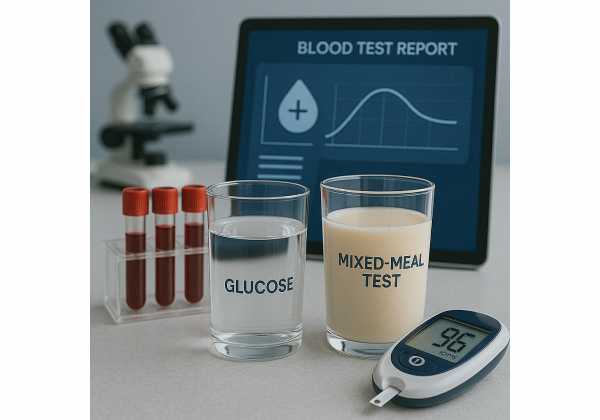
An OGTT and a mixed-meal test both ask the same broad question: how well does your body handle a glucose challenge? The difference is the challenge. An oral glucose tolerance test, or OGTT, uses a fixed glucose drink, usually 75 g of glucose in adults. It is standardized, diagnostic, and easier to compare with clinical cutoffs. A mixed-meal test uses real food or a standardized meal containing carbohydrate, protein, and fat. It is less standardized, but it often shows what happens after normal eating.
For healthy aging, the best test is the one that matches the question. Choose an OGTT when you need a formal look at impaired glucose tolerance, diabetes risk, or a comparable baseline. Choose a mixed-meal test when you want to understand post-meal glucose, insulin demand, and real-life food responses. Neither test replaces A1c, fasting glucose, fasting insulin, or clinical judgment.
Table of Contents
- Bottom Line: Which Test Should You Choose?
- What Each Test Measures
- When OGTT Is the Better Choice
- When a Mixed-Meal Test Is the Better Choice
- How to Prepare So the Result Means Something
- What to Measure and How to Read the Patterns
- Common Mistakes That Distort Results
- A Practical Decision Guide
Bottom Line: Which Test Should You Choose?
Choose the OGTT when you need a standardized clinical challenge. It is the better option for diagnosing impaired glucose tolerance, comparing results with accepted cutoffs, tracking risk over time, or clarifying a borderline A1c or fasting glucose result.
Choose the mixed-meal test when you want a more realistic view of how your body handles ordinary food. It is the better option for studying post-meal glucose peaks, insulin response, reactive lows, and differences between meal types.
A simple rule works well:
| Question | Better test | Why |
|---|---|---|
| Do I meet criteria for impaired glucose tolerance or diabetes? | OGTT | It has standard glucose dosing and clinical cutoffs. |
| How do I respond to a normal breakfast, lunch, or dinner? | Mixed-meal test | It reflects real digestion, protein, fat, fiber, and meal timing. |
| Is my fasting glucose missing a post-meal problem? | OGTT or mixed-meal test | OGTT is cleaner; mixed meal is more practical. |
| How much insulin do I need to control glucose? | Either, with insulin or C-peptide | The sampling plan matters more than the drink or meal alone. |
| Am I testing a diet change or meal strategy? | Mixed-meal test | It directly tests the intervention you use in daily life. |
| Do I want a clean baseline before a lifestyle program? | OGTT | It gives a repeatable challenge under controlled conditions. |
For most adults focused on longevity, the OGTT is best as a baseline risk test, while the mixed-meal test is best as a behavior test. The OGTT tells you whether your glucose handling breaks down under a standard load. The mixed-meal test tells you what your current breakfast, lunch, or dinner does inside your body.
The strongest approach often combines layers: fasting markers, a challenge test, and daily-life data. A basic lab panel such as A1c, fasting glucose, and fasting insulin gives the quiet background signal. A challenge test adds stress. A short run with continuous glucose monitoring adds real-world context.
What Each Test Measures
Both tests measure glucose tolerance, which means how well your body clears glucose from the bloodstream after a carbohydrate load. The useful information does not come from glucose alone. The deeper story includes insulin secretion, insulin sensitivity, liver glucose output, muscle glucose uptake, gut hormone signaling, stomach emptying, and the timing of the response.
What happens during an OGTT
In a standard adult OGTT, you arrive after an overnight fast. A baseline blood sample is taken, then you drink a solution containing 75 g of glucose. Blood glucose is commonly measured at fasting and 2 hours. More detailed versions add 30-, 60-, and 90-minute samples, plus insulin or C-peptide.
The OGTT gives a sharp, controlled challenge. Because the glucose dose is fixed, two people receive the same carbohydrate load regardless of their body size, usual diet, or appetite. That standardization is the main strength and the main weakness.
It is a strength because results are easier to compare. It is a weakness because a 75 g glucose drink is not how most people eat. It lacks protein, fat, fiber, chewing, food structure, and the slower absorption pattern of a normal meal.
The classic OGTT result focuses on the 2-hour glucose value:
| 2-hour plasma glucose | Common interpretation |
|---|---|
| Below 140 mg/dL | Normal glucose tolerance |
| 140–199 mg/dL | Impaired glucose tolerance |
| 200 mg/dL or higher | Diabetes range, usually requiring confirmation unless symptoms are clear |
Those cutoffs are not “longevity targets.” They are diagnostic categories. Someone with a 2-hour glucose of 132 mg/dL does not meet impaired glucose tolerance criteria, but a clinician might still view the pattern differently if fasting insulin is high, waist circumference is rising, triglycerides are high, or glucose stays elevated for hours after meals.
What happens during a mixed-meal test
A mixed-meal test uses a defined meal instead of a pure glucose drink. The meal contains carbohydrate plus protein and fat. Some labs use a commercial liquid meal. Others use a standardized food meal. A practical home-style version might use the same breakfast repeatedly while tracking glucose with fingersticks or a CGM.
A mixed meal triggers a wider metabolic response than glucose alone. Protein stimulates insulin and glucagon. Fat slows stomach emptying and changes the timing of the glucose rise. Fiber and food structure slow absorption. The gut releases hormones such as GLP-1 and GIP, which help coordinate insulin release.
This makes the mixed-meal test more realistic, but less clean. A different meal gives a different result. A larger meal gives a different result. Liquid calories usually behave differently from solid food. Even the same meal eaten quickly, after poor sleep, or after a hard workout gives a different response.
The mixed-meal test works best when the meal and the sampling plan stay consistent. It is especially useful when paired with a clear question, such as:
- Does my usual breakfast push glucose above 140 mg/dL for more than 1 hour?
- Do I overshoot insulin early and crash low 3–4 hours later?
- Does adding protein, fiber, or a walk change the curve?
- Does a lower-glycemic meal reduce the total glucose exposure?
- Do symptoms like shakiness, sleepiness, or cravings match a glucose pattern?
When OGTT Is the Better Choice
The OGTT is the better choice when standardization matters more than realism. It gives a controlled stress test for carbohydrate handling. That makes it useful when fasting labs look normal but risk still seems present.
Use OGTT to detect impaired glucose tolerance
Fasting glucose and A1c miss some people with abnormal post-challenge glucose. This matters because early metabolic dysfunction often appears after meals before fasting glucose rises. A person might have a fasting glucose of 92 mg/dL and an A1c of 5.4%, yet reach 165 mg/dL at 2 hours on an OGTT. That pattern suggests impaired glucose tolerance despite reassuring fasting numbers.
The OGTT is especially useful when risk factors are present:
- Increasing waist circumference or visceral fat
- History of gestational diabetes
- Family history of type 2 diabetes
- High triglycerides, low HDL, or fatty liver markers
- Hypertension or sleep apnea
- Polycystic ovary syndrome
- Unexplained post-meal fatigue or strong carbohydrate cravings
- Borderline A1c with normal fasting glucose
In longevity-focused testing, the OGTT is less about labeling someone and more about finding a weak point early enough to act. If the 1-hour or 2-hour response is high, the next step is not panic. The next step is a better plan: resistance training, post-meal walking, body composition improvement, sleep repair, protein-forward meals, and targeted follow-up.
For people comparing fasting markers with challenge results, HOMA-IR, OGTT, and mixed-meal tests belong in the same conversation because they answer different parts of the insulin-resistance question.
Use OGTT when you need a repeatable baseline
The OGTT works well before and after a structured intervention because the input stays fixed. If you complete 12 weeks of strength training, lose visceral fat, improve sleep, or change medication under medical guidance, repeating the same OGTT protocol shows whether glucose clearance improved.
A useful repeat test uses the same:
- Glucose dose
- Fasting duration
- Testing time of day
- Lab method
- Sample times
- Medication plan, as directed by a clinician
- Carbohydrate intake pattern during the 3 days before testing
Small protocol changes produce misleading comparisons. A morning OGTT after normal sleep is not the same as a late-morning OGTT after a stressful commute and 5 hours of sleep.
Use OGTT when diagnostic clarity matters
The OGTT has recognized diagnostic thresholds. That makes it the better choice when the result affects medical decisions, insurance documentation, pregnancy-related care, diabetes prevention programs, or clinician-directed follow-up.
A mixed-meal test does not have the same universal diagnostic cutoffs. A high response to one meal might show poor tolerance of that meal, but it does not carry the same diagnostic meaning as a properly performed OGTT.
The main drawback: the OGTT is artificial. It often feels unpleasant, especially for people who rarely drink sweet liquids. Nausea, lightheadedness, headache, and a later glucose dip are common complaints. Still, when the question is formal glucose tolerance, the OGTT remains the cleaner test.
When a Mixed-Meal Test Is the Better Choice
A mixed-meal test is the better choice when real-life relevance matters more than diagnostic standardization. It shows how your body handles food, not just glucose.
Use a mixed-meal test to study post-meal patterns
Post-meal glucose is not just about the peak. The shape of the curve matters. A healthier response usually rises modestly, peaks within about 60–90 minutes, and returns toward baseline within 2–3 hours. A less favorable pattern rises higher, stays elevated longer, or drops sharply below baseline later.
A mixed-meal test helps identify patterns such as:
- A high early spike after refined carbohydrates
- A delayed rise after a high-fat meal
- A prolonged plateau after large portions
- A sharp fall 3–4 hours later with hunger or shakiness
- Better control when protein, vegetables, or walking come first
- Higher responses to the same meal after poor sleep or late-night eating
These patterns are useful because they point to specific changes. If a meal spikes quickly, reduce fast starch or add fiber and protein. If glucose stays elevated for hours, reduce total meal size or evening carbohydrate load. If the curve crashes later, look at meal balance, alcohol, medication timing, and reactive hypoglycemia with a clinician.
The mixed-meal test connects well with food strategy. For example, a person using food habits that flatten glucose spikes can test whether the change works in their own body.
Use a mixed-meal test to assess insulin demand
Two people can show the same glucose curve with very different insulin responses. One person clears glucose with modest insulin. Another needs a large insulin surge to produce the same glucose value. The second pattern suggests more metabolic strain, even if glucose looks “normal.”
This is where insulin or C-peptide testing adds value. Insulin is the hormone released by the pancreas. C-peptide is released alongside insulin and often gives a steadier signal of insulin production. In practical terms:
- High glucose with high insulin suggests insulin resistance with compensation.
- Normal glucose with high insulin suggests compensation is still working, but at a cost.
- High glucose with low or delayed insulin suggests inadequate beta-cell response.
- A strong early insulin rise with a later glucose low suggests overshoot in some people.
A mixed meal often gives a more natural view of insulin demand than glucose alone because protein, fat, and gut hormones contribute to the response. This matters for metabolic healthspan because the goal is not simply “low glucose at any cost.” The goal is flexible glucose control with a reasonable insulin demand.
Use a mixed-meal test for meal design
The mixed-meal test works well as a personal experiment. Keep the meal fixed, then change one variable at a time.
Useful comparisons include:
- Same meal with and without a 10- to 20-minute walk
- Same carbohydrates eaten first versus after protein and vegetables
- Oats alone versus oats with Greek yogurt, berries, and nuts
- White rice hot versus cooled and reheated
- Large dinner versus smaller dinner with the same total daily protein
- Breakfast after poor sleep versus breakfast after adequate sleep
This is where CGM shines. A CGM does not diagnose diabetes by itself, but it shows timing, direction, and repeated daily patterns. It is especially helpful when the goal is to adjust meal composition, meal timing, and post-meal movement.
How to Prepare So the Result Means Something
A glucose challenge is only as useful as the setup. The same person can get different results after low carbohydrate intake, poor sleep, infection, intense exercise, alcohol, dehydration, or medication changes.
Before an OGTT
For a standard OGTT, preparation usually includes an overnight fast of at least 8 hours. Many protocols also call for normal carbohydrate intake during the 3 days before the test, often at least 150 g of carbohydrate per day. This matters because several days of very low carbohydrate intake can worsen the apparent response to a sudden glucose drink. The result might look abnormal even though the test was poorly matched to the person’s recent diet.
The practical preparation checklist:
- Eat your usual balanced diet for at least 3 days before testing.
- Avoid unusually low-carbohydrate dieting unless your clinician specifically wants that context.
- Avoid heavy alcohol the day before.
- Avoid unusually hard training in the 24 hours before the test.
- Sleep as normally as possible.
- Schedule the test in the morning when feasible.
- Stay seated during the test unless the protocol says otherwise.
- Do not eat, drink calories, smoke, or exercise during the test.
- Ask your clinician how to handle medications and supplements.
Do not stop prescribed medication on your own. Glucose-lowering drugs, steroids, stimulants, beta-blockers, thyroid medication changes, and some psychiatric medications affect results. The correct plan depends on why the test is being done.
Before a mixed-meal test
A mixed-meal test needs even more consistency because the meal itself changes the result. Write down the meal in detail: food items, grams or household measures, cooking method, drink, timing, and order of eating. Repeat the same meal if you plan to compare results later.
A good standardized meal includes a known amount of carbohydrate. For practical testing, many adults choose a meal with 40–75 g carbohydrate because it is large enough to challenge the system but still resembles normal eating. The exact amount should match the question. A small low-carb meal does not test carbohydrate tolerance. A huge dessert meal tests overload more than daily metabolism.
Track the context too:
- Time of day
- Fasting duration
- Sleep duration and quality
- Recent exercise
- Stress level
- Menstrual cycle phase, when relevant
- Alcohol in the prior 24 hours
- Medication timing
- Symptoms during the test
This context often explains “mystery” results. A meal that is easy to handle after good sleep and a morning walk might cause a larger spike after a late night, stress, and inactivity.
What to Measure and How to Read the Patterns
The minimum useful test measures glucose. A stronger test measures glucose plus insulin or C-peptide. The most useful interpretation looks at the full curve, not just one number.
Glucose timing
For an OGTT, a detailed sampling plan often includes:
- 0 minutes: fasting glucose, insulin, and sometimes C-peptide
- 30 minutes: early insulin and glucose response
- 60 minutes: peak screening point for many people
- 90 minutes: transition point
- 120 minutes: standard diagnostic value
- 180 minutes: optional, useful when reactive lows are suspected
For a mixed-meal test, the same schedule works well, though a high-fat meal might need 3–4 hours of tracking because fat slows digestion and delays the glucose rise.
A single 2-hour value misses important patterns. A person who peaks at 210 mg/dL at 60 minutes and returns to 115 mg/dL at 2 hours looks normal by the 2-hour value alone, but the early spike still deserves attention. Another person might peak at 145 mg/dL but remain at 138 mg/dL for several hours, suggesting slow clearance.
Insulin and C-peptide
Glucose is the visible result. Insulin and C-peptide show the effort required to produce that result.
Insulin interpretation needs caution because labs use different assays and insulin varies widely. Still, the pattern is useful. A high fasting insulin often points toward insulin resistance before glucose becomes abnormal. A delayed insulin response can allow early glucose to rise too high. A very high insulin response with normal glucose suggests compensation.
C-peptide is especially useful when insulin measurement is hard to interpret, when someone uses insulin therapy, or when beta-cell function is the key question. It reflects insulin production by the pancreas, not injected insulin.
For a longevity-minded interpretation, the best pattern is not “the lowest glucose possible.” It is a controlled glucose rise, timely return toward baseline, and no excessive insulin requirement. Muscle mass, aerobic fitness, sleep, liver fat, and meal quality all influence that pattern. This is why glucose testing connects closely with strength training’s effect on insulin sensitivity and everyday movement after meals.
CGM data during a challenge
A CGM measures interstitial glucose, not plasma glucose. It often lags behind blood glucose by several minutes, especially when glucose is rising or falling quickly. That means a CGM should not replace lab plasma glucose during a diagnostic OGTT. Still, it adds helpful shape and timing.
Useful CGM observations include:
- Starting glucose before the meal or drink
- Peak glucose and time to peak
- Time above 140 mg/dL
- Time above 180 mg/dL
- Return to baseline
- Late dips below baseline
- Overnight effects after late meals
- Repeated response to the same meal
CGM patterns are most useful when repeated. One unusual spike matters less than a pattern that appears across several similar meals. For daily-life testing, pair CGM data with meal notes and activity notes. Without notes, the graph becomes interesting but hard to act on.
Common Mistakes That Distort Results
The most common mistake is choosing the wrong test for the question. An OGTT is not the best way to learn whether your usual dinner works for you. A mixed-meal test is not the best way to diagnose impaired glucose tolerance with standard cutoffs.
Other common mistakes include:
| Mistake | Why it matters | Better approach |
|---|---|---|
| Doing an OGTT after several very low-carb days | It can exaggerate the glucose response. | Eat normal carbohydrate for several days unless instructed otherwise. |
| Walking around during the test | Muscle activity lowers glucose and changes the result. | Stay seated during a formal test. |
| Comparing different mixed meals | The meal, not your metabolism, might explain the difference. | Repeat the same meal when testing change over time. |
| Looking only at the peak | Duration and recovery matter too. | Track peak, time to peak, and return to baseline. |
| Ignoring insulin | Normal glucose can hide high insulin demand. | Add insulin or C-peptide when the question involves insulin resistance. |
| Using CGM as a diagnostic OGTT substitute | Interstitial glucose differs from lab plasma glucose. | Use lab testing for diagnosis and CGM for pattern recognition. |
| Testing during illness or poor sleep | Stress hormones raise glucose and insulin resistance. | Reschedule when the goal is a clean baseline. |
Another mistake is treating every glucose rise as harmful. Glucose is supposed to rise after carbohydrate. A moderate, brief rise after a balanced meal is normal. The concern grows when spikes are high, frequent, prolonged, paired with high insulin, or part of a broader pattern that includes central weight gain, high triglycerides, fatty liver, elevated blood pressure, or declining fitness.
Overreacting to CGM data is also common. Some people start removing healthy foods because they cause a visible rise. Beans, oats, fruit, and lentils might raise glucose more than eggs, but they also bring fiber, minerals, polyphenols, and long-term cardiometabolic benefits. A better question is not “Did glucose rise?” It is “Was the rise reasonable, brief, and worth the nutritional tradeoff?”
A Practical Decision Guide
Start with the decision you need to make. The test should serve that decision.
Choose OGTT when:
- You need diagnostic clarity.
- A1c and fasting glucose do not match your risk profile.
- You have a history of gestational diabetes.
- You want a standardized baseline before a lifestyle program.
- You need to compare your result with clinical thresholds.
- Your clinician wants to evaluate impaired glucose tolerance.
Choose mixed-meal testing when:
- You want to understand your real meals.
- You are adjusting breakfast, dinner, or carbohydrate timing.
- You suspect reactive lows after eating.
- You want to test post-meal walking.
- You want to compare meal order, fiber, protein, or portion size.
- You are using CGM for short-term behavior feedback.
Choose fasting labs first when:
- You have not checked A1c, fasting glucose, fasting insulin, lipids, liver enzymes, or kidney markers recently.
- You need a low-cost starting point.
- You are not ready for a longer test.
- You want to screen broadly before choosing a challenge test.
For many adults, the cleanest sequence is:
- Start with fasting glucose, A1c, fasting insulin, lipids, liver enzymes, and waist measures.
- Use OGTT if risk looks higher than fasting markers suggest, or if diagnostic clarity matters.
- Use mixed-meal testing or CGM to turn the result into daily meal and movement changes.
- Repeat the same test only when the result will change your plan.
The best follow-up actions are usually simple. Build more muscle. Walk after meals. Reduce large refined-carbohydrate loads. Improve sleep consistency. Treat sleep apnea when present. Reduce visceral fat gradually. Eat enough protein and fiber. Limit late-night meals if they worsen overnight glucose. These changes improve the system that handles the glucose challenge, not just the test result.
A useful glucose challenge does not shame food choices or chase perfect numbers. It shows where the system strains, where it recovers well, and which habits produce a better curve. The OGTT gives the controlled answer. The mixed-meal test gives the lived answer. Used together with fasting markers and common sense, they turn glucose testing from a one-time number into a practical map for metabolic health.
References
- 2. Diagnosis and Classification of Diabetes: Standards of Care in Diabetes—2026 2026 (Guideline)
- Glucose Tolerance Test 2025 (Review)
- Metabolic Effects of an Oral Glucose Tolerance Test Compared to the Mixed Meal Tolerance Tests: A Narrative Review 2022 (Review)
- A mixed meal tolerance test predicts onset of type 2 diabetes in Southwestern Indigenous adults 2024 (Cohort Study)
- Continuous glucose monitoring and metrics for clinical trials: an international consensus statement 2023 (Consensus Statement)
- Standardized Mixed-Meal Tolerance and Arginine Stimulation Tests Provide Reproducible and Complementary Measures of β-Cell Function: Results From the Foundation for the National Institutes of Health Biomarkers Consortium Investigative Series 2016 (Clinical Study)
Disclaimer
This article is educational and does not replace care from a qualified clinician. Glucose challenge testing affects diagnosis, medication decisions, pregnancy care, and diabetes risk assessment, so review abnormal, borderline, or symptomatic results with a healthcare professional. Do not stop or change prescribed medication before testing unless your clinician tells you to do so.