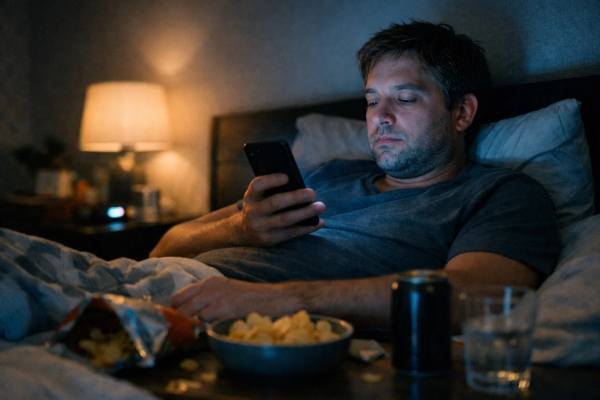
Screen time can contribute to weight gain, but usually not for the simplistic reason people assume. Phones, TV, streaming, gaming, and late-night scrolling do not directly “cause fat gain” on their own. The bigger issue is what they do to appetite, sleep, meal timing, movement, and automatic eating. Screens can make it easier to snack without noticing, stay up later than planned, eat in response to boredom or stress, and keep sitting long after your body needed a break.
That means screen time matters less as an isolated number and more as a behavior pattern. This article explains how phones, TV, and late nights can affect appetite, why some screen habits are more disruptive than others, and what to change if you want better appetite control without trying to quit modern life.
Table of Contents
- Why screen time and weight gain are linked
- How screens change appetite in the moment
- Late-night screens, sleep, and circadian disruption
- Phones, TV, and work screens affect you differently
- How to tell screen-driven eating from real hunger
- Practical ways to cut the appetite damage
- A realistic screen routine that supports weight loss
Why screen time and weight gain are linked
Screen time and weight gain are linked mainly through behavior, not through some mysterious metabolic effect of looking at a device. The more time you spend on screens, especially during passive, late, or distracted periods of the day, the more chances you create for overeating, delayed sleep, and low movement. Those effects can stack on top of each other in ways that are easy to miss.
A typical pattern looks like this: you sit for long stretches, your energy dips, you keep scrolling or watching, you start wanting something small, you snack while distracted, bedtime drifts later, sleep gets shorter, and the next day your appetite is harder to control. None of those steps guarantees weight gain on its own, but repeated often enough, they can create a steady upward pull on calories and a downward pull on routine quality.
One reason this matters is that screen time often travels with other appetite-disrupting habits. A person watching TV at night may also be eating mindlessly. A person scrolling in bed may also be pushing bedtime later. A person glued to a laptop for hours may also be missing movement breaks and eating reactively at their desk. In that sense, screen time often acts like an amplifier of other patterns.
Another reason is that modern screen use keeps food cues constantly available. You are not just sitting quietly. You are often seeing restaurant ads, recipe videos, delivery apps, snack images, or emotionally stimulating content that leaves you wanting relief. Even when the screen is not showing food, it may still be increasing the likelihood of cue-driven eating by keeping you sedentary, mentally tired, overstimulated, or disengaged from your body’s signals.
This is one reason screen-heavy days often overlap with sedentary habits that make weight loss harder. The issue is not simply that sitting burns fewer calories than walking. It is that long sedentary stretches can blur together into fatigue, restlessness, snacking, and weak self-monitoring.
It also helps to remember that screen time is not all the same. Work screens, social media, gaming, streaming, and bedtime phone use affect appetite differently. A laptop used for focused work does not necessarily have the same impact as doomscrolling in bed or eating dinner in front of a show. The context matters.
So when people ask whether screen time causes weight gain, the most accurate answer is this: screen time can absolutely support the conditions that make weight gain more likely, especially when it increases distracted eating, reduces movement, delays bedtime, and weakens appetite regulation. That is why it fits into the bigger picture of diet, sleep, stress, and routine rather than sitting in a separate category.
How screens change appetite in the moment
Screens can change appetite in the moment by making eating less aware, more automatic, and less connected to physical hunger. The biggest mechanism is distraction. When you eat while watching something engaging, your attention shifts away from portion size, fullness, eating speed, and memory of what you just consumed. That can make it easier to keep eating after your body would otherwise have signaled enough.
TV is a classic example because it combines passive sitting, long uninterrupted viewing, and a strong association with snacking. Many people do not even think of it as a separate eating occasion. It just feels like “having something while watching.” But that habit can add up quickly, which is why TV snacking at night is such a common weight-loss obstacle.
Phones can do something similar, but often in a more fragmented way. Instead of one long eating session, the phone can trigger repeated small episodes of grazing: a handful of chips while scrolling, a sweet after a stressful message, a delivery order after seeing food content, or random bites taken while half-paying attention. Because those episodes are broken up, people often remember them less clearly and underestimate how much they ate.
Screens can also increase appetite indirectly by changing your emotional state. Stressful news, social comparison, boredom, work overload, and mental fatigue can all raise the urge to eat for comfort or stimulation. In those cases, the problem is not true hunger. It is the feeling that food will change your state faster than doing nothing. That is why heavy phone and computer use can overlap with stress snacking at work or end-of-day overeating.
Another factor is learned association. If your brain repeatedly pairs a certain screen with a certain food, the craving can become automatic. Sit on the couch, open the streaming app, want something salty. Pick up the phone in bed, want something sweet. Start gaming, want a high-reward snack. Over time, the screen becomes the cue, even if physical hunger is low.
A useful way to think about it is that screens often weaken three protective systems:
- Attention: You notice your eating less.
- Interoception: You register fullness and hunger less clearly.
- Self-interruption: You are less likely to pause and ask whether you actually want the food.
That does not mean you can never eat while using a screen. It means the combination deserves more respect than people usually give it. If you are trying to lose weight, the risk is rarely one dramatic binge caused by a device. It is the slow normalization of distracted, low-awareness eating that no longer feels like a decision at all.
Late-night screens, sleep, and circadian disruption
Late-night screen use can affect appetite even more strongly than daytime screen use because it does not just change how you eat in the moment. It can also shift when you sleep, how much you sleep, and how aligned your body feels with the next day.
There are two main problems here. The first is simple: screens keep people awake later. Sometimes that happens because the content is stimulating, sometimes because scrolling is hard to stop, and sometimes because bedtime becomes the first moment of the day when there are no demands. The result is often the same. Sleep gets pushed later, total sleep drops, and the next day appetite becomes harder to regulate.
The second problem is that light at night, especially bright or blue-enriched light close to bedtime, can interfere with the body’s natural evening wind-down signals. That matters because circadian timing influences not just sleep, but also hunger, food reward, and the timing of eating. This is why blue light and sleep habits matter for weight loss even when the content itself seems harmless.
Poor sleep can increase appetite in several ways. It can make high-reward foods feel more appealing, reduce patience for effortful choices, increase daytime fatigue, and make the body feel like it needs quick energy. That is one reason poor sleep often makes people feel hungrier and more snack-prone the next day.
Late nights also create a practical eating problem: more waking hours mean more opportunities to eat. If you are awake, bored, under-recovered, and near the kitchen at 11:30 p.m., appetite does not need to be purely biological for extra calories to happen. Sometimes the issue is not hormonal hunger so much as extended exposure to cues, lower inhibition, and a weaker routine.
This is where circadian disruption enters the picture. Your body handles food differently across the day. When sleep, light exposure, and meal timing drift later and become less consistent, appetite regulation can feel less stable. People often notice that late nights come with more cravings, later meals, less structure the next morning, and a general sense that their eating day has become harder to manage.
You do not need to become perfect about screens to reduce this effect. But you do need to respect the compounding pattern. A few extra nights per week of phone use in bed can lead to:
- later bedtime
- shorter sleep
- more next-day cravings
- more caffeine reliance
- more decision fatigue
- more evening overeating
That is why screen time near bed is often less about entertainment and more about appetite management. If your hardest eating window is at night, reducing bedtime screen drift may help just as much as changing what is in your pantry.
Phones, TV, and work screens affect you differently
Not all screens affect appetite in the same way. The device matters, but the bigger issue is usually the combination of posture, timing, content, and emotion.
TV and streaming are strongly linked to passive, extended viewing. They are often paired with evening downtime, habitual snacking, and low movement. TV also creates a “permission atmosphere” for eating. People are more likely to bring food to the couch, keep eating beyond fullness, and treat snacks as part of the viewing experience. This makes TV one of the most common drivers of mindless evening calories.
Phones are more portable and more emotionally variable. They can expose you to food cues, social comparison, work stress, boredom, and constant stimulation within a single hour. Phones also fragment attention, which means eating may happen in small, forgettable episodes rather than one obvious session. That can make phone-related overeating less visible but still meaningful.
Work screens are different again. They may not trigger couch-style snacking, but they can fuel long sedentary stretches, skipped breaks, mental fatigue, and reactive eating later. After several hours of concentrated screen work, many people feel a strong urge for something rewarding, even if they are not especially hungry. That overlap with decision fatigue helps explain why evening takeout, desk snacks, and “I deserve this” eating show up after heavy computer days.
Gaming deserves separate mention because it can combine duration, stimulation, late hours, and low awareness of time. Some people under-eat during intense gaming and then overeat later. Others snack continuously without noticing. The appetite pattern can vary, but the disrupted routine is common.
A useful comparison looks like this:
| Screen habit | Most common appetite risk | Typical problem window |
|---|---|---|
| TV and streaming | Mindless snacking and oversized portions | Evening |
| Phone scrolling | Cue-driven grazing, boredom eating, later bedtime | Throughout day and late night |
| Work computer use | Mental fatigue, skipped breaks, reactive eating later | Afternoon and after work |
| Gaming | Time loss, irregular meals, late-night eating | Evening and night |
This is why screen advice should be specific. “Reduce screen time” is too vague to help most people. A better question is: Which screen habit is most strongly linked to your overeating? For one person, it is TV on the couch. For another, it is phone use in bed. For someone else, it is all-day desk work that spills into late-night reward eating.
Once you identify the real pattern, the solution gets much easier to design.
How to tell screen-driven eating from real hunger
One of the most useful skills in this area is learning to tell whether the urge to eat is coming from your body or from the screen situation around you. This is not always obvious, because screen-driven eating can feel physically real. You may think you are hungry when you are actually tired, overstimulated, bored, emotionally flat, or simply cued by habit.
True hunger usually builds gradually and is not very picky. You could eat a balanced meal and feel satisfied. Screen-driven appetite is often more sudden, more specific, and more tied to a setting. It tends to sound like: “I want something crunchy while I watch,” “I need a treat after this workday,” or “I want something sweet even though I ate dinner an hour ago.”
A few clues can help.
It is more likely to be real hunger when:
- you have gone several hours without eating
- you would be willing to eat a normal meal, not just a snack food
- the feeling is present before the screen session starts
- it is not strongly tied to one specific food or ritual
It is more likely to be screen-driven when:
- it appears only after you sit down with a show or your phone
- it disappears when you get up and do something else
- it is strongly linked to one type of food
- it arrives right after stress, boredom, or a long work block
- you were not thinking about food until the screen cue started
This is where understanding boredom versus stress eating becomes especially useful. Screens can feed both. TV and passive scrolling often pair with boredom eating. Work screens and emotionally intense content often pair with stress eating. Both can feel like hunger in the moment.
A quick test can help. Before eating, try this sequence:
- Pause the screen or put the phone down.
- Stand up and move for two minutes.
- Ask whether you would still want a balanced option such as yogurt, fruit, eggs, or a normal meal.
- If yes, it may be real hunger.
- If no and you only want a screen-paired snack, the urge may be more contextual than physical.
Another clue is how you feel after. Real hunger usually leads to relief and satisfaction when you eat a proper meal or snack. Screen-driven eating often leads to “How did I finish that?” or “I do not even feel better.” That mismatch matters.
This is also why better meal structure helps. If your meals are irregular, it becomes harder to separate real hunger from reactive eating. A more consistent routine, especially earlier in the day, makes evening signals easier to interpret.
You do not need to get this right perfectly. The goal is not to judge yourself every time you eat near a screen. The goal is to notice the difference often enough that screen-driven eating stops running on autopilot.
Practical ways to cut the appetite damage
The most effective fixes are usually environmental and routine-based, not motivational. You do not need to become anti-screen. You need to make the highest-risk screen situations less automatic.
Start with the biggest appetite trap, not the broadest rule. If TV snacking is your real issue, work on that first. If the problem is phone use in bed, start there. If it is desk-bound work leading to afternoon grazing, target the work block.
A few practical strategies work especially well:
- Keep meals off the couch and out of bed. If possible, eat at a table instead of while watching or scrolling.
- Pause or park the screen when you eat. Even one more intentional meal per day can improve awareness.
- Create friction around snack foods. Use a simple food environment reset so screen-paired snacks are not always within reach.
- Set a screen cutoff before bed. Even 30 to 60 minutes helps if bedtime drift is part of your problem.
- Use a real evening routine. A better bedtime routine lowers the chance that “just one more video” turns into hunger, grazing, and lost sleep.
- Take breaks during long screen blocks. Stand, walk, or reset before your brain starts asking food to do the job of movement.
- Pre-decide the snack. If you truly want something while watching, portion it first instead of eating from the bag or box.
- Change the order of events. Dinner first, then show. Brush teeth first, then couch. Phone charges outside the bedroom, then lights out.
It also helps to match the fix to the trigger:
- If the trigger is boredom, use movement or a non-food transition.
- If the trigger is stress, try a decompression ritual before the kitchen.
- If the trigger is late-night wakefulness, reduce bedtime screens and make sleep easier.
- If the trigger is mental fatigue, use a break before reaching for food.
The biggest mistake is trying to solve a screen-linked appetite problem with generic self-control. If the environment keeps cueing the same behavior, you will end up repeating the same fight every night. Small structural changes work better than repeated promises to “be better next time.”
Remember that partial improvement counts. If you stop eating dinner in front of the TV but still watch afterward, that is progress. If you cut phone use in bed from 90 minutes to 20, that is progress. If you keep your favorite snack out of arm’s reach and pause before refilling, that is progress.
Appetite control often improves not when temptation disappears, but when the routine stops feeding it.
A realistic screen routine that supports weight loss
A realistic screen routine is one that works on your worst ordinary day, not just on a highly disciplined day. The goal is not zero screens. The goal is to stop screen use from quietly controlling when you move, when you eat, and when you sleep.
A practical routine might look like this:
During work hours
- Take a short standing or walking break every 60 to 90 minutes.
- Keep snack decisions separate from the screen. Do not graze at the keyboard.
- If stress spikes, step away before eating.
After work
- Create a transition before the couch or phone. A short walk, change of clothes, or shower can break the stress-to-snack chain.
- Eat dinner before recreational screen time whenever possible.
During evening screen time
- Decide in advance whether you are eating or watching. Try not to blend both by default.
- If you want a snack, portion it first and keep the package in the kitchen.
- Notice which shows, apps, or times of night make eating feel most automatic.
Before bed
- Set a screen stopping point, not just a bedtime goal.
- Move into a consistent wind-down routine.
- Avoid letting the phone become the bridge between lights-off and one last snack run.
This kind of routine works because it protects the highest-risk windows: long sitting, after-work depletion, passive evening viewing, and bedtime drift. It also supports sleep consistency, which matters because more stable sleep usually leads to more stable appetite the next day.
If late-night eating is your biggest problem, combine screen changes with a more direct strategy to stop late-night snacking. Those two habits often reinforce each other, so changing only one can leave the other pulling you back.
The best long-term mindset is not “screens are bad.” It is “some screen habits make appetite regulation harder, and I can redesign those.” That keeps the focus on behavior, not blame. Modern life is full of screens. The realistic goal is to stop them from turning your evenings into a mix of sitting, snacking, and sleeping too little.
When you do that, weight loss usually feels easier not because appetite disappears, but because fewer avoidable triggers are pushing it in the wrong direction all day long.
References
- Electronic Media Use and Sleep Quality: Updated Systematic Review and Meta-Analysis 2024 (Systematic Review)
- Electronic Screen Use and Sleep Duration and Timing in Adults 2025 (Observational Study)
- Watching Television While Eating Increases Food Intake: A Systematic Review and Meta-Analysis of Experimental Studies 2025 (Systematic Review)
- The time-stamped effects of screen exposure on food intake in adults: A meta-analysis of experimental studies 2025 (Meta-Analysis)
- Advancing Chrononutrition for Cardiometabolic Health: A 2023 National Heart, Lung, and Blood Institute Workshop Report 2025 (Workshop Report)
Disclaimer
This article is for general educational purposes only and is not a substitute for medical, nutrition, sleep, or mental health advice, diagnosis, or treatment. If you have persistent insomnia, binge eating, severe loss-of-control eating, or health conditions that affect appetite and weight, talk with a qualified healthcare professional.
If this article helped you, please share it on Facebook, X, or your preferred platform so others can understand how screen habits may be affecting appetite and weight.