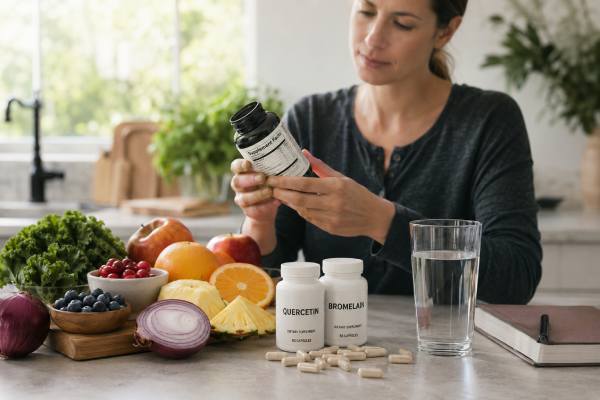
Quercetin and bromelain are often sold as a pair, especially in supplements aimed at immune support, seasonal respiratory comfort, and recovery during periods of stress. On paper, the combination sounds compelling. Quercetin is a plant flavonoid linked to antioxidant, anti-inflammatory, and histamine-related effects, while bromelain is a pineapple-derived enzyme complex known for proteolytic activity and a long history of use for swelling and sinus symptoms. That pairing has helped create a strong “natural immune support” reputation.
But reputation and evidence are not the same thing. The real questions are more practical: what benefits are actually supported, what claims go beyond the data, what doses make sense, and when can this combination create problems because of medication interactions or side effects? Those details matter more than the marketing language on the bottle.
This article breaks down what quercetin and bromelain may do, where the evidence is still thin, how to think about dosage and form, and who should use extra caution before taking them regularly.
Key Insights
- Quercetin may help regulate inflammation and histamine-related symptoms more than it directly prevents everyday infections.
- Bromelain appears more convincing for swelling, mucus, and sinus-related complaints than for broad immune enhancement.
- Human evidence for the quercetin and bromelain combination is limited, and many positive studies use multi-ingredient formulas rather than the two-ingredient pair alone.
- Short-term quercetin supplementation is often used in the 500 to 1000 mg per day range, but higher-dose long-term use is less clearly defined.
- Avoid routine use with blood thinners, before surgery, or alongside complex medication regimens unless a clinician or pharmacist has checked for interactions.
Table of Contents
- How quercetin and bromelain may help
- What the human evidence shows
- Why the combination is so common
- Dosage forms and timing
- Interaction risks and side effects
- When it makes sense and when it does not
How quercetin and bromelain may help
The main reason people reach for quercetin and bromelain is not that either one has been proven to “boost” the immune system in a broad, reliable way. It is that both may influence processes that shape how the body handles inflammation, irritation, and recovery. That is a more modest claim, but it is also the more accurate one.
Quercetin is a flavonoid found in foods like onions, apples, berries, capers, and tea. In supplements, it is usually discussed for three possible effects. First, it has antioxidant activity, which means it can help counter oxidative stress. Second, it appears to influence inflammatory signaling pathways. Third, it may affect mast cells and histamine release, which is why it is often marketed to people with seasonal allergies or irritated airways. In an immune-health context, that makes quercetin more about regulation than stimulation. It may help support a calmer, more balanced response in some situations rather than making immunity “stronger” in a blanket sense.
Bromelain is different. It is not a polyphenol or vitamin. It is a mixture of proteolytic enzymes derived mainly from pineapple stem and fruit. Its best-known uses relate to swelling, sinus congestion, mucus, and post-procedure inflammation. It has also been studied for pain, tissue recovery, and wound-related applications. That matters because many “immune” complaints are not really about immune weakness. They are about upper-airway inflammation, thick mucus, or lingering nasal and sinus symptoms. In that setting, bromelain may have a more practical role than the average immune-support label suggests.
Together, the two are often positioned as a kind of natural respiratory-support duo. Quercetin is supposed to calm inflammatory and histamine-related activity, while bromelain is supposed to help with tissue irritation and secretions. That logic is plausible, especially for people whose “immune support” needs overlap with allergy season or frequent upper-airway irritation. It also fits the broader idea of immune resilience, which focuses on recovery and regulation instead of overstated promises about “boosting.”
Still, plausible is not the same as proven. Much of the strongest enthusiasm around quercetin and bromelain comes from mechanisms, cell studies, animal work, or indirect reasoning. Human outcomes are more mixed. That is why it helps to see the pair as a potentially useful supportive tool, not a stand-alone answer for infection prevention or chronic immune concerns.
This distinction is especially important because supplement marketing often blurs the line between anti-inflammatory support, allergy support, and immune support. Those areas overlap, but they are not identical. A product may help someone feel better during allergy season or a period of airway irritation without meaningfully changing how often they get viral infections.
What the human evidence shows
If you strip away the marketing and look at human evidence, the picture becomes clearer and more restrained. Quercetin has some encouraging data, but the strongest evidence is not for dramatic immune outcomes in the average healthy adult. Instead, it is more consistent around inflammation-related markers, vascular effects, and possibly narrower situations such as physically stressed groups, respiratory symptom patterns, or people with higher baseline inflammatory burden.
One reason quercetin stays popular is that it has biologically appealing properties and decent human tolerability. But when researchers looked at upper respiratory infections in a large community trial, the overall result was not impressive. Across the full group, quercetin did not significantly reduce the total number of upper respiratory tract infection sick days or symptom severity. A benefit appeared only in a narrower subgroup of middle-aged and older people who rated themselves as physically fit. That does not make the study negative in every sense, but it does push back against the idea that quercetin is a general-purpose infection shield.
Bromelain’s evidence base points in a different direction. It has more support for swelling, postoperative recovery, and some sinus-related applications than for broad immune enhancement. That does not make it irrelevant for immune health. Reduced swelling, improved drainage, and better tolerance of upper-airway symptoms can be quite useful in real life. It simply means the most defensible claims are more targeted than supplement labels often imply.
The combination of quercetin and bromelain is even less settled. There are studies and case series involving broader formulas that include vitamin C, zinc, or specialized quercetin delivery systems, but that makes it hard to isolate the two-ingredient combination itself. In other words, some of the most positive supplement data do not tell you whether bromelain truly adds a meaningful immune benefit, whether quercetin is doing most of the work, or whether the result reflects a multi-ingredient package rather than a clean synergy.
This is why the pair fits better under “may help in selected contexts” than “proven immune support.” It may be most reasonable when someone is dealing with overlapping issues such as airway irritation, seasonal allergy patterns, or recovery from inflammatory stress. It is less convincing as a routine daily supplement for otherwise healthy people hoping to prevent every cold.
That broader context matters because many people who want an immune supplement may benefit more from the basics that have better evidence: enough sleep, adequate protein, a varied plant-rich diet, and fewer ultra-processed foods. Quercetin and bromelain can fit inside that bigger picture, but they do not replace it. That is why articles on immune boosting claims and anti-inflammatory eating often end up being more useful than a long list of promising supplement ingredients.
Why the combination is so common
Quercetin and bromelain are paired so often that many people assume the combination itself is firmly established. In reality, the pairing is partly science-driven and partly product-design logic.
The scientific part starts with quercetin’s limitations. Quercetin has relatively poor oral bioavailability, which means the amount that actually reaches circulation after swallowing a supplement can vary. It is also metabolized quickly, and different formulations behave differently. That has led manufacturers to look for ways to improve absorption or at least support more reliable uptake. Specialized forms such as phytosome or phospholipid complexes are one solution. Pairing quercetin with other ingredients is another common strategy.
Bromelain enters the picture for two reasons. The first is functional overlap. A supplement aimed at immune support, allergy season, or respiratory comfort can market quercetin for histamine and inflammatory balance, while bromelain adds a second story around mucus, sinus pressure, and tissue swelling. The second reason is the long-standing claim that bromelain may improve quercetin absorption or make the combination more effective. That claim is repeated often, but the direct human evidence behind it is not as robust as the marketing suggests. It is best treated as a plausible but not fully settled explanation, not as a proven reason that every combination product is superior.
This matters because the combination has become a kind of category shorthand. Consumers see it on labels and infer that the duo has been studied extensively for immunity. What has actually been studied is more fragmented: quercetin alone in some trials, bromelain alone in others, and mixed formulas in still others. That is not useless, but it does mean the evidence base is less tidy than the packaging implies.
There is also a practical reason the combination appeals to people with seasonal symptoms. Quercetin is often discussed as a mast-cell and histamine-related nutrient, while bromelain is commonly used when congestion, sinus pressure, or thicker secretions are part of the picture. For people whose “immune problems” are partly allergy-driven, that overlap can make the pair feel especially relevant. This is one reason it often sits near products aimed at seasonal allergy and immune overlap or other upper-airway support.
The important nuance is that a common pairing is not the same as a proven synergy. Sometimes two ingredients are paired because they complement each other. Sometimes they are paired because it makes a product easier to sell. With quercetin and bromelain, the truth is somewhere in between. There is a reasonable rationale for combining them, but the human evidence still supports caution in how strongly we describe the benefit.
A fair summary is that the combination makes sense conceptually, especially for short-term symptom support, but the claims should stay narrower than many supplement labels suggest.
Dosage forms and timing
Dosage is where many supplement articles become too confident. Quercetin and bromelain are good examples. There is no single, universally accepted immune-health dose for the combination, and different products are built around very different assumptions.
For quercetin, supplemental doses commonly fall in the 500 to 1000 mg per day range, either once daily or divided into two doses. That range shows up repeatedly in trials and safety discussions, especially for short-term use lasting several weeks to about three months. Lower doses may still be used, particularly in enhanced-delivery formulations. Higher amounts are not automatically more effective, and the long-term safety picture becomes less certain as dose and duration go up. One practical lesson is that the form matters as much as the milligrams. Standard quercetin, quercetin dihydrate, enzymatically modified forms, and phospholipid-based forms may not behave the same way.
Bromelain is less straightforward because labels may emphasize milligrams, enzyme activity, or both. In practice, marketed products often land somewhere in the low hundreds of milligrams up to around a gram per day, depending on the reason for use and whether the goal is digestive support or systemic use. For general supplement use, more is not always better, and the evidence does not justify treating bromelain as a dose-escalation supplement.
Timing also matters. Some companies recommend taking quercetin and bromelain away from meals, especially when the goal is systemic anti-inflammatory support rather than digestion. Others place them with meals for better tolerance. A sensible approach is to start with label instructions from a reputable product and adjust only if a clinician recommends otherwise or if stomach upset becomes an issue. Divided dosing can make sense for people taking larger amounts, especially if they are trying to avoid nausea or GI discomfort.
A practical way to think about it is this:
- Start lower rather than higher, especially if you are new to either ingredient.
- Choose a product with clear labeling and standardized information, not a formula that hides behind a proprietary blend.
- Use short-term goals first, such as a defined allergy season or a brief period of respiratory stress, instead of assuming indefinite daily use is necessary.
- Reassess if nothing meaningful changes after a reasonable trial period.
For many people, that also means asking whether a supplement is even the best tool. If your diet is consistently poor, you may get more value from improving overall plant intake, protein intake, and micronutrient coverage than from layering on a specialized combo. Articles on food-based immune support and safer supplement selection often provide a better starting point than chasing the highest-dose capsule.
In short, common use does not equal optimal use. Quercetin and bromelain are best approached as targeted supplements with a defined reason, modest expectations, and attention to product quality and tolerability.
Interaction risks and side effects
This is the part many people skip, but it is often the most important. Quercetin and bromelain are both sold as natural products, yet both can create meaningful problems in the wrong setting.
Quercetin can affect drug handling in the body. That includes possible effects on transporters and enzymes involved in medication absorption and metabolism. In practical terms, that raises caution for people taking medicines where small changes in drug levels matter. Quercetin also has potential relevance for people with kidney concerns and may not be ideal for those with certain estrogen-sensitive conditions unless a clinician has reviewed the risk. Short-term studies generally report mild side effects, but that is not the same as proving long-term safety across all groups.
Bromelain brings a different interaction profile. The biggest practical concern is bleeding risk. Because bromelain may affect platelet activity or interact with anticoagulant and antiplatelet therapy, it deserves caution in people taking warfarin, apixaban, rivaroxaban, clopidogrel, aspirin, or similar drugs. The same caution applies before surgery or dental procedures. Many clinicians advise stopping products with bromelain ahead of scheduled procedures for that reason.
Other interaction questions may involve certain antibiotics, sedatives, or anticonvulsants, although the strength and relevance of those interactions can vary. This is where individualized review matters more than generic internet advice. The risk is not the same for a healthy adult taking no medications and for an older adult on six prescriptions.
Common side effects are usually gastrointestinal. With quercetin, that may mean stomach discomfort, headache, or nausea in some users, especially at higher doses. With bromelain, stomach upset, diarrhea, and mouth or throat irritation can occur. Allergic reactions are also possible, particularly in people sensitive to pineapple or certain pollens. Someone with a history of plant or latex cross-reactivity may want to be more cautious with bromelain-containing products.
Pregnancy and breastfeeding are another area where “natural” should not be confused with “clearly safe.” The evidence is not strong enough to treat regular supplemental quercetin and bromelain as automatically appropriate during pregnancy or lactation without professional input. The same goes for children, unless a pediatric clinician has a specific reason to recommend a product.
The simplest rule is this: the more medically complex your situation, the less sensible it is to self-prescribe this combination. If you take regular medication, have chronic kidney disease, bruise easily, are preparing for surgery, or have a history of severe allergies, a quick review of supplement and medication interactions is more valuable than another immune-support promise. And if you notice easy bruising, bleeding, rash, or persistent GI symptoms after starting the supplement, that is a clear signal to stop and reassess.
When it makes sense and when it does not
Quercetin and bromelain make the most sense when the goal is narrow, practical, and time-limited. They may be a reasonable option for an adult who wants short-term support during allergy season, a stretch of frequent upper-airway irritation, or a period where inflammation and histamine-related symptoms seem to overlap. In those situations, the appeal of the combination is understandable. Quercetin may offer some anti-inflammatory and mast-cell-related support, and bromelain may be more relevant when mucus, sinus pressure, or tissue irritation are part of the picture.
They make less sense as a routine, indefinite “just in case” supplement for everyone. The evidence is simply not strong enough to support that use with confidence. If your main concern is getting sick too often, the better first questions are usually: are you sleeping enough, eating enough protein, getting enough plant variety, training too hard, drinking too much alcohol, or missing a nutrient deficiency that actually needs attention? Supplements like quercetin and bromelain can distract from those bigger drivers.
They also make less sense when the expectation is too broad. Neither ingredient has strong evidence for replacing vaccination, treating an active infection, correcting a true immune deficiency, or compensating for a chronically stressful lifestyle. In fact, people who feel drawn to “immune support” formulas again and again may benefit more from stepping back and looking at the larger foundations of health: consistent sleep, stress load, balanced meals, hydration, and the overall quality of their diet. That is where approaches such as polyphenol-rich foods and evidence-based immune habits usually outperform any single supplement over time.
There is also a quality-control issue. Combination products vary widely. Some use low quercetin doses that are unlikely to matter. Others rely on proprietary blends that make the real amount of bromelain hard to interpret. Some add vitamin C, zinc, or herbs, which makes side effects and interaction review more complicated. That is another reason a defined use case is better than casual long-term use.
The bottom line is balanced but useful. Quercetin and bromelain are not nonsense, and they are not miracle supplements. They may have a place for adults who want short-term support for specific inflammatory or upper-airway complaints and who have checked for medication conflicts. They are less convincing as a general immune insurance policy. If you treat them as targeted tools rather than broad solutions, you are more likely to use them well and less likely to be disappointed by what they cannot do.
References
- Recent Advances in Potential Health Benefits of Quercetin 2023 (Review)
- Rutin and Quercetin – Health Risks of Intake of Food Supplements 2024 (Risk Assessment)
- Quercetin supplementation and upper respiratory tract infection: A randomized community clinical trial 2010 (RCT)
- Efficacy and safety of bromelain: A systematic review and meta-analysis 2023 (Systematic Review and Meta-Analysis)
- Exploring the Therapeutic Potential of Bromelain: Applications, Benefits, and Mechanisms 2024 (Review)
Disclaimer
This article is for educational purposes only and is not medical advice. Quercetin and bromelain supplements can interact with medications, especially blood thinners and other drugs that require careful dosing. They may also be inappropriate for people with kidney disease, certain hormone-sensitive conditions, upcoming surgery, pregnancy, breastfeeding, severe allergies, or complex medical histories. If you take prescription medicine or are considering regular or higher-dose use, review the plan with a qualified clinician or pharmacist before starting.
If you found this article useful, please consider sharing it on Facebook, X, or another platform you use so others can find clear, balanced information too.