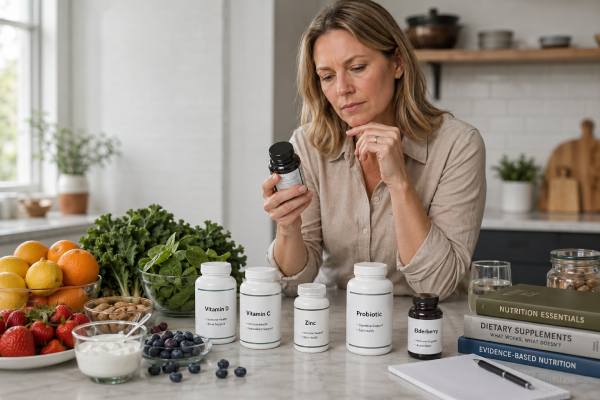
Immune support supplements are easy to buy and hard to judge. The labels promise resilience, defense, and faster recovery, but the science is rarely as clean as the marketing. Some supplements do have a reasonable role, especially when they correct a true deficiency or are used in a specific way for a specific problem. Others have only weak or mixed evidence, and some are more likely to waste money, cause side effects, or create dangerous interactions than to meaningfully help.
That does not mean all immune supplements are useless. It means they should be treated like tools, not charms. The right question is not “What boosts immunity?” but “What problem am I actually trying to solve, and does this product have evidence, a sensible dose, and a good safety profile?” This guide sorts the field into what helps, what remains uncertain, and what deserves more skepticism, so you can make decisions that are practical rather than promotional.
Key Takeaways
- The strongest case for immune support supplements is usually correcting a real deficiency or using a well-studied ingredient in a narrow, specific setting.
- Vitamin D, zinc, and some probiotics have the most practical evidence, but none of them acts like a universal shield against infection.
- Many immune blends are mostly marketing, especially products built around vague botanicals, high doses, or proprietary mixtures.
- Excess zinc, high-dose vitamin A, supplement stacking, and drug interactions can create real harm even when a label looks natural or harmless.
- A smarter approach is to start with diet, sleep, vaccines, and targeted supplementation only when the evidence and safety fit your situation.
Table of Contents
- Why Immune Supplements Are So Confusing
- Supplements With the Best Case
- Where the Evidence Is Mixed
- Products That Deserve Extra Skepticism
- What Makes Supplements Risky
- How to Choose More Rationally
Why Immune Supplements Are So Confusing
Immune support supplements are confusing because they are trying to simplify something that is not simple. The immune system is not one dial that can be turned up. It is a network of cells, tissues, signaling molecules, barriers, and rhythms that has to be responsive without becoming overactive. That is why the phrase “immune boosting” is usually too sloppy to be useful. A supplement can affect one pathway, one nutrient status, or one type of infection risk without meaning it broadly improves immune health.
The other reason for confusion is that the evidence often lives in narrow categories while the marketing speaks in broad promises. A supplement might show a small benefit in people who are deficient, in adults under specific dosing schedules, or for cold duration rather than cold prevention. Then the label turns that into “supports immune defense” as though the result applies to everyone, all year, in every context. It usually does not.
This is especially clear with vitamins and minerals. Several nutrients are essential for normal immune function. That is real. But “essential” does not mean that more is better once needs are met. Correcting deficiency is not the same thing as pushing intake far beyond normal. That difference matters in immune health because deficiencies can impair function, yet excessive intake can cause side effects, displace other nutrients, or create toxicity.
Botanicals add another layer of complexity. One company’s echinacea or elderberry formula may not resemble another’s in species, extraction method, dose, or purity. Even when a study looks promising, the actual product used by consumers may be quite different. Probiotics have a similar issue: strain, dose, formulation, and storage all matter, so “a probiotic” is not a very specific intervention.
A better starting point is the framework in what is real versus what is marketing. Instead of asking whether a supplement is “good for immunity,” ask a tighter question:
- Is there a defined use case?
- Does the evidence relate to prevention, severity, or duration?
- Does the evidence apply to people like me?
- Is the dose reasonable?
- What are the side effects and interaction risks?
That is also why supplements should sit below foundational habits, not above them. If sleep is poor, stress is high, vaccines are overdue, and diet quality is weak, a supplement may have only a modest effect compared with those larger levers. The broader lesson from immune resilience is that the body usually does better with consistent support than with one dramatic product.
In other words, the supplement question is not “What is strongest?” It is “What actually fits the biology, evidence, and my real-world situation?”
Supplements With the Best Case
Among immune support supplements, the strongest case is usually not for exotic products. It is for familiar nutrients and a limited number of better-studied categories used in specific ways. The most practical examples are vitamin D, zinc, and some probiotics, with an important qualifier: even these are not universal winners.
Vitamin D makes sense when deficiency or low status is likely. It plays a role in immune regulation, and low vitamin D status is associated with increased susceptibility to some infections. The evidence for supplementation is not dramatic across all populations, but daily, moderate-dose vitamin D appears more plausible than occasional large bolus dosing for respiratory support. The real value is highest when intake or status is inadequate, which is why vitamin D guidance matters more than vague “immune support” claims.
Zinc is another supplement with a reasonable but narrow use case. Zinc is essential for immune cell function, and deficiency clearly impairs immunity. Preventive zinc supplementation is not a magic cold shield in well-nourished adults, but zinc lozenges or other forms may reduce the duration of an ongoing cold when started early and used in effective doses. That is a more modest claim than “prevents illness,” but it is also more honest. The practical details are covered better in zinc guidance and zinc lozenge use than on most product labels.
Some probiotics also have a real, if modest, evidence base for respiratory infection prevention. The challenge is that benefits are strain-specific and outcome-specific. A product may reduce upper respiratory tract infection frequency or duration slightly in some settings, while another probiotic does nothing relevant. That is why probiotics are better thought of as targeted microbial interventions than generic immune boosters. The broader principle is closer to which strains help and when.
A few other supplement categories may make sense in special cases:
- A multivitamin when diet is clearly inadequate
- Iron, B12, folate, or other nutrients when deficiency is documented
- Protein supplementation when under-eating or training load is high
- Oral rehydration support during illness when hydration and intake are poor
The pattern is consistent. Supplements help most when they fill a true gap or match a narrow evidence-based use. They help less when taken “just in case” in people already meeting needs.
This is why the strongest immune-support supplement is often not a supplement at all, but fixing a weak link in the overall system. That might mean low vitamin D, low iron, poor protein intake, or a diet low in plants and fiber. For many people, improving the basics from better food choices and evidence-based immune habits will do more than adding another capsule.
The supplements with the best case are not the flashiest. They are the ones with a defined rationale, a plausible dose, and a smaller gap between what the study showed and what the label implies.
Where the Evidence Is Mixed
A large share of the immune supplement market lives in the middle zone: not obviously useless, but not clearly proven enough to deserve confident routine use either. This is where many of the most popular products sit. They may have promising mechanisms, old studies of uneven quality, mixed trial results, or benefits that depend heavily on preparation and context.
Vitamin C is a good example. It is essential for immune function, and deficiency is clearly bad. But for most well-nourished adults, routine high-dose vitamin C supplementation is not a guaranteed way to prevent colds. It may modestly shorten cold duration in some cases, and it has a clearer role in people under intense physical stress or with low intake than in everyone across the board. That is a very different message from “take this every day and you will not get sick.”
Echinacea sits even deeper in the mixed-evidence category. Some studies suggest weak benefits for prevention or duration of the common cold, while others show little. Product variability makes interpretation harder because the species, plant part, extraction process, and dose often differ across trials. That does not mean echinacea is fraudulent. It means the average consumer usually cannot tell whether the bottle in hand resembles the formula in the study. The same pattern appears with elderberry, andrographis, and a number of plant-based “immune” blends.
Probiotics can land here too, depending on how the question is framed. As a category they are promising, but as products they are extremely uneven. A strain with some support for upper respiratory infections does not justify assuming that any shelf-stable mixed probiotic will help. The evidence is real enough to be interesting, but not broad enough to justify casual substitution across brands and strains.
Other products in the mixed zone include:
- Mushroom extracts such as reishi or turkey tail
- Garlic preparations
- Green tea extracts
- Quercetin combinations
- Colostrum products
- Various combination powders and “wellness shots”
The problem is often not that these ingredients do nothing. It is that the evidence is too inconsistent, too product-specific, or too indirect to support the certainty implied by marketing. This is where people get drawn into immune myths and start stacking multiple ingredients with only partial rationale.
The best way to handle mixed-evidence supplements is with proportional expectations. If the benefit, if real, is likely to be modest, then the safety, cost, and product quality should carry more weight in the decision. A low-risk product with a small possible upside may still be reasonable for some people. But it should not be described or purchased as if it were a clinically decisive intervention.
Mixed evidence does not mean “never.” It means “not first, not automatic, and not at any price.”
Products That Deserve Extra Skepticism
Some immune support products deserve skepticism not because they are merely uncertain, but because their marketing repeatedly outruns the evidence or because safer alternatives already exist. This category includes heavily branded immune blends, megadose formulas, and products that exploit fear more than they offer plausible benefit.
One common example is the proprietary multi-ingredient formula. These products often combine vitamins, minerals, herbs, mushrooms, antioxidants, and flavorings in doses that are hard to evaluate. The label may sound comprehensive, but complexity often makes the product harder to trust, not easier. If it causes side effects or interacts with a medication, it becomes difficult to know which ingredient is responsible. If it “works,” it is just as hard to know what mattered.
Another red-flag category is products built around dramatic language such as detox, antiviral shield, or clinical-strength immune defense without a clear evidence trail. That includes many “wellness shots,” trendy powders, and influencer-driven stacks. A lot of these overlap with the concerns in immune gummies and wellness shots, where sugar, stimulant-like ingredients, or under-dosed actives can do more for branding than biology.
Colloidal silver is one of the clearest examples of an immune product that is more risk than value. It is often promoted as antimicrobial or immune-supportive, yet it carries known safety concerns and lacks a sound place in routine immune care. It is much more fairly approached through why colloidal silver is risky than through supplement marketing.
High-dose vitamin A also deserves caution. Vitamin A is essential, and deficiency impairs immunity. But that truth does not justify casual high-dose supplementation in people who are not deficient. Because vitamin A is fat-soluble, excess intake can accumulate and cause real harm. The same logic applies to several “more is better” supplement habits that sound immune-minded but ignore dose-dependent toxicity.
Products that deserve the most skepticism often share a few traits:
- They promise broad immune improvement for everyone
- They rely on proprietary blends that obscure meaningful doses
- They use natural-sounding language to downplay risk
- They stack many ingredients with overlapping effects
- They imply medical protection without product-specific evidence
- They are sold as substitutes for vaccines, sleep, or medical care
Intravenous vitamin drips for immunity also belong here for many healthy people. The idea sounds powerful, but the evidence rarely supports routine IV use for ordinary immune support, and the cost and medicalization are often out of proportion to the likely benefit.
When a supplement’s language sounds more dramatic than the actual outcomes measured in studies, skepticism is not cynicism. It is good judgment.
What Makes Supplements Risky
The biggest mistake people make with immune support supplements is assuming that low regulation, food-adjacent branding, or plant-based ingredients make them automatically safe. Supplements can create harm in several ways: excess dosing, drug interactions, contamination, poor product quality, and delay of appropriate medical care.
Excess dosing is common because people stack products without realizing it. A multivitamin, an immune powder, a zinc lozenge, and a nighttime recovery formula may all contain overlapping ingredients. Zinc is a classic example. Used intelligently, it can have a place. Used chronically at high intake, it can lead to nausea, gut upset, and copper deficiency. That is why guidance on too many supplements and zinc and copper balance matters far more than many labels suggest.
Drug interactions are another major issue. Some supplements affect bleeding risk, sedation, blood pressure, thyroid treatment, blood sugar control, or immune-suppressing medications. This is especially important for older adults, pregnant people, people with autoimmune disease, and anyone taking multiple prescriptions. Interactions are one of the clearest reasons to review supplements and medication risks before starting a stack.
Quality is the third problem. Not every supplement contains the labeled amount, and not every product is clean. Some may contain unwanted contaminants, and others may use forms or storage methods that reduce reliability. Probiotics, in particular, depend on strain identity and viable delivery. Botanicals can vary by species and extraction quality. That is why third-party testing is more than a nice extra. It is one of the few ways consumers can reduce uncertainty.
Real risk factors include:
- High doses taken for months without a clear indication
- Multiple products with overlapping ingredients
- Use alongside prescription medications
- Pregnancy, kidney disease, liver disease, or autoimmune disease
- Buying from poor-quality or unverifiable sellers
- Treating persistent symptoms with supplements instead of seeking care
There is also a behavioral risk. Supplements can create false reassurance. A person may ignore sleep, skip vaccines, keep drinking heavily, or delay care because they feel protected by a routine that is mostly symbolic. That is not a harmless mistake. It can lead to longer illness, slower recovery, and missed opportunities to address the real problem.
The safer mindset is that supplements are potent enough to matter, which means they are potent enough to require respect. They should be selected for a reason, used in a defined way, and reassessed when the situation changes.
How to Choose More Rationally
Choosing immune support supplements rationally starts with narrowing the goal. Are you trying to correct a deficiency, reduce the duration of colds, support recovery during a high-risk season, or fill a diet gap you cannot reliably solve right now? Those are different problems, and they do not all point to the same product.
The next step is to ask what has to be true for a supplement to be worth trying. A useful filter looks like this:
- There is a clear problem or reason to use it.
- The ingredient has evidence that matches that problem.
- The dose and form are sensible.
- The safety profile fits your medications and health conditions.
- The product quality is credible.
- You know when you will stop, continue, or reassess it.
This usually leads people away from big stacks and toward simpler decisions. For example, a person with low vitamin D and repeated winter respiratory illness has a more rational reason to consider vitamin D than someone already taking high-dose vitamin D “just in case.” A person who wants a cold-duration strategy may choose a zinc lozenge plan rather than a broad daily immune cocktail.
In practice, the most rational supplement use often looks like this:
- Correct a documented deficiency
- Use one targeted product at a time
- Avoid mega-dosing unless medically indicated
- Review medications and health conditions first
- Prefer products with transparent labeling and independent testing
- Judge outcomes honestly instead of assuming a product must be helping
It also helps to know when not to buy anything. If your main problems are poor sleep, irregular meals, high alcohol intake, and constant stress, the best investment may be in changing the routine, not adding another capsule. The most reliable supplement strategy still sits on top of fundamentals, not in place of them.
This is especially true because some of the best immune-supportive changes are not supplements at all: more consistent sleep, enough protein, more plant variety, sensible hydration, vaccination, and early rest when sick. When those basics improve, the question of supplements often gets smaller and clearer.
The smartest way to use immune support supplements is to make them boring. One reason, one product, one evidence trail, one plan to reassess. Once you move away from supplement theater and toward targeted use, you are much more likely to get whatever real value these products actually have.
References
- Dietary Supplements for Immune Function and Infectious Diseases – Health Professional Fact Sheet 2025 (Fact Sheet)
- Probiotics for preventing acute upper respiratory tract infections 2022 (Systematic Review)
- Optimal methods of vitamin D supplementation to prevent acute respiratory infections: a systematic review, dose-response and pairwise meta-analysis of randomized controlled trials 2024 (Systematic Review and Meta-analysis)
- Zinc for prevention and treatment of the common cold 2024 (Review)
- Zinc Toxicity: Understanding the Limits 2024 (Review)
Disclaimer
This article is for educational purposes only and is not medical advice. Supplements can affect immune health in limited and sometimes useful ways, but they can also cause side effects, toxicity, and medication interactions. Talk with a qualified clinician before using high-dose supplements, combining multiple immune products, or taking supplements if you are pregnant, immunocompromised, have kidney or liver disease, or use prescription medications. Persistent infections, unexplained fatigue, weight loss, or other concerning symptoms deserve medical evaluation rather than supplement self-treatment.
If this article helped you sort signal from marketing, consider sharing it on Facebook, X, or your preferred platform so others can approach immune support supplements with more clarity and less hype.