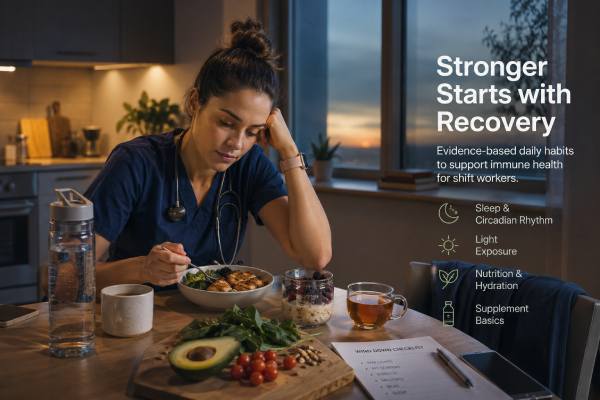
Shift work asks the body to do something it was not built to do consistently: stay alert when biology expects sleep, then rest when light, noise, and daily life are pulling the other way. Over time, that mismatch can affect more than energy and mood. It can shape appetite, recovery, infection risk, and how steady the immune system feels from one week to the next. That is why immune support for shift workers is less about one supplement and more about managing the signals that tell the body when to sleep, eat, recover, and stay alert.
The good news is that the basics are unusually powerful here. Better-timed light exposure, more protected sleep, steadier meal routines, smart caffeine use, and selective supplements can make night work or rotating schedules more manageable. None of these fully cancels circadian disruption, but together they can lower the strain. The goal is not perfect biology. It is fewer preventable hits to an already stressed system.
Quick Overview
- The strongest immune support for shift workers usually starts with protected sleep, not supplements.
- Bright light during work and darker conditions before daytime sleep can improve alertness and recovery.
- Meal timing matters; lighter, steadier eating patterns often work better than large overnight meals.
- Caffeine and melatonin can help in some schedules, but poor timing can worsen sleep and recovery.
- A practical starting plan is to stabilize one sleep window, one light routine, and one meal pattern before adding supplements.
Table of Contents
- Why shift work hits immunity so hard
- Sleep is the main immune tool
- How light can work for you
- Meal timing matters more than people think
- Supplement basics without the hype
- A real-world plan for rotating and night shifts
Why shift work hits immunity so hard
Shift work strains the immune system less by one single mechanism than by several smaller disruptions piling up at the same time. The biggest is circadian misalignment. The immune system does not operate at one flat level across the day. Many immune processes follow daily rhythms, including hormone signaling, inflammatory activity, sleep-related recovery, and the timing of how the body responds to stressors. When work hours repeatedly force wakefulness at night and sleep during the day, those signals become less synchronized.
That does not mean every shift worker is destined to be sick more often. It does mean the margin for error gets smaller. A daytime worker may recover from a rough night more easily because the next day still lines up with normal light exposure, social cues, and meal timing. A shift worker often has to recover while the body is receiving mixed messages. Bright morning light on the commute home tells the brain to stay awake. Noise and family schedules can cut sleep short. Meals may drift later, become more erratic, or lean heavily on convenience foods during fatigue.
This is why immune support for shift workers should not be framed only as “take something for immunity.” The more useful question is what is increasing the body’s total stress load. Sleep loss matters. Light exposure matters. Repeated overnight eating matters. High caffeine, irregular hydration, more alcohol on days off, and the stop-start pattern of rotating shifts all matter. Together they can increase the kinds of strain discussed in circadian rhythm and immunity and the broader set of behaviors covered in what weakens your immune system.
There is also a cumulative effect. Many shift workers do not feel terrible every day. Instead, they feel “mostly okay” until a virus, overtime block, family disruption, or travel week pushes them over the edge. That is an important pattern. It suggests the system is often running close to capacity. The aim of immune support is to create more buffer.
Another reason shift work feels so difficult is that it often distorts recovery behaviors themselves. People may have less time to exercise, prepare meals, or maintain social routines that protect mental health. Fatigue can lead to heavier snacking, less daylight exposure on days off, and more reliance on stimulants. None of that is a personal failure. It is an expected response to a schedule that conflicts with normal biology.
So when people ask whether shift work “lowers immunity,” the most honest answer is that it can push the body toward lower-quality recovery, more circadian stress, and in some cases higher infection vulnerability. The practical response is not fear. It is to protect the few levers that make the biggest difference.
Sleep is the main immune tool
If there is one place to start, it is sleep. That sounds obvious, but many shift workers hear “get more sleep” as vague advice that ignores real life. The more useful version is this: protect the most repeatable sleep window you can, even if it is not perfect, and treat it like a biological appointment rather than leftover time.
The immune system relies heavily on sleep for regulation, repair, and recovery. Short sleep, fragmented sleep, and constantly shifting sleep timing can all make the body feel less resilient. This is one reason the link between sleep and immunity is especially important for shift workers. The problem is not only fewer hours. It is that daytime sleep is often lighter, more easily interrupted, and less aligned with the body’s strongest drive for sleep.
A good sleep setup for shift workers usually includes environmental protection. That means a dark room, cool temperature, consistent pre-sleep routine, and active noise control. Blackout curtains help, but they often are not enough on their own. Eye masks, white noise, earplugs, and clear boundaries with family or housemates can be just as important. Daytime sleep usually needs more active defense than nighttime sleep.
Timing also matters. Many night workers do better when they avoid drifting too far between workdays and days off. Total social normality on off days can feel good in the moment but may make the next night block much harder. The body usually adapts better to some consistency than to repeated extremes. That does not mean you need a rigid nocturnal life every day of the week. It means large swings come with a cost.
Naps can help if they are used strategically. A short pre-shift nap can reduce sleepiness during the night shift, and a short operational nap during breaks may help in some workplaces. The goal is alertness support, not replacing a main sleep episode. Long naps at the wrong time can also make daytime sleep harder, so they work best when treated as a supplement to sleep rather than the plan itself.
A practical sleep-support routine often includes:
- a protected main sleep block after the shift
- a dark and quiet sleep environment
- a wind-down period that is boring, repeatable, and screen-light reduced
- limited caffeine in the second half of the shift
- a fallback nap plan for bad sleep days
This is also where perfectionism becomes unhelpful. Many shift workers quit good routines because they cannot do them perfectly. In reality, the difference between four hours of broken sleep and six and a half hours of protected sleep is meaningful, even if it still falls short of an ideal schedule.
The best sleep plan is the one that survives real life. Once that foundation is stronger, every other immune support measure works better.
How light can work for you
Light is one of the strongest circadian signals the body receives, which makes it especially important for shift workers. It can help alertness when used at the right time and sabotage sleep when used at the wrong time. That is why immune support for shift workers is not only about what to eat or take. It is also about when your eyes are getting bright light and when they are protected from it.
For night workers, bright light during the shift can improve alertness and support temporary circadian adjustment. This does not require magical equipment in every case, though some people benefit from structured light tools. Even workplace lighting and strategic exposure to brighter environments can help if timing is consistent. The biggest mistake is often not lack of light during work, but too much of the wrong light after the shift.
Morning light on the commute home can push the brain further toward wakefulness right when a night worker needs to prepare for sleep. This is why dark glasses or reduced light exposure after the shift can matter. The goal is not to live in darkness all day. It is to reduce the signal that tells the body “now is the time to be fully awake.” That makes the transition into daytime sleep easier.
Light planning also has to account for days off. Many shift workers unknowingly send mixed signals by using strong light at inconsistent times across the week. A simple routine is often better than an ambitious one. Decide when you want to feel alert, when you want to sleep, and make light exposure support that pattern rather than fight it.
Here are some of the most useful light principles:
- Get brighter light during the work period when you need alertness.
- Reduce bright light exposure after the shift if you are about to sleep.
- Keep the bedroom dark enough that daytime sleep feels biologically possible.
- On rotating schedules, accept that complete circadian adaptation may not happen and aim instead for less disruption.
This is where shift work overlaps with indoor environment quality more generally. A recovery-friendly room is not only dark. It is also quiet, cool, and not overly dry. Small improvements in the sleep setting often amplify the benefit of better light timing.
Light strategy is also a reminder that more intervention is not always better. Some people jump quickly to high-dose melatonin, wake-promoting drugs, or elaborate gadget stacks before fixing the obvious mismatch between their work lighting, commute exposure, and sleep environment. Usually the order should go the other way.
Used well, light is one of the most practical tools shift workers have. It does not eliminate circadian strain, but it can improve alertness on duty and make sleep more achievable off duty. Those two changes alone can meaningfully reduce the day-to-day immune burden of shift work.
Meal timing matters more than people think
Shift workers are often told what to eat, but not when eating may be most disruptive. That timing question matters because meal patterns act like signals to the body’s peripheral clocks, especially in organs involved in metabolism and digestion. When food intake becomes highly irregular or heavily concentrated overnight, the result is often more than digestive discomfort. It can also mean poorer glucose control, lower-quality energy, and a more inflamed-feeling recovery pattern.
That does not mean night workers should never eat at night. Real-world work demands make that advice unrealistic for many people. The more practical goal is to avoid turning the entire shift into a grazing window built around large, heavy, or highly processed foods. Many shift workers feel better when they use a steadier pattern: a more substantial meal before the shift, lighter intake during the biological night, and a sleep-friendly approach after work instead of a huge breakfast before bed.
This is where meal composition and timing connect. Overnight, the body often handles heavy meals less efficiently. Large portions, high sugar intake, or greasy convenience foods can worsen sleepiness during the shift and also make daytime sleep less comfortable later. A lighter meal or planned snack pattern often works better than swinging between under-eating and a late-shift binge.
Useful meal-timing habits often include:
- eating a balanced meal before starting the shift
- keeping overnight intake lighter and easier to digest
- using protein and fiber to reduce the crash that follows vending-machine foods
- avoiding very large meals close to the main sleep window
- keeping hydration steady rather than trying to catch up all at once
This does not need to become a rigid fasting protocol unless a clinician or dietitian has helped make that plan fit the person. Some workers do well with structured eating windows. Others simply need more consistent meal timing and better food availability. The basics usually matter more than labels.
The nutrition side of shift work also overlaps with gut comfort and immune resilience. Irregular eating, low fiber intake, and repeated ultra-processed overnight meals can disrupt digestion and leave people feeling inflamed, bloated, or sluggish. That is why many shift workers benefit from a pattern closer to an anti-inflammatory diet and from the broader logic behind microbiome diversity.
Caffeine belongs in this section too because it often gets used as liquid meal replacement. It can help early in the shift, but using it late can damage the main sleep block that matters most for recovery. The same is true for sugary “wellness” drinks that combine caffeine, herbs, and vitamins without offering much real nourishment.
A better meal plan for shift work does not have to look perfect. It just needs to reduce the most common stressors: large overnight meals, long gaps followed by overeating, too much sugar, too little fiber, and food timing that makes sleep worse instead of easier.
Supplement basics without the hype
Shift workers are a prime audience for immune supplements because fatigue creates a strong temptation to look for a shortcut. But the most useful supplement plan is usually selective and boring. It starts with deficiency risk, work schedule, diet quality, and medication safety, not with a broad “immunity stack.”
Vitamin D is one of the first nutrients worth thinking about because some shift workers get less daylight exposure and may also spend less time outdoors overall. That does not mean everyone on nights should automatically take high doses. It means low sun exposure can raise the value of reviewing intake, risk factors, and sometimes testing, especially if there are other reasons to suspect deficiency. A grounded overview of vitamin D and immunity is much more useful than guessing with large doses.
Magnesium can be relevant for some workers, especially when sleep quality, muscle tension, or dietary intake are poor, but it is not an immune supplement in the narrow sense and it is not a cure for circadian disruption. Melatonin can help some shift workers with sleep timing, yet it is a timing tool more than a general wellness supplement. Used badly, it can create grogginess or shift the rhythm in an unhelpful direction. That is one reason people should treat it more like a schedule aid than a nightly default.
Zinc is often added during cold season, but it is best used with caution and purpose. High-dose long-term zinc is not a good general strategy, and timing matters if a person is taking other medicines. Similar caution applies to multi-ingredient immune blends that stack zinc, vitamin C, herbs, mushrooms, and caffeine together. These products often create more complexity than benefit.
Good supplement basics for shift workers usually follow these rules:
- Fix sleep, light, and meal timing before expecting supplements to carry the load.
- Use supplements to correct likely gaps, not as a substitute for recovery.
- Avoid large multi-ingredient blends when a single targeted nutrient would do.
- Check medication interactions before adding herbs or high-dose minerals.
- Reassess whether the product is doing anything measurable after a reasonable trial.
This is also where supplement and medication interactions matters. Shift workers are not immune to drug-supplement problems just because the product is sold over the counter. Melatonin, minerals, herbal “immune boosters,” and stimulant-heavy formulas can all complicate sleep, blood pressure, medication timing, or next-day alertness.
The most honest supplement advice for shift workers is simple: use the least exciting product that solves the clearest problem. When the problem is sleep timing, light and melatonin timing may matter more than antioxidants. When the problem is poor meal quality, protein and fiber may matter more than adaptogens. When the problem is chronic exhaustion, the answer may be schedule strain, not a missing pill.
A real-world plan for rotating and night shifts
Shift work advice often fails because it sounds like it was written for a person with total control over their rota, family schedule, and workplace environment. Most people do not have that. A better plan is one built around priorities: what gives the biggest return when life is messy.
For fixed night shifts, the first priority is a stable anchor sleep block. Even if total sleep varies, keeping part of the sleep timing consistent can reduce weekly chaos. The second priority is light management: brighter light during work, less bright light on the way home, dark room for sleep. The third is food structure: one real meal before work, lighter intake overnight, no giant meal right before bed unless that clearly works for the person. Supplements come after that.
For rotating schedules, full circadian adaptation is often unrealistic. The goal becomes damage control rather than perfect alignment. In that setting, workers usually benefit from protecting sleep duration as much as possible, using naps strategically, keeping meal quality steadier than meal timing can be, and being more careful with alcohol and late caffeine around schedule flips.
A practical weekly plan can include:
- one protected sleep routine after each night shift
- a pre-shift meal that reduces reliance on overnight junk food
- caffeine mainly in the first half of the shift
- a backup nap on transition days
- a small, consistent checklist for symptoms of overload: sore throat, worsening sleep, irritability, gut upset, or unusually heavy fatigue
This is also where self-monitoring helps. Some workers notice their recovery falls apart after three nights in a row. Others do relatively well until rapid rotation or weekend schedule swings enter the picture. Tracking patterns is useful, whether done mentally, in a notebook, or with a device. That does not mean every worker needs biometrics, but some may find value in the broader logic behind HRV and illness readiness when the goal is spotting overload early.
There are times when self-management is not enough. Recurrent insomnia, severe daytime sleepiness, near-miss driving events, dependence on sedatives or stimulants, repeated illness, and depression symptoms all deserve more than generic shift-work advice. In those cases, it may be time to assess for shift work sleep disorder, untreated sleep apnea, iron deficiency, or other causes of persistent fatigue and low resilience.
The right goal for most shift workers is not to become “optimized.” It is to become less vulnerable. When sleep is more protected, light is less chaotic, meals are more deliberate, and supplements are used selectively, the body usually has a better chance to recover between shifts. That is what immune support for shift workers really looks like in practice.
References
- The Effects of Shift Work on the Immune System: A Narrative Review 2023 (Review)
- Night-shift work and susceptibility to infectious diseases: a systematic review and meta-analysis 2025 (Systematic Review and Meta-Analysis)
- Current sleep interventions for shift workers: a mini review to shape a new preventative, multicomponent sleep management programme 2024 (Review)
- Provider Fact Sheet – Shift Work 2022 (Clinical Guidance)
- Dietary Supplements for Immune Function and Infectious Diseases – Health Professional Fact Sheet 2025 (Official Guidance)
Disclaimer
This article is for educational purposes only and is not a substitute for medical advice, diagnosis, or treatment. Shift work can meaningfully affect sleep, alertness, metabolism, and immune recovery, but the right plan depends on the person’s schedule, medical history, medications, and symptoms. Seek professional care for severe daytime sleepiness, repeated near-miss driving events, persistent insomnia, frequent infections, depression symptoms, chest pain, fainting, or suspected sleep apnea. Supplements, melatonin, stimulants, and sedatives should be used thoughtfully, especially if you take prescription medications or have chronic health conditions.
If this article helped you, please share it on Facebook, X, or another platform so more shift workers can find practical, evidence-based ways to protect sleep and recovery.