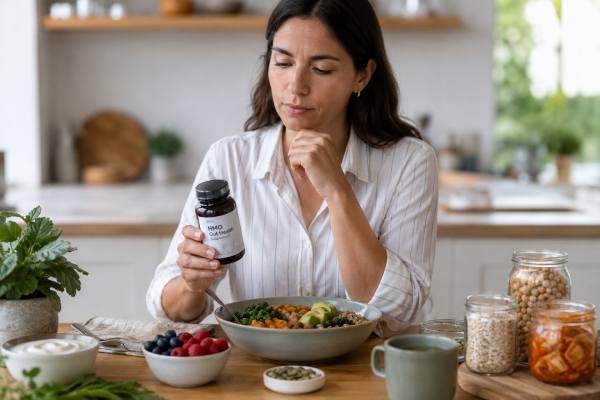
HMO supplements are one of the newer entries in the gut-health world, and they sound unusual for a reason: HMOs, or human milk oligosaccharides, were first studied as natural components of breast milk. That origin alone makes adult use feel surprising. But researchers are now testing specific HMOs, especially 2’-FL, as targeted prebiotic ingredients that may shape the adult gut microbiome in ways that are more selective than many older fibers. That has sparked interest among people with IBS, post-antibiotic gut disruption, and a broader curiosity about gut-immune support.
The catch is that adult evidence is still early. Some studies show better bifidobacteria growth, shifts in short-chain fatty acids, and symptom improvement in selected groups. Others show more modest effects, and the long-term picture is not yet clear. This article explains what HMO supplements are, how 2’-FL differs from standard prebiotics, what benefits seem realistic for adults, how dosing is being studied, and who may want extra caution.
Brief Summary
- 2’-FL is the best-studied HMO supplement for adults and appears to act mainly as a targeted prebiotic rather than a direct immune booster.
- Adult studies suggest possible benefits for bifidobacteria growth, gut comfort, and microbiome recovery in selected situations.
- The strongest adult evidence is still limited, and HMO supplements should not be sold as proven infection-prevention products.
- A practical starting point is to use one clearly labeled product for a defined trial instead of combining several gut supplements at once.
Table of Contents
- What HMO Supplements Are
- Why 2’-FL Gets the Most Attention
- What Gut Benefits Look Realistic
- Who May Benefit Most
- Dosage, Forms, and Product Choices
- Side Effects and Who Should Be Cautious
- How to Think About HMOs Practically
What HMO Supplements Are
HMO stands for human milk oligosaccharide. These are complex carbohydrates found naturally in breast milk, where they help shape the infant microbiome and interact with the gut environment in ways that support early development. Modern supplements do not come from donated human milk. They are manufactured versions of specific HMO structures, usually made through fermentation or related production methods, then added to powders, sachets, capsules, or nutrition formulas.
That is the first point many adults need clarified: HMO supplements are not hormones, antibodies, or probiotic bacteria. They are specialized carbohydrates. In most adult products, the best-known ingredient is 2’-fucosyllactose, written as 2’-FL. Some products also include LNnT, short for lacto-N-neotetraose, or smaller amounts of other HMOs such as 3’-SL or 6’-SL. These ingredients are being marketed as next-generation prebiotics because they appear to feed certain beneficial microbes, especially bifidobacteria, in a more selective way than many older fibers.
That selectivity is what makes the topic interesting. Traditional prebiotics such as inulin, FOS, and GOS can be helpful, but they are not always tolerated well and they can produce a lot of gas or bloating in sensitive people. HMOs may behave differently because they are not just generic fermentable carbohydrates. They also seem to influence how microbes interact with the intestinal environment, which is why they are often discussed alongside topics such as the gut-immune connection and prebiotic support for a stronger microbiome.
Even so, it helps to keep the adult use case in perspective. HMOs are far better studied in infants than in adults, and some marketing language still borrows too heavily from infant research. The fact that HMOs matter in breast milk does not automatically mean they produce dramatic results in adult digestion, immunity, or daily health. Adults have very different microbiomes, diets, immune histories, and gut conditions. That means adult supplementation has to be judged on adult data, not on a simple assumption that “if it is good in infancy, it must be good for everyone.”
A practical definition is this: HMO supplements are specialized, prebiotic-style carbohydrates that may help shift the adult gut microbiome and gut environment in targeted ways. That is more accurate than calling them miracle gut healers, and it sets up the right question for the rest of the article: not whether HMOs are biologically interesting, but whether they produce benefits in adults that are meaningful enough to justify using them.
Why 2’-FL Gets the Most Attention
Among adult HMO supplements, 2’-FL gets most of the attention because it is the best-studied structure and the one most commonly used in clinical trials. That matters more than people might think. “HMO supplement” sounds like a single category, but HMOs are a family of many distinct molecules, and they do not all behave the same way. When a company sells a product with one HMO, a two-HMO blend, or a more complex mix, those should not be treated as interchangeable.
2’-FL stands out for two main reasons. First, it has the strongest adult safety and tolerance data. Healthy adult studies have tested it alone and in blends, including fairly high doses, and the overall picture is that it is usually well tolerated, though gastrointestinal symptoms can increase at higher intakes. Second, 2’-FL has shown fairly consistent bifidogenic effects. In plain language, it seems good at encouraging certain bifidobacteria, which are often treated as favorable residents in the gut ecosystem.
That does not mean 2’-FL is the only HMO worth knowing. LNnT is often paired with it in a 4:1 blend, especially in gut studies. There is also early adult research on 3’-SL and 6’-SL, but the adult evidence base for those is smaller and their intended uses are less established. If someone is shopping for an HMO supplement for general gut support, 2’-FL is usually the molecule behind the marketing story, even when the label emphasizes the broader HMO category.
Mechanistically, 2’-FL seems to matter for more than one reason. It can act as a substrate for beneficial bacteria, and it may also influence gut ecology through effects on fermentation products such as short-chain fatty acids. That is part of why it gets mentioned in conversations about postbiotics and butyrate production. Still, it is smarter to think of it as a contributor to microbial balance rather than a stand-alone maker of butyrate. Other dietary inputs still matter enormously, including fiber variety, resistant starch, and overall food quality. Someone eating a low-fiber, ultra-processed diet will not turn their gut around with one teaspoon of 2’-FL.
Another reason 2’-FL gets so much attention is that it fits the supplement industry’s search for more targeted products. Older gut formulas often combine broad-spectrum fibers, probiotics, digestive enzymes, herbs, and vague “gut repair” language. By contrast, 2’-FL is marketed as a more precise tool. That framing is not completely wrong, but it can create inflated expectations. A selective prebiotic is still just one lever in a larger ecosystem. It may be helpful, especially when older prebiotics are poorly tolerated, but it is not a shortcut around the harder parts of gut care such as diet quality, sleep, stress, and medication review.
What Gut Benefits Look Realistic
The most realistic adult benefits of HMO supplements are not dramatic digestive overhauls. They are narrower and more specific. Based on the available studies, the clearest signals are improved bifidobacteria abundance, possible increases in some beneficial fermentation products, and symptom improvement in selected groups rather than universal benefit across all adults.
In healthy adults, 2’-FL and related HMO blends have shown the ability to shift the gut microbiota, particularly by increasing bifidobacteria. That is a meaningful finding, because bifidobacteria are often reduced by low-fiber diets, antibiotics, and some chronic gut conditions. A more bifidobacteria-rich environment may support better fermentation patterns and a steadier gut barrier, though that does not automatically translate into obvious day-to-day symptom changes for every person.
The more clinically interesting data come from adults with gastrointestinal complaints. In IBS and other chronic gut conditions, small trials and pilot work suggest that certain HMO supplements may improve gastrointestinal quality of life, bowel patterns, or symptom burden while also increasing bifidobacteria and, in some studies, butyrate-related activity. That is promising, but it is still early-stage evidence. The studies are not large enough or consistent enough to say HMOs are a first-line IBS treatment. They are better viewed as a targeted adjunct that may help some people, especially when gut microbiome disruption seems to be part of the picture.
There is also growing interest in how HMOs might help after antibiotic exposure. Early adult work suggests that 2’-FL may support microbiome resilience after vancomycin use, which is a particularly relevant question because antibiotics can strip back microbial diversity and leave the gut slow to recover. That idea overlaps with broader strategies such as probiotic timing after antibiotics and increasing microbiome diversity, but HMOs offer a different angle by feeding selected microbes rather than simply adding new ones.
What about immune benefits? This is where expectations need tightening. Adult HMO research supports a gut-immune connection in principle, but it does not yet prove that supplements such as 2’-FL clearly reduce infections, prevent colds, or create a stronger immune system in everyday healthy adults. The immune claim is more indirect: if an HMO improves microbial balance, fermentation, and barrier function, that may support a steadier gut environment that interacts more favorably with immune signaling. That is plausible. It is just not the same as a proven infection-prevention supplement.
So the honest summary is this: the gut benefits that look most realistic are microbiome shifts and possible symptom relief in selected adults, especially those with gut disruption. The benefits that look least certain are broad claims about immunity, energy, or total digestive transformation.
Who May Benefit Most
Not every adult needs an HMO supplement, and for many people it would not be the first place to start. The adults most likely to consider HMOs seriously are those with a specific reason rather than a vague interest in “better gut health.”
One obvious group is adults with IBS-type symptoms, especially when bloating, bowel inconsistency, and food sensitivity make more aggressive fibers hard to tolerate. HMO blends have been studied in IBS more than in many other adult conditions, and while the evidence is not definitive, it is at least directionally encouraging. That does not mean HMOs replace dietary treatment or IBS-focused care. It means they may be worth considering as part of a stepwise approach, particularly if the goal is to support the microbiome without using a broad, highly fermentable fiber that worsens symptoms.
A second group is adults recovering from antibiotics or dealing with a microbiome that feels destabilized after medical treatment. The emerging antibiotic-resilience data are still limited, but this is one of the more interesting real-world use cases. Someone who has had repeated antibiotic exposure, especially with noticeable gut disruption afterward, may find HMOs worth discussing alongside strategies such as food-based fiber diversity, probiotics, and careful symptom tracking.
A third group is adults who want a more targeted prebiotic and have not done well with common options. Some people tolerate inulin, GOS, or resistant starch very well. Others feel significantly worse on them. For that second group, HMOs may represent a narrower, sometimes gentler approach. “May” matters here, because gentler is not guaranteed. But the rationale is reasonable.
There are also people who probably do not need to spend money on HMO supplements yet. Healthy adults who simply want stronger immunity would often get more value from improving sleep, protein intake, plant diversity, and meal quality first. Likewise, someone eating very little fiber overall may be better served by gradually improving their base diet and exploring other next-generation gut strategies only after the basics are in place. Adults hoping for broad immune benefits should also understand that HMOs fit better into the language of immune resilience than into claims of immune boosting.
A practical way to think about “who may benefit” is to ask whether there is a defined gut reason to try one. HMOs make the most sense when the goal is targeted microbiome support, not when the goal is solving every vague symptom under the umbrella of wellness. The more specific the use case, the more rational the trial becomes. The vaguer the goal, the easier it is to overspend on a supplement that has interesting science but not enough evidence to justify broad use.
Dosage, Forms, and Product Choices
Adult HMO dosing is not fully standardized, which is one reason product shopping can feel confusing. Research has used a fairly wide range, from lower gram-level doses up to much higher amounts in tolerance studies. In healthy adults, 2’-FL and LNnT have been tested at doses as high as 20 grams per day in controlled settings, mainly to assess tolerance and microbiome effects. In IBS and chronic gut studies, more typical adult research doses have been closer to 4 to 10 grams per day, often using either 2’-FL alone or a 4:1 blend of 2’-FL and LNnT. Newer adult studies have also looked at lower amounts in special contexts, depending on the HMO structure being used.
For real-world use, that matters in two ways. First, it shows that “clinically studied” does not point to one magic number. Second, it means consumers should be careful about product claims that imply a tiny sprinkle of HMO is automatically equivalent to the doses used in adult trials. Some supplements rely on the reputation of HMOs while delivering amounts that may be more symbolic than practical.
Powders and sachets are common because meaningful HMO doses are often easier to deliver that way than in capsules. Capsules can work, but they may require a large number to match the gram amounts used in studies. Blends can also be harder to interpret than they look. A label may say “HMO complex” without making clear how much actual 2’-FL is present, what other HMOs are included, or whether the dose reflects adult research at all.
A sensible buying approach includes a few checkpoints:
- Look for the specific HMO structure, not just the word “HMO.”
- Check the gram amount per serving.
- Notice whether the product is plain 2’-FL or a 2’-FL and LNnT blend.
- Avoid assuming that extra probiotics, herbs, or enzymes make it better.
- Prefer products with transparent manufacturing and testing information.
Because HMOs are newer ingredients, quality signaling matters. A product that is third-party tested and clearly labeled is more trustworthy than one wrapped in broad immune language. It is also worth remembering that more is not always better. Higher doses may be more likely to create bloating, rumbling, or stool changes without adding proportionate benefit.
If you decide to try an HMO supplement, using a single product for a defined period is usually the clearest way to judge response. This is especially true if you already take multiple powders or gut blends and need to think about how supplement combinations can complicate safety and interpretation. A simple trial tells you more than a stack does.
Side Effects and Who Should Be Cautious
The good news is that adult HMO supplements generally look well tolerated in the studies published so far. That is one reason they have attracted so much attention. But well tolerated does not mean side-effect free, and it definitely does not mean every adult should use them casually.
The most likely side effects are gastrointestinal. These include bloating, abdominal rumbling, gas, stool changes, and occasional discomfort, especially at higher doses. This pattern makes sense because HMOs are microbiome-active carbohydrates. Even though they may be more targeted than some older prebiotics, they still change fermentation patterns. For a sensitive gut, that can feel helpful at one dose and aggravating at another.
This is particularly relevant for people with IBS, SIBO concerns, active gut inflammation, or a history of reacting badly to prebiotics. The adult IBS data are encouraging, but that does not mean every IBS patient will feel better on HMOs. A person in the middle of a flare, severe constipation, or intense post-infectious sensitivity may need a slower and more careful approach than a label suggests. The same is true for people with major dietary restriction or those already using multiple gut-directed products. More layers are not always better.
Another group that deserves caution includes pregnant and breastfeeding adults. There is no strong signal that HMO supplements are uniquely dangerous in these groups, but adult-targeted safety data are not deep enough to support casual use without guidance. The same cautious logic applies to people with complex medical conditions, including significant gastrointestinal disease, immune suppression, or major metabolic illness. Here, the question is not whether HMOs are likely to cause harm. It is whether the evidence is strong enough to justify self-prescribing when the clinical situation is more complicated.
People taking HMO blends should also pay attention to the rest of the ingredient list. Some products add probiotics, flavors, sweeteners, fibers, or botanical extracts. If you react badly, the HMO itself may not be the only reason. That is another argument for starting with a simpler formula rather than a “total gut” stack.
Finally, there is a caution that has more to do with expectations than toxicity: do not treat HMO supplements as if they are proven adult immune therapeutics. The research is not there yet. They are interesting, plausible, and in some cases promising. That is not the same as established standard care. Used thoughtfully, they may be helpful. Used as a substitute for clinical evaluation, good diet, or evidence-based treatment, they become much less impressive.
How to Think About HMOs Practically
HMO supplements are probably best understood as targeted, early-stage gut tools rather than as essential daily supplements for the general public. That framing keeps both the promise and the limitations in view. The promise is real: adult studies suggest that 2’-FL and related HMO formulas can shift the gut microbiome, support bifidobacteria, and in some contexts improve gut symptoms or recovery patterns. The limitation is equally real: the evidence is still narrow, population-specific, and much less mature than the marketing often suggests.
If you are deciding whether to try one, the first question should not be “Are HMOs good?” It should be “What problem am I trying to solve?” If the answer is a specific gut issue, such as post-antibiotic disruption, stubborn bowel inconsistency, or poor tolerance to common prebiotics, an HMO supplement may be worth a defined trial. If the answer is a vague hope for better immunity, better energy, and better digestion all at once, the case is much weaker.
It also helps to place HMOs in a hierarchy. Before an adult spends money on a specialized prebiotic, it is worth asking whether the foundations are already in place. Those foundations include enough total protein, better sleep, a more diverse plant intake, and an eating pattern that is not dominated by ultra-processed foods. In many cases, those basics will do more for the gut environment than a premium HMO powder. For some people, the smartest first move is still food-based work, such as increasing plant variety and using practical ideas from a more diverse weekly plant intake rather than relying on a specialized ingredient.
That said, specialized tools do have a place. An adult with a fragile gut may not tolerate a big leap into beans, onions, resistant starch, and fiber powders right away. In that situation, HMOs may offer a more focused approach. The key is to test them the way you would test any thoughtful intervention: one product, clear dose, defined timeline, and honest symptom tracking.
The bottom line is that HMOs deserve attention, but not hype. 2’-FL appears to be the most relevant adult option, especially for targeted microbiome support. The gut benefits are plausible and sometimes encouraging. The immune claims are still mostly indirect. The people most likely to benefit are those with a clear reason to use them, not those simply looking for the newest wellness ingredient. That is a more restrained conclusion than the marketing, but it is also the one most likely to hold up.
References
- Clinical evidence and mechanistic pathways of human milk oligosaccharide supplementation for health benefits: an updated review 2025 (Review)
- Clinical Studies on the Supplementation of Manufactured Human Milk Oligosaccharides: A Systematic Review 2023 (Systematic Review)
- Impact of 2′-Fucosyllactose on Gut Microbiota Composition in Adults with Chronic Gastrointestinal Conditions: Batch Culture Fermentation Model and Pilot Clinical Trial Findings 2021 (Pilot Clinical Study)
- Oral supplementation of healthy adults with 2′-O-fucosyllactose and lacto-N-neotetraose is well tolerated and shifts the intestinal microbiota 2016 (Clinical Trial)
- 2′-Fucosyllactose supplementation results in a transient improvement in gut microbial resilience after vancomycin use in adults with overweight or obesity: a randomized, double-blind, placebo-controlled intervention 2025 (Randomized Controlled Trial)
Disclaimer
This article is for educational purposes only and is not medical advice, diagnosis, or treatment. HMO supplements for adults are still an emerging area of research, and they are not a substitute for medical care, prescribed treatment, or individualized nutrition guidance. If you are pregnant, breastfeeding, immunocompromised, have significant gastrointestinal disease, or take regular medications or multiple supplements, talk with a qualified clinician or pharmacist before starting an HMO product. Seek medical evaluation for persistent abdominal pain, blood in the stool, unexplained weight loss, severe diarrhea, or symptoms that are getting worse rather than better.
If this article helped you, please share it on Facebook, X, or another platform where it may help someone make a more informed decision about HMO supplements and gut health.