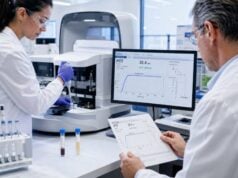
The thrombin time test measures the final step of blood clot formation: how quickly fibrinogen turns into fibrin after thrombin is added to a plasma sample. A normal result usually means this final clotting step is working as expected, while a prolonged result points toward a fibrinogen problem, a medication effect, or an inhibitor in the sample.
Thrombin time is not the same as prothrombin time, INR, PTT, or aPTT. Those tests evaluate earlier parts of the clotting pathway. Thrombin time focuses narrowly on fibrin formation, which makes it useful when bleeding, abnormal clotting studies, liver disease, disseminated intravascular coagulation, suspected heparin contamination, or a possible fibrinogen disorder needs clarification. The test result is reported in seconds, and the correct interpretation depends heavily on the laboratory’s own reference interval, the person’s medications, and related tests such as fibrinogen level and reptilase time.
- A typical adult thrombin time reference range is about 12–19 seconds, though some laboratories report normal as less than 20 or 21 seconds.
- A prolonged thrombin time usually means delayed fibrin formation, often from low fibrinogen, dysfunctional fibrinogen, heparin, direct thrombin inhibitors, or fibrin degradation products.
- A normal thrombin time does not rule out every bleeding disorder, because platelet problems, von Willebrand disease, and many clotting factor deficiencies affect other parts of hemostasis.
- Preparation usually focuses on medication review, especially heparin, argatroban, bivalirudin, dabigatran, thrombolytic drugs, and sometimes warfarin.
- Follow-up commonly includes fibrinogen testing, reptilase time, PT/INR, aPTT, D-dimer, and liver-related tests, depending on the clinical situation.
Table of Contents
- Thrombin Time Normal Range
- What the Thrombin Time Test Measures
- What Normal, High, and Low Results Mean
- Common Causes of a Prolonged Thrombin Time
- Test Preparation and Sample Quality
- Related Tests and Follow-Up
- When Results Need Urgent Attention
Thrombin Time Normal Range
A typical thrombin time normal range is about 12–19 seconds in adults. Some laboratories use a cutoff such as less than 20 seconds or less than 21 seconds. The exact range changes with the thrombin reagent, analyzer, sample handling process, and local validation method.
Thrombin time is reported in seconds because the lab measures how long it takes for a clot to form after thrombin is added to platelet-poor plasma. A result inside the lab’s reference interval generally means fibrinogen is present in enough functional form and no strong thrombin inhibitor is delaying clot formation.
Use the reference range printed beside your result rather than comparing your number with a general internet range. A thrombin time of 20 seconds, for example, might be normal in one laboratory and mildly prolonged in another.
| Result pattern | Common interpretation | Important note |
|---|---|---|
| About 12–19 seconds | Often considered normal in adults | Use the lab’s own reference interval first |
| Less than 20 or 21 seconds | Normal by some laboratory cutoffs | Method-dependent; not a universal cutoff |
| Mildly prolonged | Possible mild fibrinogen abnormality, medication effect, or sample issue | Needs review with fibrinogen level and medication history |
| Clearly prolonged | Delayed fibrin formation from low or abnormal fibrinogen, heparin, direct thrombin inhibitor, DIC, liver disease, or fibrin breakdown products | Often needs repeat or reflex testing |
| Very prolonged or no clot | Strong inhibitor effect, severe fibrinogen deficiency, major fibrinogen dysfunction, or major sample problem | Clinically important if bleeding, surgery, trauma, pregnancy complication, or critical illness is present |
The thrombin time test does not have an “optimal” wellness range in the same way that some metabolic markers do. A result comfortably inside the lab range is usually treated as normal. A lower number rarely carries meaning by itself unless the lab flags it or the clinical context raises concern.
The range also differs in newborns and young infants. Pediatric coagulation testing needs age-specific reference intervals because clotting proteins mature over time. Adult ranges should not be used to interpret infant results.
What the Thrombin Time Test Measures
The thrombin time test measures the conversion of fibrinogen into fibrin, the protein mesh that helps form a stable clot. It bypasses most of the clotting cascade by adding thrombin directly to plasma. That narrow focus is the reason the test helps separate fibrin-related problems from broader clotting pathway problems.
In normal clotting, the body activates a series of clotting factors that eventually generate thrombin. Thrombin then cuts fibrinogen into fibrin strands. Those strands polymerize and help build the clot. Thrombin time skips the earlier steps and asks a direct question: when thrombin is already present, does fibrin form on time?
This makes thrombin time different from prothrombin time and aPTT. PT and aPTT look at upstream clotting factor pathways. Thrombin time looks at the final fibrin-forming step.
What happens in the lab
The laboratory collects blood into a sodium citrate tube, usually a light blue-top tube. Citrate binds calcium and keeps the sample from clotting before testing. The lab then separates plasma from blood cells, prepares platelet-poor plasma, adds a standardized thrombin reagent, and records the time until a clot forms.
Many laboratories detect the clot mechanically or optically. The reported number reflects the test method, not just the patient’s biology. For that reason, thrombin time is especially method-sensitive. Different thrombin concentrations, different reagents, and different instruments produce different reference intervals.
What the test is best at finding
Thrombin time is most useful for detecting problems that slow fibrin formation after thrombin is added. These include:
- Low fibrinogen, called hypofibrinogenemia
- Absent or extremely low fibrinogen, called afibrinogenemia
- Dysfunctional fibrinogen, called dysfibrinogenemia
- Mixed low and dysfunctional fibrinogen, called hypodysfibrinogenemia
- Heparin effect or heparin contamination
- Direct thrombin inhibitor effect
- High fibrin degradation products that interfere with fibrin polymerization
- Some paraproteins, such as those seen with multiple myeloma or amyloidosis
The test does not directly measure platelet count, platelet function, factor VIII, factor IX, vitamin K status, or blood clot risk. A person with a normal thrombin time still needs other testing when symptoms or other lab results suggest a broader bleeding or clotting disorder.
What Normal, High, and Low Results Mean
A thrombin time result is best interpreted as a pattern, not as a single isolated number. The key questions are whether the result is normal or prolonged, whether the person is taking anticoagulants, whether fibrinogen level is low or abnormal, and whether other coagulation tests are also abnormal.
Normal thrombin time
A normal thrombin time usually means the final conversion of fibrinogen to fibrin is working at the level the test detects. In practical terms, it suggests:
- Enough functional fibrinogen is present for this assay
- No strong heparin or direct thrombin inhibitor effect is present in the tested sample
- Fibrin polymerization is not obviously delayed
- Severe dysfibrinogenemia is less likely
A normal result does not rule out all bleeding disorders. Platelet disorders, von Willebrand disease, mild clotting factor deficiencies, blood vessel disorders, and some medication effects need different tests. A normal thrombin time also does not prove that a person has no clotting risk. Thrombin time is mainly a bleeding and fibrin-formation test, not a general thrombosis risk test.
High or prolonged thrombin time
A high thrombin time means the clot formed more slowly than expected after thrombin was added. The most common explanations include a fibrinogen problem, an anticoagulant effect, or an interfering substance in the plasma.
A prolonged result deserves attention because it often points to a correctable cause. For example, a sample drawn through a heparinized line might show a prolonged thrombin time because of heparin contamination rather than a true bleeding disorder. In a person with liver disease or DIC, a prolonged result might reflect reduced fibrinogen production, increased fibrinogen consumption, or interfering fibrin breakdown products.
A detailed discussion of abnormal elevation belongs in a focused high thrombin time review, but the key point is simple: a prolonged thrombin time means fibrin formation is delayed and needs context.
Low thrombin time
A low thrombin time is usually less clinically important than a high result. Many laboratories do not emphasize shortened thrombin time because the test is designed to detect delayed fibrin formation, not faster-than-average clot formation.
A shortened result sometimes reflects higher fibrinogen activity, technical variation, or reagent-related differences. It rarely diagnoses a clotting disorder by itself. When the result is flagged low, clinicians usually interpret it alongside fibrinogen level, platelet count, inflammation markers, and the reason the test was ordered. A dedicated low thrombin time discussion is useful when the lab report flags the result and other clotting or inflammatory markers are abnormal.
Borderline results
A borderline thrombin time needs cautious interpretation. A result one second above the lab range is not the same as a result that is twice the upper limit or reported as “no clot.” Mild prolongation often leads to a repeat test, medication review, or a comparison with reptilase time and fibrinogen level.
Borderline results matter more when they match the clinical picture. For example, mild prolongation in a person with unexplained surgical bleeding carries more weight than the same result found during routine testing in a person with no bleeding history.
Common Causes of a Prolonged Thrombin Time
A prolonged thrombin time has a focused set of causes because the test examines the final fibrin-forming step. The most useful way to understand the result is to divide the causes into fibrinogen problems, medication effects, fibrin breakdown or consumption, and sample-related issues.
| Cause category | Examples | Why thrombin time gets longer |
|---|---|---|
| Low fibrinogen | Severe liver disease, DIC, major bleeding, massive transfusion, thrombolytic therapy, congenital hypofibrinogenemia | There is not enough functional fibrinogen to form fibrin normally |
| Dysfunctional fibrinogen | Inherited dysfibrinogenemia, acquired dysfibrinogenemia in liver disease, some malignancies | Fibrinogen is present but does not convert or polymerize normally |
| Anticoagulant effect | Heparin, argatroban, bivalirudin, dabigatran, hirudin-like drugs | The drug inhibits thrombin or thrombin-related clot formation |
| Fibrin breakdown products | DIC, severe fibrinolysis, thrombolytic treatment | Breakdown fragments interfere with fibrin polymerization |
| Paraproteins or abnormal proteins | Multiple myeloma, amyloidosis | Abnormal proteins interfere with fibrin clot formation |
| Specimen problem | Heparinized line draw, underfilled citrate tube, clotted sample, diluted sample from IV fluids | The sample no longer reflects the person’s true plasma clotting behavior |
Low fibrinogen
Fibrinogen is made by the liver and circulates in plasma. Thrombin time becomes prolonged when functional fibrinogen is very low because thrombin has too little usable substrate to convert into fibrin. Many laboratories note that thrombin time becomes extended when functional fibrinogen drops below about 100 mg/dL, though the exact threshold varies with method.
Low fibrinogen has inherited and acquired causes. Inherited causes include afibrinogenemia and hypofibrinogenemia. Acquired causes are more common and include severe liver disease, DIC, major blood loss, massive transfusion, and fibrinolytic therapy.
A separate fibrinogen blood test helps confirm whether fibrinogen concentration or activity is low.
Dysfunctional fibrinogen
Dysfibrinogenemia means fibrinogen is present but does not work normally. Some people inherit this condition; others develop acquired fibrinogen dysfunction, often in association with liver disease or certain cancers.
Thrombin time is sensitive to many fibrinogen function problems because it directly tests fibrin formation. A person with dysfibrinogenemia might have a normal fibrinogen antigen level but a low functional fibrinogen result. This mismatch between amount and function is one clue that the fibrinogen molecule is not working properly.
Symptoms vary widely. Some people have no symptoms, some have bleeding, and some have thrombosis. That mix of possible outcomes is one reason specialist interpretation matters when a congenital fibrinogen disorder is suspected.
Heparin and direct thrombin inhibitors
Heparin commonly prolongs thrombin time. So do direct thrombin inhibitors such as argatroban, bivalirudin, and dabigatran. A prolonged result in a person taking these medicines often reflects the drug effect rather than a new fibrinogen disorder.
Heparin contamination is a classic reason for an unexpected prolonged thrombin time. This happens when blood is drawn from a heparinized catheter or line without proper technique. The patient’s circulation might not contain enough heparin to explain the result, but the sample itself does.
When anticoagulant effect is the question, the clinical team often reviews medication timing, line-draw details, and related tests such as anti-Xa or drug-specific assays. For heparin monitoring, anti-Xa testing is often more useful than thrombin time.
DIC and fibrin breakdown products
Disseminated intravascular coagulation, or DIC, is a serious condition in which clotting and bleeding processes become abnormally activated throughout the body. Fibrinogen gets consumed, and fibrin breakdown products rise. Both changes prolong thrombin time.
DIC is not diagnosed with thrombin time alone. Clinicians look at the whole pattern, including platelet count, PT/INR, aPTT, fibrinogen, D-dimer, blood smear findings, and the underlying illness. In suspected DIC or major clot breakdown, a D-dimer blood test often helps show whether fibrin formation and breakdown are increased.
Liver disease
The liver makes fibrinogen and many other clotting proteins. Advanced liver disease disrupts this balance. Thrombin time becomes prolonged when fibrinogen is low, structurally abnormal, or affected by abnormal plasma proteins.
Liver-related interpretation is complex because people with severe liver disease have both bleeding and clotting risks. A prolonged thrombin time does not automatically mean the person is “auto-anticoagulated.” Clinicians interpret it with PT/INR, platelet count, fibrinogen, liver enzymes, bilirubin, albumin, and the clinical picture. A broader liver function test panel often helps place the coagulation result in context.
Test Preparation and Sample Quality
Thrombin time is sensitive to medication effects and sample quality. A technically poor sample produces misleading results, especially when the test is ordered to evaluate unexplained bleeding or an abnormal clotting panel.
For most people, the blood draw itself is simple. The important preparation step is telling the ordering clinician and laboratory about anticoagulants, recent thrombolytic therapy, recent surgery, liver disease, kidney disease, pregnancy complications, bleeding symptoms, and prior abnormal coagulation tests.
Medication review
Do not stop prescribed anticoagulants unless the prescribing clinician gives specific instructions. Stopping these medicines without guidance raises the risk of dangerous clots.
The lab or clinician needs to know about:
- Unfractionated heparin
- Low molecular weight heparin
- Argatroban
- Bivalirudin
- Dabigatran
- Warfarin
- Thrombolytic drugs such as alteplase
- Recent fibrin glue exposure or surgical products when relevant
- Supplements or over-the-counter drugs that affect bleeding risk, even though many do not directly prolong thrombin time
Some test directories advise avoiding anticoagulant therapy before thrombin time testing when the goal is to diagnose a fibrinogen disorder. In real clinical practice, the decision depends on why the test was ordered and whether the medication itself is the suspected cause of the abnormal result.
Blood collection details that matter
Coagulation samples require correct collection because the blood-to-citrate ratio matters. A blue-top citrate tube should be properly filled and gently mixed. Underfilling the tube leaves too much citrate relative to blood and distorts clotting results. A clotted specimen, severe hemolysis, dilution with IV fluid, thawing during transport, or wrong specimen type leads to rejection or unreliable results.
High hematocrit also matters. When hematocrit is above about 55%, the citrate volume often needs adjustment because there is less plasma in the tube. Without adjustment, excess citrate affects plasma-based coagulation tests.
Line draws need special care. Blood drawn from an arm with a heparin lock or heparinized catheter risks heparin contamination. When an unexpected thrombin time result appears in someone not taking heparin, the first practical question is often whether the sample came from a heparin-exposed line.
Repeat testing
Repeat testing is common when the result does not match the person’s symptoms, medication list, or other lab values. A repeat sample drawn from a clean peripheral vein sometimes resolves an unexpected prolonged thrombin time caused by heparin contamination or collection error.
Repeating the same test is not always enough. The follow-up plan usually adds other assays to separate low fibrinogen, dysfunctional fibrinogen, anticoagulant effect, and fibrin breakdown products.
Related Tests and Follow-Up
Thrombin time answers one narrow question. Follow-up testing shows where the abnormality fits in the larger clotting system. The most useful companion tests depend on whether the person has bleeding, a clotting history, liver disease, pregnancy complications, anticoagulant therapy, or an abnormal preoperative screen.
Fibrinogen activity and antigen
Functional fibrinogen testing shows how well fibrinogen performs in clot formation. Fibrinogen antigen testing measures how much fibrinogen protein is present. Comparing the two helps identify dysfibrinogenemia.
A low functional level with a similar low antigen level suggests reduced fibrinogen quantity. A low functional level with a normal antigen level suggests dysfunctional fibrinogen. This distinction matters because inherited fibrinogen disorders have different bleeding and clotting patterns.
Reptilase time
Reptilase time is often paired with thrombin time because it also evaluates fibrin formation but is not affected by heparin in the same way. The pattern is especially useful:
- Prolonged thrombin time with normal reptilase time suggests heparin effect or certain direct thrombin inhibitor patterns.
- Prolonged thrombin time with prolonged reptilase time suggests low fibrinogen, dysfunctional fibrinogen, or interference with fibrin polymerization.
- Normal thrombin time and normal reptilase time make a major fibrinogen conversion problem less likely.
A focused reptilase time test discussion is helpful when heparin contamination, direct thrombin inhibitor effect, or fibrinogen dysfunction is suspected.
PT, INR, aPTT, and coagulation panels
PT, INR, and aPTT evaluate earlier clotting pathways. When they are abnormal along with thrombin time, the pattern points toward broader coagulation disturbance, liver disease, DIC, anticoagulant effect, or multiple factor problems.
A coagulation panel often includes PT/INR, aPTT, fibrinogen, and D-dimer. This broader view is more useful than thrombin time alone when the concern is bleeding after surgery, trauma, sepsis, severe liver disease, or DIC.
Mixing studies
A mixing study combines patient plasma with normal pooled plasma and repeats a clotting test. If the prolonged time corrects, a deficiency is more likely. If it does not correct, an inhibitor is more likely.
Mixing studies are used more often with PT and aPTT, but the same principle helps frame coagulation interpretation. For thrombin time abnormalities, clinicians often prioritize fibrinogen assays, reptilase time, medication review, and heparin assessment.
Testing for inherited fibrinogen disorders
When a congenital fibrinogen disorder is suspected, follow-up often includes functional fibrinogen, fibrinogen antigen, family history, genetic testing, and specialist review. The suspicion rises when abnormal results persist after medication and sample issues have been excluded, especially if there is lifelong bleeding, umbilical cord bleeding in infancy, heavy menstrual bleeding, recurrent pregnancy loss, unusual thrombosis, or a family history of fibrinogen disorders.
When Results Need Urgent Attention
A mildly abnormal thrombin time in a stable person usually allows careful outpatient follow-up. The same abnormal result becomes more urgent when it appears with active bleeding, major trauma, sepsis, pregnancy complications, severe liver disease, or anticoagulant overdose.
Seek urgent medical care for symptoms such as:
- Heavy bleeding that does not stop with pressure
- Vomiting blood or passing black, tarry stool
- Blood in urine with weakness, dizziness, or pain
- Severe headache, confusion, fainting, or neurological symptoms while on anticoagulants
- Large unexplained bruises or rapidly spreading bruising
- Heavy postpartum bleeding
- Bleeding after surgery, dental extraction, or injury that seems excessive
- Shortness of breath, chest pain, or one-sided leg swelling along with abnormal clotting tests
Thrombin time itself does not diagnose an emergency. The emergency comes from the clinical situation around it. A prolonged thrombin time in a person with suspected DIC, severe bleeding, or anticoagulant-related hemorrhage needs rapid evaluation because treatment decisions depend on the cause.
Questions to ask about your result
Useful questions make the follow-up visit more productive:
- What was my result in seconds, and what is this lab’s reference range?
- Was the sample drawn from a peripheral vein or a line that might contain heparin?
- Am I taking any medication that explains the result?
- What were my fibrinogen, PT/INR, aPTT, platelet count, and D-dimer results?
- Should the thrombin time be repeated?
- Do I need reptilase time or fibrinogen antigen testing?
- Is this result important for surgery, pregnancy, anticoagulant dosing, or bleeding risk?
- Do I need a hematology referral?
How clinicians put the result together
Clinicians rarely act on thrombin time alone. They combine the result with symptoms, bleeding history, medication timing, sample quality, liver and kidney status, pregnancy status, and related coagulation tests.
A normal thrombin time is reassuring for the final fibrin-forming step. A prolonged thrombin time is a clue, not a diagnosis. The next step is to determine whether the delay comes from fibrinogen quantity, fibrinogen quality, anticoagulant effect, fibrin breakdown products, paraproteins, or the sample itself.
References
- International council for standardisation in haematology recommendations on fibrinogen assays, thrombin clotting time and related tests in the investigation of bleeding disorders 2024 (Guideline)
- Laboratory Evaluation of Coagulopathies 2024 (Review)
- Collection, Transport, and Processing of Blood Specimens for Testing Plasma-Based Coagulation Assays 2024 (Guideline)
- 015230: Thrombin Time | Labcorp 2026 (Test Directory)
- Table: Laboratory Tests of Hemostasis by Phase-Merck Manual Professional Edition 2026 (Review)
- Thrombin Time | UMass Memorial Health 2026 (Patient Education)
Disclaimer
This article is for education only and does not replace care from a qualified clinician. Thrombin time results need interpretation with your symptoms, medications, sample details, and related coagulation tests. Seek urgent medical care for significant bleeding, symptoms of internal bleeding, or abnormal clotting results during serious illness, pregnancy complications, trauma, or anticoagulant treatment.