Avocados can help improve a cholesterol-lowering diet, but they are not a guaranteed or dramatic LDL-lowering treatment by themselves. Their main advantage is that they supply monounsaturated fat, fiber, plant sterols, potassium, and other nutrients while containing very little saturated fat. When avocado replaces butter, fatty cheese, processed meat, or other sources of saturated fat, LDL cholesterol is more likely to move in the right direction. Clinical trials and recent meta-analyses suggest that avocado intake can modestly lower total cholesterol and, in some groups, LDL cholesterol, but results are not perfectly consistent. The effect depends on baseline cholesterol, the comparison diet, amount eaten, and what the avocado replaces. A reasonable serving is about 1/3 to 1/2 of a medium avocado, although some studies have tested one avocado daily. The practical goal is not to add unlimited avocado to your current diet. It is to use avocado strategically inside an overall heart-healthy eating pattern.
Table of Contents
- How avocado can affect LDL
- What clinical studies show
- How much avocado to eat
- What to replace with avocado
- Calories, weight, and triglycerides
- Easy heart-healthy ways to use it
- When avocado is not enough
How avocado can affect LDL
LDL cholesterol carries cholesterol through the bloodstream. Higher LDL is a major cause of atherosclerosis, so lowering LDL is an important prevention goal for many adults. Diet can influence LDL, especially through the balance of saturated and unsaturated fats and the amount of soluble fiber in the diet.
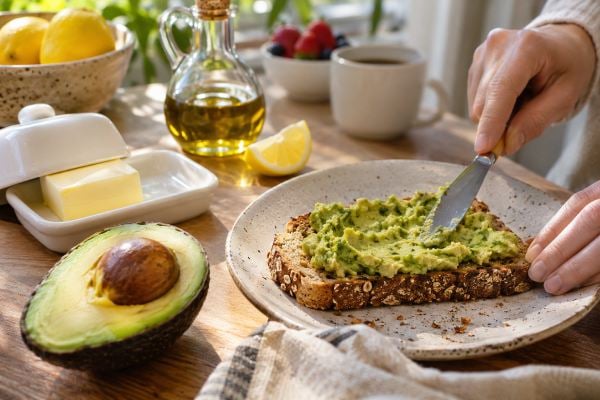
Avocado helps mainly because of food substitution. Most of its fat is unsaturated, particularly monounsaturated fat. Replacing saturated fat with unsaturated fat generally lowers LDL cholesterol. That means avocado spread on whole-grain toast instead of butter has a different cardiovascular effect from adding avocado to a meal that already contains large amounts of cheese, bacon, and creamy sauce.
A typical avocado also contains several grams of fiber. Fiber contributes to fullness and, as part of a high-fiber pattern, can support healthier cholesterol levels. Avocado is not as concentrated in viscous soluble fiber as psyllium, oats, or barley, so it should not be treated as the strongest fiber-based LDL intervention. If you want to emphasize that mechanism, soluble fiber for lowering LDL is a more direct strategy.
Avocados also provide plant sterols in small amounts. Plant sterols reduce intestinal cholesterol absorption, but the quantity in a normal avocado serving is far below the roughly 2 g/day used in many cholesterol-lowering studies of sterol-enriched foods. So the sterol content is a bonus, not the main reason avocado affects lipids.
The takeaway is simple: avocado is useful because its nutrient profile makes it a strong replacement for less heart-friendly fats.
What clinical studies show
Research does not support the claim that everyone who eats avocado will see a large LDL drop. The evidence is more nuanced.
A 2024 systematic review and meta-analysis of avocado consumption found a small reduction in total cholesterol overall. In subgroup analysis, people with high cholesterol had an LDL reduction of roughly 9 mg/dL, while people with normal cholesterol did not show a clear LDL change. The authors rated the certainty of evidence as low to very low, meaning the estimate may change as better studies are published.
A 2025 dose-response meta-analysis of randomized trials reported an average LDL reduction of about 6 mg/dL with avocado interventions. Another 2025 evidence review found benefits mainly in people with dyslipidemia, but noted inconsistent findings across outcomes and limitations in the available trials. At the same time, another recent meta-analysis found no statistically significant overall change in several cardiovascular risk markers. These differences are a reminder that nutrition trials vary in design, duration, participants, and comparison diets.
One of the largest avocado trials, the Habitual Diet and Avocado Trial, assigned more than 1,000 adults with increased waist circumference to eat one avocado per day or continue their habitual diet for six months. It did not reduce visceral fat, the study’s primary outcome. Secondary cardiovascular markers changed only modestly. That matters because a large, real-world trial can produce smaller effects than short, tightly controlled feeding studies.
So does avocado lower LDL? It can, especially when it replaces saturated-fat foods and in people who start with elevated cholesterol, but the average effect is modest and not guaranteed.
For someone with clearly high LDL, the most effective nutrition strategy usually combines several changes rather than relying on one “superfood.” That may include more soluble fiber, nuts, legumes, whole grains, vegetables, and unsaturated oils; less saturated fat; and, when needed, cholesterol-lowering medication. See high LDL cholesterol causes and treatment for the broader picture.
How much avocado to eat
You do not need a whole avocado every day to build a heart-healthy diet. For many adults, 1/3 to 1/2 of a medium avocado is a practical serving. That provides enough volume to replace another spread, topping, or ingredient without adding a large calorie load.
One medium avocado commonly contains around 240 calories, though size varies. A half avocado therefore often provides roughly 120 calories. Because avocados are calorie-dense, the best portion depends on your energy needs and what else is in the meal.
Some clinical trials have used one avocado per day. That does not mean one whole avocado is a required dose for cholesterol reduction. Trials use standardized interventions to test a question; daily life should focus on the overall diet.
A useful rule is: match the portion to the food you are replacing. If you normally use 1–2 tablespoons of mayonnaise, a few slices of avocado may be enough. If avocado is the primary fat source in a grain-and-bean bowl, half an avocado may be reasonable.
More is not necessarily better. Adding two avocados to an already calorie-rich meal does not create a stronger heart benefit. It may simply increase energy intake.
What to replace with avocado
Avocado is most useful when it pushes saturated fat or refined ingredients out of the meal.
| Instead of | Try | Why it can help |
|---|---|---|
| Butter on toast | Mashed avocado | Replaces saturated fat with mostly unsaturated fat |
| Mayonnaise-heavy sandwich | Avocado plus mustard or yogurt | Adds fiber and reduces reliance on saturated fat |
| Large cheese topping | Smaller cheese portion plus avocado | Can reduce total saturated fat while keeping richness |
| Creamy dip | Guacamole with vegetables | Provides unsaturated fat and more produce |
| Processed-meat breakfast | Avocado, beans, tomato, and egg | Shifts the meal toward minimally processed foods |
The replacement concept explains why two people can eat the same amount of avocado and get different results. Person A replaces butter, cheese, and processed meat with avocado, olive oil, beans, and vegetables. Person B adds avocado to bacon cheeseburgers without changing anything else. Their overall saturated-fat intake and calorie balance remain very different.
If you track saturated fat, read the whole day rather than focusing on one meal. Butter, coconut oil, fatty red meat, processed meat, full-fat dairy, pastries, and many restaurant foods can all contribute. For practical comparisons, butter, saturated fat, and LDL explains why the type of fat matters.
Calories, weight, and triglycerides
Avocados are high in fat and therefore high in calories per gram, but that does not automatically make them “fattening.” Body weight changes mainly according to long-term energy balance. A food can be calorie-dense and still fit a weight-maintenance or weight-loss plan if portions and substitutions are appropriate.
The large six-month avocado trial did not show that one avocado per day reduced visceral abdominal fat, but it also did not demonstrate a large harmful weight effect. Participants appeared to incorporate the food into their existing diet rather than simply adding all of its calories on top.
If your goal is weight loss, the simplest strategy is to budget avocado as a fat source. For example, use avocado instead of cheese and mayonnaise, not in addition to both. A salad with vegetables, beans, chicken or fish, and avocado may need little or no additional oil-based dressing.
Triglyceride results in avocado studies are inconsistent and usually not dramatic. High triglycerides respond more strongly to reducing excess alcohol, added sugar, refined carbohydrate, and excess calories; improving diabetes control; losing weight when appropriate; and increasing physical activity. Avocado can fit that plan, but it is not a specific triglyceride treatment.
The same caution applies to HDL cholesterol. Raising HDL is not a primary treatment target in the same way lowering LDL is. A diet should be judged by its effect on overall cardiovascular risk, not by whether it boosts the “good cholesterol” number.
Easy heart-healthy ways to use it
Avocado works well because it can replace creamy textures without requiring special recipes.
For breakfast, spread 1/3 to 1/2 avocado on whole-grain toast and add tomato, pepper, and an egg. Keep salt modest, especially if blood pressure is also a concern.
For lunch, add avocado to a bean or lentil bowl with leafy greens, chopped vegetables, and a whole grain. The combination supplies unsaturated fat, fiber, and plant protein. A simple squeeze of lime or lemon can replace part of a salty bottled dressing.
For dinner, use avocado with fish tacos, black-bean tacos, or a grain bowl. If you are already using cheese or sour cream, reduce those portions rather than piling every topping on at once.
A basic guacamole can be heart-friendly: avocado, lime, tomato, onion, cilantro, and jalapeño. Salt lightly. The main nutritional problem is often not guacamole itself but the amount of salty chips eaten with it. Pairing it with sliced peppers, carrots, cucumbers, or a modest portion of whole-grain crackers changes the snack.
Avocado can also blend into sauces. Puree it with herbs, lemon, plain yogurt, or water to make a creamy dressing. That can reduce saturated fat compared with cream-based sauces while keeping texture and flavor.
Oxidation turns cut avocado brown quickly. Lemon or lime juice slows browning, and pressing reusable wrap or another airtight barrier directly against the surface reduces air exposure. Browning is mostly a quality issue, not a sign that the avocado suddenly becomes unsafe.
When avocado is not enough
Food changes are valuable, but LDL level and cardiovascular risk determine how aggressive treatment needs to be. People with very high LDL, familial hypercholesterolemia, established cardiovascular disease, diabetes, chronic kidney disease, or a high calculated risk may need medication even with an excellent diet.
A common mistake is delaying effective treatment while trying one food or supplement after another. If LDL is markedly elevated, ask your clinician what target is appropriate and when to repeat testing after a dietary change. Many diet-related lipid changes become measurable within about 4–12 weeks.
Avocado also does not cancel out a high-saturated-fat diet. The most useful pattern combines several evidence-based changes: more vegetables, fruits, legumes, whole grains, nuts, seeds, fish, and liquid plant oils; less processed meat, butter, high-fat dairy, and heavily refined foods. That is consistent with major cardiovascular dietary guidance.
People with a latex allergy can occasionally have cross-reactivity to avocado. Those taking warfarin do not generally need to avoid avocado, but they should keep vitamin K intake consistent overall and follow their anticoagulation team’s advice. Avocado contains some vitamin K, though typically less than dark leafy greens.
For most people, avocado is best viewed as a high-quality fat source, not a cholesterol medicine. Use it to make the rest of the meal better. If that swap becomes routine, it can contribute to meaningful long-term LDL control.
A useful way to test whether avocado is helping your cholesterol plan is to ask what changed because you started eating it. If breakfast used to be buttered toast and is now whole-grain toast with avocado and tomato, that is a meaningful substitution. If the avocado simply became an extra topping on a meal that still contains the same butter, cheese, and processed meat, the expected LDL effect is much smaller.
This substitution principle matters because saturated fat has a stronger and more predictable effect on LDL than most individual “heart-healthy” foods have in the opposite direction. Replacing 100 calories of butter with 100 calories of avocado changes the fatty-acid pattern substantially. Replacing 100 calories of fruit or beans with avocado does not necessarily improve the meal in the same way.
It also helps to distinguish LDL lowering from cardiovascular risk lowering. LDL is an important causal risk factor, but the overall diet also affects blood pressure, glucose control, body weight, inflammation, and nutrient adequacy. Avocado contributes potassium and fiber, and it can make vegetable-heavy meals more satisfying. Those features may improve the whole pattern even when the LDL change is small.
If you are monitoring cholesterol, avoid overreacting to tiny differences between tests. LDL can vary from one measurement to another because of normal biological variation, recent illness, weight change, laboratory conditions, and fasting status. A 3 mg/dL change after two weeks of avocado is not strong evidence of an effect. A larger shift after 6–12 weeks of consistent dietary changes is more informative.
For people who want a more aggressive food-based approach, combine avocado with high-impact LDL strategies rather than using it alone. A breakfast of oats with berries and nuts, a lunch built around beans and vegetables, and a dinner using olive oil, fish, whole grains, and avocado addresses several mechanisms at once. Reducing butter, coconut oil, fatty meat, and high-fat dairy at the same time makes the plan much stronger.
Cost can be another practical issue. Avocados are relatively expensive in some regions and spoil quickly. They are optional, not essential. Olive oil, canola oil, nuts, seeds, peanut butter, and other unsaturated-fat foods can fill a similar role. No one needs to buy avocados to have a heart-healthy diet.
Ripeness affects usability but not the basic heart-health message. A ripe avocado should yield slightly to gentle pressure. If several ripen at once, refrigerate them to slow further softening. Frozen avocado chunks can work in smoothies or sauces, though texture after thawing is usually softer than fresh slices.
People sometimes worry that the fat content makes avocado inappropriate for high cholesterol. The type of fat matters more than the simple fact that a food contains fat. Unsaturated fats are generally preferred to saturated fats, and low-fat products are not automatically healthier if they are high in refined starch or added sugar.
At the same time, avocado should not be used to justify an extremely high-fat diet. Total energy intake still matters for body weight, and body-weight gain can worsen triglycerides, blood pressure, insulin resistance, and other risk factors. A moderate portion that replaces a less favorable fat is the simplest strategy.
If your LDL is only mildly elevated, dietary changes may produce a noticeable improvement. If LDL is very high—especially around 190 mg/dL or higher—genetic causes become more likely and medication is often recommended regardless of lifestyle. In that situation, avocado can still be part of the diet, but it should not delay appropriate treatment.
For meal planning, one more useful rule is to balance avocado with other calorie-dense healthy foods. A bowl that contains avocado, nuts, seeds, olive oil, and a large portion of cheese can become very high in calories even though several ingredients have favorable nutrient profiles. Choose one or two main fat sources per meal and let vegetables, legumes, fruit, and whole grains provide most of the volume. That keeps the dietary pattern heart-supportive without turning “healthy fats” into unlimited fats.
References
- Is avocado beneficial for lipid profiles? An umbrella review of systematic reviews and meta-analyses 2025 (Umbrella Review)
- Exploring the effect of avocado on lipid profile modulation: a systematic review and dose-response and meta-analysis of clinical trials 2025 (Systematic Review)
- Avocado Consumption and Cardiometabolic Health: A Systematic Review and Meta-Analysis 2023 (Systematic Review)
- Effect of Incorporating 1 Avocado Per Day Versus Habitual Diet on Visceral Adiposity: A Randomized Trial 2022 (RCT)
- 2021 Dietary Guidance to Improve Cardiovascular Health: A Scientific Statement From the American Heart Association 2021 (Scientific Statement)
Disclaimer
This article is for general education and does not replace medical advice. If your LDL is very high or you have known cardiovascular disease, diabetes, kidney disease, or a strong family history of early heart disease, discuss cholesterol targets and treatment with your clinician rather than relying on food changes alone.