Butter is not a heart-health “poison,” but it is a concentrated source of saturated fat, and eating a lot of it can raise LDL cholesterol. That matters because long-term exposure to LDL-containing particles contributes to atherosclerosis. The most useful question is not whether butter is absolutely good or bad; it is what amount you eat, what your LDL and overall cardiovascular risk are, and what you use instead. Replacing butter with unsaturated fats such as olive oil, canola oil, nuts, seeds, or avocado generally produces a more favorable cholesterol profile. Replacing it with refined carbohydrates or sugary foods offers much less benefit. An occasional small amount of butter can fit into a heart-supportive diet for many people, especially when the rest of the diet is rich in vegetables, legumes, whole grains, fruit, fish, and unsaturated fats. People with high LDL cholesterol, familial hypercholesterolemia, or established cardiovascular disease usually have more reason to limit butter and other major sources of saturated fat.
Table of Contents
- Why Butter Can Raise LDL Cholesterol
- How Much Saturated Fat Is in Butter?
- What You Replace Butter With Matters
- Butter vs Olive Oil, Margarine, Ghee, and Other Fats
- Who Should Limit Butter Most?
- Practical Ways to Use Less Butter Without Losing Flavor
- The Bottom Line on Butter and Heart Health
Why Butter Can Raise LDL Cholesterol
Butter is rich in saturated fatty acids. When saturated fat replaces unsaturated fat in the diet, LDL cholesterol commonly rises. LDL is not just a number associated with heart disease; LDL-containing particles can enter the artery wall, contribute to plaque formation, and drive atherosclerotic cardiovascular disease over time.
The size of the LDL response varies from person to person. Genetics, baseline cholesterol, body weight, metabolic health, total calorie intake, and the rest of the diet all matter. Some people see only a modest change when they add more saturated fat; others see a much larger rise.
That does not make the biology irrelevant. If your LDL increases from 100 to 140 mg/dL after a high-saturated-fat diet, the fact that someone else responds less strongly does not protect your arteries. The useful approach is to look at your own lipid response and your lifetime cardiovascular risk.
If you are unsure what your numbers mean, a guide to cholesterol levels and target ranges can help place LDL in context. People at high cardiovascular risk often need lower LDL levels than people at low risk.
LDL is part of a larger particle picture
LDL cholesterol estimates the amount of cholesterol carried within LDL particles. Apolipoprotein B, or ApoB, measures the number of atherogenic particles more directly because each LDL, VLDL remnant, and similar particle contains one ApoB molecule. In people with high triglycerides, diabetes, or metabolic syndrome, LDL cholesterol and particle number can sometimes be discordant.
That does not mean everyone needs an ApoB test. But if risk and LDL results do not seem to match, ApoB testing compared with LDL can explain why a clinician may order it.
Butter’s main cardiovascular concern is therefore not that it is a “processed toxin” or that one serving acutely clogs an artery. The concern is cumulative exposure: a dietary pattern high in saturated fat can maintain higher LDL or ApoB for years. Cardiovascular risk builds from that long-term exposure together with blood pressure, smoking, diabetes, age, genetics, and other factors.
How Much Saturated Fat Is in Butter?
One tablespoon of butter weighs about 14 grams and provides roughly 100 calories and 7 grams of saturated fat. A teaspoon contains about one-third of that amount. Those numbers make butter easy to underestimate because a generous spread on toast, a pat used in cooking, and butter in baked goods can add up quickly.
Many dietary guidelines advise keeping saturated fat below about 10% of total calories, while some heart-focused plans use lower targets for people who need substantial LDL reduction. On a 2,000-calorie diet, 10% of calories from saturated fat equals about 22 grams per day. One tablespoon of butter can therefore use close to one-third of that amount.
That does not mean everyone must count grams. It does show why portions matter.
Consider two patterns:
- A teaspoon of butter on vegetables at dinner, with most other fats coming from olive oil, nuts, seeds, fish, and avocado.
- Two tablespoons of butter at breakfast, cheese at lunch, fatty processed meat at dinner, and pastries made with butter.
Both include butter, but the second pattern creates a much larger saturated-fat load.
Saturated fat comes from more than butter
Common sources include fatty red meat, processed meat, cheese, cream, full-fat dairy, coconut oil, palm oil, baked goods, and some restaurant foods. A person who removes butter but replaces it with large amounts of coconut oil may not reduce saturated fat much at all.
This is why food tracking for a few days can be useful when LDL remains high. You may discover that butter is a minor contributor, or you may find that it appears in breakfast, cooking, sauces, and snacks throughout the day.
For people trying to lower LDL efficiently, focusing on the biggest sources gives more benefit than obsessing over trace amounts. A guide to foods that help lower high cholesterol can provide more high-impact swaps.
What You Replace Butter With Matters
The cardiovascular effect of eating less butter depends heavily on the replacement. Nutrition studies can be misleading if they compare “more saturated fat” with “less saturated fat” without asking what fills the missing calories.
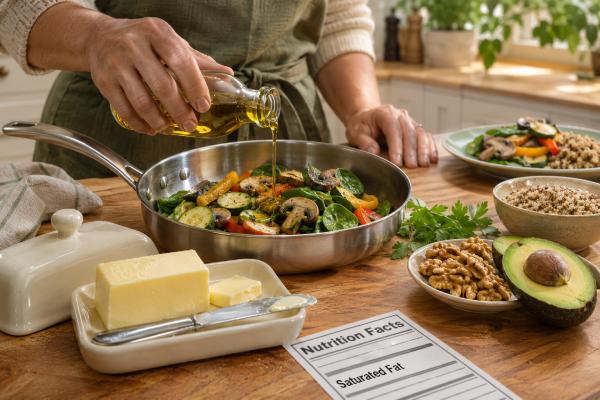
Replacing saturated fat with polyunsaturated or monounsaturated fats generally lowers LDL cholesterol and improves the lipid profile. Good replacements include:
- Extra-virgin olive oil.
- Canola oil.
- Nuts and nut butters without added hydrogenated fat.
- Seeds such as chia, flax, sunflower, or sesame.
- Avocado.
- Fish, particularly when it replaces fatty or processed meat.
Replacing butter with refined starch or added sugar is much less helpful. White bread, pastries, sweets, and sugary cereal may not raise LDL in the same way, but they can worsen triglycerides, glycemic control, and overall diet quality.
Think in food swaps, not nutrient subtraction
Instead of saying “eat less saturated fat,” use a concrete substitution:
- Cook vegetables in olive oil instead of butter most days.
- Spread avocado or nut butter on whole-grain toast instead of a thick layer of butter.
- Use olive oil and vinegar for salad dressing instead of a cream-based dressing.
- Replace a butter-heavy pastry breakfast with oats, berries, nuts, and plain yogurt.
- Choose fish or beans in place of a fatty meat meal a few times each week.
These changes do more than lower saturated fat. They add fiber, unsaturated fat, minerals, and plant compounds that support cardiovascular health.
Avocado is one example of a food that can replace saturated fat while providing unsaturated fat and fiber; see avocados and LDL cholesterol for the evidence and practical portions.
The whole dietary pattern wins
A Mediterranean-style pattern naturally makes butter a smaller player without requiring a ban. Olive oil becomes the main cooking fat; nuts, seeds, legumes, fish, whole grains, vegetables, and fruit make up more of the plate. Butter can remain an occasional flavoring rather than the default fat at every meal.
This approach is usually easier to sustain than a rule that labels individual foods as forbidden. It also avoids the common error of replacing butter with highly processed low-fat products that contain large amounts of refined carbohydrate.
Butter vs Olive Oil, Margarine, Ghee, and Other Fats
Not all fats have the same effect on LDL cholesterol, and not every product within a category is identical.
| Fat | Main fat pattern | Heart-health takeaway |
|---|---|---|
| Butter | High in saturated fat | Best used in modest amounts, especially if LDL is high |
| Extra-virgin olive oil | Mostly monounsaturated fat | Strong everyday replacement for butter |
| Canola oil | Mostly unsaturated fat | Useful neutral-flavor cooking oil |
| Soft tub margarine | Usually more unsaturated fat | Can be a good option when low in saturated fat and free of partially hydrogenated oils |
| Ghee | High in saturated fat | Not a heart-health upgrade over butter simply because milk solids are removed |
| Coconut oil | Very high in saturated fat | Usually raises LDL more than liquid unsaturated oils |
Olive oil vs butter
Randomized feeding studies show a more favorable LDL response with olive oil than butter. Extra-virgin olive oil also contains polyphenols and fits naturally into Mediterranean dietary patterns with strong cardiovascular evidence.
That does not mean olive oil is calorie-free. One tablespoon has roughly the same calorie density as butter. If weight loss is a goal, pouring unlimited oil can slow progress. The advantage is the type of fat, not permission to ignore portions.
Margarine is not the product it was decades ago
Older margarines sometimes contained substantial industrial trans fat from partially hydrogenated oils. Those fats are particularly harmful for cardiovascular risk. Modern soft margarines in many markets are formulated differently and can be rich in unsaturated fats.
Read the label rather than judging by the word “margarine.” Favor products with low saturated fat and no partially hydrogenated oil. Very hard stick products may contain more saturated fat than soft tub spreads.
Ghee is still a saturated-fat source
Ghee is clarified butter with water and milk solids largely removed. It can have culinary advantages, including a higher smoke point and a distinctive flavor, but it does not become cardioprotective through clarification. It remains rich in saturated fat and should be treated similarly to butter when LDL reduction is a priority.
“Grass-fed” does not cancel the saturated fat
Grass-fed butter may have a somewhat different fatty-acid profile and small differences in certain nutrients, but it remains a concentrated saturated-fat food. If your LDL rises on regular butter, switching to grass-fed butter is unlikely to solve the core issue.
Who Should Limit Butter Most?
The stricter your LDL goal, the more worthwhile it is to make unsaturated fats your default. This is especially important for people with:
- Established coronary artery disease, prior heart attack, ischemic stroke, or peripheral artery disease.
- Familial hypercholesterolemia or another inherited high-LDL disorder.
- Persistently high LDL despite other lifestyle changes.
- Diabetes or chronic kidney disease with elevated cardiovascular risk.
- A high coronary artery calcium score or other evidence of atherosclerosis.
- Multiple major risk factors such as smoking and high blood pressure.
For a person with very high LDL or known cardiovascular disease, “I only use natural butter” is not a reassuring argument. The artery responds to the particle burden, not to whether the fat came from a minimally processed food.
If LDL reduction is a major goal, foods that can help lower LDL are most effective when they replace saturated-fat-rich foods rather than simply being added on top of the same diet.
What if your cholesterol is excellent?
A low-risk person with favorable LDL, blood pressure, glucose, weight, activity, and family history can usually fit modest butter intake into an otherwise high-quality diet. The point is not to create fear around a teaspoon of butter.
But “my numbers are normal” should be interpreted in context. Cholesterol risk is continuous rather than divided into perfectly safe and dangerous zones. If a diet is very high in saturated fat, checking lipids after several months can show how your body responds.
What if butter is one of your favorite foods?
You do not necessarily need to eliminate it. Use it where you notice it most. A teaspoon melted onto fresh corn may provide more satisfaction than a tablespoon hidden in a pan for cooking. Using olive oil for routine sautéing and reserving butter for flavor can dramatically cut saturated fat without making meals feel deprived.
This is a useful general nutrition principle: reduce the ingredient where it contributes little pleasure and keep a small amount where it contributes a lot.
Practical Ways to Use Less Butter Without Losing Flavor
A heart-supportive plan works better when it survives real cooking. Try changes that keep texture and flavor rather than simply making food dry.
For sautéing and roasting
Use olive or canola oil. Garlic, herbs, pepper, smoked paprika, lemon, vinegar, and chili can add flavor that does not depend on a heavy butter coating.
On bread and toast
Try avocado, hummus, natural peanut or almond butter, or a thin layer of butter rather than a thick one. Choosing whole grains for heart health adds fiber and makes the overall meal more favorable than focusing on the spread alone.
In mashed potatoes and vegetables
Use a smaller amount of butter and add plain yogurt, olive oil, roasted garlic, herbs, or a splash of milk for texture. The goal is not to make every dish fat-free.
In baking
Some recipes tolerate partial replacement with unsaturated oil, yogurt, fruit puree, or nut butter, but baking chemistry varies. If a dessert is occasional, a small butter-containing portion may be more realistic than trying to turn every pastry into a health food.
At restaurants
Butter can appear in sauces, grilled foods, mashed potatoes, bread baskets, and finishing glazes. If LDL is high and you eat out often, ask for vegetables or fish prepared with olive oil and request sauces on the side. You do not need to interrogate every ingredient; target frequent, high-volume sources.
Make your default fat visible
Keep olive oil near the stove and put butter away rather than making it the first thing you reach for. Small environmental changes reduce the need for willpower. If butter is still used for a particular dish, measure a teaspoon or tablespoon occasionally so your visual estimate stays realistic.
The Bottom Line on Butter and Heart Health
Butter can raise LDL cholesterol because it is high in saturated fat. For heart health, the strongest practical move is to replace much of it with unsaturated fats rather than to fear every small serving.
A useful decision depends on three questions:
- How much butter and other saturated fat do you actually eat? One teaspoon a day is a different exposure from several tablespoons plus cheese, cream, and fatty meat.
- What are your LDL, ApoB if measured, and overall cardiovascular risk? Higher-risk people benefit more from aggressive LDL reduction.
- What will replace the butter? Olive oil, nuts, seeds, avocado, and fish generally improve the fat profile; refined carbohydrates do not provide the same advantage.
If your LDL is above goal, try a six- to 12-week period in which liquid unsaturated oils become the main cooking fats, butter portions are reduced, soluble fiber increases, and highly processed foods decrease. Then repeat lipids at the interval your clinician recommends. That turns a nutrition debate into a personal experiment with an objective result.
Do not lose sight of the larger cardiovascular picture. Smoking, high blood pressure, diabetes, inactivity, poor sleep, and untreated very high LDL can carry far more risk than an occasional pat of butter. At the same time, diet is one of the exposures you repeat every day, so small substitutions accumulate over years.
The most accurate answer to “Is butter bad for your heart?” is therefore nuanced but actionable: butter is a saturated-fat-rich food that tends to raise LDL compared with unsaturated oils. Small amounts can fit for many people, but making butter the main dietary fat is not the best choice for cardiovascular prevention—especially when LDL is already high.
References
- Saturated Fat Intake and the Prevention and Management of Cardiovascular Disease in Adults: An Academy of Nutrition and Dietetics Evidence-Based Nutrition Practice Guideline 2023 (Guideline)
- Effect of reducing saturated fat intake on cardiovascular disease in adults: an umbrella review. 2024 (Umbrella Review)
- The effects of extra virgin olive oil or butter on cardiovascular biomarkers in European and Chinese males in the UK: A pilot randomised crossover trial. 2025 (RCT)
- Dietary intake, biomarkers and supplementation of fatty acids and risk of coronary events: a systematic review and dose-response meta-analysis of randomized controlled trials and prospective observational studies 2024 (Systematic Review and Meta-Analysis)
- Cardiometabolic benefits of replacing saturated fatty acids with unsaturated fatty acids. 2026 (Review)
Disclaimer
This article provides general nutrition information and is not a personalized cholesterol or cardiovascular treatment plan. LDL goals and the appropriate degree of saturated-fat restriction depend on overall cardiovascular risk, medical history, and medications. If you have familial hypercholesterolemia, established cardiovascular disease, or very high LDL, discuss diet and lipid-lowering treatment with your clinician.