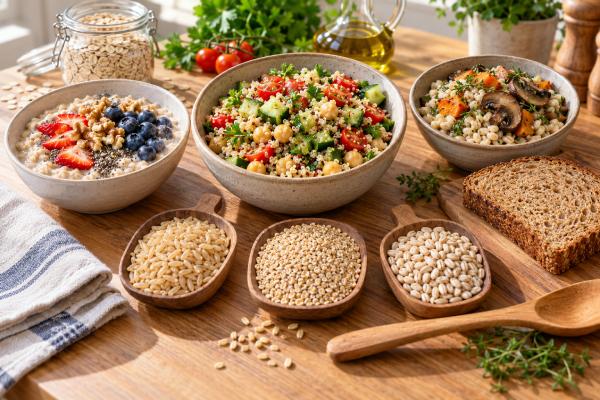
Whole grains are a practical heart-health upgrade because they keep the fiber-rich bran and nutrient-rich germ that refined grains largely lose during processing. Eating more whole grains is associated with lower cardiovascular risk, and randomized-trial evidence suggests they can modestly improve LDL cholesterol, blood pressure, blood sugar, and other cardiometabolic markers. You do not need specialty foods or a grain-heavy diet to benefit. Oats at breakfast, whole-grain bread at lunch, barley in soup, or brown rice with dinner can all count.
The most useful approach is replacement rather than addition: swap some refined grains for intact or minimally processed whole grains while keeping portions appropriate for your energy needs. Product labels matter, because brown color, “multigrain,” and “made with whole grain” do not guarantee that a food is mostly whole grain. The best choices combine genuine whole-grain ingredients with useful fiber and modest amounts of sodium, added sugar, and saturated fat.
Table of Contents
- Why whole grains help the heart
- Best whole grains for heart health
- How much whole grain to eat
- How to read labels and avoid grain traps
- Easy ways to add whole grains daily
- Special situations and common questions
- A simple heart-healthy whole-grain plan
Why whole grains help the heart
Whole grains support cardiovascular health through several small effects that add up over time. A whole grain contains the bran, germ, and endosperm in roughly their natural proportions. Refined grain processing removes much of the bran and germ, which lowers fiber and reduces some vitamins, minerals, antioxidants, and other plant compounds.
The strongest long-term evidence comes from large prospective studies. A 2023 dose-response meta-analysis found that each additional 30 g per day of whole grains was associated with lower risks of coronary heart disease, overall cardiovascular disease, and all-cause mortality. Observational evidence cannot prove that whole grains alone caused those benefits, because people who eat more whole grains often have other healthy habits. However, controlled trials help explain why the association is biologically plausible.
A 2026 meta-analysis of randomized trials reported that higher whole-grain intake improved several cardiometabolic risk markers, including modest reductions in LDL cholesterol, triglycerides, fasting glucose, body weight, and systolic blood pressure. The average changes were not dramatic, which is important: whole grains are not a substitute for blood-pressure medicine, cholesterol treatment, or other indicated care. They are one dietary tool that can improve the overall risk profile.
Fiber is a major reason. Soluble fibers, especially beta-glucan in oats and barley, can reduce intestinal reabsorption of bile acids. The liver then uses more cholesterol to make new bile acids, which can help lower circulating LDL. If LDL reduction is a main goal, soluble fiber intake deserves attention along with total whole-grain intake.
Whole grains can also slow digestion compared with many refined grain foods, support a healthier gut microbiome, and make meals more filling. Replacing white bread, refined crackers, sugary cereal, or large portions of white rice with higher-fiber whole-grain options may improve meal quality without requiring a completely different cuisine.
Best whole grains for heart health
There is no single “best” grain for everyone. Oats and barley stand out when lowering LDL is a priority because they contain beta-glucan, while intact grains such as farro, quinoa, bulgur, and brown rice can add texture, fiber, and variety. The best choice is one you will eat regularly in place of a more refined option.
| Whole grain | Why it is useful | Easy everyday use |
|---|---|---|
| Oats | Rich in beta-glucan soluble fiber | Oatmeal, overnight oats, unsweetened muesli |
| Barley | Also high in beta-glucan; chewy and filling | Soups, grain bowls, side dishes |
| Brown rice | Versatile replacement for white rice | Stir-fries, curries, bean-and-rice meals |
| Quinoa | Whole-grain-like seed with fiber and relatively high protein | Salads, bowls, breakfast porridge |
| Bulgur | Quick-cooking whole wheat with a tender texture | Tabbouleh, pilaf, stuffed vegetables |
| Farro | Chewy wheat grain that works well in mixed dishes | Salads, soups, roasted-vegetable bowls |
| Whole rye | Dense, flavorful grain with substantial fiber when truly whole | Rye berries, whole-rye bread, crispbread |
| Whole-grain corn | Counts when the germ and bran remain | Plain popcorn, whole-corn tortillas, polenta labeled whole grain |
Oats deserve special mention because the cholesterol benefit of oat beta-glucan is more specific than the general claim that “fiber is good.” If you want to use oats strategically, oat beta-glucan amounts and qualifying products matter more than whether the package looks wholesome.
Barley offers a similar advantage. Hulled barley retains more of the grain than pearled barley, although pearled barley can still provide substantial beta-glucan even though some outer layers have been removed. For a focused cholesterol strategy, barley and beta-glucan can be used as a regular meal component rather than an occasional side.
Quinoa, buckwheat, and amaranth are technically pseudocereals rather than botanical cereal grains, but nutrition guidance commonly groups them with whole grains because their culinary and nutrient profiles are similar. They can be useful for people who want variety or need gluten-free choices.
The degree of processing also changes how a grain behaves in a meal. An intact wheat berry, oat groat, or barley kernel usually takes longer to chew and digest than flour made from the same grain. That can improve fullness and may blunt the post-meal glucose rise for some people. This does not make whole-grain flour “bad”; whole-wheat bread and pasta are practical, nutritious foods. It simply means intact grains are worth including when you enjoy them.
Do not assume the most exotic grain is the healthiest. Plain oats and brown rice can deliver as much practical value as expensive specialty blends. Variety is useful because different grains contribute different fibers, minerals, textures, and flavors, but consistency matters more than novelty. A grain you can afford, cook easily, and use several times per week is usually a better choice than a premium product that sits untouched in the pantry.
How much whole grain to eat
A practical target is to make at least half of your grain choices whole grain. For someone eating about six grain-ounce equivalents per day, that works out to roughly three whole-grain ounce equivalents. Your exact amount depends on calorie needs, activity level, appetite, and the rest of your diet.
One ounce-equivalent is approximately one slice of bread, 1/2 cup cooked rice, pasta, bulgur, or oatmeal, or about 1 cup of ready-to-eat cereal, although product density varies. Research papers often report grams of whole-grain ingredients rather than household servings, so the numbers are not always directly interchangeable.
The dose-response evidence suggests that benefits rise as whole-grain intake increases from very low levels. The 2023 meta-analysis found lower cardiovascular risk with each 30 g/day increment, while a 2026 randomized-trial meta-analysis found favorable cardiometabolic changes across a range of intakes and larger average effects for several outcomes around 60–100 g/day. That does not mean everyone needs to weigh grains or aim for the highest studied dose. A person moving from nearly zero whole grains to one or two reliable servings a day has already made a meaningful dietary change.
Portion size still matters. A large bowl of granola, several thick slices of bread, or an oversized rice bowl can provide far more calories than expected. Heart health depends on the overall pattern, not unlimited intake of a food just because it is whole grain. Pairing grains with vegetables, beans, fish, yogurt, nuts, or other nutrient-dense foods usually produces a more balanced plate than making grains the entire meal.
If blood pressure is a major concern, the grain choice fits best within a broader pattern such as the DASH diet, where whole grains sit alongside fruits, vegetables, legumes, low-fat dairy, and lower-sodium choices.
How to read labels and avoid grain traps
The ingredient list tells you more than the front of the package. Terms such as “multigrain,” “wheat,” “stone-ground,” “seven-grain,” or “made with whole grain” can appear on foods that still contain mostly refined flour.
Look for a whole-grain ingredient near the top of the list, such as “whole wheat,” “whole rye,” “whole oats,” “brown rice,” or another clearly named whole grain. A product labeled “100% whole wheat” is more straightforward than one that mixes whole and refined flours, but mixed products can still be useful stepping stones.
Fiber on the Nutrition Facts panel is helpful, but it does not prove that a product is whole grain. Manufacturers can add isolated fibers to refined-grain foods. Conversely, some genuine whole-grain foods are not exceptionally high in fiber per serving. Use both the ingredient list and the nutrition panel.
For breads, crackers, and cereals, also check sodium, added sugars, and saturated fat. A whole-grain cookie remains a dessert. Granola can contain substantial added sugar and oil. Savory crackers can be surprisingly salty. A heart-health label check should ask four questions:
- Is a whole grain one of the main ingredients?
- Does the serving provide useful fiber, often at least 3 g when possible?
- Is added sugar modest for the role the food plays in the meal?
- Is sodium reasonable, especially if you have hypertension or eat several packaged foods per day?
Breakfast cereal illustrates the tradeoff well. A cereal can be whole grain yet contain enough added sugar to make it less useful as an everyday staple. Choose a higher-fiber, lower-sugar cereal and add fruit for sweetness. The same logic applies to packaged breads and snack bars.
Whole-grain claims should not distract from the rest of the product. If much of your grain intake comes from packaged snack foods, improving overall food quality may matter as much as switching flour type. Reducing heavily processed foods can make room for simpler grain choices such as oatmeal, plain popcorn, brown rice, or intact cooked grains.
Easy ways to add whole grains daily
The easiest strategy is to attach one whole-grain swap to meals you already eat. You do not need to overhaul every meal at once.
For breakfast, replace a refined cereal, pastry, or white toast with oatmeal, overnight oats, a low-sugar whole-grain cereal, or whole-grain toast. Add berries, banana, chopped nuts, or plain yogurt so the meal is satisfying without relying on added sugar.
At lunch, choose a sandwich bread whose first ingredient is whole grain, or build a bowl with 1/2 to 1 cup of cooked barley, quinoa, farro, or brown rice. Add beans or lentils, vegetables, and a protein source. The combination of grain plus legumes is especially filling; beans and lentils also add soluble fiber and plant protein.
At dinner, use a half-and-half transition if a full swap feels unfamiliar. Mix brown and white rice, or combine whole-wheat and regular pasta. Over several weeks, increase the whole-grain share. This often works better for families than an abrupt texture change.
For snacks, air-popped popcorn is a whole grain. Keep the heart-health advantage by using modest salt and avoiding large amounts of butter or coconut oil. Whole-grain crispbread with hummus, nut butter, or cottage cheese can also work.
Batch cooking makes intact grains more realistic. Cook a large pot of brown rice, barley, farro, or quinoa and refrigerate portions for several days. Most cooked grains also freeze well. Flatten cooled portions in freezer bags or freeze individual containers so they reheat quickly.
A simple rotation can prevent boredom:
- Use oats on two or three mornings each week.
- Keep a whole-grain bread or wrap for quick lunches.
- Cook one intact grain on the weekend for bowls, salads, and sides.
- Keep plain popcorn or whole-grain crispbread for an easy snack.
- Try one unfamiliar grain each month rather than buying several at once.
This approach also reduces waste. A pantry full of “healthy” grains does not help if they are too unfamiliar to use.
Special situations and common questions
Whole grains are appropriate for many people, but the best type and amount can change with medical needs, digestive tolerance, and medication plans.
What if you have high LDL cholesterol?
Prioritize oats and barley because their beta-glucan has direct LDL-lowering evidence. Whole grains help most when they replace lower-fiber refined grains and are part of an overall pattern lower in saturated fat. If you are tracking cholesterol results, understand what LDL, HDL, and triglycerides represent with a clear cholesterol overview rather than judging one food by a single lab value.
What if you have diabetes or prediabetes?
Whole grains can fit well, but “whole grain” does not mean “carbohydrate-free.” Portion size and the total carbohydrate content of the meal still affect glucose. Intact or less finely milled grains often produce a slower glucose rise than highly processed grain products, especially when eaten with protein, healthy fat, and vegetables. Individual responses vary, so home glucose data can help if you monitor it.
What if you need gluten-free foods?
Choose naturally gluten-free whole grains and pseudocereals such as brown rice, quinoa, buckwheat, millet, sorghum, amaranth, and certified gluten-free oats. People with celiac disease should avoid wheat, barley, and rye and should choose oats specifically labeled gluten-free because of cross-contact risk.
Can whole grains cause bloating?
A sudden jump in fiber can cause gas, bloating, or stool changes. Increase intake gradually, drink enough fluid, and spread fiber across the day. If symptoms are persistent, severe, or associated with weight loss, bleeding, anemia, or major bowel changes, seek medical evaluation rather than assuming fiber is the cause.
Are refined grains always harmful?
No. The evidence is clearer that whole grains are beneficial than that every refined grain is independently harmful. Refined grains can fit occasionally, and fortified refined products provide important nutrients. The practical goal is to make whole grains the default more often, not to treat white rice or white bread as toxic.
A simple heart-healthy whole-grain plan
A sustainable plan starts with one repeatable swap and builds from there. If you currently eat few whole grains, aim for one serving daily during the first week, then move toward two or three servings as your meals and digestion adjust.
Here is a realistic day:
- Breakfast: oatmeal cooked with milk or fortified soy milk, topped with berries and walnuts.
- Lunch: turkey, hummus, or bean sandwich on whole-grain bread with vegetables and fruit.
- Snack: plain popcorn or whole-grain crispbread with nut butter.
- Dinner: salmon, tofu, or beans with roasted vegetables and 1/2 to 1 cup cooked barley or brown rice.
You do not need whole grains at every eating occasion. What matters is the pattern across the day and week. If you eat restaurant meals often, use breakfast and home meals to build consistency. If cost is a concern, oats, brown rice, whole-wheat pasta, and popcorn are often cheaper than specialty grains.
Measure success by habits rather than perfection. A good sign is that whole grains become your automatic choice for several common foods, while refined grains become the occasional alternative. Combined with vegetables, fruit, legumes, nuts, healthy fats, and appropriate protein sources, that shift supports the broader dietary pattern associated with better cardiovascular health.
If you are unsure where to begin, keep a three-day food note and circle the grain foods you eat most often. Pick the one that appears most frequently and test two whole-grain alternatives. Compare taste, texture, price, preparation time, and how filling each option feels. This small experiment is more useful than buying a long list of foods based on health claims alone. Once one swap becomes routine, repeat the process with the next most common refined grain.
Whole grains work best as a replacement, not a supplement piled on top of an already adequate diet. Start with the refined grain you eat most often, find a whole-grain version you genuinely like, and repeat that swap until it feels routine. Small changes that survive busy weeks are more valuable than a complicated plan you follow for only a few days.
References
- Whole-grain consumption and cardiometabolic risk: a meta-analysis of randomized trials. 2026 (Meta-Analysis)
- The impact of whole grain consumption on metabolic health: an umbrella review of systematic reviews and meta-analyses of randomized controlled trials 2025 (Systematic Review)
- Whole grain and refined grain consumption and the risk of hypertension: a systematic review and meta-analysis of prospective studies 2025 (Systematic Review)
- Consumption of whole grains and refined grains and associated risk of cardiovascular disease events and all-cause mortality: a systematic review and dose-response meta-analysis of prospective cohort studies 2023 (Meta-Analysis)
- Long-Term Consumption of 10 Food Groups and Cardiovascular Mortality: A Systematic Review and Dose Response Meta-Analysis of Prospective Cohort Studies 2023 (Systematic Review)
Disclaimer
This article provides general nutrition and cardiovascular-health information and is not a substitute for individualized medical or dietetic advice. If you have celiac disease, diabetes, kidney disease, significant digestive symptoms, or a prescribed therapeutic diet, ask your clinician or registered dietitian how whole grains fit your plan. Do not change prescribed heart or blood-pressure treatment based on dietary changes alone.