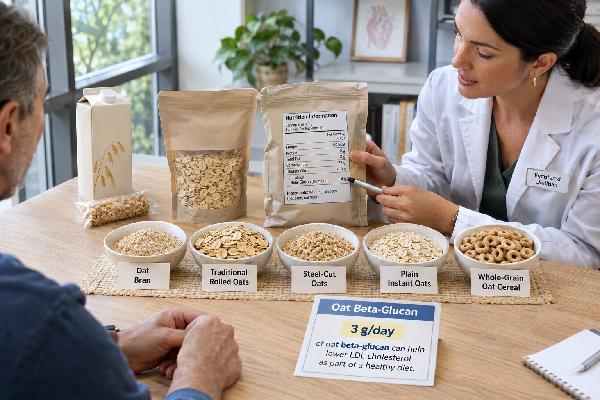
Oat beta-glucan is one of the few food fibers with a well-established cholesterol-lowering dose. About 3 g per day of oat beta-glucan is the practical target most often linked with lower LDL cholesterol, especially when used consistently for several weeks as part of an overall heart-healthy diet. That amount is not the same as 3 g of total fiber. Beta-glucan is a specific soluble fiber concentrated in oats and barley, and different oat foods provide very different amounts.
The most reliable choices are oat bran, rolled oats, steel-cut oats, whole oat flour, and products that state their beta-glucan content. Instant oats can still count, but sugary packets may add ingredients that work against your broader nutrition goals. Oat milk, oat cookies, and snack bars are much less predictable because the amount of actual oat beta-glucan may be low or unstated. The cholesterol effect depends partly on how beta-glucan behaves in the gut: molecular size, solubility, and viscosity matter, so two products with the same “oat” branding may not perform identically.
Table of Contents
- How oat beta-glucan lowers LDL
- How much beta-glucan you need
- Which oat products count
- How processing changes beta-glucan
- How to build a 3-gram day
- Common mistakes and label traps
- When oats are not enough
How oat beta-glucan lowers LDL
Beta-glucan is a soluble, gel-forming fiber found in the cell walls of oats and barley. When enough of it dissolves in the digestive tract, it increases the viscosity of intestinal contents. That thicker environment changes how bile acids and cholesterol move through the gut.
Bile acids are made from cholesterol and released into the intestine to help digest fat. Much of that bile is normally reabsorbed and recycled. Viscous soluble fiber can increase bile-acid loss in stool. The liver then needs to pull more cholesterol from the bloodstream to make replacement bile acids, which can increase LDL-receptor activity and lower circulating LDL cholesterol.
Fermentation in the colon may also contribute. Gut bacteria break down some beta-glucan and produce short-chain fatty acids, which can influence cholesterol metabolism. The viscosity mechanism, however, appears to be central to the LDL effect.
Randomized-trial evidence supports a modest but real reduction. A 2022 meta-analysis in adults with high cholesterol found that oat beta-glucan lowered LDL by about 0.27 mmol/L, roughly 10 mg/dL, on average. Earlier meta-analysis of trials using at least 3 g/day found a similar reduction of about 0.25 mmol/L. A 2023 review found that both whole oats and isolated beta-glucan improved lipid profiles.
The effect is meaningful but should be put in context. A reduction of around 5% to 10% can help, especially when combined with other dietary changes, but it is not equivalent to the LDL lowering expected from a statin or potent nonstatin medication in someone at high cardiovascular risk.
Beta-glucan also tends to lower total and non-HDL cholesterol without meaningfully lowering HDL. If you want the bigger picture on soluble fiber, soluble fiber for cholesterol explains how oats compare with psyllium, legumes, fruit, and other sources.
How much beta-glucan you need
A daily target of about 3 g of oat beta-glucan is the best-supported practical benchmark. U.S. food-labeling rules for the heart-disease health claim involving soluble fiber from oats and barley are built around a daily intake of 3 g or more of beta-glucan soluble fiber.
That does not mean benefits suddenly begin at exactly 3.00 g. Fiber effects exist on a continuum. The 3 g figure is useful because it is a studied and regulatory benchmark that is achievable with food.
The key distinction is beta-glucan grams versus total fiber grams. A bowl containing 4 g of total dietary fiber does not necessarily contain 4 g of beta-glucan. Total fiber also includes insoluble fiber and other soluble fibers.
Oat beta-glucan content varies by cultivar and product, but whole oat foods commonly contain several grams of beta-glucan per 100 g dry weight. A normal bowl of cooked oatmeal often supplies around 1 to 2 g, depending on the dry amount used. That means one modest serving may not reach the 3 g target by itself.
This is why a practical strategy often uses either:
- a larger oat serving;
- oat bran, which is relatively concentrated;
- oats at more than one meal;
- or an oat food with a declared beta-glucan amount.
Consistency matters more than taking a large amount once or twice per week. Cholesterol metabolism responds to the repeated presence of viscous fiber in the diet. Most clinical trials last several weeks, so it is reasonable to assess the effect after a sustained routine rather than after a few breakfasts.
If you are using oats as part of a plan to lower LDL, combine them with other evidence-based changes such as replacing saturated fat with unsaturated fat. Saturated versus unsaturated fat is often a larger driver of LDL than whether you choose one oat format over another.
Which oat products count
Whole oat products are the most dependable starting point. The FDA’s authorized health-claim framework specifically recognizes whole oat sources such as oat bran, rolled oats, and whole oat flour when they provide qualifying amounts of beta-glucan soluble fiber.
| Oat product | Does it count? | Practical note |
|---|---|---|
| Steel-cut oats | Yes | Whole oat groats cut into pieces; beta-glucan remains present |
| Rolled oats | Yes | Convenient and well suited to daily use |
| Quick or instant plain oats | Yes | More processed but still an oat source; check added ingredients |
| Oat bran | Yes | Often more concentrated in beta-glucan per serving |
| Whole oat flour | Yes | Can count when used in meaningful amounts |
| Oat milk | Maybe | Depends on oat content and processing; beta-glucan is often not listed |
| Oat snack bars or cookies | Maybe | Oats may be a minor ingredient; added sugar and saturated fat can be high |
| Purified oat beta-glucan ingredient | Potentially | Look for a stated dose and reputable product quality |
Steel-cut oats are not inherently more cholesterol-lowering than rolled oats simply because they look less processed. Rolled oats are steamed and flattened, but they still contain beta-glucan. Quick oats are cut and rolled thinner, which shortens cooking time. The more important issues are the amount of beta-glucan, its molecular properties, and what else is added to the food.
Oat bran can be especially useful when someone wants to reach 3 g without eating a very large bowl of oatmeal. It can be stirred into hot cereal, yogurt, pancake batter, soups, or baked foods.
Oat milk is less reliable as a therapeutic beta-glucan source. Some brands retain useful soluble fiber, while others are heavily filtered or diluted. Unless the label states beta-glucan content or makes a qualifying soluble-fiber claim, do not assume one glass contributes the same amount as a bowl of oats.
How processing changes beta-glucan
Beta-glucan works partly because it forms a viscous solution. Its molecular weight, solubility, concentration, and how easily it is released from the food matrix influence that viscosity. Processing can change all of these characteristics.
This does not mean “processed oats are bad.” Kilning, steaming, rolling, and cooking are normal parts of making oats edible and stable. In some cases, processing increases beta-glucan extractability. The issue is that intense mechanical, enzymatic, fermentation, or thermal processing can reduce molecular size enough to decrease viscosity.
A 2024 review of oat beta-glucan emphasized that processing conditions can alter molecular weight and functional behavior. A 2026 review similarly described beta-glucan as a continuum: higher-molecular-weight fractions tend to create greater viscosity, while lower-molecular-weight fractions may behave differently in the gut.
For a shopper, you generally cannot measure molecular weight from the package. The practical workaround is to prioritize recognizable whole oat foods or products specifically standardized for beta-glucan. Do not pay a premium simply because a package says “oat fiber” if it does not state what kind of fiber or how much beta-glucan is present.
Cooking ordinary oatmeal does not destroy its heart-health value. Overnight oats, microwaved oats, stovetop oats, and baked oat dishes can all contribute. What matters more is whether the portion contains enough oats and whether excessive added sugar or saturated fat changes the overall nutritional profile.
Texture can provide a rough clue but not a guarantee. A thicker, more viscous oat cereal often reflects soluble fiber behavior, yet recipes, starch, temperature, and other ingredients also affect thickness. You cannot accurately estimate beta-glucan dose from how gummy a food feels.
How to build a 3-gram day
Because exact beta-glucan content varies, use a package value when available. If it is not listed, treat the following as practical patterns rather than exact calculations.
One approach is a generous bowl of oats at breakfast plus a smaller oat contribution later in the day. Another is to use oat bran to concentrate the amount. You can also combine oats with barley, which contains a similar cholesterol-lowering beta-glucan, although the regulatory and research literature sometimes discusses them together and sometimes separately.
A simple day could look like:
- Breakfast: oatmeal made from a substantial dry-oat portion, topped with berries and walnuts.
- Lunch: bean and vegetable soup with a spoonful of oat bran stirred in to thicken it.
- Snack: plain yogurt with fruit rather than an oat-branded granola bar that contains little actual oat.
Another option is to use oatmeal once daily and add psyllium separately if more LDL lowering is needed. Psyllium is a different soluble fiber but also has strong evidence for reducing LDL. The idea of a soluble-fiber stack can be useful when one food alone does not provide enough viscous fiber.
Build the meal around the fiber rather than burying it under ingredients that raise LDL. A bowl of oats topped with berries, nuts, and cinnamon is different from oats cooked with butter and topped with coconut oil, cream, and large amounts of brown sugar.
If you prefer savory food, oats can replace rice or breadcrumbs in some meals. Steel-cut oats work as a savory grain bowl with vegetables, beans, and olive oil. Oat bran can thicken soups. Whole oat flour can replace part of refined flour in pancakes or muffins.
Increase fiber gradually if your current intake is low. Jumping quickly from a low-fiber diet to large servings of beta-glucan, psyllium, beans, and bran can cause bloating or gas. Add fluids and increase over a week or two.
Common mistakes and label traps
The first mistake is assuming any product with “oat” in the name provides a therapeutic amount of beta-glucan. An oat cookie may contain only a small percentage of oats. Oat milk may contain little fiber. A granola bar may be mostly sugar syrup and refined cereal.
The second mistake is confusing total fiber with beta-glucan. If a cereal has 5 g of fiber, that does not tell you how much is oat beta-glucan unless the manufacturer says so.
Other common mistakes include:
- choosing flavored oatmeal packets with large amounts of added sugar;
- adding coconut oil or large amounts of butter because the base is “heart healthy”;
- expecting a dramatic LDL drop in a few days;
- using oats instead of prescribed lipid-lowering medication without medical guidance;
- overlooking portion size and eating too little oat to reach a meaningful beta-glucan intake;
- abandoning oats because the first week causes gas instead of increasing fiber gradually.
Label claims can help when they are specific. In the United States, foods that use the authorized soluble-fiber and coronary-heart-disease claim must meet defined conditions, including qualifying soluble-fiber content per serving and limits related to saturated fat and cholesterol. A specific beta-glucan amount is more informative than vague phrases such as “heart smart.”
If you have celiac disease, choose oats labeled gluten-free. Oats do not naturally contain wheat gluten, but cross-contact with wheat, barley, or rye is common during growing and processing. Some people with celiac disease also react to oat avenin and should follow guidance from their clinician or dietitian.
When oats are not enough
Oat beta-glucan is best viewed as one effective dietary lever. It can produce a modest LDL reduction, but the right treatment depends on your starting LDL and cardiovascular risk.
If LDL is mildly elevated, combining beta-glucan with unsaturated fats, more legumes, nuts, plant sterols, physical activity, and weight loss when appropriate may produce a meaningful overall change. If LDL is very high—especially around 190 mg/dL or higher—diet alone often does not address the underlying risk sufficiently, and familial hypercholesterolemia should be considered.
People with established cardiovascular disease, diabetes, chronic kidney disease, or high calculated risk may need medication even when their diet is excellent. Current guidelines base therapy on absolute risk and the amount of LDL lowering required, not on whether someone has “tried oatmeal first.”
Recheck lipids after a sustained change rather than guessing whether the diet works. A clinician may repeat testing after several weeks to a few months depending on the situation. If your LDL falls 5% to 10% after adding beta-glucan and improving dietary fat quality, that is a useful response even if the target has not yet been reached.
It is also worth looking beyond LDL. If triglycerides are high, total carbohydrate quality, alcohol, weight, diabetes control, and physical activity may matter more than increasing beta-glucan alone. If apoB or non-HDL cholesterol stays high despite a reasonable LDL result, the particle burden may deserve further attention.
For most people, the practical conclusion is straightforward: aim for about 3 g/day of oat beta-glucan if you are using oats specifically to help lower LDL, choose whole oat foods or products with a stated beta-glucan amount, and evaluate the change as part of a complete heart-risk plan rather than as a stand-alone remedy.
When a label gives a beta-glucan amount, planning is straightforward: add the servings until the daily total is close to 3 g. When it does not, the exact dose is less certain. In that situation, favor products in which oats or oat bran are the main ingredient rather than foods containing a small amount of oat flour for marketing or texture.
Preparation can influence function without creating a simple ranking. Beta-glucan needs to remain sufficiently soluble and viscous in the gut. Recent reviews emphasize that molecular weight and food processing can change those properties. Ordinary cooking methods such as boiling oatmeal are compatible with beta-glucan’s cholesterol-lowering role; the bigger uncertainty comes with highly processed products where the amount and physical properties of beta-glucan are unknown.
A practical way to test the strategy is to keep the daily dose steady for several weeks while avoiding other major changes, then repeat the lipid panel on the schedule recommended by your clinician. If you change five things at once, the overall result may still be excellent, but you will not know how much came from beta-glucan.
Do not chase the 3 g target by adding large amounts of sweetened oat foods. Reaching a fiber dose through cookies or dessert bars can bring extra calories, added sugar, and saturated fat. Whole oats and oat bran make the tradeoff much better.
Finally, remember that fiber tolerance is individual. Increase intake gradually if you develop gas or bloating, and drink enough fluid. People with swallowing disorders or conditions that narrow the gastrointestinal tract should ask a clinician before using concentrated fiber products, because thick, rapidly expanding fiber can require special precautions.
A simple label calculation can prevent underdosing. If a serving states that it provides 1 g of beta-glucan, three servings across the day reach the 3 g target. If it provides 1.5 g, two servings do. If the package lists only total fiber, you cannot assume all of that fiber is beta-glucan.
For plain oats without a beta-glucan claim, use serving estimates as a guide rather than a guarantee. Cultivar, milling, and processing create natural variation. That is not a reason to avoid ordinary oatmeal; it is a reason not to treat a rough serving estimate as laboratory precision.
The food matrix can also help adherence. Oat bran mixed into regular oats raises beta-glucan without requiring an enormous bowl. A portion can be added to yogurt or a smoothie, although very thick fiber mixtures may need extra fluid. Savory oatmeal can work at lunch or dinner, which makes the target easier for people who do not want a large breakfast.
When cholesterol is rechecked, look at the entire lipid response. LDL and non-HDL are the most relevant expected changes. HDL and triglycerides may move little. If LDL does not change, first ask whether the daily beta-glucan dose was actually close to the target and whether the routine was consistent. Then look at the rest of the diet, especially saturated fat. A technically adequate fiber dose can be overwhelmed by larger dietary or genetic drivers of LDL.
References
- Effects of Oat Beta-Glucan Intake on Lipid Profiles in Hypercholesterolemic Adults: A Systematic Review and Meta-Analysis of Randomized Controlled Trials 2022 (Systematic Review)
- The separate effects of whole oats and isolated beta-glucan on lipid profile: A systematic review and meta-analysis of randomized controlled trials 2023 (Systematic Review)
- Efficacy of oats in dyslipidemia: a systematic review and meta-analysis 2024 (Systematic Review)
- Research Progress in the Extraction, Structural Characteristics, Bioactivity, and Commercial Applications of Oat β-Glucan: A Review 2024 (Review)
- Authorized Health Claims That Meet the Significant Scientific Agreement (SSA) Standard 2024 (Official Guidance)
- Not all β-glucans are equal: processing-induced structural diversity of oat β-glucan and its functional and health outcomes 2026 (Review)
Disclaimer
This article is for general nutrition education and is not a substitute for individualized medical care. Oat beta-glucan can support LDL lowering but should not replace prescribed lipid-lowering treatment when medication is indicated. People with celiac disease, significant gastrointestinal disease, or very high cholesterol should discuss dietary changes with an appropriate healthcare professional.