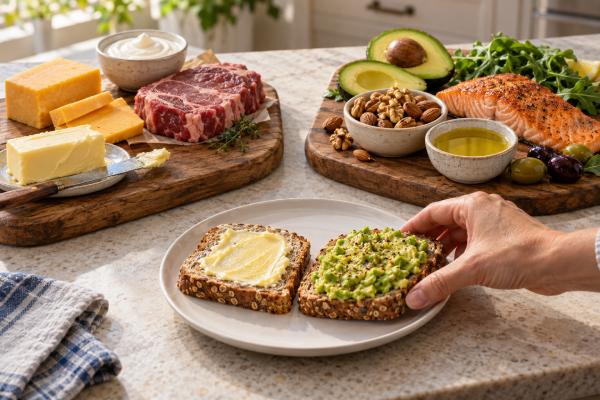
For heart health, the most useful question is not whether saturated fat is “bad” and unsaturated fat is “good.” It is what happens when one replaces the other in a real diet. Saturated fat can raise LDL cholesterol and ApoB-containing particles in many people, while replacing it with polyunsaturated fat—and often plant-based monounsaturated fat—usually improves the lipid profile. But replacing saturated fat with refined starches or added sugars may offer little cardiovascular benefit. Food source matters too: butter, cheese, processed meat, nuts, olive oil, and fish cannot be judged only by the percentage of one fatty acid they contain. Current guidance therefore focuses on an overall eating pattern rich in vegetables, fruits, legumes, whole grains, nuts, seeds, fish, and liquid plant oils, with fewer foods dominated by saturated fat. The biggest practical win is usually a swap, not a subtraction: use unsaturated-fat-rich foods in place of the saturated-fat sources you eat most often.
Table of Contents
- What Saturated and Unsaturated Fat Are
- What They Do to Cholesterol and ApoB
- Replacement Matters More Than Isolation
- Food Source Changes the Picture
- How Much Saturated Fat Is Reasonable?
- Practical Swaps That Improve Fat Quality
- How to Personalize Your Approach
What Saturated and Unsaturated Fat Are
Saturated and unsaturated fats are both dietary fats, but their chemical structures differ. Saturated fatty acids have no carbon-carbon double bonds. Unsaturated fatty acids have one or more, which changes how they behave in foods and in the body.
Monounsaturated fats have one double bond. Common sources include olive oil, avocado, many nuts, and some seeds. Polyunsaturated fats have multiple double bonds and include omega-6 fats such as linoleic acid and omega-3 fats such as alpha-linolenic acid, EPA, and DHA. Sources include many liquid vegetable oils, walnuts, flaxseed, chia, and fatty fish.
Saturated fat is common in butter, cream, cheese, fatty meat, processed meat, coconut oil, palm oil, baked goods, and some restaurant foods. Most foods contain a mixture rather than a pure type of fat. Olive oil, for example, is mostly monounsaturated but still contains some saturated and polyunsaturated fat. Beef contains saturated and monounsaturated fats. Walnuts contain both omega-6 and omega-3 polyunsaturated fats.
This matters because nutrition labels can make fat quality look more binary than it is. The body does not receive a single isolated nutrient; it receives a food matrix containing protein, carbohydrate, minerals, fiber, sodium, and many other compounds. That is one reason broad dietary patterns predict health better than a single nutrient viewed in isolation.
Fat is also energy dense: it provides about 9 calories per gram, more than twice the energy density of protein or carbohydrate. Replacing one fat with another at the same calorie intake is different from simply adding olive oil or nuts on top of an already calorie-surplus diet.
One important exception to the simple saturated-versus-unsaturated split is trans fat. Industrial trans fats are chemically unsaturated, yet they raise LDL-C, can lower HDL-C, and clearly worsen cardiovascular risk. Many countries have largely removed partially hydrogenated oils from the food supply, but small amounts can still appear in some foods and naturally occur in ruminant meat and dairy. This is a useful reminder that chemical category alone does not determine health effects. In everyday practice, the most favorable fats are generally cis-unsaturated fats from plant oils, nuts, seeds, avocado, and fish—not trans fats from partially hydrogenated oils.
What They Do to Cholesterol and ApoB
The clearest metabolic difference is that saturated fat tends to raise LDL cholesterol when compared with unsaturated fats. In many people it also raises ApoB, which reflects the number of atherogenic lipoprotein particles in the blood.
LDL-C measures how much cholesterol is carried inside LDL particles. ApoB is closer to a particle count because each major atherogenic particle carries one ApoB molecule. More ApoB-containing particles means more opportunities for particles to enter and become retained in the artery wall. If you are new to the terms, LDL, HDL, and triglycerides explained provides the basic framework.
Saturated fatty acids can reduce the liver’s clearance of LDL particles, partly by affecting LDL receptor activity. The response varies by fatty acid and by person, but palmitic and myristic acids generally raise LDL-C more than stearic acid. When saturated fat is replaced with monounsaturated or polyunsaturated fat, LDL-C usually falls; some trials also show reductions in ApoB or LDL particle burden.
That does not mean every unsaturated fat has the same effect. Omega-3 fats from fish have a strong triglyceride-lowering effect at therapeutic doses, while omega-6-rich oils are particularly effective at replacing saturated fat without raising LDL-C. Monounsaturated fats can also lower LDL-C when used in place of saturated fat.
The relationship is also not perfectly captured by LDL particle size. A diet can shift LDL toward larger particles while still increasing the total number of ApoB-containing particles. Particle number remains important even when triglycerides are low or HDL-C is high.
For people who track ApoB, the practical question is measurable: does changing fat quality lower the number of atherogenic particles? A focused discussion of saturated fat and ApoB explains why this can be more informative than arguing about one LDL-C value in isolation.
Replacement Matters More Than Isolation
Nutrition research often produces confusing headlines because “eat less saturated fat” is incomplete. Calories have to come from somewhere. If saturated fat falls, another nutrient usually rises. The replacement can change the result dramatically.
The strongest case is replacing saturated fat with polyunsaturated fat. Current guidelines and several lines of evidence support this substitution because it lowers LDL-C and is associated with lower cardiovascular risk. Evidence for plant-based monounsaturated fat is also favorable, although long-term randomized endpoint data are less extensive.
Replacing saturated fat with high-fiber carbohydrate foods—such as whole grains, legumes, fruits, and vegetables—can also be useful. These foods add fiber, micronutrients, and lower energy density while displacing concentrated saturated fat.
Replacing saturated fat with refined carbohydrate is different. If butter, cheese, or fatty meat is simply replaced with white bread, sweets, or sugary cereal, LDL-C may fall somewhat, but triglycerides, blood glucose, calorie intake, and overall diet quality can worsen. That trade can erase much of the expected cardiovascular benefit.
A simple comparison makes the point:
| If you eat less… | And replace it with… | Likely heart-health direction |
|---|---|---|
| Butter | Olive, canola, or other liquid plant oil | Favorable |
| Fatty processed meat | Fish, beans, lentils, or nuts | Favorable |
| Coconut oil | Unsaturated plant oil | Favorable for LDL-C |
| Full-fat cream sauce | Olive-oil or legume-based sauce | Generally favorable |
| Cheese-heavy snack | Nuts and fruit | Generally favorable |
| Saturated-fat-rich food | Sugary pastry or refined snack | Little or uncertain benefit |
This replacement concept also helps explain why studies can appear to disagree. A trial that lowers saturated fat by adding polyunsaturated oil asks a different biological question from a cohort study in which people who eat less saturated fat consume more refined carbohydrate. Both may be accurately reported while producing different outcomes.
The newest randomized-trial reviews still show uncertainty around exact event reductions, especially in lower-risk populations and older trials with varied diets. Benefits appear more important in people at higher cardiovascular risk and when saturated fat is specifically replaced by polyunsaturated fat. That is a more precise conclusion than either “saturated fat never matters” or “every gram of saturated fat is dangerous.”
Food Source Changes the Picture
The food carrying the fat can change its effect. Butter and cheese both contain substantial saturated fat, yet controlled trials often find that butter raises LDL-C more than an equivalent amount of fat from cheese. Fermented dairy, calcium content, protein structure, and the physical food matrix may all contribute.
Likewise, chocolate contains saturated fat, but much of it is stearic acid, which has a more neutral effect on LDL-C than palmitic or myristic acid. Coconut oil is plant-based, but it is still very high in saturated fat and generally raises LDL-C compared with unsaturated vegetable oils. “Plant-based” is therefore not automatically the same as “unsaturated.”
Processed meat deserves separate attention because its health effects are not just about saturated fat. Sodium, preservatives, heme iron, preparation methods, and the foods it displaces can also matter. A sausage-and-fries meal cannot be reduced to a saturated-fat number.
Unsaturated-fat foods vary too. Extra-virgin olive oil brings mostly monounsaturated fat plus polyphenols. Nuts and seeds add fiber, plant protein, minerals, and phytochemicals. Fish provides EPA and DHA. Refined seed oils provide unsaturated fatty acids without much fiber or protein, but they can still be useful replacements for butter or animal fat in cooking. For practical questions about linoleic-acid-rich cooking oils, seed oils and heart health looks at the omega-6 debate in more detail.
This food-source nuance should improve choices, not become an excuse to ignore quantities. A person with very high LDL-C who eats large amounts of butter, cream, cheese, fatty meat, and coconut oil may benefit from reducing several of those sources even if one individual food has a more favorable matrix than another.
The most defensible pattern is to make foods rich in unsaturated fat the default while treating concentrated saturated-fat foods as smaller or less frequent components.
How Much Saturated Fat Is Reasonable?
Most major public-health guidance recommends keeping saturated fat below about 10% of total energy. The American Heart Association has often used a lower target—around 6%—for people who need aggressive LDL-C reduction or have established cardiovascular disease.
To translate percentages into food:
- On a 1,600-calorie diet, 10% of calories is about 18 g of saturated fat; 6% is about 11 g.
- On a 2,000-calorie diet, 10% is about 22 g; 6% is about 13 g.
- On a 2,500-calorie diet, 10% is about 28 g; 6% is about 17 g.
You do not need to calculate every gram forever. Use the numbers briefly to find your major sources. Two tablespoons of butter, a large serving of cheese, fatty meat, and a dessert can push the daily total up quickly even when the rest of the diet seems healthy.
A good first step is to track three ordinary days, including one weekend day. Identify the top two or three recurring sources of saturated fat. Those are the targets most likely to produce meaningful change with the least effort.
Do not confuse saturated fat with total fat. A heart-supportive diet can be moderate or even relatively high in total fat if much of that fat comes from olive oil, nuts, seeds, fish, and avocado. The Mediterranean diet for heart health is a classic example: it is not a low-fat diet, but its fat quality is largely favorable.
People with familial hypercholesterolemia, established atherosclerotic disease, or markedly elevated LDL-C or ApoB may need tighter limits plus medication. Others with low overall risk may have more flexibility. The percentage is a starting framework, not a universal treatment target.
Practical Swaps That Improve Fat Quality
You can improve fat quality without rebuilding your entire diet. The easiest method is to change the ingredients you use repeatedly.
Breakfast
Instead of buttered toast plus processed meat, try whole-grain toast with avocado or nut butter, oatmeal topped with walnuts and fruit, or yogurt paired with oats and seeds. If yogurt is part of your routine, compare products by added sugar and portion size rather than assuming fat-free is always superior.
Lunch
Replace some cheese- and meat-heavy sandwiches with hummus, bean spreads, grilled chicken, tuna, salmon, or leftover lentils. Add vegetables and choose a dressing based on olive or canola oil rather than cream.
Dinner
Cook with liquid plant oil more often than butter or coconut oil. Use fish, beans, tofu, or lean poultry for some meals that would otherwise feature fatty red meat. Keep whole grains or starchy vegetables as the carbohydrate source rather than using refined bread or fries as the automatic replacement for fat.
Snacks
Nuts, seeds, fruit with nut butter, hummus with vegetables, or whole-grain crackers can replace cheese-heavy snacks, pastries, or processed meat. A small handful of nuts is energy dense, so portion size still matters if weight management is a goal.
Baking and sauces
Olive or canola oil can replace some butter in savory cooking and many baked recipes. Tomato sauces, pesto-style sauces, tahini, bean purées, and yogurt-based sauces can replace heavy cream in different dishes.
These changes often improve several variables at once. Nuts and seeds replace saturated fat, add unsaturated fat, and contribute fiber. Beans replace some animal fat while adding soluble fiber, which can help lower LDL-C. If cholesterol lowering is a priority, soluble-fiber-rich foods are a useful second lever alongside fat quality.
A practical goal is not to make every meal perfect. If most of your cooking fats and staple proteins shift toward unsaturated and plant-forward choices, occasional butter, cheese, or dessert becomes a smaller part of the overall pattern.
How to Personalize Your Approach
The same diet can produce different lipid responses in different people. Genetics, body weight, insulin sensitivity, thyroid function, medications, menopause, baseline LDL receptor activity, and overall calorie intake all influence the result.
If you are making a deliberate fat-quality change, use laboratory data to see what happens. A reasonable approach is to obtain a baseline lipid panel, make a sustainable change for about 6–12 weeks, then repeat the panel. ApoB can be especially helpful when triglycerides are elevated, LDL-C and non-HDL-C do not seem to agree, or you want a direct estimate of atherogenic particle burden.
Look at the pattern rather than one number:
- LDL-C shows cholesterol carried in LDL particles.
- Non-HDL-C captures cholesterol in all ApoB-containing particles.
- ApoB estimates the number of those atherogenic particles.
- Triglycerides provide information about triglyceride-rich lipoproteins and metabolic health.
- HDL-C adds context but should not be used to “cancel out” high LDL-C or ApoB.
If LDL-C or ApoB rises sharply on a high-saturated-fat diet—even if triglycerides fall—that is a meaningful signal to discuss with a clinician. Conversely, if replacing saturated fat with unsaturated fat lowers LDL-C and ApoB while your diet remains enjoyable and nutritionally adequate, you have direct evidence that the change works for you.
Personalization should not become an excuse to ignore a consistently unfavorable response. If repeat testing shows that a particular eating pattern drives LDL-C or ApoB much higher, the safer default is to modify that pattern rather than assuming another marker will cancel the risk. At the same time, a modest saturated-fat intake within a diet rich in vegetables, legumes, whole grains, fish, nuts, and unsaturated oils is different from a pattern dominated by butter, fatty processed meats, coconut oil, and refined foods. The practical target is the whole diet you can sustain, with enough attention to fat quality that your measured risk markers remain in an appropriate range for your overall cardiovascular risk.
A practical way to personalize fat intake is to separate “what works on paper” from what you can repeat for years. A diet that lowers saturated fat by replacing butter with olive or canola oil, choosing nuts instead of pastries, and using fish or legumes in place of some fatty meats may be easier to sustain than a rigid low-fat plan. Sustainability matters because LDL-C and ApoB respond to the pattern you follow most of the time, not to a few unusually strict days before a blood test.
It also helps to watch for substitutions that look healthy but miss the point. Replacing cheese with refined crackers, butter with sugary low-fat desserts, or a fatty meat meal with a large portion of refined starch does not provide the same cardiovascular advantage as replacing saturated fat with unsaturated fat and high-fiber foods. Similarly, adding large amounts of nuts, oils, or avocado without reducing anything else can push calorie intake upward. For some people, weight gain can worsen blood pressure, triglycerides, and glucose control even when the added fat is mostly unsaturated. The most useful plan improves fat quality while keeping total energy intake, fiber, protein, and overall food quality in a range that supports your broader health goals.
The bottom line is that fat quality matters, but replacement and overall food pattern matter even more. Unsaturated fats are most useful when they displace saturated-fat-rich foods, not when they are simply added to excess calories. Choose liquid plant oils, nuts, seeds, avocado, and fish more often; keep fiber-rich whole foods high; and use your lipid results to fine-tune how strict you need to be.
References
- Top Things to Know: 2026 Dietary Guidance to Improve Cardiovascular Health 2026 (Position Statement)
- Saturated fatty acid and trans-fatty acid intake for adults and children: WHO guideline 2023 (Guideline)
- Saturated Fat Intake and the Prevention and Management of Cardiovascular Disease in Adults: An Academy of Nutrition and Dietetics Evidence-Based Nutrition Practice Guideline 2023 (Guideline)
- Dietary intake, biomarkers and supplementation of fatty acids and risk of coronary events: a systematic review and dose-response meta-analysis of randomized controlled trials and prospective observational studies 2024 (Systematic Review)
- Effect of Interventions Aimed at Reducing or Modifying Saturated Fat Intake on Cholesterol, Mortality, and Major Cardiovascular Events : A Risk Stratified Systematic Review of Randomized Trials 2026 (Systematic Review)
Disclaimer
This article provides general nutrition information and does not replace individualized medical advice. People with very high LDL-C or ApoB, familial hypercholesterolemia, established cardiovascular disease, diabetes, kidney disease, or other major risk factors may need more specific dietary targets and medication. Discuss major diet changes and lipid results with a qualified healthcare professional.