Blood pressure is supposed to move. It rises with activity, stress, caffeine, pain, and cold, and it usually falls during rest and sleep. That normal movement becomes more important when the swings are unusually large, repeated, or unrelated to obvious triggers. Researchers call this blood pressure variability, and higher long-term variability has been linked with greater risks of stroke, cardiovascular events, and death even after average blood pressure is considered. Still, there is no single home cutoff that tells you your variability is “too high,” and most treatment decisions continue to focus first on accurate average blood pressure. The best way to make sense of bouncing numbers is to standardize how and when you measure, look for patterns over days or weeks, and address causes such as missed medication, poor sleep, stress, pain, stimulants, and inconsistent treatment. One odd reading matters much less than a repeatable pattern.
Table of Contents
- What Blood Pressure Variability Means
- Why Blood Pressure Changes So Much
- When Variability May Matter for Heart and Stroke Risk
- How to Tell Normal Fluctuation From a Real Pattern
- Common Causes of Excessive Blood Pressure Swings
- How to Reduce Unnecessary Blood Pressure Variability
- When to Call Your Clinician or Seek Urgent Care
What Blood Pressure Variability Means
Blood pressure variability is the amount your readings change over time, but it can be measured over very different time scales. A person can have minute-to-minute fluctuations, changes across a 24-hour day, differences from one morning to the next, or large shifts between clinic visits months apart.
Researchers commonly separate variability into several categories:
- Very short-term variability: changes from beat to beat or minute to minute.
- Short-term variability: changes across the day and night, often measured with a 24-hour ambulatory monitor.
- Day-to-day variability: changes in home readings from one day to the next.
- Visit-to-visit variability: changes across clinic visits over months or years.
These forms are related but not identical. The factors that cause a morning reading to differ from an evening reading are not necessarily the same factors that explain why your clinic systolic pressure is 125 mm Hg one month and 155 mm Hg the next.
Average blood pressure remains the main clinical target. If your home readings are 150/90, 148/88, and 152/92, the variability is small but the average is clearly high. If your readings are 105/65, 145/85, and 115/70, the average may look better, but the swings are larger and may deserve context.
There is also no universally accepted home “variability number” that patients should calculate on their own. Research often uses statistical measures such as standard deviation, coefficient of variation, or average real variability. Those tools are useful for studies but are not yet routine treatment targets for most people.
If your concern is sudden dramatic peaks rather than general day-to-day movement, blood pressure spikes are best evaluated with symptoms and triggers in mind.
Why Blood Pressure Changes So Much
Blood pressure changes because your body is constantly adjusting circulation to what you are doing and what your organs need. A stable cardiovascular system is not one that produces the same number all day; it is one that adapts appropriately.
Activity and posture
Standing up, walking, climbing stairs, exercising, bending, and lifting all change blood flow requirements. Systolic pressure normally rises during physical activity and returns toward baseline during recovery. Measuring immediately after movement can make a normal physiologic response look like “unstable blood pressure.”
Stress and emotions
Fear, anger, pain, anticipation, and anxiety activate the sympathetic nervous system. Heart rate may rise, blood vessels constrict, and blood pressure can increase quickly. Some people have a strong white coat response in medical settings even when home pressure is normal.
Sleep and the day-night pattern
Blood pressure usually falls during sleep and rises after waking. People whose pressure does not fall normally at night, or rises during sleep because of obstructive sleep apnea, can have a different risk profile from people with a healthy night-time dip.
Food, caffeine, nicotine, and alcohol
Caffeine and nicotine can raise pressure temporarily. Alcohol can have different short- and long-term effects, and heavy intake can worsen hypertension. Large meals, dehydration, and changes in salt intake may also alter readings in susceptible people.
Medication timing
Blood pressure medicines do not all have identical duration. A dose may provide smooth 24-hour control in one person but wear off earlier in another. Missed doses, inconsistent timing, or abrupt discontinuation can cause much larger swings.
Measurement technique
Some apparent variability is simply measurement error. A cuff that is too small, an unsupported arm, crossed legs, talking, a full bladder, or measuring over clothing can shift the result enough to create a false pattern.
That is why accurate home blood pressure technique matters before you conclude that your cardiovascular system is unstable.
When Variability May Matter for Heart and Stroke Risk
Higher long-term blood pressure variability is associated with greater cardiovascular risk, but the science is not yet simple enough to treat variability as a stand-alone diagnosis. Recent research supports the idea that repeated wide swings carry information beyond the average pressure.
A 2023 systematic review and meta-analysis including nearly 10 million people found that greater long-term systolic variability was associated with higher risks of all-cause mortality, cardiovascular mortality, major cardiovascular events, stroke, and myocardial infarction after accounting for mean blood pressure.
A 2024 meta-analysis in adults aged 65 and older also found that higher systolic variability was associated with cardiovascular disease and adverse brain-related outcomes. Importantly, that review noted that no gold-standard definition of “high variability” exists.
More recent 2026 dose-response analyses of visit-to-visit variability suggest that risk may rise more noticeably above certain statistical thresholds. Those findings are useful for research, but they should not be converted into a DIY home rule such as “my standard deviation is 12 mm Hg, therefore I am high risk.” The way readings are collected, the number of visits, and the metric used all affect the result.
Why might variability be harmful?
Several mechanisms are possible:
- Large pressure swings may expose arteries to repeated mechanical stress.
- High variability may reflect stiff arteries or impaired autonomic regulation.
- It can be a marker of poor medication adherence or inadequate 24-hour treatment.
- It may reflect sleep apnea, kidney disease, or other conditions that also raise cardiovascular risk.
- Some variability may be a consequence of existing vascular disease rather than a cause.
That last point is important. Association does not prove that deliberately reducing variability, independent of lowering average pressure, will always improve outcomes.
The 2025 high blood pressure guideline continues to emphasize accurate average blood pressure, standardized home monitoring, and effective treatment. That is the right priority for most people.
Why the average and the swings tell different stories
Two people can have the same weekly average but very different patterns. One person might stay close to 132/80 every day. Another might alternate between 108/66 and 156/92 and end up with a similar mathematical average. The second pattern deserves more context because it could reflect inconsistent medication use, changing measurement conditions, alcohol or stimulant exposure, pain, poor sleep, or an underlying medical issue.
The reverse is also important. Very stable readings are not reassuring if they are consistently high. A week of readings clustered around 155/95 has little variability, but the average pressure still needs attention. This is why variability should add context to blood pressure management rather than replace the average.
Clinicians may care more about variability when swings are reproducible, occur despite standardized technique, cause symptoms, or appear along with difficult-to-control hypertension. They may use a home log or 24-hour ambulatory monitoring to see whether the pattern follows sleep, medication timing, activity, or another trigger.
How to Tell Normal Fluctuation From a Real Pattern
You need repeated readings taken under similar conditions before variability becomes interpretable. Comparing a post-exercise reading with a rested bedtime reading does not tell you much about abnormal variability.
A useful home monitoring approach is:
- Measure at the same general times each day, often morning and evening if your clinician recommends it.
- Rest quietly for five minutes first.
- Use the same arm and a validated upper-arm monitor.
- Take two readings about one minute apart.
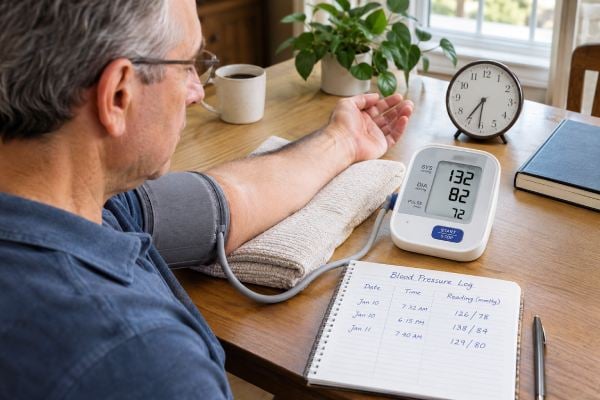
- Record both readings and note unusual circumstances.
- Look at at least several days of data rather than reacting to one number.
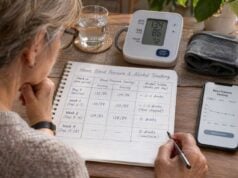
A log is more useful when it includes context. Note missed medication, poor sleep, caffeine, alcohol, pain, illness, intense exercise, unusual stress, or a new over-the-counter medicine.
Do not compare every reading with the one immediately before it and treat each difference as meaningful. First compare readings taken under similar conditions: morning with morning, evening with evening, and rested measurements with other rested measurements. A 20 mm Hg difference between a rushed post-exercise reading and a quiet morning reading may be expected, while a repeated 20 mm Hg difference between standardized morning readings can be more informative.
It also helps to separate within-session variation from day-to-day variation. If two readings taken one minute apart differ, sit quietly and take another if your clinician has advised you to do so. If the first reading is routinely highest and later readings settle, the pattern may partly reflect insufficient rest or anticipatory stress. By contrast, a large change that repeats at the same time on different days may point toward medication timing, sleep, meals, or another recurring factor.
Example 1: likely normal situational change
Morning readings are around 122/76 for several days. One evening after a stressful commute and two coffees, the reading is 148/88, then falls to 130/80 after rest. That may represent an understandable short-term response.
Example 2: possible treatment issue
Morning pressure is repeatedly 150/90 before medication and 120/72 later in the day. That pattern may suggest timing, duration of medication effect, or another morning trigger worth discussing.
Example 3: possible measurement problem
Readings are erratic only when using a wrist cuff, but become consistent with a validated upper-arm device. The “variability” may have come from technique rather than physiology.
Example 4: a reason for further evaluation
Readings swing from low-normal to very high with headache, palpitations, or sweating, and the pattern repeats without an obvious trigger. That deserves medical review rather than continued self-testing.
If you need a structured schedule, a home blood pressure monitoring routine can make the trend much easier to interpret.
Common Causes of Excessive Blood Pressure Swings
Large or repeated swings often have a practical explanation, and the most common causes should be reviewed before rare conditions.
Inconsistent medication use
Missed doses are one of the most preventable causes. Taking medication at widely different times can also create peaks and troughs, especially with shorter-acting drugs. Some people intentionally skip doses when a reading is “too low,” which can produce rebound highs later.
White coat or masked hypertension
White coat hypertension means office pressure is high while out-of-office pressure is lower. Masked hypertension is the opposite: clinic readings look acceptable while home or work readings are high. Both patterns can make clinic-to-clinic variability difficult to interpret.
White coat hypertension often requires home or ambulatory monitoring to confirm the pattern.
Sleep apnea
Obstructive sleep apnea can cause repeated nighttime surges and may contribute to resistant hypertension. Snoring, witnessed breathing pauses, morning headaches, and daytime sleepiness increase suspicion.
Stress, panic, and pain
Emotional stress, panic episodes, migraines, chronic pain flares, and acute injury can produce dramatic temporary increases. Treating the trigger may reduce the swing more effectively than adding medication blindly.
Autonomic and neurologic disorders
Less common disorders involving autonomic control can cause unstable pressure, especially when accompanied by major changes with posture, heart rate abnormalities, fainting, or neurologic disease.
Secondary hypertension
Kidney disease, primary aldosteronism, thyroid problems, renovascular disease, certain adrenal disorders, and medications or substances can cause difficult-to-control hypertension. A sudden change in a previously stable pattern is more concerning than mild variability that has been present for years.
Dehydration and overtreatment
Variability can also come from pressure dropping too low. Dehydration, diuretics, heat, illness, weight loss, or an antihypertensive dose that has become too strong can produce low readings followed by compensatory rises.
Do not solve this by independently alternating doses. Bring the pattern to your prescriber.
How to Reduce Unnecessary Blood Pressure Variability
The most effective strategy is to make measurement, medication use, and daily habits more consistent. You usually do not need a special treatment labeled “for blood pressure variability.”
Start with medication adherence. Use a pill organizer, alarms, or a fixed daily routine. If you are missing doses because of side effects or cost, tell your clinician instead of quietly taking the drug inconsistently.
Next, reduce measurement noise:
- Use the correct cuff size.
- Measure on bare skin.
- Rest before measuring.
- Avoid caffeine, smoking, and exercise for about 30 minutes beforehand when possible.
- Empty your bladder.
- Keep your back and feet supported.
- Do not talk during the reading.
Lifestyle consistency also helps. Large swings in sodium intake, binge drinking, highly variable sleep, and alternating between inactivity and extreme exercise can all change blood pressure from day to day.
Sleep is especially important. If your readings are high in the morning or vary after poor nights, poor sleep and high blood pressure may be part of the pattern.
Should medication be changed to reduce variability?
Sometimes. Long-acting medications, combination therapy, or better dose timing can provide smoother 24-hour coverage. But the decision should be based on your average pressure, symptoms, kidney function, cardiovascular risk, and the pattern of readings—not variability alone.
The STEP trial analysis published in 2023 found that visit-to-visit variability remained associated with cardiovascular outcomes in older adults receiving either intensive or standard blood pressure control. That supports the idea that consistency matters, but it does not provide a simple self-treatment target.
When to Call Your Clinician or Seek Urgent Care
Call your clinician when the variability is new, extreme, symptomatic, or associated with repeated highs or lows. Do not wait for months of data if you are having concerning symptoms.
Arrange medical review if:
- Your home readings repeatedly alternate between very high and unusually low.
- You feel faint or fall when the pressure is low.
- High episodes come with pounding heartbeat, sweating, or severe headaches.
- Your pressure has become unstable after a medication change.
- Morning pressure is consistently much higher than later readings.
- You are taking several medications but control remains unpredictable.
- The pattern started suddenly after years of stable pressure.
For severe readings, symptoms guide urgency. Blood pressure above about 180/120 mm Hg that remains high on repeat measurement requires prompt clinical attention. If severe pressure is accompanied by chest pain, shortness of breath, weakness, numbness, trouble speaking, confusion, vision changes, fainting, or another sign of acute organ injury, seek emergency medical care.
Very low pressure can also be dangerous when it causes fainting, shock-like symptoms, or poor perfusion. A number that is “low” for one person may be normal for another, so symptoms and baseline matter.
The practical takeaway is straightforward: some variation is normal, but repeated large swings deserve context and a standardized log. Focus first on accurate averages, consistent medication use, and identifiable triggers. If the variability persists despite those steps, your clinician can decide whether ambulatory monitoring, medication adjustment, or testing for an underlying condition is appropriate.
References
- Long-term systolic blood pressure variability independent of mean blood pressure is associated with mortality and cardiovascular events: A systematic review and meta-analysis 2023 (Systematic Review)
- Elevated blood pressure variability is associated with an increased risk of negative health outcomes in adults aged 65 and above-a systematic review and meta-analysis 2024 (Systematic Review)
- Visit-to-visit blood pressure variability and outcome: a traditional and a dose-response meta-analysis 2026 (Systematic Review)
- Visit-to-Visit Blood Pressure Variability and Cardiovascular Outcomes in Patients Receiving Intensive Versus Standard Blood Pressure Control: Insights From the STEP Trial 2023 (Cohort Analysis)
- Top Things to Know: 2025 High Blood Pressure (BP) Guideline 2025 (Guideline)
Disclaimer
This article is for general education and cannot diagnose abnormal blood pressure variability or determine the cause of large swings. Discuss repeated high or low readings, fainting, medication-related changes, or new symptoms with a healthcare professional. Seek emergency care for severe blood pressure accompanied by chest pain, shortness of breath, neurologic symptoms, vision changes, confusion, or fainting.