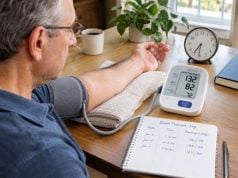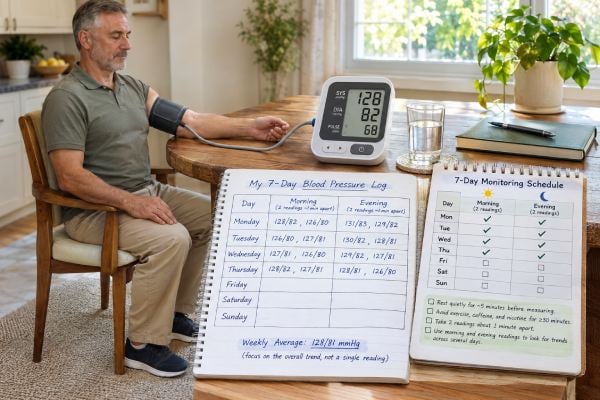
The best home blood pressure routine for an accurate short-term trend is usually two readings in the morning and two in the evening, about one minute apart, for 7 consecutive days. This is often called the “722” approach: two measurements per sitting, two sittings per day, for seven days. The value of this schedule is not that every person must measure forever. It is that repeated readings taken under similar conditions give a much better estimate than isolated checks taken only when you feel stressed, dizzy, or curious. Technique matters just as much as timing: use a validated upper-arm cuff that fits, rest quietly for 5 minutes, sit with your back supported and feet flat, keep the arm at heart level, and avoid exercise, caffeine, nicotine, and other short-term influences beforehand. This guide explains how to build a reliable home blood pressure schedule, calculate a useful average, avoid common errors, and know when a reading deserves prompt medical attention.
Table of Contents
- The Best 7-Day Home Blood Pressure Schedule
- How to Take Each Reading Correctly
- The Best Time for Morning and Evening Readings
- How to Average and Interpret Your Home Readings
- How Often to Monitor After the First Week
- Common Mistakes That Distort Blood Pressure Trends
- When a Home Blood Pressure Reading Needs Action
The Best 7-Day Home Blood Pressure Schedule
For diagnosing hypertension, checking a medication change, or establishing a reliable baseline, a structured 7-day block is more informative than random measurements. Evidence and multiple hypertension guidance documents support a pattern of repeated morning and evening readings, commonly summarized as the 722 protocol.
A practical schedule is:
| Day | Morning | Evening |
|---|---|---|
| 1 | 2 readings, 1 minute apart | 2 readings, 1 minute apart |
| 2 | 2 readings, 1 minute apart | 2 readings, 1 minute apart |
| 3 | 2 readings, 1 minute apart | 2 readings, 1 minute apart |
| 4 | 2 readings, 1 minute apart | 2 readings, 1 minute apart |
| 5 | 2 readings, 1 minute apart | 2 readings, 1 minute apart |
| 6 | 2 readings, 1 minute apart | 2 readings, 1 minute apart |
| 7 | 2 readings, 1 minute apart | 2 readings, 1 minute apart |
That produces up to 28 readings, which smooths out normal day-to-day variation. Some clinical protocols use a minimum of 3 days when 7 days are not practical, but a full week provides a more stable picture.
Do not measure repeatedly until you get a number you like. Record the planned readings even if one is higher than expected. Blood pressure naturally varies from beat to beat and from minute to minute. The goal is to estimate your usual pressure, not to produce a perfect individual measurement.
If your clinician gives you a different schedule, follow that plan. Pregnancy, kidney disease, medication titration, orthostatic symptoms, or very high blood pressure may require a more specific routine. Likewise, some clinicians instruct patients to exclude the first day when calculating an average, while other protocols use all valid readings. The important point is to use one consistent method and tell the clinician exactly how the average was calculated.
A good home routine complements office readings because out-of-office measurements can reveal white-coat effects, masked hypertension, and changes that are missed by occasional clinic checks. When the pattern remains unclear, 24-hour ambulatory blood pressure monitoring may provide a more complete day-and-night profile.
How to Take Each Reading Correctly
A carefully timed schedule cannot compensate for poor technique. Small setup errors can shift systolic or diastolic readings enough to create a misleading trend.
Before each measurement:
- Avoid vigorous exercise, caffeine, nicotine, and a large meal for roughly 30 minutes when possible.
- Empty your bladder.
- Sit quietly for at least 5 minutes.
- Sit in a chair with your back supported rather than perching on a bed or stool.
- Keep both feet flat on the floor and do not cross your legs.
- Rest the measured arm on a table so the middle of the cuff is near heart level.
- Place the cuff on bare skin, not over clothing.
- Do not talk, text, or watch upsetting content while the device is measuring.
- Take the first reading, wait about 1 minute, then take the second.
- Record both readings rather than choosing the lower one.
The cuff must also fit your arm. A cuff that is too small can falsely raise the reading, while an oversized cuff can distort it in the other direction. Measure the circumference of your upper arm and compare it with the manufacturer’s stated cuff range. For more detail, see how blood pressure cuff size affects accuracy.
A validated automatic upper-arm monitor is usually preferred for home use. Wrist monitors can be useful in selected circumstances, but they are highly sensitive to wrist position and are easier to use incorrectly. If you are choosing a device, this guide to home blood pressure monitors explains upper-arm versus wrist models and validation considerations.
When you first buy a monitor, bring it to a clinic visit if possible. A healthcare professional can check your technique, confirm cuff placement, and compare its readings with the office equipment. Also replace batteries when needed and follow the manufacturer’s calibration or replacement guidance.
The Best Time for Morning and Evening Readings
Consistency is more important than choosing an exact clock time. Try to measure at similar points in your daily routine so one day is comparable with the next.
For the morning session, a common approach is to measure after waking and using the bathroom, but before breakfast, caffeine, exercise, and—when your clinician wants a pre-medication reading—before taking blood pressure medicine. Sit quietly first even if you have just gotten out of bed.
Do not automatically delay prescribed medication just to obtain a measurement. If your clinician has told you to take a medication at a particular time, keep that schedule unless you are specifically instructed to measure before the dose. The purpose is consistency, not creating an artificial medication trough.
For the evening session, choose a repeatable time when you can sit calmly. Avoid measuring immediately after exercise, a hot shower, alcohol, a large meal, an argument, or rushing through chores. If bedtime is your most consistent quiet period, that can work well, provided you follow the same preparation each night.
Morning and evening pressures are not expected to be identical. Blood pressure follows a daily rhythm and responds to activity, sleep, meals, stress, medications, and posture. A difference between sessions becomes useful when the pattern is consistent across several days.
This is why “checking whenever I remember” creates noisy data. A reading at 7 a.m. before breakfast should not be compared directly with one taken at 3 p.m. after coffee and climbing stairs as though they represent the same physiologic condition.
If you repeatedly see high readings only at certain times, keep the schedule standardized before drawing conclusions. Late meals, sleep quality, medication timing, and sleep apnea can all affect morning pressure. If numbers remain highly inconsistent despite good technique, blood pressure variability and its causes may help you identify what to discuss with your clinician.
How to Average and Interpret Your Home Readings
Home blood pressure is most useful as an average, not as the highest or lowest number from the week. If your device stores readings, use its memory or app rather than relying on recollection. Otherwise, write down the systolic pressure, diastolic pressure, pulse, date, and time.
To create a simple average:
- Decide whether your clinician wants all 7 days included or prefers the first day excluded.
- Add the valid systolic readings and divide by the number of readings.
- Do the same for the diastolic readings.
- Keep morning and evening averages separate if your clinician wants to compare them.
- Note any unusual circumstances, such as fever, severe pain, missed medication, or an unusually strenuous workout.
Do not delete an uncomfortable number merely because it is higher. At the same time, a clearly invalid measurement—such as a reading taken while talking, immediately after running upstairs, or with the cuff visibly loose—should be marked as technically unreliable rather than quietly blended into the trend.
The threshold used to diagnose or treat hypertension depends on the guideline, setting, cardiovascular risk, age, and medical history. Home readings are often lower than office readings, so do not assume that an office threshold and a home threshold are interchangeable. The 2024 European Society of Cardiology guideline and the 2025 US blood pressure guideline both emphasize the role of out-of-office measurement, but clinical targets should be individualized.
The best question is not “Was one reading high?” It is “What is my properly measured average, and how does it compare with the target my clinician gave me?”
If your home average conflicts sharply with clinic readings, the difference may be meaningful. White-coat hypertension refers to higher office readings with lower out-of-office pressure, while masked hypertension is the reverse. Ambulatory monitoring is often useful when that discrepancy could change treatment.
How Often to Monitor After the First Week
You usually do not need two morning and two evening readings every day forever. A 7-day block is especially useful when you need a baseline, are confirming a diagnosis, or are assessing a treatment change. Once blood pressure is stable, the monitoring burden can often be reduced.
The appropriate long-term frequency depends on why you are monitoring. Examples include:
- New diagnosis or uncertain control: a structured 7-day series before a visit can give the clinician useful data.
- After starting or changing medication: your clinician may request another 7-day block after the treatment has had time to take effect.
- Stable, well-controlled hypertension: periodic measurements or occasional multi-day blocks may be enough rather than daily checking.
- Lifestyle changes: repeating the same standardized week after several weeks or months can show whether the overall trend is improving.
- Symptoms such as dizziness: extra readings may be requested around symptoms, including standing measurements if orthostatic hypotension is suspected.
A 2022 review of standardized home monitoring noted that repeated 722 blocks can be scheduled at intervals ranging from weeks to months depending on the clinical situation. That is more useful than an arbitrary rule such as “check three times every day for life.”
Overchecking has downsides. Repeatedly measuring after every stressful moment can create anxiety, encourage cherry-picking, and fill the log with readings taken under incomparable conditions. If monitoring itself makes you anxious, agree on a specific schedule with your clinician and put the cuff away between planned sessions.
The opposite problem is checking too rarely. One reading the night before an appointment cannot establish whether your treatment has been working for the previous three months. Use short, standardized measurement blocks to create data that are easy to interpret.
Common Mistakes That Distort Blood Pressure Trends
Home monitoring looks simple, but real-world studies show that many people do not follow recommended technique consistently. Common errors can make a normal trend look high or a high trend look falsely reassuring.
Using a cuff that does not fit. This is one of the most avoidable sources of error. Measure your arm rather than assuming the cuff included with the device fits everyone.
Skipping the 5-minute rest. Walking in from another room, sitting down, and immediately pressing start can capture the temporary effect of movement rather than resting pressure.
Measuring over clothing. The cuff should generally sit directly on bare skin and be positioned as the manufacturer instructs.
Letting the arm hang down. If the arm is unsupported below heart level, the reading can be higher. Use a table or pillow to support it.
Crossing the legs or talking. Both can alter the measurement enough to matter when you are comparing small changes over time.
Taking only one reading. The first reading is often higher. Two readings one minute apart provide a better estimate and are central to the 722 routine.
Checking only when you feel bad. This creates selection bias. Blood pressure is often symptomless, and headache or anxiety can themselves raise it temporarily.
Repeatedly testing until the result falls. If you take six readings and record only the last, your log no longer reflects the original condition. Stick to the planned pair unless your clinician has told you otherwise.
Changing conditions from day to day. One day before coffee, the next after coffee, one day seated quietly, the next during a work call—this makes the trend hard to interpret. For a full technique walkthrough, see how to measure blood pressure at home.
Relying on an unvalidated wearable. Cuffless blood pressure technology is developing quickly, but it should not automatically replace a validated cuff for diagnosis or medication decisions. Smartwatch blood pressure tracking accuracy explains why calibration and validation matter.
When a Home Blood Pressure Reading Needs Action
A single unexpectedly high reading is not always an emergency. First check the setup. Sit quietly, make sure the cuff is positioned correctly, and repeat the measurement after several minutes. Record what happened rather than panicking or taking extra medication unless your clinician has given you a specific action plan.
If your blood pressure is repeatedly at or above 180 mmHg systolic or 120 mmHg diastolic, it needs prompt medical attention even if you feel well. Recheck after quiet rest and contact a healthcare professional promptly for guidance if it remains severely elevated.
Seek emergency care when very high blood pressure is accompanied by symptoms that could indicate acute organ injury, such as chest pain, severe shortness of breath, new weakness or numbness, trouble speaking, confusion, fainting, a severe sudden neurologic symptom, or major vision change. Do not spend an hour taking repeated home measurements while serious symptoms continue.
Also contact your clinician when your multi-day average is consistently above your assigned treatment target, even if no individual reading is dramatic. Hypertension often causes no symptoms, so waiting until you “feel high blood pressure” is unreliable.
Low readings matter when they cause symptoms. Dizziness, fainting, weakness, or falls with low pressure may signal over-treatment, dehydration, bleeding, or another medical problem and should be discussed promptly.
Do not adjust prescription blood pressure medication based on one home number unless you have an explicit clinician-directed plan. Some drugs take time to work, and adding extra doses can create delayed hypotension.
What to bring to a blood pressure follow-up
Bring the full log rather than only the average. Include dates, morning and evening pairs, pulse readings, and notes about missed medication, illness, unusually hard exercise, or symptoms. If your monitor stores measurements internally, bring the device or app record so the clinician can see the original sequence. This makes it easier to distinguish a consistent problem from one isolated spike.
It is also useful to bring the cuff itself at least once after purchase and whenever the numbers seem implausible. A staff member can watch your technique, check cuff fit, and compare your monitor with a clinic device. If the home and office values repeatedly disagree despite good technique, the next step may be ambulatory monitoring rather than buying several new cuffs.
Before the visit, calculate your average using the method you were instructed to use and write down any questions about medication timing. A clear 7-day record is far more useful than saying that your pressure is “usually around 140” based on memory. Good data can help prevent both undertreatment and unnecessary dose increases.
For sudden temporary elevations, the article on blood pressure spikes, triggers, and warning signs explains common reasons a number can jump. For day-to-day management, however, the most useful habit remains simple: measure correctly, on a schedule, and judge the average rather than the emotional impact of one reading.
A well-run 7-day home log can turn blood pressure from a string of confusing numbers into a clinically useful trend. Keep the conditions consistent, take two readings each time, and share the complete record with the professional guiding your care.
References
- 2025 AHA/ACC/AANP/AAPA/ABC/ACCP/ACPM/AGS/AMA/ASPC/NMA/PCNA/SGIM Guideline for the Prevention, Detection, Evaluation, and Management of High Blood Pressure in Adults 2025 (Guideline)
- 2024 ESC Guidelines for the Management of Elevated Blood Pressure and Hypertension 2024 (Guideline)
- Home Blood Pressure Monitoring 2025 (Review)
- Home Blood Pressure Measurements Are Not Performed According to Guidelines and Standardized Education Is Urgently Needed 2025
- Standardized home blood pressure monitoring: Rationale behind the 722 protocol 2022 (Review)
Disclaimer
This article is for general education and does not replace individualized blood pressure targets or medication instructions. Repeated readings at or above 180/120 mmHg require prompt clinical attention, and severe blood pressure elevation with chest pain, major breathing difficulty, neurologic symptoms, fainting, or major vision changes can be an emergency. Follow the monitoring and treatment plan provided by your healthcare professional.