Smartwatches can estimate blood pressure, but most cuffless models should not yet be treated as a replacement for a validated upper-arm blood pressure monitor. The key problem is that many watches do not directly measure the pressure inside an artery. Instead, they use optical sensors, pulse-wave timing, algorithms, and often a calibration reading from a conventional cuff to estimate systolic and diastolic pressure. Those estimates can look precise on the screen while still being meaningfully wrong in real-world conditions such as exercise, sleep, changes in arm position, or after blood pressure medication. Current hypertension guidance therefore recommends relying on validated cuff-based measurements for diagnosis and treatment decisions. A smartwatch can still be useful for noticing trends, recording heart rate, prompting regular checks, and helping you stay engaged with your health. The safest approach is to know what the device actually measures, how it was validated, and when to confirm any surprising reading with a proper cuff.
Table of Contents
- How Smartwatches Estimate Blood Pressure
- How Accurate Are Smartwatch Blood Pressure Readings?
- Why Calibration and Arm Position Matter
- What Smartwatches Are Good At
- What They Should Not Be Used For
- How to Check a Device Before You Trust It
- The Best Way to Track Blood Pressure at Home
How Smartwatches Estimate Blood Pressure
Most smartwatch blood pressure features are indirect estimates rather than direct measurements. A conventional arm cuff temporarily compresses the brachial artery and detects pressure as blood flow returns. A cuffless watch usually cannot do that.
Instead, many devices combine signals such as:
- Photoplethysmography, or PPG: an optical sensor detects changes in blood volume under the skin with each heartbeat.
- Electrocardiography, or ECG: some watches record the electrical timing of the heartbeat.
- Pulse transit time or pulse arrival time: algorithms estimate how quickly a pressure wave travels through the circulation.
- Tonometry: a sensor detects pulse pressure at the skin surface over an artery.
- Machine learning: software combines sensor data with calibration values and sometimes personal characteristics to estimate pressure.
The basic idea is plausible: arterial stiffness, pulse-wave shape, and timing change as blood pressure changes. The difficulty is that these signals are also affected by movement, temperature, vascular tone, sensor contact, posture, exercise, age, medications, and other factors.
Some watch-like devices contain an actual miniature inflatable cuff in the band. Those are different from purely cuffless systems and may have stronger measurement principles, although each specific device still needs independent validation.
Do not assume that a familiar brand name guarantees clinically accurate blood pressure measurement. A watch can have excellent heart-rate tracking and still have an unproven blood pressure feature. Each function needs its own validation.
How Accurate Are Smartwatch Blood Pressure Readings?
Accuracy is inconsistent across devices and conditions, which is why cuffless smartwatch readings are not currently recommended for diagnosing hypertension or adjusting treatment. Some research devices perform reasonably well under controlled conditions, especially soon after calibration. Performance often worsens when the test population includes older adults, people with hypertension, or a wider range of blood pressures.
A key distinction is average bias versus individual error. A device can have a small average difference compared with a reference cuff while still being off by 10, 15, or more mm Hg for an individual reading. For clinical decisions, that spread matters.
For example, a watch that reports 128/78 mm Hg when your true pressure is 145/88 could falsely reassure you. The opposite error could cause unnecessary anxiety or lead someone to change medication without a valid reason.
Controlled validation also does not automatically prove real-world accuracy. A device might be tested while a person is sitting still with the wrist positioned carefully at heart level. Daily life includes walking, sleeping, driving, exercising, stress, temperature changes, and inconsistent arm positions. These conditions can distort the signals used by cuffless systems.
The American Heart Association’s scientific statement on cuffless blood pressure devices emphasized that many available technologies have not been adequately proven accurate and clinically useful in real-world settings. The 2025 U.S. high blood pressure guideline similarly recommends avoiding reliance on cuffless devices, including smartwatches, for accurate blood pressure measurement until precision and reliability improve.
That does not mean every reading is wrong. It means you should treat the number as an estimate unless the specific device has robust validation for the way you are using it.
It is also worth separating precision from accuracy. A watch can be very consistent—giving nearly the same value three times in a row—and still be consistently wrong compared with a reference measurement. Conversely, a device can have a small average error across a study while individual readings vary too widely for medication decisions. This is why a simple side-by-side check at home cannot prove that a device is clinically accurate.
Another complication is regression toward the average. Some algorithms may perform best around common blood pressure values and become less reliable at very low or very high pressures. That is exactly where accuracy matters most. A device that looks impressive around 120/80 mm Hg may not perform as well during hypertension, hypotension, exercise, illness, or medication changes.
Why Calibration and Arm Position Matter
Many smartwatch blood pressure systems require calibration with a conventional cuff. The watch is only as good as the calibration process plus the stability of its algorithm afterward.
If the calibration cuff is inaccurate, the watch starts from a bad reference point. If the cuff is the wrong size, the person is talking, the arm is unsupported, or the reading is taken immediately after exercise, the watch may learn from a distorted value.
Calibration also may not remain valid indefinitely. Blood pressure physiology changes with weight, medications, illness, vascular tone, and time. Some systems therefore require recalibration at regular intervals.
Arm and wrist position create another challenge. Blood pressure changes with vertical height because of hydrostatic pressure. A watch held below heart level can register a different pressure-related signal than one held at heart level. Even a technically excellent sensor may struggle if the user changes position between readings.
Motion is a major source of noise. Optical sensors work best when they maintain stable contact with the skin. Exercise, tremor, loose watch fit, sweat, and ambient light can degrade the signal.
Skin characteristics and body habitus may also affect performance. Validation studies need to include diverse skin tones, ages, arm sizes, health conditions, and blood pressure ranges so clinicians know whether a device works equally well across populations.
If your watch requires cuff calibration, use a validated upper-arm device and a careful home blood pressure measurement technique. A rushed or poorly positioned calibration undermines the entire feature.
What Smartwatches Are Good At
Smartwatches can still be useful in cardiovascular self-management even when their blood pressure feature is not accurate enough for diagnosis.
Trend awareness
Repeated estimates may help you notice that something changed—perhaps readings are consistently higher during a stressful week or after a medication change. The watch can prompt you to confirm the pattern with a validated cuff.
Adherence and reminders
A device on your wrist can remind you to take prescribed medication, check blood pressure, walk, sleep, or attend to other health habits. For many people, the behavioral value is greater than the sensor itself.
Heart rate and rhythm information
Many watches measure resting heart rate reasonably well under stable conditions. Some also provide single-lead ECG recordings or irregular-rhythm alerts. Those functions have separate strengths and limitations and should not be confused with blood pressure measurement. If a watch reports a rhythm concern, review it appropriately rather than assuming the blood pressure feature is equally validated.
Data sharing
A well-organized trend can help a clinician understand when symptoms occur or how often you are checking. However, dozens of unverified blood pressure estimates can also create noise. It is usually more useful to share a structured log from a validated cuff than hundreds of cuffless readings.
Motivation
For some users, seeing trends encourages better sleep, activity, or medication adherence. That can be valuable as long as the watch does not create false reassurance or compulsive checking.
A smartwatch is best thought of as a support tool, not the reference standard. Use it to ask better questions and prompt proper measurements.
What They Should Not Be Used For
Do not use an unvalidated cuffless smartwatch to make high-stakes medical decisions.
That includes:
- Diagnosing yourself with hypertension
- Deciding that you no longer have hypertension
- Starting, stopping, or changing the dose of blood pressure medication
- Determining whether severe symptoms are “safe” because the watch reading looks normal
- Replacing recommended home or ambulatory blood pressure monitoring
- Ruling out a hypertensive emergency
If a watch gives a surprising reading, confirm it with a validated upper-arm cuff under standardized conditions. If the confirmed pressure is severely elevated and you have chest pain, shortness of breath, weakness, confusion, vision changes, or other concerning symptoms, seek urgent medical care.
A normal smartwatch estimate should never override serious symptoms. Blood pressure is only one part of emergency assessment.
Cuffless devices also cannot replicate 24-hour ambulatory blood pressure monitoring simply because they collect many readings. Ambulatory monitors use validated cuff measurements on a defined schedule and have established clinical interpretation. A stream of unvalidated smartwatch estimates is not equivalent.
How to Check a Device Before You Trust It
Before buying or relying on a smartwatch for blood pressure, look for evidence rather than marketing language.
Ask these questions:
- Does the device measure pressure with a cuff or estimate it without one? Cuffless estimates need especially careful scrutiny.
- Has the exact model been independently validated? Evidence for one model does not automatically apply to another model from the same company.
- Was validation performed against a recognized standard? A company comparison against its own internal reference is weaker than testing against accepted protocols.
- Were people with hypertension included? Accuracy in young normotensive volunteers does not prove accuracy in the people most likely to use the feature medically.
- Does it require calibration? If yes, how often, and with what type of cuff?
- Does the manufacturer state that the feature is for wellness only? That wording is a clue that the number should not guide treatment.
- Is accuracy maintained during sleep, exercise, and daily activity? Real-world performance matters more than a perfect reading while sitting still immediately after calibration.
Be cautious with vague claims such as “medical grade,” “AI-powered,” or “clinically tested” when no published validation is provided. Those phrases do not tell you the size of the error or whether the device meets an accepted standard.
A practical home comparison
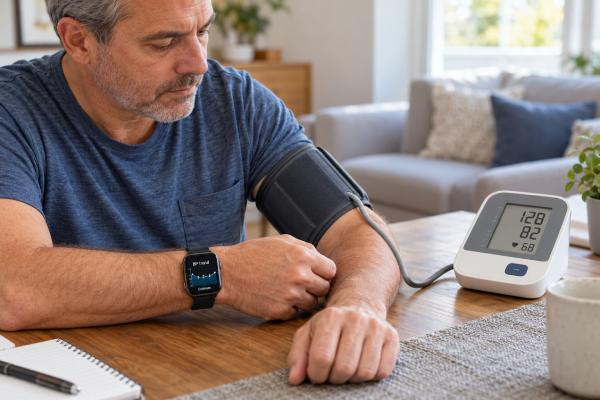
If you want to see whether your watch is at least behaving plausibly, compare it with a validated upper-arm cuff under calm, repeatable conditions. Sit quietly for five minutes, keep both devices positioned as instructed, and avoid comparing a watch reading taken while walking with a cuff reading taken after resting. Repeat the comparison on several days rather than performing ten rapid checks in one sitting.
Large, repeated differences are a reason to stop using the watch value for decisions. Small differences do not prove clinical validity, but they can tell you whether the feature is obviously unstable for you. If the watch must be recalibrated, repeat the comparison after recalibration and after major changes such as a new blood pressure medication or substantial weight change.
Do not “correct” the watch by mentally adding or subtracting a fixed number. Error can change across pressure ranges and conditions, so a watch that is 8 mm Hg low today may not be 8 mm Hg low tomorrow.
A useful reference point is the validated cuff itself. If you already own a reliable upper-arm monitor, compare the watch only under similar resting conditions. Even then, a handful of matching readings does not establish scientific validation, but repeated large mismatches are a clear reason not to trust the watch for decisions.
The Best Way to Track Blood Pressure at Home
For routine home monitoring, a validated automatic upper-arm cuff remains the practical standard. Wrist cuffs can work in some situations but are much more sensitive to position. Finger devices are generally less reliable for routine hypertension management.
Choose a cuff that fits your arm. A cuff that is too small can overestimate pressure; one that is too large can distort readings in the other direction. If you are unsure, check the arm-circumference range printed on the cuff.
For a high-quality home reading:
- Avoid smoking, caffeine, and exercise for about 30 minutes beforehand when possible.
- Empty your bladder.
- Sit quietly for about five minutes.
- Keep your back supported and feet flat on the floor.
- Place the cuff on a bare upper arm.
- Support the arm so the cuff is at heart level.
- Do not talk during the measurement.
- Take two readings about one minute apart.
For diagnosis or treatment review, clinicians often prefer several days of morning and evening readings rather than random checks throughout the day. A structured home blood pressure schedule produces data that are easier to interpret.
| Tool | Best use | Main limitation |
|---|---|---|
| Validated upper-arm cuff | Home diagnosis support and treatment monitoring | Requires correct cuff size and technique |
| 24-hour ambulatory monitor | Nighttime pressure, white-coat or masked hypertension | Less comfortable and usually clinician-arranged |
| Cuffless smartwatch | Trend awareness and wellness tracking | Accuracy and real-world reliability remain uncertain |
| Wrist cuff | Alternative when upper-arm measurement is difficult | Very sensitive to wrist position |
If your smartwatch motivates you to check pressure correctly, that is useful. Let the watch be the reminder and the validated cuff be the measurement you use for medical decisions.
If you are bringing data to an appointment, a concise log is usually more useful than screenshots of hundreds of watch readings. Record the date, time, cuff reading, any symptoms, and whether the measurement was before medication, after exercise, or under unusual stress. This gives the clinician context and makes it easier to decide whether the pattern is real.
One final point: do not over-measure. Blood pressure naturally changes from minute to minute. Rechecking every few minutes after one high number can increase anxiety and create a string of stress-driven readings. Follow a planned schedule, average repeated measurements, and review persistent patterns with a clinician.
The technology will likely improve, and standardized validation should make future devices easier to compare across brands, populations, blood pressure ranges, and everyday conditions as sensors and algorithms become more mature clinically. Cuffless blood pressure monitoring could eventually provide valuable information during sleep and daily activity that conventional cuffs cannot easily capture. For now, the promise is ahead of the evidence. Use smartwatch readings as supplemental information, confirm important values with a validated cuff, and base diagnosis and treatment on measurements that meet accepted clinical standards.
When a cuffless device reports a trend that looks important, use a confirmation rule. For example, if the watch repeatedly shows values much higher than your usual range, sit quietly and check with the validated upper-arm cuff rather than reacting to the watch alone. If the cuff confirms a persistent change, record it and follow the plan your clinician has given you. This keeps the smartwatch useful as an alert without giving an unproven estimate too much authority.
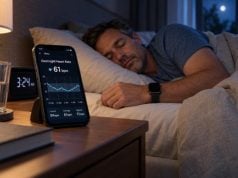
Nighttime readings deserve particular caution. Cuffless devices are attractive because a traditional cuff can disturb sleep, but measuring pressure during sleep introduces new problems: wrist position changes, the arm may be above or below heart level, contact pressure changes, and movement can corrupt optical signals. Until a specific device has strong validation for sleeping conditions, a graph of overnight estimates should not be interpreted like a validated ambulatory blood pressure study.
Software updates can also change algorithms without changing the watch hardware. If a manufacturer changes the blood pressure feature, old validation data may not perfectly describe the new version. Check whether the company identifies the exact software and model that were tested. In clinical measurement, “the same watch” is not always the same measurement system after a major algorithm update.
If your clinician asks you to bring home readings, prioritize measurements from the validated cuff and label smartwatch values separately. Mixing the two into one average can make the record misleading because the devices do not share the same measurement method or error profile. Clear labeling preserves whatever usefulness the watch data may have.
References
- Cuffless Devices for the Measurement of Blood Pressure: A Scientific Statement From the American Heart Association 2026 (Position Statement)
- 2025 AHA/ACC/AANP/AAPA/ABC/ACCP/ACPM/AGS/AMA/ASPC/NMA/PCNA/SGIM Guideline for the Prevention, Detection, Evaluation and Management of High Blood Pressure in Adults: A Report of the American College of Cardiology/American Heart Association Joint Committee on Clinical Practice Guidelines 2025 (Guideline)
- European Society of Hypertension recommendations for the validation of cuffless blood pressure measuring devices: European Society of Hypertension Working Group on Blood Pressure Monitoring and Cardiovascular Variability 2023 (Position Statement)
- Cuffless Blood Pressure Measurement Using Smartwatches: A Large-Scale Validation Study 2023 (Validation Study)
- Wearable cuffless blood pressure monitoring devices: a systematic review and meta-analysis 2022 (Systematic Review)
Disclaimer
This article is for general education and does not replace individualized medical advice. Do not start, stop, or change blood pressure medication based on an unvalidated smartwatch reading. Confirm important readings with a validated cuff and seek urgent care for severely elevated confirmed blood pressure with chest pain, shortness of breath, neurologic symptoms, confusion, or other emergency warning signs.