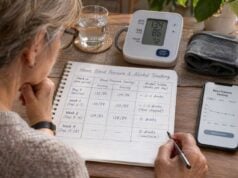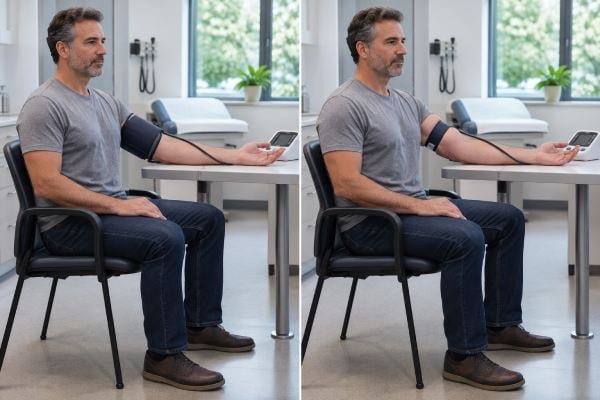
The size of your blood pressure cuff can change the number on the screen enough to affect whether a reading looks normal, elevated, or dangerously high. A cuff that is too small for your upper arm usually pushes the reading upward, while a cuff that is too large can make it read lower than it really is. In a randomized trial, using a regular cuff on people who needed an extra-large cuff raised systolic pressure by about 19.5 mm Hg on average. That is not a minor technical detail. It can influence diagnosis, medication decisions, and how worried you feel about a home reading. The safest approach is simple: measure your mid-upper-arm circumference, use a validated upper-arm monitor, and choose a cuff whose printed size range actually includes your arm measurement. Then use the same correct cuff and standardized technique each time. Good blood pressure tracking starts with a cuff that fits.
Table of Contents
- Why Cuff Size Changes Blood Pressure Readings
- How to Measure Your Arm and Choose the Right Cuff
- What Happens When the Cuff Is Too Small or Too Large
- How to Position and Fit the Cuff Correctly
- Special Fit Problems and Alternative Options
- Other Measurement Errors That Can Distort Your Reading
- When to Check Your Monitor or Talk With a Clinician
Why Cuff Size Changes Blood Pressure Readings
Blood pressure cuffs are measuring tools, and the tool must match the arm it is measuring. The inflatable bladder inside the cuff compresses the brachial artery in the upper arm. An automated monitor then analyzes pressure changes as the cuff deflates and estimates systolic and diastolic blood pressure.
If the cuff is not the right size, the amount and distribution of pressure around the arm changes. That can create a systematic error rather than a random one. In other words, a wrong cuff may not simply give a slightly different number once. It may keep pushing readings in the same direction every time you use it.
The problem is often called miscuffing. Two common forms are:
- Undercuffing: the cuff is too small for the arm. This tends to overestimate blood pressure.
- Overcuffing: the cuff is too large for the arm. This tends to underestimate blood pressure.
The effect is especially important when the mismatch is large. Someone whose arm requires an extra-large cuff may get a much bigger error from a standard cuff than someone whose arm is only slightly outside the standard range.
Cuff size also matters because blood pressure decisions often depend on differences of only a few millimeters of mercury, written as mm Hg. A repeated error of 5, 10, or nearly 20 mm Hg can move a person across diagnostic or treatment thresholds. It can also make a medication appear ineffective or make a well-controlled pressure look too low.
This is why a good home blood pressure monitor is not just a machine with a reassuring brand name or a large display. It needs a cuff that fits the person who will actually use it.
How to Measure Your Arm and Choose the Right Cuff
Choose cuff size from your measured upper-arm circumference, not from your clothing size, body weight, or a guess such as “average adult.” Different monitor manufacturers use different cuff ranges, so the label on the specific cuff matters more than a generic small, medium, large, or extra-large name.
A flexible tape measure is enough for most adults. If possible, have another person help so the tape stays level without being pulled too tight.
- Relax your arm and let it hang naturally at your side.
- Find the point halfway between the top of your shoulder and the point of your elbow.
- Wrap the tape around the arm at that midpoint.
- Keep the tape snug against the skin without compressing it.
- Record the circumference in centimeters, because many cuff labels use centimeters.
- Check the cuff or device instructions and confirm that your measurement falls inside the stated circumference range.
For example, if a cuff is labeled for 22–42 cm arms and your arm measures 44 cm, the cuff is not a correct fit even if you can force the Velcro to close. The fact that a cuff physically wraps around the arm does not mean the inflatable section is designed for that circumference.
Likewise, an oversized “wide range” cuff is not automatically better for everyone. If your arm is smaller than the lower limit printed on the cuff, the reading can be biased downward.
Measure again if your arm size changes
Upper-arm circumference can change after substantial weight loss or gain, strength training, swelling, or changes in muscle mass. If the cuff that used to fit now barely closes, overlaps unusually far, or leaves the size marker outside the printed range, remeasure your arm.
If several people share one monitor, each person may need a different cuff. Keep the correct cuff with each person’s name or arm measurement if confusion is likely.
When buying a device, check the available cuff range before purchasing. A monitor can be clinically validated yet still be a poor practical choice if the supplied cuff does not fit your arm. If you are learning how to measure blood pressure at home, sizing the cuff is one of the first steps to get right.
What Happens When the Cuff Is Too Small or Too Large
A cuff that is too small usually reads too high, while a cuff that is too large usually reads too low. The farther the size mismatch, the larger the potential error. Recent randomized studies show that miscuffing can create clinically meaningful differences even with automated monitors.
In the 2023 Cuff(SZ) randomized crossover trial, 195 adults had repeated automated measurements with correct and incorrect cuff sizes. When a regular cuff was used instead of the proper size:
| Correct cuff needed | Wrong cuff used | Average systolic difference | Likely effect |
|---|---|---|---|
| Small | Regular | About 3.6 mm Hg lower | Pressure may look lower than it is |
| Large | Regular | About 4.8 mm Hg higher | Pressure may look higher than it is |
| Extra-large | Regular | About 19.5 mm Hg higher | Major overestimation is possible |
A separate 2025 randomized crossover study of 223 hospitalized adults measured blood pressure while participants were lying down. It found the same general pattern: cuffs that were too small raised readings in people with larger arms, while oversized cuffs lowered readings in people with smaller arms.
These numbers help explain why cuff size can create a false impression of blood pressure variability. If you use a correct cuff at home but a too-small cuff at a pharmacy kiosk or clinic, the difference may come partly from equipment rather than from a true physiologic change.
The direction of error matters, but do not try to “correct” the number yourself
It may be tempting to subtract 5 or 20 points from a high reading because you suspect the cuff is too small. Do not do that. The research averages describe groups, not a guaranteed correction factor for one person. The exact error depends on arm size, cuff design, device, positioning, and how large the mismatch is.
Instead, repeat the measurement with an appropriately sized cuff under standard conditions. If the correct cuff is unavailable, treat the reading as potentially unreliable and arrange a better measurement rather than doing mental arithmetic.
How to Position and Fit the Cuff Correctly
Correct size is necessary, but the cuff also has to be placed and tightened correctly. A perfectly sized cuff can still give a poor reading if it is wrapped over thick clothing, hangs loosely, sits far from the recommended position, or is held above or below heart level during measurement.
Follow the instructions for your specific monitor first, because cuff shapes and alignment markers vary. For a typical automated upper-arm monitor:
- Put the cuff on bare skin, not over a shirt or sweater.
- Place it on the upper arm above the bend of the elbow as directed by the manufacturer.
- Keep the cuff smooth and evenly wrapped rather than twisted or folded.
- Tighten it snugly enough that it stays in place without painfully squeezing before inflation.
- Use any artery, index, or range markings exactly as the manufacturer describes.
- Support the arm so the middle of the cuff is roughly at heart level during the reading.
Do not assume a visible gap automatically means the cuff is too loose or a firm fit means it is too tight. Modern cuffs differ in construction. The better test is whether you followed the device instructions and the arm circumference falls within the cuff’s labeled range.
Avoid rolling a tight sleeve above the cuff
Rolling a sleeve high on the upper arm can create its own compression, especially with thick or tight clothing. If the sleeve bunches around the arm, remove that garment or change into something loose enough to expose the arm comfortably.
Use the same arm when tracking trends
Blood pressure can differ between arms. Your clinician may check both arms initially and advise which one to use for ongoing monitoring. Once you have that guidance, using the same arm, same cuff, and same general technique makes trends easier to interpret.
If you are building a home log, a consistent blood pressure monitoring schedule reduces noise from both technique and timing.
Special Fit Problems and Alternative Options
Some arms do not fit a standard cylindrical cuff well even when the circumference appears to be in range. Large, muscular, short, tapered, or conical upper arms can make proper placement harder. Swelling, lymphedema, dialysis access, prior lymph-node surgery, pain, skin injury, pregnancy, and pediatric age can also change how or where blood pressure should be measured.
Large or conical upper arms
If a standard cuff will not wrap evenly or repeatedly slides down, look for a validated device with a cuff specifically designed for the needed circumference and shape. Some manufacturers offer extra-large or wide-range cuffs as separate accessories. Confirm that the accessory cuff is approved for the exact monitor model; a cuff from another brand may not be interchangeable even if the connector fits.
Large arms deserve particular attention because a too-small standard cuff can substantially overestimate systolic pressure. Do not accept a routine “regular adult” cuff simply because it is the only cuff available.
Very small arms
Adults with small upper arms can be miscuffed too. If the cuff’s lower circumference limit is larger than your arm, an oversized cuff may underestimate pressure. A smaller compatible cuff may be required.
Wrist monitors
Validated upper-arm monitors are generally preferred for home use. A wrist monitor can be useful in selected people when a properly fitting upper-arm cuff cannot be used, but wrist measurements are highly sensitive to position. The wrist must be held at heart level, and the device instructions must be followed carefully.
Do not switch to a smartwatch or other cuffless device simply to avoid cuff-fit problems. The 2025 high blood pressure guideline advises against relying on cuffless devices for accurate blood pressure measurement until they demonstrate better precision and reliability. For more detail, see how smartwatch blood pressure tracking differs from standard cuff measurement.
Pregnancy, children, and medical conditions affecting one arm
Pregnancy and childhood have their own clinical measurement considerations, including appropriate cuff dimensions and interpretation standards. If you have a dialysis fistula, significant arm swelling, recent surgery, injury, or a condition that makes one arm unsuitable, ask your healthcare team which arm and device to use. Do not improvise by moving the cuff to the forearm or another site unless a clinician has shown you an appropriate method.
Other Measurement Errors That Can Distort Your Reading
Fixing cuff size will not make a reading accurate if the rest of the measurement setup is poor. Blood pressure is sensitive to posture, activity, stress, recent substances, and whether your body is supported.
Before a routine home measurement, use a repeatable setup:
- Avoid smoking, caffeinated drinks, alcohol, and exercise for about 30 minutes beforehand when possible.
- Empty your bladder.
- Sit quietly for at least five minutes.
- Sit with your back supported, feet flat on the floor, and legs uncrossed.
- Support the measured arm on a surface so the cuff is at heart level.
- Do not talk, text, or move during the measurement.
- Take at least two readings about one minute apart and record the results.
Technique errors can stack. Imagine that a cuff is too small, you just walked up a flight of stairs, your arm is hanging below heart level, and you are talking while the machine inflates. A high number from that situation does not tell you which factor caused how much of the elevation.
This is one reason to avoid repeatedly checking every few minutes in changing conditions. If a reading is unexpectedly high but you have no emergency symptoms, sit quietly, correct the setup, and repeat it after a short rest according to your clinician’s plan.
A home result also needs context. White coat hypertension can make office readings higher than home readings, while masked hypertension can create the opposite pattern. Correct cuff sizing is essential in both settings because you cannot compare two locations fairly if one uses the wrong equipment.
Keep the measuring system consistent
When possible, use the same validated monitor and correct cuff for serial readings. Switching among home devices, gym kiosks, pharmacy machines, and different clinic cuffs can add equipment-related variation. Consistency makes changes over time more meaningful.
When to Check Your Monitor or Talk With a Clinician
Recheck the cuff and device whenever your readings seem implausible, change suddenly without explanation, or differ consistently from properly taken clinic measurements. A fitting problem is common enough to check early, especially before changing medication based on a surprising home trend.
Bring your monitor and cuff to a medical appointment if:
- You are not sure the cuff size is correct.
- Your arm measurement is near the upper or lower limit of the cuff range.
- The cuff repeatedly pops open, slips, or cannot wrap smoothly.
- Home readings are consistently far above or below office readings.
- Two home monitors give very different results under the same conditions.
- You have lost or gained substantial weight since the cuff was selected.
- You need a replacement cuff and are unsure which model is compatible.
A clinician or trained staff member can watch your technique, confirm the cuff fit, and compare your device with office equipment. This does not mean the numbers must match exactly on every reading. Blood pressure naturally changes from minute to minute, and devices have normal measurement tolerances. The goal is to rule out a consistent problem large enough to mislead treatment decisions.
Do not adjust blood pressure medication from one questionable reading
If you get an unexpectedly high or low value, first consider whether the reading was taken correctly. Repeat it using the proper cuff and standardized technique. Medication changes should be based on a pattern of reliable readings plus your symptoms and clinical history, not one measurement from an uncertain cuff.
The current high blood pressure guideline supports home monitoring as part of blood pressure control when it is paired with standardized measurement and clinical follow-up. That makes accuracy worth the extra minute it takes to check cuff fit.
If you repeatedly record readings above the range your clinician gave you, or you develop dizziness, fainting, or other symptoms with low readings, contact your healthcare professional. If blood pressure is above about 180/120 mm Hg and remains that high on repeat measurement, seek prompt medical guidance. If a very high reading occurs with chest pain, shortness of breath, weakness, numbness, trouble speaking, confusion, vision changes, or another sign of acute illness, seek emergency medical care.
The key point is practical: the right cuff is part of the measurement, not an optional accessory. Measure your arm, match it to the cuff’s labeled range, position the cuff correctly, and keep your technique consistent. Those steps make the numbers far more useful for deciding what your blood pressure really is and what to do about it.
References
- Effects of Cuff Size on the Accuracy of Blood Pressure Readings: The Cuff(SZ) Randomized Crossover Trial 2023 (RCT)
- Influence of cuff size on the accuracy of supine blood pressure measurement. 2025 (RCT)
- Home Blood Pressure Measurement Instructions 2025 (Patient Instructions)
- Top Things to Know: 2025 High Blood Pressure (BP) Guideline 2025 (Guideline)
- Self-Measured Blood Pressure Monitoring at Home: A Joint Policy Statement From the American Heart Association and American Medical Association 2020 (Position Statement)
Disclaimer
This article is for general education and cannot determine whether your blood pressure cuff, monitor, or readings are accurate for your individual situation. Ask a healthcare professional to review unexpected readings, persistent high or low blood pressure, or uncertainty about cuff fit and measurement technique. Seek emergency care for very high blood pressure accompanied by chest pain, shortness of breath, neurologic symptoms, confusion, fainting, or other signs of acute illness.