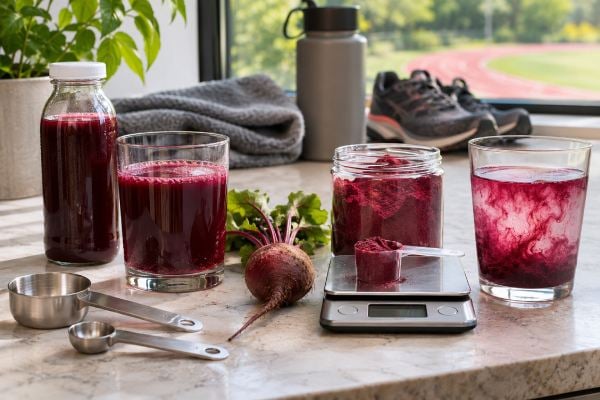
Beetroot juice is the better-studied option for both blood pressure and exercise performance, mainly because researchers can standardize the nitrate dose. Beetroot powder can work too, but only if the product provides enough nitrate and clearly states that amount. A scoop measured only in grams of beet powder cannot be assumed to match a research dose.
For exercise, many studies use about 300–600 mg nitrate, usually taken 2–3 hours before activity or consumed daily for several days. For hypertension, trials have used roughly 200–800 mg nitrate per day, with recent evidence showing an average reduction of about 5 mmHg in clinic systolic blood pressure from nitrate-rich beetroot juice. Results vary, and 24-hour blood-pressure benefits are less consistent. The practical question is therefore not just “powder or juice?” It is whether the product delivers a known nitrate dose, whether the timing matches your goal, and whether concentrated nitrate is safe with your medications and usual blood pressure.
Table of Contents
- How Beetroot Nitrate Works
- Beetroot Juice: Advantages and Drawbacks
- Beetroot Powder: Advantages and Drawbacks
- Best Dose for Blood Pressure
- Best Dose and Timing for Exercise Performance
- Juice vs Powder: Which Should You Choose?
- Safety and Common Mistakes
How Beetroot Nitrate Works
Beetroot is rich in inorganic nitrate. After ingestion, nitrate is absorbed and concentrated in saliva. Bacteria on the tongue reduce some of it to nitrite, which can later form nitric oxide. Nitric oxide helps blood vessels dilate and may improve muscle efficiency during exercise.
This pathway explains why mouth bacteria matter. Strong antibacterial mouthwash around the time of beetroot use can reduce nitrate-to-nitrite conversion and may blunt the effect. Ordinary toothbrushing is not the same as eliminating oral bacteria with repeated antiseptic rinses.
Nitrate is the active component most closely linked to the acute blood-pressure and performance effects. Betalains and other beet compounds may have biological effects too, but if you are comparing products, nitrate content is the most useful number.
A product can be vivid red and still provide a low nitrate dose. Agricultural and processing conditions create wide variation, so labels that list milligrams or millimoles of nitrate are much more informative than labels that list only grams of “beetroot.”
Beetroot Juice: Advantages and Drawbacks
Beetroot juice has the strongest research base. Many trials use concentrated “shots” rather than large glasses of ordinary juice. These products can provide several hundred milligrams of nitrate in a small volume, making them convenient before exercise and easier to standardize in research.
For hypertension, a 2024 meta-analysis of 11 randomized trials found that beetroot juice lowered clinic systolic blood pressure by about 5.3 mmHg on average. There was no significant pooled effect on clinic diastolic blood pressure or 24-hour blood pressure, and the certainty of evidence was low. That makes juice a possible adjunct, not a substitute for established treatment.
For exercise, nitrate supplementation tends to produce small average benefits, with the clearest effects in some endurance and repeated high-intensity tasks. Trained elite athletes may see smaller benefits than recreationally active people because their nitric-oxide systems and exercise economy are already highly developed.
The downsides of juice are cost, taste, storage, and the possibility of added sugar in some retail products. Concentrated sports shots usually contain less total sugar than a large glass of beet juice, but labels differ. Choose products that state nitrate content rather than relying on serving volume alone.
Beetroot Powder: Advantages and Drawbacks
Powder is portable, shelf-stable, and easy to mix into water or a smoothie. It can be a good alternative for people who dislike juice. The problem is standardization. Dehydrated beet powder may lose or concentrate nitrate depending on processing, and many products do not disclose the final nitrate amount.
A label that says “10 g beet powder” is not enough to predict a blood-pressure or performance effect. If the same product also states “400 mg nitrate,” it becomes much easier to compare with the research.
Some powders are actually made from concentrated beetroot juice and then dried, while others are whole-root powders. Neither category is automatically superior. What matters is a transparent nitrate specification, quality testing, and a serving that is practical to use consistently.
Powder can also be easier to dose in smaller increments. If a full research-style dose causes stomach upset or lightheadedness, a lower standardized amount may be easier to tolerate. But do not use “more scoops” to compensate for an unlabeled product; without nitrate data you still do not know the active dose.
If your focus is blood pressure rather than exercise, see whole beets versus beet supplements for the whole-food tradeoffs.
Best Dose for Blood Pressure
Hypertension trials have used daily nitrate doses roughly between 200 and 800 mg from beetroot juice. This is a wide range, and the available evidence does not establish a single perfect dose for every person. A moderate, standardized dose is usually more sensible than chasing the upper end.
Blood pressure should be measured repeatedly, not judged by symptoms. If you test a nitrate product, keep the dose and timing consistent for several days and use a validated upper-arm monitor. Take readings after five minutes of quiet sitting and average two measurements.
Because nitrate can lower blood pressure, discuss concentrated supplements with a clinician if you take several antihypertensive drugs, use prescription nitrates for angina, have frequent dizziness, or tend to run low. Do not stop or reduce medication because a beet product lowers one or two readings.
For a broader lifestyle plan, drinks for blood pressure can help you compare beetroot juice with coffee, tea, alcohol, and sugary beverages. The overall pattern is more important than any single drink.
Best Dose and Timing for Exercise Performance
A common performance dose is about 300–600 mg nitrate, often equivalent to roughly 5–10 mmol. Many studies give the dose 2–3 hours before exercise because plasma nitrite tends to rise over that time. Some protocols use daily supplementation for 3–6 days or longer before a competition.
The likely benefit is small. A large meta-analysis found a modest overall improvement in exercise performance, with beetroot juice and nitrate-rich diets showing clearer effects than nitrate salts. More recent umbrella evidence also suggests that benefits vary by exercise type, training status, dose, and protocol.
For recreational athletes, the most realistic expectation is a small improvement in exercise economy, time to exhaustion, or repeated high-intensity work rather than a dramatic jump in speed. Sprint-only outcomes are less consistent. In resistance exercise, some reviews suggest benefits for repetitions to failure and mean power, but the evidence base is smaller.
Test the product in training before race day. Beetroot can cause stomach upset, and red urine or stool can be surprising. A supplement strategy that causes GI distress is not performance-enhancing, no matter how promising the mechanism.
Juice vs Powder: Which Should You Choose?
For research-like dosing, choose the product that gives you a known nitrate amount and that you can take consistently. Juice wins on evidence. Powder wins on portability and often on convenience.
| Factor | Beetroot juice | Beetroot powder |
|---|---|---|
| Research support | Strongest | Less standardized |
| Nitrate labeling | Often available in sports shots | Highly variable |
| Travel/storage | Less convenient | Very convenient |
| Taste | Strong earthy flavor | Can be mixed into other drinks |
| Best use | Predictable standardized dosing | When nitrate content is clearly stated |
Do not compare products by beet grams alone. Compare milligrams of nitrate per serving, serving size, additives, third-party testing, and cost per effective dose.
If a powder does not disclose nitrate, treat it as a food powder rather than a performance supplement. It may still add useful plant compounds, but you cannot assume it will lower blood pressure or improve exercise in the same way as a standardized nitrate product.
Safety and Common Mistakes
Beetroot is safe for most healthy adults, but concentrated nitrate deserves respect. The most common issues are stomach upset, headache, lightheadedness, and beeturia—the harmless red or pink color that can appear in urine or stool.
People with recurrent calcium oxalate kidney stones may need to limit high-oxalate foods, including beets, depending on their overall diet and urine chemistry. People with kidney disease may need individualized potassium guidance.
Common mistakes include buying a product with no nitrate information, taking a huge dose immediately before an important event, using antibacterial mouthwash around dosing, or assuming supplements can replace antihypertensive medication.
If you are using nitrate for exercise, do not forget fundamentals: training, carbohydrate availability, hydration, sleep, and pacing usually matter more than a small supplement effect. If you are using it for blood pressure, sodium intake, body weight, activity, alcohol, sleep apnea, and medication adherence usually matter more.
The best beet strategy is therefore modest and measurable: use a standardized dose, test your response, and keep expectations realistic.
If your goal is performance, standardization matters because a very small effect can be lost in normal day-to-day variability. Test the same dose, timing, pre-exercise meal, and workout more than once before deciding whether the supplement helps you. One unusually good or bad session is not reliable evidence.
For blood pressure, the same logic applies. Record several days of baseline readings and compare averages after introducing the product. Avoid changing caffeine, sleep schedule, medication timing, and sodium intake at the same time if you want to isolate the beet effect.
Athletes should also check sport governing-body rules and use certified supplements when contamination risk matters. Beetroot itself is not a prohibited substance, but multi-ingredient performance products can contain undeclared stimulants or other compounds.
How to Convert Millimoles to Milligrams of Nitrate
Research papers often report nitrate in millimoles rather than milligrams. One millimole of nitrate is about 62 mg. That means 5 mmol is about 310 mg, 6 mmol about 372 mg, 8 mmol about 496 mg, and 10 mmol about 620 mg. This conversion helps when comparing a scientific study with a commercial product label.
Do not confuse nitrate with sodium nitrate. A label that lists the weight of a nitrate salt is not necessarily stating the same number as pure nitrate. If the label is unclear, contact the manufacturer or choose a product that directly states nitrate content.
Also check whether the listed dose is per scoop, per packet, or per recommended serving. Some powders require two scoops to reach the stated nitrate amount. Cost comparisons should therefore use cost per standardized nitrate dose rather than cost per container.
Acute Dosing vs Multi-Day Loading
For exercise, both acute and multi-day approaches have been studied. Acute dosing usually means taking nitrate about 2–3 hours before the session. Multi-day protocols use a daily dose for several days leading into an event. The multi-day approach may be more practical for events with several stages or when someone wants to avoid relying on perfect timing on race day.
There is no strong evidence that everyone needs a long “loading” phase. Recreational athletes often begin by testing a single standardized dose in training. If it is well tolerated, they can decide whether a short multi-day protocol is worth trying.
For blood pressure, repeated daily intake is more relevant than a one-time pre-exercise dose because the goal is a sustained average reduction. Still, home readings should determine whether the effect is meaningful for you.
Who Is Most Likely to Notice a Performance Benefit?
Meta-analyses suggest that less highly trained athletes may respond more than elite athletes. One explanation is that elite endurance athletes already have highly developed nitric-oxide signaling, mitochondrial efficiency, capillary density, and exercise economy, leaving less room for improvement.
Exercise type matters too. Evidence is stronger for some endurance, time-to-exhaustion, and repeated high-intensity tasks than for a single maximal sprint. Resistance-training research suggests possible improvements in repetitions to failure and mean power, but study numbers are smaller.
That means expectations should be sport-specific. A cyclist doing a 20-minute hard effort, a recreational runner, and a powerlifter may not respond the same way. If the expected gain is one or two percent, consistent testing is essential before deciding that a supplement works.
Food, Juice, or Supplement for Long-Term Use?
For long-term cardiovascular health, a nitrate-rich diet built from leafy greens and beets has advantages over relying only on supplements. Whole foods provide fiber, potassium, folate, and polyphenols and can displace less healthful foods. A standardized supplement is most useful when you need a predictable dose for a specific experiment, training session, or blood-pressure trial.
This distinction prevents supplement use from crowding out diet quality. You can eat nitrate-rich vegetables daily and still use a standardized beet shot before an important workout. The two strategies serve different purposes.
If cost, taste, or GI symptoms make daily juice impractical, do not force it. The cardiovascular benefit of regular exercise, blood-pressure control, sleep, and a high-quality diet is far larger than the likely incremental benefit of beetroot supplementation.
Common Labeling Traps
Do not assume that “nitric oxide booster,” “beet power,” or “clinically dosed” means a product contains a research-backed nitrate amount. Marketing language is not a substitute for a number. Look for nitrate in mg or mmol. If that information is missing, you cannot make a confident dose comparison.
Some products combine beetroot with citrulline, arginine, caffeine, or other performance ingredients. Those combinations may be useful for sport, but they make it harder to attribute a blood-pressure or performance change to nitrate. They can also introduce additional side effects or interactions. For a clean self-test, a single-ingredient standardized nitrate product is easier to interpret.
Storage matters too. Follow the package instructions, especially for liquid shots after opening. If a product has been exposed to heat or stored far beyond its recommended period, potency may be less predictable.
Finally, avoid using beetroot as a reason to ignore symptoms. Chest pain, fainting, severe shortness of breath, or neurologic symptoms require medical evaluation, not another serving of nitrate. Supplements can fine-tune performance or blood pressure; they are not emergency treatment.
The most useful way to apply this information is to make one change, measure the result, and then decide whether it deserves a permanent place in your routine. Cardiovascular risk factors respond to the total pattern over time, so a modest intervention can still be worthwhile when it is safe, affordable, and easy to sustain. At the same time, do not let a modest food or supplement effect delay treatment that has stronger evidence when your risk is high.
Keep records simple: note the product or food amount, the dates you used it, relevant home measurements, and the next lab value or clinic reading. This prevents memory from exaggerating benefits or side effects. If the expected benefit does not appear after a reasonable trial, reassess rather than automatically increasing the dose. If it does help, keep the rest of the plan in place—diet quality, physical activity, sleep, smoking avoidance, and prescribed treatment remain the foundation of cardiovascular prevention.
A final caution is to separate a useful average effect from a guaranteed personal result. Research reports group averages, and individual responses can be smaller, larger, or absent. Genetics, baseline values, medication use, diet, training status, and measurement technique can all shift the response. That is why a short, structured trial with repeat measurements is more informative than assuming a product will work because a study was positive. Keep expectations proportional to the evidence and use objective follow-up to decide what belongs in your long-term plan.
References
- Effects of beetroot juice on blood pressure in hypertension according to European Society of Hypertension Guidelines: A systematic review and meta-analysis 2024 (Systematic Review)
- Factors that Moderate the Effect of Nitrate Ingestion on Exercise Performance in Adults: A Systematic Review with Meta-Analyses and Meta-Regressions 2022 (Systematic Review)
- Dietary Nitrate Supplementation and Exercise Performance: An Umbrella Review of 20 Published Systematic Reviews with Meta-analyses 2025 (Umbrella Review)
- Effects of Dietary Nitrate Supplementation on High-Intensity Cycling Sprint Performance in Recreationally Active Adults: A Systematic Review and Meta-Analysis 2024 (Systematic Review)
- Effects of Dietary Nitrate Supplementation on Back Squat and Bench Press Performance: A Systematic Review and Meta-Analysis 2023 (Systematic Review)
Disclaimer
This article is general education, not individualized medical advice. Ask a clinician before using concentrated nitrate products if you take blood-pressure or nitrate medicines, have frequent low blood pressure, kidney disease, or recurrent kidney stones. Do not change prescribed medication based on beetroot use without medical guidance.