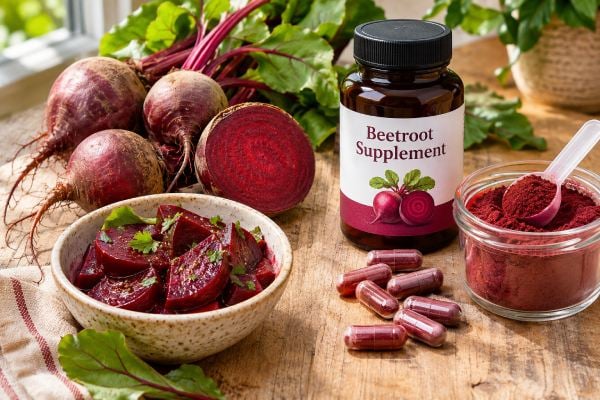
For lowering blood pressure, the most reliable beet evidence is for nitrate-rich beetroot juice and other products that provide a clearly measured dose of nitrate. Whole beets can also contribute dietary nitrate, potassium, fiber, and other nutrients, but their nitrate content varies more from serving to serving. Beet powders and capsules are convenient, yet they are only likely to reproduce the blood-pressure effect if the label tells you how much nitrate the product actually provides.
Clinical trials in people with hypertension suggest that beetroot juice can lower clinic systolic blood pressure by roughly 5 mmHg on average, although the evidence is not uniform and 24-hour blood-pressure effects are less consistent. That makes beets an adjunct, not a replacement for medication or a broader blood-pressure plan. The key comparison is not “food versus supplement” in the abstract. It is how much usable nitrate you get, how consistently you take it, and whether the product has been tested and dosed clearly.
Table of Contents
- Why Beets Can Affect Blood Pressure
- Whole Beets vs Beetroot Juice
- Beet Powder, Capsules, and Chews
- How Much Nitrate May Help?
- Which Form Is Best for Blood Pressure?
- Safety, Side Effects, and Red Urine
- How to Test Whether It Works for You
Why Beets Can Affect Blood Pressure
Beets are rich in inorganic nitrate. After you eat nitrate, bacteria in the mouth convert some of it to nitrite. The body can then convert nitrite to nitric oxide, a signaling molecule that helps blood vessels relax and can reduce vascular resistance. This nitrate–nitrite–nitric oxide pathway is the main reason beetroot has been studied for blood pressure and exercise performance.
The effect depends on more than the color of the product. Nitrate content can vary with soil, growing conditions, processing, storage, and serving size. Two beet powders that both contain “5 g beetroot” may deliver very different amounts of nitrate. A standardized shot of beetroot juice can be more predictable if it lists nitrate in milligrams or millimoles.
Oral bacteria are part of the pathway, which explains an unusual practical point: strong antibacterial mouthwash used around the time of nitrate intake may reduce nitrate conversion and blunt some physiological effects. You do not need to avoid dental hygiene, but frequent antiseptic mouthwash can interfere with the oral nitrate pathway.
Beets also contain potassium, folate, betalain pigments, and fiber when eaten whole. Those nutrients are useful, but the short-term blood-pressure effect studied in trials is most strongly tied to nitrate.
Whole Beets vs Beetroot Juice
Whole beets are an excellent food, but they are not the easiest way to deliver a research-like nitrate dose. A serving of roasted, boiled, or raw beets can contribute meaningful nitrate, yet the amount varies and is rarely shown on a grocery label. For someone who simply wants a heart-healthy vegetable, that variation is not a problem. For someone trying to reproduce a clinical-trial dose, it matters.
Beetroot juice is easier to standardize. Trials in hypertension have used nitrate-rich juice providing roughly 200–800 mg nitrate per day. A 2024 meta-analysis found an average reduction in clinic systolic blood pressure of about 5.3 mmHg, with no significant change in clinic diastolic or 24-hour blood pressure. The certainty of evidence was rated low, so results should be viewed as promising rather than definitive.
Juice has less fiber than whole beets and can provide more carbohydrate in a small volume. That is usually not a major issue at the small concentrated doses used in nitrate shots, but large glasses of juice can add calories quickly.
If you enjoy beets, whole beets are a strong default because they improve the overall diet. If your primary goal is a consistent nitrate dose, a standardized juice product is easier to use. See beetroot juice for high blood pressure for a closer look at the clinical evidence.
Beet Powder, Capsules, and Chews
Beet supplements vary widely. Powder may be made from dehydrated beetroot or concentrated beet juice. Capsules may contain beet powder, nitrate salts, or proprietary blends. Chews may include sugar or other ingredients. The form itself does not tell you the effective dose.
Look for a label that states nitrate content. If a product lists only “beetroot powder 5,000 mg” without nitrate, you cannot reliably compare it with a study that used 400 mg nitrate. The same limitation applies to powders sold by scoop. A brightly colored powder is not necessarily nitrate-rich.
Some sports supplements use standardized nitrate doses and may be better documented than generic beet powders. Even then, verify the serving size, nitrate amount, other stimulants, and third-party testing. More is not always better; excessive nitrate intake can cause headache, lightheadedness, stomach upset, or an excessive blood-pressure drop in susceptible people.
A powder can be more convenient than juice and easier to travel with. It may also be lower in sugar. But convenience only matters if the product delivers the active component consistently. For a direct comparison of common dosing formats, beetroot powder versus beet juice covers blood pressure and exercise use.
How Much Nitrate May Help?
Trials often use nitrate doses in the range of about 300–600 mg for exercise performance, while hypertension studies have used a broader range from roughly 200 to 800 mg per day. Because 1 millimole of nitrate is about 62 mg, a supplement labeled as 6 mmol provides roughly 372 mg nitrate.
For blood pressure, consistency may matter more than taking one very large dose. Some studies use daily intake for days or weeks. Acute effects can occur within a few hours, but long-term blood pressure should be judged with repeated home readings rather than how you feel after one serving.
Do not chase a specific dose without considering your medications. If you use nitrates for angina, PDE-5 inhibitors, several blood-pressure drugs, or have a history of low blood pressure, adding concentrated nitrate may increase lightheadedness or hypotension. The evidence for dangerous interactions with food-level nitrate is limited, but concentrated supplements justify more caution.
Also remember that vegetable nitrate is not the same thing as processed-meat nitrite exposure. Vegetables come with vitamin C, polyphenols, and other compounds, and epidemiologic patterns differ substantially. The concern around processed meats should not be used to argue that nitrate-rich vegetables are unhealthy.
Which Form Is Best for Blood Pressure?
If the goal is a predictable nitrate dose, standardized beetroot juice or a supplement that clearly states nitrate content is the most practical choice. If the goal is overall diet quality, whole beets offer more advantages because they provide fiber and can replace less healthful side dishes.
| Form | Main advantage | Main limitation |
|---|---|---|
| Whole beets | Fiber, nutrients, whole-food value | Nitrate amount varies |
| Beetroot juice | Best studied; easier to standardize | Less fiber; some products add sugar |
| Beet powder | Portable and convenient | Nitrate often not listed |
| Capsules/chews | Easy dosing | Quality and nitrate content vary |
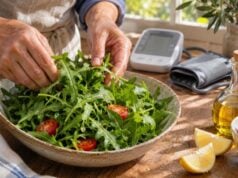
For most people, a reasonable approach is to eat nitrate-rich vegetables regularly and use a standardized product only if there is a specific reason. Arugula, spinach, lettuce, celery, and beet greens can also provide nitrate. That means you do not need beet supplements to support nitric oxide production.
No beet product should be framed as a treatment that allows you to ignore sodium, exercise, weight, sleep, alcohol, or prescribed medication. Those factors have larger and better-established effects on long-term cardiovascular risk.
Safety, Side Effects, and Red Urine
Beets are safe for most people in food amounts. A harmless effect called beeturia can turn urine or stool pink or red after eating beets. This can be startling but is usually not dangerous. If red urine occurs without recent beet intake, or is accompanied by pain or other symptoms, it should not be assumed to be beeturia.
Beets are relatively high in oxalate, so people with recurrent calcium oxalate kidney stones may need individualized advice about portion size and overall oxalate intake. People with chronic kidney disease may also need to monitor potassium intake depending on kidney function and medications.
Concentrated nitrate supplements can cause headache, stomach upset, or dizziness. Because nitrate can lower blood pressure, be cautious if your usual pressure is already low or you take multiple antihypertensive drugs. Check readings rather than relying on symptoms.
Supplements are not all tested to the same standard. Look for transparent labels and independent certification when possible. Avoid products that make extreme claims such as “replaces blood pressure medicine” or promise guaranteed reductions.
If you are using beets as part of a broader food strategy, vegetables for heart health can help you diversify nitrate, potassium, and fiber sources.
How to Test Whether It Works for You
A simple home experiment can tell you more than guessing. First, use a validated upper-arm cuff and establish a baseline with readings at consistent times for several days. Then add a consistent amount of the beet product while keeping major variables—such as caffeine, exercise timing, and medication—stable.
Measure blood pressure under the same conditions. Take two readings about one minute apart after sitting quietly for five minutes, and record the average. Look for a trend across several days rather than a single low number. If you become dizzy or your readings are unusually low, stop the concentrated product and contact your clinician.
If you see a modest improvement, that can be useful, but do not reduce prescription medication on your own. Medication changes should be based on a clinician’s review of repeated blood-pressure data and your overall cardiovascular risk.
The bottom line is straightforward: whole beets are excellent food, but standardized nitrate-rich juice or a clearly labeled nitrate supplement is more predictable for blood-pressure experiments. The best option is the one that supplies a known dose safely and fits into a broader plan you can sustain.
Cost can also guide the choice. Whole beets are usually inexpensive per serving and contribute to a meal. Standardized nitrate shots can be much more expensive, especially when used every day. If the blood-pressure effect is small, consider whether the recurring cost is worthwhile compared with investments that improve several risk factors at once, such as buying more vegetables, a validated blood-pressure monitor, or supportive exercise equipment.
Taste matters because adherence matters. Some people dislike concentrated beet flavor but happily eat roasted beets, arugula, spinach, and other nitrate-rich vegetables. A nitrate-rich diet can support the same biological pathway without requiring a supplement ritual.
Also avoid assuming that visible redness indicates potency. Betalain pigments create the color, while nitrate concentration is a separate characteristic. A deeply red product can still have an unknown nitrate dose.
Whole-Food Nitrate Sources Beyond Beets
Beets are not the only nitrate-rich food. Arugula, spinach, lettuce, celery, chard, and beet greens can provide substantial nitrate as part of ordinary meals. Nitrate content varies, but a diet that regularly includes leafy greens can support nitric-oxide biology without relying on a single supplement. This is useful for people who dislike beets or do not want the cost of concentrated products.
Whole vegetables also bring fiber, potassium, folate, vitamin C, and polyphenols. That matters because long-term cardiovascular health depends on much more than the nitrate pathway. A salad built from arugula and leafy greens may not provide the same standardized nitrate dose as a research shot, but it improves overall diet quality in a way a capsule does not.
Cooking does not make vegetables useless. Some nitrate can leach into cooking water, especially with boiling, but cooked greens can still contribute meaningfully. If you boil beets or greens, using the cooking liquid in soup retains more of what would otherwise be discarded. Roasting and steaming are other practical options.
How to Read a Beet Supplement Label
Look first for nitrate, not total beet weight. A useful label might say “provides 400 mg nitrate per serving” or list nitrate in millimoles. If the label says only “beetroot powder 5 g,” you do not know whether the dose is equivalent to what was studied. Also check serving size, added sugars, caffeine, amino acids, and other performance ingredients.
Third-party testing is particularly valuable for athletes or people who want confidence in purity. Certification cannot guarantee a blood-pressure effect, but it can reduce uncertainty about contaminants and whether the product contains the listed ingredients.
Avoid products that combine beetroot with many stimulants if the goal is blood pressure. Caffeine and other stimulants can raise heart rate or blood pressure and make it impossible to know what the beet component is doing. Simpler formulations are easier to evaluate.
When a Small Blood-Pressure Drop Matters
An average systolic reduction of around 5 mmHg may sound modest, but population studies suggest that even small sustained blood-pressure reductions can matter for cardiovascular risk. The key word is sustained. A temporary drop for a few hours after a nitrate dose is not the same as maintaining lower blood pressure across weeks and months.
That is why 24-hour ambulatory or repeated home readings are more informative than a single clinic measurement. The latest meta-analysis found a clearer effect on clinic systolic pressure than on 24-hour pressure, so expectations should stay realistic.
If beetroot helps by a few mmHg, it can be one part of a layered approach alongside sodium reduction, exercise, weight management, sleep, and medication. If it does nothing, you have not failed; individual nitrate responses vary. Move on to interventions with stronger or more predictable effects rather than escalating the dose indefinitely.
Practical Serving Ideas for Whole Beets
If you prefer food over supplements, roasted beets can be prepared in a batch and added to salads, grain bowls, or yogurt-based dips. Shredded raw beets work in slaws, and cooked beets pair well with lentils, walnuts, citrus, and leafy greens. Beet greens are edible too and provide potassium, magnesium, and nitrate.
A serving of whole beets does not need to mimic a clinical trial dose to be worthwhile. The goal can simply be to replace a lower-quality side dish with a vegetable. If you want to test blood-pressure response more formally, use a standardized nitrate product rather than trying to estimate nitrate from the weight of cooked beets.
This distinction helps avoid false precision. Whole foods are best judged by their contribution to the overall diet, while supplements are best judged by dose, purity, and measurable effect.
The most useful way to apply this information is to make one change, measure the result, and then decide whether it deserves a permanent place in your routine. Cardiovascular risk factors respond to the total pattern over time, so a modest intervention can still be worthwhile when it is safe, affordable, and easy to sustain. At the same time, do not let a modest food or supplement effect delay treatment that has stronger evidence when your risk is high.
Keep records simple: note the product or food amount, the dates you used it, relevant home measurements, and the next lab value or clinic reading. This prevents memory from exaggerating benefits or side effects. If the expected benefit does not appear after a reasonable trial, reassess rather than automatically increasing the dose. If it does help, keep the rest of the plan in place—diet quality, physical activity, sleep, smoking avoidance, and prescribed treatment remain the foundation of cardiovascular prevention.
References
- Effects of beetroot juice on blood pressure in hypertension according to European Society of Hypertension Guidelines: A systematic review and meta-analysis 2024 (Systematic Review)
- Nitrate Derived From Beetroot Juice Lowers Blood Pressure in Patients With Arterial Hypertension: A Systematic Review and Meta-Analysis. 2022 (Systematic Review)
- Factors that Moderate the Effect of Nitrate Ingestion on Exercise Performance in Adults: A Systematic Review with Meta-Analyses and Meta-Regressions 2022 (Systematic Review)
- Dietary Nitrate Supplementation and Exercise Performance: An Umbrella Review of 20 Published Systematic Reviews with Meta-analyses 2025 (Umbrella Review)
- Effects of Dietary Nitrate Supplementation on High-Intensity Cycling Sprint Performance in Recreationally Active Adults: A Systematic Review and Meta-Analysis 2024 (Systematic Review)
Disclaimer
Beets and nitrate supplements can lower blood pressure in some people and may interact with an existing treatment plan. If you take blood-pressure medicines, nitrate medicines, have kidney disease, recurrent kidney stones, or frequent low blood pressure, ask your clinician before using concentrated beet or nitrate supplements.