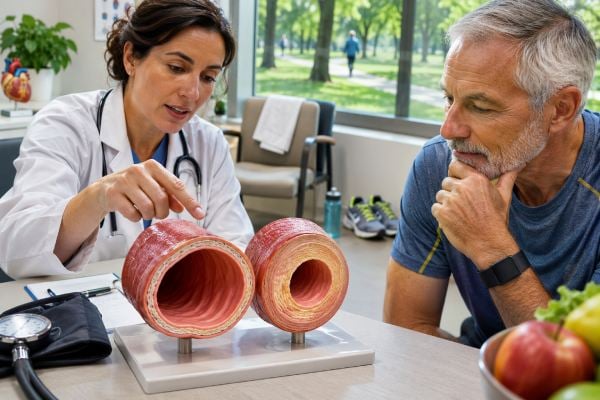
Arterial stiffness means the large arteries—especially the aorta—do not expand and recoil as easily with each heartbeat. Some stiffening is a normal part of aging, but high blood pressure, diabetes, smoking, kidney disease, inflammation, inactivity, and other cardiovascular risk factors can accelerate it. Stiffer arteries increase the speed of the pressure wave traveling through the circulation and can raise systolic pressure and pulse pressure, increasing the workload on the heart. Clinicians and researchers often estimate central arterial stiffness with carotid-femoral pulse wave velocity, although it is not a routine screening test for everyone. The good news is that arterial stiffness is not completely fixed. Regular aerobic exercise, well-designed resistance training, blood-pressure control, smoking cessation, weight loss when needed, adequate sleep, and a Mediterranean-style or similarly high-quality diet can improve vascular function and sometimes reduce measured stiffness. The goal is not to “soften arteries” with a supplement. It is to reduce the processes that damage vessel walls over time.
Table of Contents
- What arterial stiffness means
- How it is measured
- What causes arteries to stiffen
- Exercise and arterial stiffness
- Diet, weight, sleep, and smoking
- Blood pressure and medical treatment
- A practical plan to improve vascular health
What arterial stiffness means
Healthy large arteries are elastic. When the heart ejects blood, the aorta expands to absorb part of the pressure, then recoils between beats to help maintain steady forward flow. This “Windkessel” function reduces the pressure load on smaller vessels.
With stiffening, the arterial wall becomes less compliant. Structural changes include fragmentation of elastin, increased collagen, calcification, glycation of proteins, inflammation, and changes in vascular smooth muscle tone. Functional stiffness can also rise temporarily when blood pressure is high because an artery under greater distending pressure behaves more stiffly.
This creates a feedback loop: high blood pressure promotes arterial remodeling and stiffness, while stiff arteries can raise systolic blood pressure and pulse pressure.
Stiffness also changes how pressure waves reflect back toward the heart. In more elastic arteries, reflected waves tend to return later. In stiffer arteries, wave travel is faster, and the reflected wave can return earlier during systole, increasing the load on the left ventricle.
Arterial stiffness is not the same as atherosclerosis. Atherosclerosis refers to plaque buildup in the artery wall. The two processes often occur together and share risk factors, but a person can have increased stiffness without a major obstructive plaque and vice versa.
How it is measured
The reference noninvasive measure for central arterial stiffness is carotid-femoral pulse wave velocity (PWV). Sensors record the arterial pulse at the carotid and femoral sites, and the device estimates how fast the pressure wave travels between them. A faster wave indicates a stiffer aorta and large arteries.
Other measures include brachial-ankle PWV, cardio-ankle vascular index (CAVI), augmentation index, and imaging-based measures of arterial distensibility. These are related but not interchangeable.
PWV rises with age and blood pressure, so a single number must be interpreted in context. Device method, heart rate, recent exercise, caffeine, room temperature, and current blood pressure can influence results. That is one reason population cutoffs are not as simple as a cholesterol reference range.
For most adults, arterial-stiffness testing is not needed to decide whether to exercise, stop smoking, or treat high blood pressure. Those actions are recommended because they reduce cardiovascular risk regardless of the PWV number.
Consumer devices that estimate “vascular age” or arterial stiffness should be treated cautiously. Some may track pulse-wave features, but algorithms and validation vary. A trend from one device can be interesting, but it should not override standard blood-pressure, lipid, glucose, and clinical assessments.
What causes arteries to stiffen
Aging is the strongest nonmodifiable factor. Elastin fibers fatigue and fragment over decades, collagen becomes more prominent, and calcium deposition can increase.
High blood pressure is both a cause and consequence. Chronic pressure stress promotes wall thickening and remodeling, while a stiff aorta transmits more pulsatile energy to smaller vessels.
Diabetes and high blood sugar accelerate glycation and oxidative stress. Advanced glycation end products can cross-link collagen and make arterial tissue less flexible.
Smoking damages the endothelium, increases oxidative stress, and promotes vascular dysfunction. Stopping smoking reduces cardiovascular risk rapidly even if structural changes take longer to improve.
Kidney disease is strongly associated with vascular calcification, disordered mineral metabolism, inflammation, and arterial stiffness.
Inactivity and obesity are linked to higher stiffness through blood pressure, insulin resistance, inflammation, and reduced vascular fitness.
Poor sleep and sleep apnea also matter. A meta-analysis found that both short and long sleep duration were associated with higher pulse wave velocity, and obstructive sleep apnea can expose arteries to repeated surges in sympathetic activity and blood pressure.
Genetics, menopause, chronic inflammatory diseases, and some treatments can also influence vascular aging.
Exercise and arterial stiffness
Regular aerobic exercise has some of the strongest lifestyle evidence for improving arterial function. Walking, cycling, swimming, jogging, and similar activities repeatedly increase blood flow and shear stress across the endothelium, stimulating nitric oxide signaling and vascular adaptation.
Systematic reviews in older adults and in people with elevated blood pressure generally find improvements in pulse wave velocity after aerobic training. Benefits are not limited to vigorous exercise. Moderate-intensity programs can help when performed consistently for weeks to months.
A practical target is at least 150 minutes per week of moderate-intensity aerobic activity, or an equivalent combination, unless a clinician gives you different limits. If you are inactive, even 10–15 minute walks are a useful starting point.
Resistance training is more nuanced. Older concerns suggested that heavy strength training might increase stiffness because blood pressure rises sharply during maximal lifts. Current evidence shows that low- to moderate-intensity resistance exercise can be compatible with improved vascular health, especially when combined with aerobic training. Very high-intensity lifting may have different acute effects and deserves individualized guidance in people with uncontrolled hypertension or aortic disease.
Use controlled breathing and avoid prolonged breath-holding during lifting. The Valsalva maneuver can create large temporary blood-pressure spikes. For people with hypertension, safe strength training for high blood pressure provides a practical framework.
High-intensity interval training can improve arterial stiffness in some high-risk groups, but it is not required. A sustainable walking and strength routine is more valuable than an aggressive program you cannot maintain.
Diet, weight, sleep, and smoking
Diet affects arterial stiffness mostly through blood pressure, lipids, glucose, inflammation, body weight, and nitric oxide availability. A 2025 systematic review found that greater adherence to a Mediterranean diet was generally associated with lower measures of arterial stiffness, although the evidence included many observational studies.
A Mediterranean-style pattern emphasizes vegetables, fruits, legumes, whole grains, nuts, seeds, olive oil, and fish, while limiting processed meats and heavily refined foods. It overlaps substantially with the Mediterranean diet for heart health and with DASH principles.
Sodium reduction is particularly useful when blood pressure is elevated. Potassium-rich foods can also support pressure control when kidney function allows. Nitrate-rich vegetables may improve nitric oxide signaling, but no single food reverses structural stiffening.
Weight loss can improve some measures of arterial compliance in people with overweight or obesity, particularly when it lowers blood pressure and improves insulin sensitivity. The goal should be a sustainable change, not rapid crash dieting.
Sleep deserves the same attention. Aim for a consistent schedule and enough sleep to feel rested, often about 7–9 hours for adults. Loud snoring, witnessed breathing pauses, morning headaches, or severe daytime sleepiness should prompt evaluation for sleep apnea.
Smoking cessation is one of the highest-value cardiovascular interventions. Nicotine and smoke exposure impair endothelial function and promote arterial damage. Vaping is not a proven vascular-health strategy; nicotine itself can raise heart rate and blood pressure.
Blood pressure and medical treatment
Because arterial stiffness and blood pressure reinforce each other, controlling hypertension is central. If your home readings are consistently elevated, do not wait for a stiffness test before treating the problem.
Lifestyle measures can reduce pressure, but many people need medication. Several antihypertensive drug classes improve outcomes by reducing the mechanical load on arteries and preventing heart, kidney, and brain complications. Some may also improve stiffness beyond what would be expected from pressure reduction alone, but treatment is chosen primarily for proven clinical benefit and the person’s conditions.
Cholesterol treatment matters too. Statins reduce heart attack and stroke risk by lowering LDL and stabilizing atherosclerotic plaque. Their purpose is not simply to change PWV. A person can have “better” stiffness measurements and still need LDL treatment based on overall risk.
Diabetes treatment, kidney care, and management of inflammatory disease can also slow vascular damage.
If you have aortic aneurysm, bicuspid aortic valve, connective tissue disease such as Marfan syndrome, or known aortic dilation, exercise and blood-pressure targets may need special guidance. Do not use generic high-intensity exercise advice for those conditions.
A practical plan to improve vascular health
You do not need to measure pulse wave velocity to start reducing arterial stress. Focus on actions with broad cardiovascular benefit.
First, know your blood pressure. Use a validated upper-arm monitor and average multiple readings. Correct technique is essential; measuring blood pressure at home correctly prevents false reassurance or unnecessary worry.
Second, move most days. Build toward 30 minutes of brisk walking on five days per week, then add two strength sessions. Break long periods of sitting with short walks.
Third, improve the food pattern. Make vegetables, fruit, legumes, whole grains, nuts, fish, and unsaturated oils routine. Reduce sodium, processed meat, added sugar, and excess alcohol.
Fourth, address sleep and smoking. Treat sleep apnea if present and stop tobacco exposure.
Fifth, follow standard risk markers. Blood pressure, LDL or ApoB, blood glucose or A1C, kidney function, and smoking status are more actionable in routine practice than a consumer “arterial age” score.
Arterial stiffness is best understood as one expression of vascular aging. You cannot make arteries biologically young again, but you can reduce the pressure, metabolic stress, inflammation, and toxic exposure that accelerate stiffening. The same habits that improve stiffness also lower the risk of heart attack, stroke, heart failure, and kidney disease—which is the outcome that matters most.
It is helpful to separate structural stiffness from functional stiffness. Structural changes—such as elastin breakdown, collagen cross-linking, and calcification—develop over years and may not fully reverse. Functional stiffness can change more quickly because vascular smooth muscle tone and current blood pressure affect how stiff an artery behaves. A lifestyle program can therefore improve measured pulse wave velocity even if it does not literally rebuild an older aorta.
This distinction explains why blood-pressure control can improve stiffness measurements relatively quickly. Lowering the distending pressure on the arterial wall changes the mechanical environment immediately, while longer-term treatment can slow remodeling. It also explains why comparing PWV values taken under different blood-pressure conditions can be misleading.
Exercise benefits likely occur through several pathways: improved endothelial nitric oxide production, lower sympathetic tone, better insulin sensitivity, reduced inflammation, and lower resting blood pressure. The best program is usually a combination of aerobic activity and moderate resistance work rather than one extreme method.
Sedentary time matters even in people who exercise. Someone can complete a 45-minute workout and still sit for ten hours. Short walking breaks throughout the day improve glucose handling and vascular function. A practical rule is to stand or walk for a few minutes every 30–60 minutes during long desk periods.
Dietary sodium affects stiffness partly through blood pressure and possibly through direct vascular effects. People who are salt-sensitive may see especially large pressure changes from sodium reduction. Reading labels on bread, sauces, deli meats, soups, and packaged meals is often more important than avoiding the salt shaker alone.
Alcohol is another variable. Heavy intake raises blood pressure and can worsen sleep and atrial arrhythmias. There is no need to start drinking for vascular health. If you drink, keeping intake low is more consistent with modern cardiovascular guidance than using alcohol as a “heart healthy” strategy.
Stress-reduction practices may help indirectly by improving sleep, blood pressure, and adherence to healthy routines. Slow breathing, mindfulness, time outdoors, and social connection can be useful, but they should not be marketed as direct treatments for structural arterial stiffness.
For women around menopause, arterial stiffness often rises as hormonal and metabolic factors change. That does not mean hormone therapy should be started specifically to reduce PWV. Decisions about menopausal hormone therapy depend on symptoms, age, timing, clotting risk, and other health factors.
If a clinician orders a stiffness test, ask what decision the result will change. A test is most useful when it changes management. If you already have hypertension, high LDL, smoking exposure, or diabetes, those conditions deserve treatment regardless of whether PWV is mildly or markedly elevated.
Tracking progress should therefore focus on standard outcomes. A lower home blood-pressure average, improved exercise capacity, better A1C, lower LDL or ApoB, smoking cessation, and healthy weight change are concrete wins. If PWV is measured again and improves, that is encouraging, but it is not the only sign that your arteries are benefiting.
The long-term goal is to reduce cumulative exposure to pressure, glucose, atherogenic lipoproteins, inflammation, and tobacco toxins. Arterial stiffness is one visible consequence of that exposure. Improving the causes is more important than chasing the stiffness number itself.
Temperature and acute behavior can influence vascular measurements, too. Caffeine, nicotine, a hard workout, a large meal, and even a cold room can change vascular tone. If pulse wave velocity is being repeated clinically or in a research setting, standardized preparation improves comparability. The same principle applies to blood pressure: trends are more useful when measurements are taken under similar conditions.
Supplements marketed for “arterial flexibility” deserve skepticism. Ingredients such as nitric-oxide boosters, antioxidants, or herbal extracts may change short-term vascular markers in small studies, but that is not the same as proving fewer heart attacks or strokes. Prioritize interventions with outcome evidence—blood-pressure control, LDL lowering when indicated, exercise, smoking cessation, diabetes care, and a high-quality diet—before spending money on products that target a surrogate measurement.
Recovery matters as much as exercise intensity. If a new program leaves you chronically sore, sleep-deprived, or unable to sustain regular movement, it is too aggressive. A moderate program performed year-round is more likely to improve vascular health than repeated cycles of extreme training and inactivity.
For older adults, balance and leg strength are part of cardiovascular prevention because they support continued mobility. Walking, cycling, swimming, and resistance training can be adapted for arthritis or limited fitness. Physical therapy or supervised cardiac rehabilitation may help people with heart disease start safely.
Progress can be slow because vascular aging develops over years. Give lifestyle changes enough time to work, and judge them by several outcomes instead of one device score. After a few months, better blood pressure, improved fitness, a smaller waist circumference when weight loss is needed, and healthier glucose and lipid values all indicate lower vascular stress even if no formal stiffness test is repeated.
If you have several risk factors at once, prioritize the ones with the strongest evidence and the largest potential benefit. Stopping smoking, treating hypertension, lowering markedly high LDL, controlling diabetes, and restoring regular physical activity usually matter more than fine-tuning supplements or chasing small changes in a vascular-age estimate.
References
- The Effect of a Mediterranean Diet on Arterial Stiffness: A Systematic Review. 2025 (Systematic Review)
- Effectiveness of exercise training on arterial stiffness and blood pressure among postmenopausal women: a systematic review and meta-analysis 2024 (Systematic Review)
- Exercise training reduces arterial stiffness in women with high blood pressure: a systematic review and meta-analysis 2024 (Systematic Review)
- The relationship between sleep duration and arterial stiffness: A meta-analysis 2023 (Meta-Analysis)
- Low-to-Moderate-Intensity Resistance Exercise Effectively Improves Arterial Stiffness in Adults: Evidence From Systematic Review, Meta-Analysis, and Meta-Regression Analysis 2021 (Systematic Review)
Disclaimer
This article provides general health information and does not diagnose vascular disease. If you have known aortic disease, uncontrolled high blood pressure, significant heart disease, or symptoms such as chest pain, fainting, or severe shortness of breath, seek individualized medical guidance before changing your exercise plan.