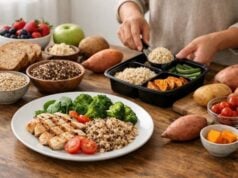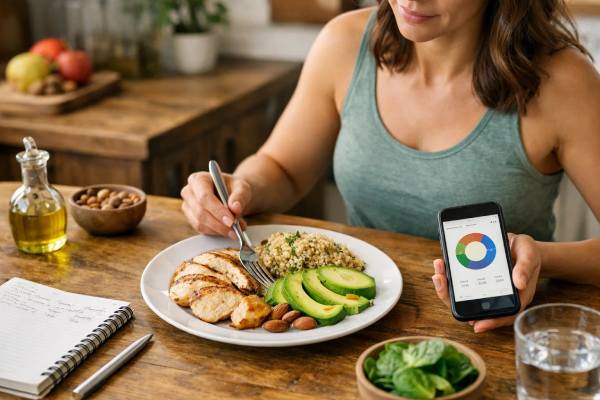
The best macros for women trying to lose weight are not a single perfect ratio. They are a practical setup that helps you stay in a calorie deficit, control hunger, keep training performance decent, and hold onto muscle while body fat comes down. For most women, protein deserves the most attention, fat needs a sensible floor, and carbs should be adjusted based on activity, food preference, and how the plan feels in real life.
This guide explains how to set protein, carbs, and fat step by step, when to use percentages versus grams, how to adjust your macros if progress stalls, and which real-world factors matter most for women, including appetite, training, cycle changes, and long-term adherence.
Table of Contents
- Why macros matter for weight loss
- The best macro priority order for most women
- How to set protein carbs and fat
- Example macro setups for different goals
- How to adjust macros based on results
- Women-specific factors that change your macros
- Best food choices for hitting your macros
- Macro mistakes that make fat loss harder
Why macros matter for weight loss
Calories still drive weight loss, but macros influence how easy or hard that calorie deficit feels. That is why two diets with the same calorie target can feel completely different in the real world. One leaves you hungry, flat in the gym, and constantly thinking about food. The other feels structured, manageable, and repeatable.
Protein, carbs, and fat each do something different.
Protein is the macro most closely linked to satiety, meal satisfaction, and muscle retention during weight loss. It helps a calorie deficit feel less punishing. Carbohydrates are your most flexible macro. They support training performance, energy, and food variety, but the exact amount that works best can vary a lot from woman to woman. Fat matters for meal satisfaction, food enjoyment, and overall diet quality, and cutting it too low usually makes the plan feel worse, not better.
Macros matter because they shape the quality of your deficit. A good macro setup can help you:
- Stay fuller on fewer calories
- Preserve more lean mass while losing weight
- Train better and recover better
- Reduce random snacking and rebound eating
- Make meals easier to repeat
That is also why many women do better with a macro setup that starts from protein first rather than obsessing over a trendy percentage split. In practice, the “best macros” are usually the macros that fit your calorie target and make consistency easier. That often lines up with the same logic used in a beginner’s guide to counting macros and in practical advice on how to calculate protein, carbs and fat for weight loss.
It is also worth clearing up one common misunderstanding: macros do not need to be perfect every day to work. Your body does not reset at midnight because you missed your fat target by 7 grams or ate slightly more carbs than planned. Macro tracking works best as a guide, not as a perfection test. A setup you can follow at 85 to 90 percent consistency is usually much more effective than one that looks ideal on paper but keeps breaking down after a few days.
The best macro priority order for most women
For most women trying to lose weight, the smartest order is:
- Set calories
- Set protein
- Set a reasonable fat minimum
- Use carbs with the remaining calories
This order works because it reflects what matters most in a calorie deficit. Protein usually has the biggest payoff for fullness and muscle retention. Fat needs to stay high enough that the diet still feels satisfying and nutritionally solid. Carbs can then be adjusted around activity level, food preference, and training demands.
That does not mean carbs are unimportant. It means they are the most adjustable part of the plan for many women. Someone lifting four days a week and walking a lot will often feel better with more carbs than someone who is sedentary and prefers higher-fat meals. Both can lose weight. The best setup depends on how the plan performs, not just on theory.
A practical way to think about it is this:
- Protein is your anchor
- Fat is your floor
- Carbs are your lever
That approach also helps avoid common overcorrections. Many women trying to lose weight end up too low in protein, too low in fat, or both, while over-focusing on cutting carbs because carbs feel like the obvious target. Sometimes that works briefly, but it often makes the plan harder to sustain. Appetite rises, workouts feel worse, and cravings increase.
A better question is not “Should I go low-carb?” but “What carb intake lets me stay in a deficit without making the rest of my week worse?” The answer might be moderate carbs, not low carbs.
This is one reason a general article on macro ratios for weight loss can be useful background, but women often benefit from a more practical, individualized approach. The same is true when comparing this article with macro setups designed to keep muscle during fat loss. The underlying principles overlap, but the details should still fit your body size, training, appetite, and stage of life.
When women say a plan “finally clicked,” it is often because they stopped chasing the most extreme macro split and started using one that felt sustainable enough to repeat.
How to set protein carbs and fat
The simplest way to set macros is to start with your calorie target, then assign each macro in grams.
Step 1: Set your calories
You need a calorie deficit for weight loss. A moderate deficit is usually easier to maintain than an aggressive one. If you do not already have a target, a good starting point is the type of intake discussed in how many calories to eat to lose weight. From there, macros help improve the quality of those calories.
Step 2: Set protein first
For many women in a fat-loss phase, a strong target is roughly 1.6 to 2.2 grams of protein per kilogram of body weight per day. Another practical option is to aim for 0.7 to 1.0 grams per pound of body weight, especially if you train regularly or want to minimize muscle loss during dieting.
That range is not a magic rule. It is a useful zone. Women at the lower end may still do well, especially if they are new to tracking and simply improve from a low baseline. Women who strength train, diet hard, or are in midlife and beyond often benefit from aiming higher within that range.
Step 3: Set fat next
A good practical floor for fat is often 0.6 to 0.8 grams per kilogram of body weight or about 25 to 35 percent of calories for many women. Going much lower can make meals less satisfying and reduce flexibility in food choices. This is especially important for women because very low-fat diets can become restrictive fast.
Step 4: Use the rest of your calories for carbs
Once protein and fat are set, the remaining calories go to carbohydrates. This is where individual preference matters most.
Women who lift, run, take a lot of daily steps, or simply feel better with more carbs often do well keeping carbs moderate. Women who prefer fattier meals, have lower activity, or find carbs easy to overeat may prefer a lower-carb setup. Both can work if calories are controlled and protein stays solid.
| Step | What to set | Example logic |
|---|---|---|
| 1 | Calories | Choose a realistic deficit, not the lowest number you can tolerate |
| 2 | Protein | Set high enough to support fullness and muscle retention |
| 3 | Fat | Keep a reasonable minimum so the diet still feels good |
| 4 | Carbs | Fill the remaining calories based on activity and preference |
If you prefer percentages, you can use them as a rough check, but grams are usually more useful in real life because protein needs are better set from body size and activity than from a percentage alone.
Example macro setups for different goals
There is no universal best macro split for all women, but a few common patterns work well.
Balanced moderate-carb setup
This often works well for women who want a flexible, sustainable approach.
- Protein: 30 to 35 percent
- Carbs: 35 to 45 percent
- Fat: 25 to 30 percent
This setup tends to be easy to build meals around and works well for women who walk regularly, do some resistance training, and want room for fruit, grains, potatoes, and social meals.
Higher-protein, lower-carb setup
This may suit women who prefer savory meals, feel hungrier on higher carbs, or do not do a lot of intense training.
- Protein: 30 to 40 percent
- Carbs: 20 to 35 percent
- Fat: 30 to 35 percent
This is not necessarily ketogenic. It is simply lower in carbs than average while still leaving room for vegetables, fruit, yogurt, legumes, and some starches.
Higher-carb training-friendly setup
This often works better for women who lift hard, do higher-volume training, or simply feel and perform better with more carbs.
- Protein: 25 to 30 percent
- Carbs: 40 to 50 percent
- Fat: 20 to 30 percent
This type of setup can be especially useful when the goal is not just scale loss but better recovery, performance, and mood during a deficit.
The biggest point is that all three can work. The best choice depends on:
- Your hunger level
- Your food preferences
- Your training demands
- How easy the plan is to repeat
- Whether the plan helps you stay in a deficit without constant friction
Some women do better with fixed calorie meal plans that indirectly create a macro pattern, such as a 1,400-calorie plan or a 1,600-calorie plan. Others prefer flexible tracking because it gives them more control over protein, carbs, and fat day to day. Neither approach is inherently better. What matters is whether it helps you stay consistent for weeks, not just three focused weekdays.
How to adjust macros based on results
Once your macros are set, you do not need to keep changing them every few days. Most women need at least two to four weeks of reasonably consistent data before deciding whether an adjustment is warranted.
You may need to adjust if:
- Weight is not trending down over several weeks
- Hunger is consistently high
- Workouts feel flat
- You are missing protein regularly
- You are technically hitting macros but overeating on weekends
- The plan feels too rigid to sustain
A good adjustment process looks like this:
- Check consistency first.
- Check calorie accuracy second.
- Adjust macros only after that.
In other words, do not assume your carbs are the problem if tracking accuracy, weekend eating, restaurant portions, liquid calories, or snack habits are the real issue. Many stalls come from execution, not from the wrong macro ratio.
If the plan truly needs work, use small adjustments:
- Raise protein if hunger is high and intake is low
- Shift some fat to carbs if training feels weak
- Shift some carbs to fat if meals feel unsatisfying
- Lower calories modestly only if adherence is good and progress is genuinely stalled
This is also where tracking trends matters more than reacting to a single weigh-in. Water retention, menstrual cycle changes, sodium intake, and hard training can all temporarily hide fat loss. That is one reason women often benefit from reviewing results more patiently than they think they should.
For women whose progress has slowed despite decent adherence, ideas from adjusting calories and macros when fat loss stalls or from a weight loss plateau decision process can be more useful than slashing carbs impulsively.
A good macro plan should evolve, but it should evolve based on trends, not frustration.
Women-specific factors that change your macros
Women do not need totally different laws of fat loss, but some real-life factors make macro setup more individual.
Training and muscle retention
Women who strength train regularly usually benefit from keeping protein solid and carbs high enough to support performance. If you are lifting three to five times per week, very low carbs often feel worse than they look on paper.
Cycle-related changes
Many women notice changes in hunger, cravings, energy, and water retention across the menstrual cycle. That does not always require different macros for each phase, but it can explain why the same macro plan feels easy one week and harder the next. In practice, it often helps to plan slightly more satisfying meals, more structured snacks, or a little extra carbohydrate around the tougher part of the month rather than assuming the whole plan has failed.
Perimenopause and menopause
As women move through perimenopause and beyond, body composition, appetite signals, recovery, sleep, and activity can all change. That often makes adequate protein even more important, especially if the goal includes preserving muscle and strength during fat loss. Many women in midlife do better with a higher protein target than they used in their twenties.
Pregnancy and breastfeeding
A standard fat-loss macro setup is not appropriate during pregnancy, and breastfeeding needs different energy and nutrition considerations. This is one of the clearest cases where general weight-loss macro advice should not be applied without individual guidance.
History of restrictive dieting
For women with a long history of crash dieting, all-or-nothing tracking, or disordered eating patterns, a strict macro plan can become mentally counterproductive. In those cases, a simpler structure focused on protein, portions, and meal composition may work better than hitting exact numbers every day.
This is also why women at different life stages may relate better to broader guidance such as a weight loss plan built specifically for women or, in midlife, more targeted help around perimenopause weight loss. The principles stay similar, but the execution often changes.
Best food choices for hitting your macros
A macro setup is only as useful as the foods you use to hit it. The easiest way to make macros work is to choose foods that make protein easier, carbs more useful, and fat more intentional.
Best protein foods
- Greek yogurt and skyr
- Cottage cheese
- Eggs and egg whites
- Chicken breast and turkey
- Lean beef
- Fish and seafood
- Tofu, tempeh, edamame
- Protein shakes when convenience matters
Best carbohydrate choices
- Oats
- Potatoes and sweet potatoes
- Rice and quinoa
- Fruit
- Beans and lentils
- Whole-grain breads and wraps
- High-fiber cereal in reasonable portions
Best fat choices
- Olive oil
- Avocado
- Nuts and seeds
- Nut butter in measured portions
- Fatty fish
The most practical macro-friendly meals usually combine all three. Examples include:
- Greek yogurt, berries, oats, and chia
- Eggs, toast, fruit, and avocado
- Chicken, rice, and vegetables
- Salmon, potatoes, and broccoli
- Tofu stir-fry with rice and vegetables
- Cottage cheese bowl with fruit and nuts
- Turkey chili with beans
This is where food quality and macro quality overlap. Women usually find it easier to hit protein without overshooting calories when they rely on a strong list of high-protein foods. The same goes for carbs. Carbs are not the issue by themselves; the more useful question is whether you are choosing from carbs that support a calorie deficit or from foods that disappear fast and leave you hungry again.
Macro tracking also gets easier when breakfast and lunch are repetitive. If you know your first two meals already cover a big chunk of your protein target, the rest of the day becomes simpler.
Macro mistakes that make fat loss harder
Most women do not fail because they chose 35 percent carbs instead of 30 percent carbs. They struggle because the overall setup is too hard to live with.
Common mistakes include:
- Setting calories too low from the start
- Treating protein as optional instead of foundational
- Cutting fat so low that meals become unsatisfying
- Going low-carb even though training and energy suffer
- Trying to hit exact percentages instead of practical gram targets
- Ignoring appetite and recovery signals
- Counting accurately Monday through Thursday and then losing structure on weekends
- Choosing foods that technically fit macros but do not keep you full
Another common issue is overestimating how much precision matters. The difference between a good macro plan and a bad one is usually not ten grams of carbs. It is whether the plan controls hunger, supports training, and feels realistic enough to repeat.
This is also why women often do better when they combine macro targets with basic meal structure. Hitting protein matters, but so does eating regular meals, planning snacks, and building plates that look like actual meals. That logic overlaps with practical strategies in macro-friendly meal ideas and with a more structured macro meal plan for weight loss.
The best macros for women trying to lose weight are the ones that make fat loss simpler, not more obsessive. If your current setup makes you think about food all day, dread social meals, and constantly feel behind, the issue may not be your discipline. It may be that your macros need to be more practical.
References
- Protein, fiber, and exercise: a narrative review of their roles in weight management and cardiometabolic health 2025 (Review)
- Obesity Management in Adults: A Review 2023 (Review)
- Nutritional Considerations During Major Weight Loss Therapy: Focus on Optimal Protein and a Low-Carbohydrate Dietary Pattern 2024 (Review)
- The Importance of Nutrition in Menopause and Perimenopause-A Review 2023 (Review)
- Impact of Protein Intake during Weight Loss on Preservation of Fat-Free Mass, Resting Energy Expenditure, and Physical Function in Overweight Postmenopausal Women: A Randomized Controlled Trial 2021 (RCT)
Disclaimer
This article is for general educational purposes only and is not a substitute for medical advice, diagnosis, or treatment. Macro targets for weight loss may need individual adjustment if you are pregnant, breastfeeding, in perimenopause or menopause with significant symptoms, have kidney disease, diabetes, a history of disordered eating, or take medications that affect appetite, blood sugar, or weight.
If you found this article useful, please share it on Facebook, X, or another platform you prefer so others can use it too.