A CD4 count measures helper T cells, a group of lymphocytes that coordinate immune responses against infections and support B cells, macrophages, and cytotoxic T cells. The test is best known for monitoring immune health in people with HIV, but clinicians also use it in selected immune deficiencies, after transplantation, during cancer treatment, and when medicines or illnesses may reduce T cells.
Results are usually reported as an absolute CD4 count in cells per cubic millimeter—equivalent to cells per microliter—and often as a CD4 percentage. Many healthy adults have roughly 500 to 1,500 cells/µL, but the laboratory’s own range is more appropriate because counts vary with age, time of day, acute illness, pregnancy, medicines, and the total lymphocyte count. In HIV care, a lower CD4 count signals greater vulnerability to opportunistic infections. A value below 200 cells/µL is especially important, but treatment decisions also depend on HIV viral load, symptoms, prior infections, and response to antiretroviral therapy.
- The CD4 count estimates helper T-cell quantity: It is usually reported as cells/µL and as a percentage of total lymphocytes.
- About 500–1,500 cells/µL is common in healthy adults: The exact reference interval depends on the laboratory and population.
- Below 200 cells/µL indicates severe immune suppression in HIV: It meets a major threshold for advanced HIV disease and affects opportunistic-infection prevention.
- Viral load and CD4 answer different questions: Viral load measures active HIV replication; CD4 count reflects immune-system damage and recovery.
- One result should be interpreted cautiously: Acute illness, steroids, chemotherapy, time of day, and normal biological variation can shift the count.
- No fasting is normally needed: The test uses a routine blood sample, but consistent timing can help when following trends.
Table of Contents
- What CD4 Cells Do
- How the CD4 Count Is Measured
- CD4 Ranges and Risk Levels
- Using CD4 Counts in HIV Care
- Causes of Low and High CD4 Counts
- Why Results Change From Test to Test
- Preparation and Test Timing
- Follow-Up and Urgent Symptoms
What CD4 Cells Do
CD4 cells are T lymphocytes that carry the CD4 surface protein. They are often called helper T cells because they do not work alone. After recognizing an antigen presented by another immune cell, they release signals that organize the response. Different CD4 subsets can help B cells produce antibodies, activate macrophages, recruit other white blood cells, maintain immune memory, or restrain excessive inflammation.
This coordinating role makes CD4 cells important against many viruses, bacteria, fungi, and parasites. They also support immune surveillance against abnormal cells. When CD4 numbers fall substantially, the immune system loses part of its ability to contain organisms that rarely cause severe illness in people with intact immunity.
HIV has a special relationship with CD4 cells. The virus uses the CD4 molecule, together with a coreceptor, to enter susceptible cells. Untreated infection can gradually destroy or dysregulate the CD4 compartment. Effective antiretroviral therapy suppresses viral replication and allows the count to recover in most people, although the speed and degree of recovery vary.
A CD4 count is one part of the broader T-cell count. CD3 identifies total T cells, while CD4 and CD8 divide them into major subsets. The count does not measure every function of a helper T cell. A person may have an adequate number with impaired function, or a low count that remains clinically stable because the underlying cause is known and controlled.
CD4 cells also include regulatory and specialized helper populations. A routine clinical test does not separately measure Th1, Th2, Th17, follicular helper, or regulatory T cells unless the laboratory uses an expanded panel. It therefore answers a broad quantitative question rather than providing a full map of helper T-cell biology.
How the CD4 Count Is Measured
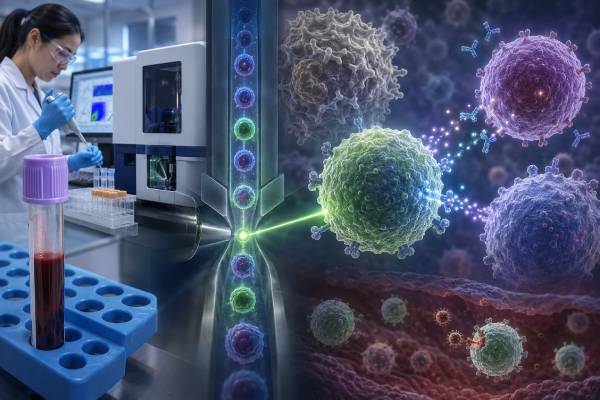
Most laboratories use flow cytometry. Fluorescent antibodies bind proteins on white blood cells, commonly CD45, CD3, CD4, and CD8. A flow cytometer passes cells through lasers and classifies them according to light scatter and fluorescence. The laboratory identifies lymphocytes, then CD3-positive T cells, then the CD4-positive portion.
The report often includes three related values:
| Result | What it shows | Main use |
|---|---|---|
| Absolute CD4 count | Number of CD4 cells per µL of blood | Main adult monitoring value and risk assessment |
| CD4 percentage | CD4 cells as a percentage of lymphocytes | Helpful when absolute counts fluctuate; important in pediatric interpretation |
| CD4/CD8 ratio | Relationship between helper and cytotoxic T cells | Additional view of immune balance, not a replacement for the count |
An absolute count can be obtained with a single-platform assay that counts cells directly or by combining the CD4 percentage with a complete blood count and lymphocyte percentage. Because the absolute value depends partly on total lymphocytes, it can change more than the CD4 percentage during acute illness, stress, or steroid treatment.
The CD4 percentage is often more stable. In adults with HIV, it can help clarify an unexpected absolute result. In young children, percentages have historically been especially useful because normal absolute lymphocyte and CD4 counts change markedly with age. Current pediatric guidance still emphasizes age-appropriate interpretation.
The CD4/CD8 ratio adds context but should not be confused with either count. A low ratio may persist even after the absolute CD4 count improves on treatment. A normal ratio cannot exclude HIV, and an abnormal ratio has many non-HIV causes.
A routine CD4 panel does not detect HIV. Diagnosis requires an HIV antigen/antibody test and, when indicated, an HIV nucleic-acid test. Similarly, the CD4 result does not measure how much virus is present. That is the role of HIV RNA viral-load testing.
CD4 Ranges and Risk Levels
Healthy adult counts often fall between about 500 and 1,500 cells/µL, but a wider or narrower laboratory interval may be printed on the report. Children, especially infants, normally have higher absolute counts. A result should always be interpreted against age and the laboratory’s method.
In HIV care, common clinical bands are useful because opportunistic-infection risk generally rises as the count falls:
| CD4 count | General interpretation in HIV care |
|---|---|
| 500 cells/µL or higher | Often within or near the typical adult range; immune function may still be affected by other factors |
| 350–499 cells/µL | Mild reduction; many people remain well, especially with suppressed viral load |
| 200–349 cells/µL | Moderate immune suppression; closer follow-up may be needed |
| Below 200 cells/µL | Advanced immune suppression and a major threshold for opportunistic-infection risk |
| Below 100 cells/µL | Very high risk for certain serious opportunistic infections |
| Below 50 cells/µL | Profound immune suppression, with risk of infections such as disseminated Mycobacterium avium complex in untreated or unsuppressed HIV |
These bands are not a countdown and should not be used without the clinical context. Opportunistic infections can occur above traditional thresholds, and many people with a low count improve substantially after starting effective therapy. Conversely, a high count does not rule out active HIV replication, treatment failure, or another health problem.
The CD4 percentage can also signal immune suppression. Adult laboratories may consider roughly 30% to 60% typical, but intervals vary. In HIV classification, a percentage below 14% has historically corresponded to severe immunosuppression and may be clinically relevant when the absolute count is discordant. Treatment and prophylaxis decisions should follow current guidelines rather than a percentage interpreted in isolation.
A single value near a threshold often warrants confirmation, especially when the patient is clinically stable and the result differs sharply from prior measurements. Clinicians may act immediately when the count is very low or symptoms suggest an opportunistic infection, but they also assess the trend and viral load.
Discordant absolute and percentage results deserve a closer look. An absolute count may fall below 200 cells/µL during a temporary drop in total lymphocytes while the CD4 percentage remains near the patient’s usual level. In another person, the absolute count may look acceptable because total lymphocytes are high even though the CD4 percentage is markedly reduced. Neither value automatically overrides the other. The clinician reviews the complete blood count, current illness, prior trend, and the decision being considered. When a prophylaxis threshold or major diagnostic classification depends on the result, repeating the panel after a transient illness has resolved may prevent a decision based on a short-lived shift.
Laboratory ranges also describe populations, not a personal target. Someone whose stable baseline is near 700 cells/µL may deserve evaluation after a persistent fall to 350 even though the count remains above 200. Another person may recover from 40 to 280 cells/µL after treatment and still have meaningful improvement despite not reaching the general adult range. Direction, duration, and viral suppression make the raw number clinically useful.
Using CD4 Counts in HIV Care
CD4 testing has four main roles in HIV: establishing baseline immune status, estimating infection risk, helping guide prevention or discontinuation of opportunistic-infection prophylaxis, and documenting immune recovery after antiretroviral therapy.
At diagnosis and before treatment
A baseline count shows how much immune damage is present. Current recommendations support antiretroviral therapy for everyone with HIV regardless of CD4 count, so a high result is not a reason to postpone treatment. A very low value may trigger urgent screening for tuberculosis, cryptococcal disease, or other opportunistic infections, depending on symptoms, geography, and guideline recommendations.
The World Health Organization defines advanced HIV disease in adults and adolescents as a CD4 count below 200 cells/µL or WHO stage 3 or 4 disease. This classification helps identify people who need an enhanced package of screening, prophylaxis, rapid treatment, and adherence support.
After antiretroviral therapy begins
The HIV viral load should fall with effective therapy, often becoming undetectable within months. CD4 recovery is slower and more variable. An adequate response commonly includes a gradual rise over the first years, but age, baseline count, duration of untreated infection, coinfections, smoking, medicines, and other illnesses affect the trajectory.
Viral suppression is the primary indicator that treatment controls HIV. A person may have an undetectable viral load and a CD4 count that remains below normal. This is called suboptimal immune recovery when it persists despite sustained suppression. It does not mean the medicines have failed to stop viral replication, but it can leave a higher risk of infections and other complications, especially when the count remains below 200.
How often the count is checked
Monitoring frequency depends on the baseline value, duration of viral suppression, and clinical stability. Current U.S. guidance recommends more frequent testing early after treatment and for people with lower counts. Testing can become less frequent once viral load remains suppressed and the CD4 count is stable, particularly when it is well above risk thresholds. Some stable patients with sustained suppression and counts above 500 may have optional rather than routine ongoing CD4 monitoring.
Monitoring should become more frequent if viral load rebounds, treatment changes, symptoms develop, an opportunistic infection occurs, or a medicine may suppress bone marrow or lymphocytes.
Opportunistic-infection prevention
CD4 thresholds are used with viral load and clinical history to guide prophylaxis. Pneumocystis pneumonia prevention is traditionally linked to counts below 200 cells/µL, while toxoplasmosis prevention may be indicated below 100 in a person with positive Toxoplasma IgG. Current guidelines include nuanced criteria for stopping or restarting prophylaxis, sometimes allowing consideration at counts between 100 and 200 when viral suppression is sustained.
Do not start or stop prophylactic medicine based on a home interpretation of one result. Prior opportunistic disease, pregnancy, drug allergies, kidney or liver function, and viral suppression all affect the decision.
Causes of Low and High CD4 Counts
HIV is an important cause of low CD4 cells, but it is not the only one. The result must be interpreted with the patient’s diagnosis and exposure history.
Causes of a low CD4 count can include:
- Untreated or advanced HIV infection
- Acute viral or bacterial illness
- Sepsis or critical illness
- Corticosteroids and other immune-suppressing medicines
- Chemotherapy or radiation
- Bone marrow failure, leukemia, or lymphoma
- Primary or acquired immune deficiencies
- Autoimmune disease and severe systemic inflammation
- Malnutrition or major physiological stress
- Loss or redistribution of lymphocytes
- Rare idiopathic CD4 lymphocytopenia
Idiopathic CD4 lymphocytopenia is considered only after repeat low counts and exclusion of HIV and other explanations. It is uncommon and requires specialist evaluation. A single low test during illness is not enough to diagnose it.
A high CD4 count is less often clinically concerning by itself. It may occur with normal biological variation, recovery after an infection or treatment, smoking, chronic immune stimulation, or lymphocytosis. Certain T-cell lymphoproliferative disorders can produce high counts, but they usually create other abnormal findings in the blood count, smear, or flow-cytometry phenotype.
A result can also look high or low because of the denominator. If total lymphocytes are elevated, the absolute CD4 number may rise even when the percentage is unchanged. If lymphocytes fall sharply, the absolute count can drop while the percentage remains stable. Reviewing both values can prevent overinterpretation.
For people without HIV, the count should be ordered to answer a specific question. Broad screening of healthy people is rarely useful because small deviations are common and nonspecific. Persistent marked abnormalities deserve evaluation, but the next step depends on infections, medicines, other cell counts, and clinical findings.
Why Results Change From Test to Test
CD4 counts naturally fluctuate. A change does not automatically represent worsening HIV or treatment failure. The absolute value may vary by 20% or more between measurements because of normal biology and changes in total lymphocytes.
Factors that can shift the result include:
- Time of day: Circadian rhythms can affect circulating lymphocyte numbers.
- Acute infection: Cells may leave the blood, and total lymphocytes may fall.
- Corticosteroids: These can rapidly lower circulating lymphocytes through redistribution.
- Exercise and stress: Short-term physiological changes can alter white-cell distribution.
- Pregnancy: Plasma-volume and immune changes may affect absolute counts; percentage can be more stable.
- Recent surgery or hospitalization: Inflammation and medicines can suppress or redistribute cells.
- Laboratory method: Different instruments and counting approaches introduce small differences.
- Specimen delay: Flow cytometry requires intact cells and validated handling.
Clinicians usually focus on a sustained trend, especially when viral load moves in the same direction. A falling CD4 count with rising HIV RNA suggests loss of virologic control or poor adherence and requires prompt review. A temporary drop with an undetectable viral load during an acute illness may recover without an HIV treatment change.
The count can also remain low despite years of suppression. Adding antiretroviral drugs to an already suppressive regimen or switching solely to raise CD4 has not generally improved outcomes. Evaluation instead looks for modifiable contributors such as untreated coinfection, medications, malignancy, or another condition causing lymphopenia.
Preparation and Test Timing
No fasting is usually needed. The sample is collected into an anticoagulant tube and sent for flow cytometry. Because cell-based tests have limited stability, the laboratory may require collection before a courier deadline or on certain weekdays.
For the clearest trend:
- Use the same laboratory when practical.
- Draw at a similar time of day.
- Record acute illnesses, steroid use, chemotherapy, and vaccination timing.
- Compare the result with the concurrent viral load and total lymphocyte count.
- Avoid delaying urgent evaluation simply to obtain a “perfect” baseline condition.
Do not stop antiretroviral therapy or other medicines before the test unless the prescribing clinician specifically instructs it. Missed doses can allow viral replication and are far more important than small laboratory fluctuations.
In a newly diagnosed person, CD4 testing should not delay antiretroviral therapy unless a specific clinical issue requires coordinated timing. If severe symptoms suggest an opportunistic infection, clinicians may obtain the count urgently while beginning the appropriate diagnostic workup.
Results may return within a day at a hospital laboratory or take several days if sent to a reference center. A count is not an emergency test in every setting, but very low values should be communicated promptly so prevention, screening, and treatment can be addressed.
Follow-Up and Urgent Symptoms
Follow-up starts by placing the value beside the viral load, prior CD4 results, symptoms, medicines, and any history of opportunistic infection. Useful questions include:
- Is the absolute count confirmed by the CD4 percentage?
- Is HIV RNA suppressed?
- Was the patient acutely ill or taking steroids?
- Has the count crossed a prophylaxis threshold?
- Is the change sustained over more than one test?
- Could another illness or medicine be reducing lymphocytes?
A low result may lead to earlier repeat testing, infection screening, prophylactic medication, vaccination planning, or specialist evaluation. A stable, high count with durable viral suppression may permit less frequent monitoring according to current guidance.
The CD4 count is not a substitute for routine HIV care. People with strong immune recovery still need viral-load monitoring, antiretroviral adherence, vaccinations, cancer screening, cardiovascular risk care, and assessment of other infections. The CD8 count and ratio can provide extra context but do not replace these priorities.
Seek urgent medical care for difficulty breathing, persistent high fever, confusion, severe headache with neck stiffness, new weakness, vision change, seizure, fainting, severe dehydration, or rapidly worsening illness. In a person with a very low CD4 count, even symptoms that initially seem mild can require prompt assessment because opportunistic infections may progress quickly.
A laboratory value can estimate risk, but it cannot determine how sick someone is at that moment. Symptoms, examination, imaging, microbiology, and treatment response remain central. The best use of CD4 testing is to identify vulnerability early, guide prevention, and document immune recovery while effective therapy keeps HIV suppressed.
References
- Plasma HIV-1 RNA (Viral Load) and CD4 Count Monitoring 2025 (Guideline)
- Suboptimal CD4 Cell Recovery Despite Viral Suppression 2025 (Guideline)
- Drug Therapies to Prevent First Episode of Opportunistic Disease 2026 (Guideline)
- WHO guidelines on the management of advanced HIV disease 2025 (Guideline)
- Advanced HIV disease 2026 (Official Guidance)
- Clinical and Laboratory Monitoring of Pediatric HIV Infection 2025 (Guideline)
Disclaimer
This article provides general information and is not a substitute for individualized HIV or immunology care. CD4 thresholds, monitoring schedules, and opportunistic-infection prophylaxis should be applied by a qualified clinician using current guidelines, viral load, symptoms, and medical history. Do not stop antiretroviral or preventive medicines based on one laboratory result.