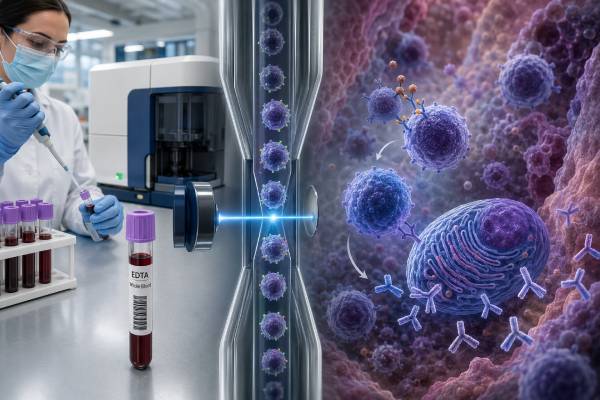
A B-cell count test measures the number and percentage of B lymphocytes in blood, usually by flow cytometry. Laboratories most often identify B cells with CD19, while some panels also include CD20 and other markers that show whether the cells are immature, naïve, memory, activated, or abnormal. B cells support immune defense by recognizing antigens, presenting them to T cells, and developing into antibody-producing plasma cells.
A low B-cell count can occur with inherited antibody disorders, treatment that intentionally depletes B cells, some combined immune deficiencies, chemotherapy, or bone marrow disease. A high count may reflect normal age-related variation, recovery after depletion, infection-related expansion, or a clonal B-cell disorder. The count cannot show antibody quality on its own. Normal B-cell numbers may coexist with poor vaccine responses or low immunoglobulins, and plasma cells are not reliably represented by a routine CD19/CD20 blood count. Results therefore need to be read with age-specific reference intervals, immunoglobulin levels, infection history, medicines, and the reason for testing.
- The test counts circulating B lymphocytes: Most laboratories report CD19-positive cells as both a percentage of lymphocytes and an absolute count per microliter.
- CD19 and CD20 are related but not identical markers: CD19 covers most B-cell stages, while CD20 is absent from early precursors and mature plasma cells.
- Low counts commonly follow anti-CD20 therapy: Rituximab, ocrelizumab, ofatumumab, and similar medicines can suppress circulating B cells for months.
- A normal count does not prove normal antibody function: Immunoglobulins and vaccine-response testing may still be needed.
- Reference ranges vary strongly with age: Infants and young children often have higher B-cell counts than adults, so adult ranges should not be used for children.
Table of Contents
- B Cells and the Markers Used to Count Them
- What the Report Includes
- Reasons for Ordering a B-Cell Count
- What Low B-Cell Counts Can Mean
- What High B-Cell Counts Can Mean
- B-Cell Numbers Versus Antibody Function
- Testing Process and Factors That Affect Results
- Next Tests and Clinical Follow-Up
B Cells and the Markers Used to Count Them
B cells begin in the bone marrow and pass through several developmental stages before entering the blood and lymphoid tissues. Each stage has a distinct combination of cell-surface proteins. Flow cytometry uses fluorescent antibodies to recognize these proteins and separate B cells from T cells, natural killer cells, monocytes, and other blood cells.
CD19 is the most common marker for routine B-cell enumeration. It appears early in B-cell development and remains present on most mature B cells. It becomes weak or absent as cells fully differentiate into plasma cells. Because it covers a broad span of the B-cell lineage, CD19 is often used in a standard lymphocyte subset panel.
CD20 appears later than CD19. Most mature naïve and memory B cells express CD20, but early B-cell precursors and terminally differentiated plasma cells generally do not. Anti-CD20 medicines exploit this pattern: they can remove many circulating mature B cells while sparing stem cells and most existing plasma cells. That distinction helps explain why serum antibodies may persist for a time even when CD19-positive cells are nearly absent.
Other markers may be added when the question is more detailed:
- CD27 helps identify many memory B cells.
- IgD and IgM help separate naïve, unswitched-memory, and class-switched populations.
- CD21 can identify activated or atypical subsets when expression is reduced.
- CD24 and CD38 help distinguish transitional B cells, mature naïve cells, and plasmablasts.
- Kappa and lambda light chains help assess whether a population is polyclonal or suspicious for a clonal disorder.
- CD5, CD10, CD23, CD43, and other markers may be used in leukemia or lymphoma evaluation.
A basic B-cell count is not the same as extended B-cell phenotyping. The basic test answers, “How many circulating cells meet the laboratory’s B-cell definition?” A detailed panel asks how those B cells are distributed among developmental and functional compartments. That deeper analysis is useful in selected primary immunodeficiencies, after immune-reconstituting therapy, or when the total count looks normal but antibody function is poor.
The test also differs from an immunoglobulin blood test. Immunoglobulin testing measures antibodies dissolved in serum; B-cell enumeration counts living cells in blood. These two results often complement each other but are not interchangeable.
What the Report Includes
Most reports present B cells in two ways:
- Relative count: the percentage of lymphocytes that are B cells
- Absolute count: the estimated number of B cells per microliter of blood
The absolute count is usually more useful when total lymphocytes are unusually high or low. For example, 15% B cells may appear normal as a percentage, but the absolute count can still be low if the patient has marked lymphopenia. Conversely, a low percentage can coexist with an adequate absolute count when another lymphocyte population is expanded.
Laboratories calculate absolute counts by either a single-platform or dual-platform method. A single-platform assay uses counting beads or another internal standard within the flow-cytometry tube. A dual-platform method combines the flow-cytometry percentage with lymphocyte data from a complete blood count. Both can be clinically useful, but their values may not match perfectly.
A typical report may include:
| Report item | What it describes |
|---|---|
| CD19-positive percentage | Proportion of lymphocytes identified as B cells |
| CD19-positive absolute count | Number of circulating B cells per microliter |
| CD20-positive count or percentage | Mature CD20-expressing B-cell population, when included |
| Total lymphocyte count | Denominator that affects the absolute and relative interpretation |
| Age-specific reference interval | Expected values for the laboratory’s method and patient age |
| Technical comments | Specimen quality, gating limits, or unusual populations |
There is no single normal B-cell number that applies across all ages and laboratories. B-cell counts are high in infancy, change rapidly through childhood, and settle into lower adult ranges. Pregnancy, acute infection, ethnicity, local population characteristics, and laboratory methods can also influence reference data. A result should be compared with the interval printed on that report, not with a number found in another laboratory’s catalog.
When monitoring depletion therapy, the report may use a very low detection threshold or state that B cells are “undetectable.” That wording does not mean there are no B cells anywhere in the body. Flow cytometry measures the cells present in the blood sample and cannot directly count tissue-resident B cells in lymph nodes, spleen, bone marrow, or inflamed organs.
Reasons for Ordering a B-Cell Count
A clinician may request B-cell enumeration when recurrent infections, abnormal immunoglobulins, unusual vaccine responses, immune-modifying treatment, or a suspected blood disorder raises a question about the B-cell compartment.
Evaluation of suspected immune deficiency
B-cell counts help divide antibody deficiencies into broad patterns. In X-linked agammaglobulinemia and several related disorders, circulating B cells are extremely low or absent because development stops before mature cells enter the blood. In common variable immunodeficiency, total B-cell numbers are often present, but memory-cell development or antibody production may be impaired. In combined immunodeficiencies, B cells may be low, normal, or occasionally high while T-cell function remains severely abnormal.
The count is therefore a starting point rather than a complete diagnosis. Clinicians combine it with the infection pattern, family history, physical findings, IgG, IgA, IgM, vaccine antibody responses, T-cell and NK-cell counts, complement testing, and sometimes genetic analysis.
Monitoring B-cell-depleting treatment
Anti-CD20 antibodies are used for B-cell lymphoma, leukemia, multiple sclerosis, neuromyelitis optica, rheumatoid arthritis, vasculitis, pemphigus, and other autoimmune conditions. They can produce profound depletion of CD20-positive cells in blood. Laboratories often monitor CD19 because the therapeutic antibody may interfere with CD20 detection or occupy the CD20 target. CD19 also identifies some B cells that may not show measurable CD20 during recovery.
Monitoring practices vary by disease and medicine. Some treatment schedules are fixed and do not require routine B-cell-guided redosing. Other specialist protocols use B-cell return, memory B-cell recovery, immunoglobulin levels, infection history, and disease activity to help time treatment. A B-cell count should not be used by itself to change a dose.
B-cell enumeration may also be used after CD19-directed CAR T-cell therapy. Persistent B-cell aplasia can act as evidence that functional CAR T cells remain active, but it also increases the need to monitor immunoglobulins and infection risk.
Investigating a possible lymphoproliferative disorder
A high B-cell count or an unusual population can prompt testing for chronic lymphocytic leukemia, monoclonal B-cell lymphocytosis, lymphoma involving blood, or another clonal process. A simple count cannot establish clonality. The laboratory must assess marker patterns, light-chain restriction, cell morphology, and often genetic or tissue findings.
Symptoms such as persistent enlarged lymph nodes, unexplained weight loss, drenching night sweats, splenomegaly, or an abnormal blood count warrant a broader evaluation. A flow cytometry immune panel intended for immunodeficiency is not always equivalent to a leukemia/lymphoma phenotyping panel.
What Low B-Cell Counts Can Mean
A low result means fewer circulating B cells were detected than expected for age and method. The cause ranges from an intended medication effect to a significant defect in B-cell development.
Common explanations include:
- Anti-CD20 treatment: Rituximab, ocrelizumab, ofatumumab, obinutuzumab, and related agents can make B cells nearly undetectable.
- CD19-directed therapy: CAR T-cell therapy or other CD19-targeted treatment can produce prolonged B-cell aplasia.
- Inherited agammaglobulinemia: Defects such as BTK variants block normal B-cell maturation and cause very low CD19-positive cells.
- Combined immune deficiency: Disorders affecting lymphocyte development may reduce B cells along with T cells or NK cells.
- Chemotherapy, radiation, or stem-cell transplantation: Bone marrow suppression and immune reconstitution can alter counts for months or longer.
- Bone marrow failure or infiltration: Aplastic processes, leukemia, lymphoma, or other marrow disease can reduce lymphocyte production.
- Severe systemic illness: Critical illness, infection, corticosteroids, and redistribution of lymphocytes may temporarily lower blood counts.
- Protein-losing or lymph-losing conditions: Severe intestinal lymph loss or chylous leakage can decrease multiple lymphocyte populations.
The timing relative to therapy is essential. B cells may remain suppressed long after an anti-CD20 infusion and then reappear gradually. Early returning cells are often transitional or naïve B cells rather than mature memory cells. Clinical protection does not instantly normalize when the total CD19 count enters the reference range because functional recovery and vaccine responsiveness may lag.
A low B-cell count becomes more clinically significant when it occurs with low immunoglobulins, poor vaccine antibodies, recurrent bacterial sinus or lung infections, unusual viral infections, chronic diarrhea, failure to thrive, bronchiectasis, or a family history of immune deficiency. In contrast, an expected low count after treatment may require monitoring rather than a new diagnostic workup.
Very low CD19-positive cells do not always mean that all antibody production has stopped. Long-lived plasma cells usually lack CD20 and may have weak or absent CD19, so they can continue releasing antibodies. However, the ability to make new responses to vaccines and newly encountered infections may be reduced, especially when depletion is prolonged or immunoglobulin levels fall.
What High B-Cell Counts Can Mean
A high B-cell percentage or absolute count can be reactive, age-related, treatment-related, or clonal. The absolute count, persistence over time, cell appearance, and the rest of the blood count determine how concerning it is.
Reactive increases may occur during or after infection, immune stimulation, and recovery from marrow suppression. In children, a value that looks high by adult standards may be normal for age. After B-cell-depleting therapy, repopulation can temporarily favor immature or naïve subsets and create a pattern that differs from the patient’s baseline.
Persistent clonal expansion is more concerning. Monoclonal B-cell lymphocytosis and chronic lymphocytic leukemia are common examples in adults, but other B-cell neoplasms can circulate as well. Clonality cannot be inferred from the total CD19 count alone. A laboratory looks for a uniform abnormal phenotype, kappa or lambda restriction, and disease-specific marker combinations.
A high percentage may be misleading when T cells are low. Suppose B cells make up 30% of lymphocytes, above the laboratory’s percentage range, but the absolute B-cell count is normal. The apparent increase may reflect a reduced denominator rather than true B-cell expansion. This is why the absolute and relative values should be reviewed together.
Additional evaluation may include a repeat complete blood count, blood smear, extended flow cytometry, serum protein studies, imaging, or hematology referral. Urgency rises when the result accompanies rapidly increasing lymphocytes, anemia, thrombocytopenia, enlarged nodes, spleen enlargement, fevers, drenching sweats, or unintentional weight loss.
B-Cell Numbers Versus Antibody Function
The most important limitation of a B-cell count is that quantity does not equal function. B cells must mature, undergo class switching, form memory, and generate effective antibodies. A person can have a normal total CD19 count but still fail at one or more of these steps.
Examples include:
- Common variable immunodeficiency, in which total B cells are often present but antibody production is impaired
- Specific antibody deficiency, with normal immunoglobulin concentrations but weak responses to polysaccharide vaccines
- Class-switch recombination disorders, which can produce high or normal B-cell counts with abnormal immunoglobulin patterns
- Selective IgA deficiency, where total B-cell numbers are usually normal
- Early recovery after depletion, when naïve cells have returned but memory compartments remain reduced
Serum IgG, IgA, and IgM measure the current antibody pool. IgG subclasses may help in selected cases, although isolated subclass abnormalities can be difficult to interpret. Vaccine-response testing evaluates whether the immune system can produce specific antibodies after exposure to antigens such as pneumococcal polysaccharides, tetanus, or diphtheria. These tests assess a different layer of immune function from cell counting.
Extended B-cell phenotyping can reveal reduced class-switched memory B cells, expanded transitional cells, increased CD21-low populations, or other distributions associated with particular immune disorders. Those findings may support classification and prognosis, but they still require clinical context and method-specific reference ranges.
Plasma cells add another reason for caution. They are the cells that secrete large amounts of antibody, yet routine CD19/CD20 blood panels may not capture them. Many plasma cells live in bone marrow and tissues rather than circulating blood. Thus, a patient can have few circulating B cells but retain antibodies from long-lived plasma cells, or have normal B-cell numbers while failing to generate effective plasma-cell responses.
Testing Process and Factors That Affect Results
The test usually requires a standard blood draw into an anticoagulant tube. Fasting is generally unnecessary. The laboratory needs intact cells, so sample age and transport conditions matter. Reference laboratories may restrict collection to certain days to ensure the specimen arrives within the validated stability period.
Tell the clinician about:
- Anti-CD20, CD19-directed, or other immune therapy and the date of the last dose
- Corticosteroids, chemotherapy, transplant medicines, or recent growth-factor treatment
- Recent vaccination or infection
- Blood transfusion, plasma exchange, or stem-cell transplantation
- Pregnancy
- Known leukemia, lymphoma, or immune deficiency
Acute illness can move lymphocytes between blood and tissues. Steroids can lower circulating lymphocytes. Treatment may alter marker expression or interfere with antibody binding. These effects do not make the test useless, but they change the question it can answer.
Preanalytic and analytic factors also matter. Delayed processing can reduce viability. Cell clumps, low event counts, and very small samples can reduce precision. A recent anti-CD20 infusion may make CD20 difficult to measure, which is one reason laboratories often rely on CD19 for enumeration. Different instruments, antibody clones, gating strategies, and counting methods can produce small systematic differences.
For serial monitoring, use the same laboratory when practical. Compare both absolute counts and percentages, and record treatment dates. A single value may be less useful than the direction of change. “Undetectable,” “1 cell/µL,” and “5 cells/µL” may all represent profound depletion, but small differences near the assay’s lower limit can reflect counting variation rather than meaningful biological change.
Next Tests and Clinical Follow-Up
The next step should address the reason the count was ordered rather than treating the number in isolation.
For recurrent infections or suspected antibody deficiency, clinicians commonly review:
- Complete blood count with differential
- IgG, IgA, and IgM
- Specific vaccine antibody titers
- T-cell and NK-cell numbers
- Clinical records of infection frequency, organisms, antibiotics, and imaging
- Extended B-cell subsets when indicated
- Genetic testing when the phenotype suggests an inherited disorder
A low count after B-cell-depleting therapy may lead to continued monitoring of B-cell return, immunoglobulins, and infections. Some patients need preventive measures, vaccination planning, antimicrobial prophylaxis, or immunoglobulin replacement, but these decisions depend on the full clinical picture. B-cell recovery alone should not automatically trigger or delay treatment without the prescribing specialist’s plan.
A high count may require repeat testing to confirm persistence. If flow cytometry detects a suspicious clonal population, hematology evaluation may include morphology, cytogenetics, molecular studies, bone marrow testing, or tissue biopsy. The presence of CD19 or CD20 does not by itself prove cancer; these are normal lineage markers as well as therapeutic targets.
Ask the ordering clinician four practical questions: Was the absolute count abnormal for age? Did the laboratory see a normal mixed population or an unusual phenotype? Do immunoglobulin and vaccine-response results agree with the cell count? Is the change expected from treatment timing?
Seek prompt medical care for fever in a severely immunocompromised patient, breathing difficulty, confusion, rapidly worsening weakness, unusual bleeding, or signs of sepsis. Contact the treating team promptly for recurrent pneumonia, persistent diarrhea, unexplained weight loss, enlarging lymph nodes, or repeated infections after B-cell-depleting therapy. The count helps define risk, but symptoms and the broader immune assessment determine what action is needed.
References
- Diagnostic tests for primary immunodeficiency disorders: Classic and genetic testing 2024 (Review)
- Flow cytometry-based diagnostic approach for inborn errors of immunity: experience from Algeria 2024 (Clinical Study)
- Comprehensive phenotyping of human peripheral blood B lymphocytes in healthy conditions 2022 (Review)
- The monitoring of B lymphocytes in non-lymphoma patients following rituximab treatment 2024 (Clinical Study)
- Establishing Reference Values for Peripheral Blood Lymphocyte Subsets of Healthy Children in China Using a Single-Platform Method 2022 (Clinical Study)
- Primary Immunodeficiency Diseases – Immunoglobulin Disorders 2026 (Clinical Guidance)
Disclaimer
This article is for general education and does not replace evaluation by an immunologist, hematologist, or other qualified clinician. B-cell counts are method- and age-dependent, and treatment decisions should not be based on a CD19 or CD20 value alone. Seek urgent care for severe infection symptoms or rapid clinical decline, especially during immune-suppressing treatment.