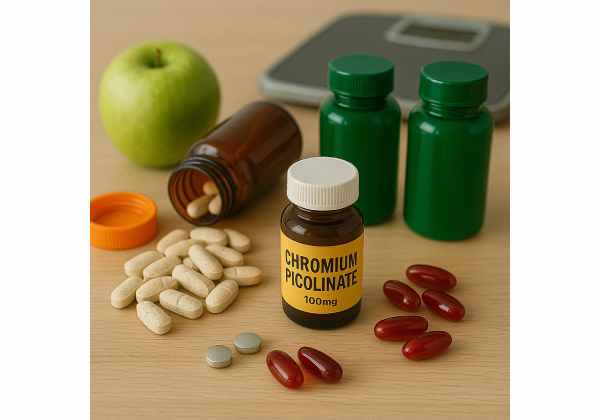
Chromium picolinate is often sold as a “craving control” supplement, especially for sugar cravings, carb cravings, and stubborn appetite during weight loss. The short answer is that it might help a little in some people, but the evidence is not strong enough to treat it as a reliable appetite suppressant or meaningful weight-loss tool.
What the research shows is more modest than the marketing. Small human studies suggest chromium picolinate may reduce hunger or cravings in select groups, but larger reviews find that any effect on body weight is usually very small. For most people, it is better viewed as an optional, low-priority supplement rather than a cornerstone strategy. The real decision is whether the possible upside is enough to justify the cost, hassle, and safety considerations.
Table of Contents
- What Chromium Picolinate Is and Why It Gets Marketed
- Does It Actually Reduce Cravings?
- How Much Weight Loss Should You Expect?
- Dose, Timing, and How to Try It
- Side Effects, Risks, and Drug Interactions
- Who Might Consider It and Who Should Skip It
- What Works Better for Cravings and Weight Loss
What Chromium Picolinate Is and Why It Gets Marketed
Chromium is a trace mineral. Chromium picolinate is a supplemental form made by binding chromium to picolinic acid. It is popular because it is inexpensive, widely available, and commonly included in “metabolism,” “blood sugar,” and “fat-burning” blends.
The theory behind chromium picolinate is fairly simple. Chromium has been linked to insulin action and glucose metabolism, so supplement marketers often make a leap: if blood sugar control becomes steadier, cravings should fall, appetite should calm down, and eating less should become easier. That idea is not completely unreasonable, but it is more of a hypothesis than a proven real-world result for most adults trying to lose weight.
This is where many people get misled. A supplement can have a plausible mechanism and still produce little or no meaningful change on the scale. Chromium picolinate also sits in a gray zone between nutrition and weight-loss marketing. Some ads frame it as a trace mineral that “supports healthy glucose metabolism,” while others stretch that into promises about appetite suppression, belly fat, and easier fat loss.
In practice, chromium picolinate is best thought of as a possible adjunct, not a primary strategy. It is not comparable to evidence-based weight-loss medications, and it is nowhere near as reliable as improving protein intake, sleep, meal structure, or calorie control.
That matters because cravings are not one single problem. They can come from:
- long gaps between meals
- low protein or low fiber intake
- poor sleep
- stress and emotional eating
- highly restrictive dieting
- habit and food environment
- blood sugar swings in some people
A supplement aimed at one possible pathway will rarely solve all of them. That is why chromium picolinate sometimes feels helpful to one person and useless to another.
It is also worth being skeptical of products that bundle chromium into flashy “thermogenic” formulas. Those formulas often rely more on stimulants and marketing than on strong evidence. Learning how to spot red-flag claims is often more useful than chasing the next supplement trend.
Does It Actually Reduce Cravings?
This is the question most people actually care about, and the answer is nuanced.
Some small human trials suggest chromium picolinate may reduce appetite, hunger, food intake, or fat cravings. The most commonly cited positive study involved overweight adult women who reported carbohydrate cravings. In that group, chromium picolinate reduced food intake and fat cravings over a short period. Other small studies in more specific populations, such as people with atypical depression or binge-eating symptoms, have also hinted at improvements in carbohydrate craving or appetite regulation.
But there are two important limits.
First, these studies were generally small and short. Small studies can produce encouraging results that do not hold up consistently in broader, more diverse groups.
Second, the populations were often selected precisely because they had prominent craving-related symptoms. That means the findings do not automatically apply to everyone who wants to lose weight.
A practical way to think about the evidence is this:
| Claim | What the research suggests | Practical takeaway |
|---|---|---|
| It kills sugar cravings | Possible small benefit in some people, especially in older, targeted studies | Not reliable enough to assume it will work for most users |
| It reduces appetite | Some trials show lower hunger or food intake, others do not show a clear effect | Any appetite effect is likely mild, not dramatic |
| It helps binge eating | Only limited pilot data in select groups | Not a substitute for formal evaluation and evidence-based treatment |
| It makes dieting easier | Possible for a small subset, but evidence is inconsistent | Best tested as a short experiment, not a long-term assumption |
So, does chromium picolinate curb cravings? Sometimes, a little, for some people. That is the honest answer. It does not have the kind of evidence that supports calling it a dependable craving suppressant.
The real-world implication is important. If cravings are being driven by under-eating earlier in the day, low protein, chronic stress, or very poor sleep, chromium is unlikely to fix the root problem. In that situation, the supplement can feel disappointing because the main driver of the craving was never chromium-responsive in the first place.
A fair expectation is not “I will stop wanting sweets.” A fair expectation is closer to “I might notice a mild decrease in appetite or fewer strong cravings, but I might also notice nothing at all.”
How Much Weight Loss Should You Expect?
If your main goal is actual scale change, chromium picolinate becomes less impressive.
Systematic reviews and meta-analyses generally show that chromium supplementation has, at best, a very small effect on body weight or body fat. In older overweight and obesity reviews, the average weight change favored chromium only slightly. The magnitude was small enough that many clinicians would not consider it clinically meaningful on its own. More recent reviews also keep landing in the same place: mixed findings, modest signals in certain subgroups, and uncertain practical relevance.
That creates a gap between expectation and reality. People often buy chromium hoping for one of these outcomes:
- faster fat loss
- visibly lower belly fat
- easier maintenance of a calorie deficit
- a measurable difference after a few weeks
Those outcomes are possible in theory, but they are not the typical result. If chromium helps at all, it is more likely to do so indirectly through appetite or eating behavior than through a meaningful direct fat-loss effect.
A helpful rule of thumb is this: if a supplement’s average effect is smaller than the weight fluctuation many people see from sodium, glycogen, bowel contents, or menstrual cycle changes, it will be hard to notice in everyday life. Chromium often falls into that category.
That does not mean it is worthless. It means the bar for success should be realistic. If you try it and it helps you stick to a sensible calorie deficit with less snacking, that can still be useful. But the benefit is coming from improved adherence, not from chromium somehow overriding the fundamentals of energy balance.
It also helps to separate two ideas:
- Statistical significance
A study may detect a small average change that is unlikely to matter much in daily life. - Clinical significance
A change is large enough to be noticeable, useful, and worth the cost or effort.
Chromium picolinate has occasionally looked statistically helpful. It has not consistently looked clinically impressive.
For most people, that means chromium is not a first-line tool for fat loss. It sits well behind high-protein meals, better sleep, resistance training, step count, and a calorie target you can actually sustain. It may have a role on the margins, but it is not a substitute for the basics.
Dose, Timing, and How to Try It
If you still want to try chromium picolinate, the smartest approach is to treat it like a short, measured experiment.
Research doses vary, but many studies and commercial products fall in the range of about 200 to 1,000 micrograms per day. The more positive appetite-related trials often used higher doses, such as 600 to 1,000 micrograms daily, while many general supplements provide 200 or 500 micrograms.
That does not mean higher is better. It means evidence is mixed, and more is not guaranteed to produce more noticeable appetite control.
A reasonable way to trial it is:
- Choose a single-ingredient product rather than a “fat burner” blend.
- Look for transparent labeling and independent quality screening.
- Use it consistently for 8 to 12 weeks rather than judging it after two or three days.
- Track one or two meaningful outcomes, such as:
- afternoon sugar cravings
- evening snacking frequency
- hunger between meals
- weekly average body weight
- Stop if there is no clear benefit.
Taking it with food can be sensible if you tend to get stomach upset from supplements.
A few practical tips matter more than people expect:
- Do not change five other things at once, or you will not know what helped.
- Do not judge the supplement by one day of appetite.
- Do not let it become an excuse to ignore meal quality.
- Do not assume a blend is better because it contains more ingredients.
This is also where product quality matters. Before buying anything, it helps to know how to read supplement labels and why third-party testing is worth looking for. Chromium products are not all identical, and some weight-loss formulas pair chromium with stimulant-heavy ingredients that create side effects without adding much real benefit.
A good personal test is simple: if your cravings, hunger, and eating behavior are no better after a well-tracked trial, there is little reason to keep paying for it.
Side Effects, Risks, and Drug Interactions
Chromium picolinate is often described as “safe,” but that word needs context.
For many generally healthy adults, short-term use at common supplement doses does not appear to cause major problems. At the same time, safety data are not unlimited, and the absence of dramatic side effects in many trials is not the same as proof of long-term safety for everyone.
Possible issues include:
- stomach upset or nausea
- headache
- dizziness in some users
- changes in blood sugar response
- rare case reports of kidney or liver problems
Serious adverse events seem uncommon, but caution is still warranted, especially if you already have a medical condition.
The biggest safety concerns are usually about who is taking it and what else they take. Chromium can potentially interact with certain medications or complicate their effects. The most relevant examples include:
- insulin
- other diabetes medications
- levothyroxine
- other medicines where timing and absorption matter
If you use diabetes medication, chromium deserves extra care because even a small added glucose-lowering effect could increase the risk of hypoglycemia in some situations. If you take levothyroxine, timing may matter because chromium picolinate can interfere with absorption.
You should be especially cautious or skip self-prescribing chromium picolinate if you:
- have kidney disease
- have liver disease
- are pregnant or breastfeeding
- are a teenager
- take multiple prescription medications
- have a history of disordered eating or binge eating that has not been evaluated
Another point people miss: there is no established upper limit for chromium from supplements in the same reassuring way people sometimes assume. That is not a green light to take high doses casually. It reflects limited data, not certainty that more is harmless.
In practical terms, chromium picolinate is not the highest-risk supplement in the weight-loss market, but it is also not risk-free. The right mindset is “potentially reasonable for some adults, with guardrails,” not “it is just a mineral, so more must be fine.”
Who Might Consider It and Who Should Skip It
Chromium picolinate makes the most sense for someone whose expectations are modest and whose main problem is recurring appetite or craving pressure, not someone looking for a dramatic body-composition change.
It may be worth considering if all of these are true:
- your cravings are frequent enough to affect adherence
- you have already improved the basics of your diet
- you want to test one low-cost intervention at a time
- you do not have obvious medication or medical contraindications
- you are comfortable stopping it if it does not help
The people most likely to be disappointed are often those expecting a supplement to compensate for an unsustainable plan. If your diet is too restrictive, your sleep is poor, and your evenings are built around ultra-processed snack foods, chromium is unlikely to rescue the situation.
It is usually a poor fit if:
- you want rapid or obvious weight loss
- you are already taking several glucose-lowering agents
- you have kidney or liver issues
- you are highly anxious about food, weight, or supplements
- you are using it instead of addressing binge eating, depression, or stress-related eating
A useful question is: What exactly am I hoping this will change?
If the answer is “I want fewer late-night urges to eat sweets,” a short chromium trial is at least logically aligned with the goal. If the answer is “I want to lose 20 pounds faster,” it is probably the wrong tool.
Chromium picolinate also should not distract from the fact that many people with “mystery cravings” are actually dealing with basic problems such as too little protein at breakfast, long gaps without food, or habit-driven evening eating. When those factors are present, the supplement is rarely the highest-yield intervention.
So the best candidates are not people chasing a miracle. They are people willing to test, track, and move on if the result is underwhelming.
What Works Better for Cravings and Weight Loss
If your real problem is cravings, there are several strategies with a better practical payoff than chromium picolinate.
The most effective approach is usually not “find the perfect supplement.” It is “reduce the number of situations that trigger cravings in the first place.”
The highest-yield moves are:
- Eat enough protein early in the day. A protein-poor breakfast often sets up stronger hunger later.
- Increase fiber and food volume. Meals that are too small or too refined tend to disappear quickly.
- Make meals predictable. Unstructured eating often turns into grazing.
- Improve sleep. Short sleep reliably makes appetite control harder.
- Address stress and emotional eating. Many cravings are less about physiology and more about regulation and habit.
- Modify your food environment. The easiest craving to manage is often the one that is not sitting in the kitchen.
If you want a practical starting point, build a small protein snacks and fiber fixes plan and tighten up meal timing habits before relying on supplements.
Here is a simple hierarchy:
- Fix meal structure.
- Raise protein and fiber.
- Improve sleep and stress control.
- Remove easy-trigger foods from constant view.
- Consider supplements only after the basics are working.
That order matters because chromium picolinate is most likely to help when it is supporting a decent foundation, not when it is trying to replace one.
So where does that leave the main question? Chromium picolinate may slightly curb cravings for some people, but it is not a dependable appetite-control strategy and it is not an impressive standalone weight-loss aid. The best use case is a cautious, time-limited trial with realistic expectations. If it helps you feel a bit less hungry and snack less, great. If not, the answer is usually to improve the plan, not to double the supplement stack.
References
- Chromium – Health Professional Fact Sheet 2022 (Fact Sheet)
- Dietary Supplements for Weight Loss – Health Professional Fact Sheet 2022 (Fact Sheet)
- Chromium – a scoping review for Nordic Nutrition Recommendations 2023 2023 (Scoping Review)
- Effects of chromium supplementation on body composition in patients with type 2 diabetes: A dose-response systematic review and meta-analysis of randomized controlled trials 2024 (Systematic Review and Meta-analysis)
- Effects of Chromium Picolinate on Food Intake and Satiety 2008 (RCT)
Disclaimer
This article is for general educational purposes only. Chromium picolinate can interact with medications and may not be appropriate for people with diabetes, kidney or liver disease, eating disorders, pregnancy, or breastfeeding. It is not a substitute for personalized medical advice, diagnosis, or treatment.
If you found this article useful, consider sharing it on Facebook, X, or any platform where it may help someone else.