Coenzyme Q10, or CoQ10, plays a real role in cellular energy production, but that does not mean everyone needs a supplement for heart health. The strongest clinical interest is in heart failure, where several trials and meta-analyses suggest CoQ10 may improve symptoms, exercise capacity, and possibly hospitalization or mortality when added to standard treatment. Evidence for blood-pressure lowering is less consistent, and there is no good proof that CoQ10 prevents heart attacks in healthy adults or replaces statins, blood-pressure medication, or guideline-directed heart-failure therapy.
Typical supplement doses range from 100 to 300 mg per day, although heart-failure trials have used different regimens. CoQ10 is generally well tolerated, but it can interact with warfarin and may affect blood glucose or blood pressure. Product quality also varies. The best use is therefore selective: identify the health goal, review medications, use a reputable product if a trial is reasonable, and measure whether it actually improves the outcome that matters rather than taking it indefinitely because it is marketed as an antioxidant.
Table of Contents
- What CoQ10 Does in the Body
- CoQ10 and Heart Failure
- Blood Pressure and Blood-Vessel Health
- Cholesterol, Statins, and Heart-Attack Prevention
- Dose, Form, and How to Take It
- Side Effects and Drug Interactions
- Who Should Avoid It or Get Medical Advice First?
- Common Questions About CoQ10 and Heart Health
What CoQ10 Does in the Body
CoQ10 is a fat-soluble compound found in cell membranes and especially in mitochondria, the structures that produce much of the cell’s usable energy. In the electron-transport chain, CoQ10 helps move electrons so cells can make ATP. It also functions as an antioxidant in its reduced form.
The body makes CoQ10, and small amounts come from food. Levels vary with age, disease, genetics, and medication use. Heart muscle has high energy demands, which is why mitochondrial function and CoQ10 have attracted attention in cardiovascular research.
Biological plausibility is not the same as clinical benefit. A molecule can be essential inside cells without extra supplementation improving outcomes in people who already have adequate levels. That is why CoQ10 claims should be separated by condition rather than treated as one broad “heart-health” effect.
The main cardiovascular areas studied are heart failure, blood pressure, endothelial function, statin-associated muscle symptoms, and ischemic heart disease. Evidence strength is different for each.
CoQ10 and Heart Failure
Heart failure is the area with the most clinically important CoQ10 research. People with heart failure can have impaired mitochondrial energy production and oxidative stress, and lower CoQ10 levels have been associated with worse disease in some studies.
A 2024 meta-analysis of 33 randomized trials reported lower all-cause mortality and heart-failure hospitalization with CoQ10, along with improvements in functional measures. The certainty of evidence was moderate for some outcomes and lower for others. A 2022 Cochrane review was more cautious: it found that CoQ10 probably reduced all-cause mortality and heart-failure hospitalization in the included trials but emphasized small studies, bias, and uncertainty for several outcomes.
A 2025 randomized trial of 120 patients reported improvements in measures of cardiac function and quality of life over six months with 120 mg/day. These findings add to the signal of benefit but do not make CoQ10 part of standard first-line heart-failure therapy.
That last point is critical. Modern heart-failure treatment with evidence for survival includes medication classes such as ARNI/ACE inhibitor/ARB therapy, evidence-based beta-blockers, mineralocorticoid receptor antagonists, and SGLT2 inhibitors for appropriate patients. CoQ10 should be viewed, at most, as an adjunct after the foundation is in place.
A person with heart failure should not start CoQ10 to replace prescribed therapy, reduce a diuretic, or avoid follow-up. Fluid status, kidney function, potassium, blood pressure, and medication titration have far stronger evidence and safety implications.
Blood Pressure and Blood-Vessel Health
CoQ10 has been studied as a blood-pressure supplement for decades. Results are mixed.
A 2022 dose-response meta-analysis of 26 randomized trials involving 1,831 people with cardiometabolic disorders found an average systolic reduction of about 4.8 mmHg. The largest modeled effect occurred around 100–200 mg/day. The evidence was rated moderate for systolic blood pressure and lower for diastolic pressure.
Other reviews, including the U.S. National Center for Complementary and Integrative Health, remain cautious and note that the available evidence does not establish a meaningful blood-pressure effect. Differences in populations, baseline blood pressure, study duration, and formulations likely contribute to the disagreement.
A 2024 meta-analysis also found improvement in measures of endothelial function. Endothelial function describes how well the inner lining of blood vessels dilates and responds to signals. Improving a laboratory measure of endothelial function is interesting, but it is not the same as proving fewer strokes or heart attacks.
If you have hypertension, use CoQ10 only as a possible adjunct, not a replacement. Learn the basics of blood pressure ranges and what the numbers mean, and prioritize treatments with proven outcome benefit.
Because CoQ10 may lower blood pressure modestly in some people, anyone taking several antihypertensive drugs should monitor for dizziness or low readings when adding it.
Cholesterol, Statins, and Heart-Attack Prevention
CoQ10 is often marketed alongside statins because statin therapy can lower circulating CoQ10 levels. The supplement has been studied for statin-associated muscle symptoms, but results are inconsistent. Some meta-analyses report modest pain improvement; others show little benefit.
Even if CoQ10 helps muscle symptoms, it does not replace the LDL-lowering and event-reduction benefits of statins. If you are considering it because of muscle pain, see how statin muscle symptoms are evaluated and managed.
CoQ10 itself is not an established LDL-lowering treatment. It should not be used instead of a statin, ezetimibe, bempedoic acid, or a PCSK9-targeting treatment when one of those is indicated.
There is also no strong evidence that healthy adults without heart disease should take CoQ10 to prevent their first heart attack. Antioxidant activity in a test tube does not establish primary-prevention benefit.
If the goal is cardiovascular prevention, focus first on the major modifiable risks: smoking, LDL and apoB exposure, blood pressure, diabetes, physical inactivity, excess body fat, sleep, and diet. Supplements can be discussed after those foundations are addressed.
Dose, Form, and How to Take It
CoQ10 is sold mainly as ubiquinone and ubiquinol. Ubiquinol is the reduced form and may have greater bioavailability in some products, particularly in older adults, but there is no definitive evidence that it produces better clinical heart outcomes than a well-formulated ubiquinone product.
Common supplemental doses are:
| Goal | Common studied range | Important note |
|---|---|---|
| General supplementation | 100–200 mg/day | No established need for healthy adults |
| Blood-pressure studies | About 100–200 mg/day | Effect is inconsistent |
| Heart-failure studies | Often 120–300 mg/day | Use only with clinician guidance |
| Statin muscle symptoms | Often 100–600 mg/day | Evidence is mixed |
CoQ10 is fat-soluble, so absorption is generally better with a meal that contains some fat. Oil-based softgels are common. Large doses can be divided between breakfast and lunch if stomach upset occurs.
Some people report insomnia when taking CoQ10 late in the day, so morning or midday dosing is reasonable. There is no proven cardiovascular advantage to taking it at night.
Give a trial enough time to assess the intended outcome. For symptoms or blood pressure, four to twelve weeks may be a reasonable assessment window depending on the goal. Heart failure should be monitored clinically rather than by self-experimentation.
Side Effects and Drug Interactions
CoQ10 is usually well tolerated. Side effects are typically mild and may include nausea, diarrhea, abdominal discomfort, reduced appetite, headache, dizziness, rash, or insomnia.
Warfarin is the interaction that deserves the most attention. CoQ10 may reduce warfarin’s anticoagulant effect in some people, potentially lowering the INR. Anyone taking warfarin should involve the clinician or anticoagulation service before starting or stopping CoQ10, because the INR may need closer monitoring.
CoQ10 may also influence glucose control. People using insulin or glucose-lowering medication should watch for changes, especially if diet or other supplements are changing at the same time.
Blood-pressure medication is another consideration. If CoQ10 produces a modest pressure reduction, it can add to the effects of antihypertensive drugs. Dizziness on standing, unusual weakness, or persistently low readings warrant review.
The National Center for Complementary and Integrative Health also notes that CoQ10 may not be compatible with some cancer treatments. Patients undergoing cancer therapy should ask their oncology team before using antioxidant supplements.
Supplement quality matters. Look for independent third-party verification, a clear amount per serving, and a manufacturer that discloses ingredients. Avoid assuming a higher price or “pharmaceutical grade” wording guarantees superiority.
Who Should Avoid It or Get Medical Advice First?
Talk with a clinician before using CoQ10 if you take warfarin, have heart failure, use multiple blood-pressure medications, use insulin or other glucose-lowering drugs, are receiving cancer treatment, or have significant liver or kidney disease.
Pregnancy and breastfeeding safety data are limited, so routine use for “heart health” is not well established in those settings.
People scheduled for surgery should disclose CoQ10 and all supplements during preoperative review. The surgical team may recommend stopping supplements in advance depending on medications and bleeding or blood-pressure concerns.
If you have unexplained chest pain, shortness of breath, swelling, fainting, or declining exercise tolerance, do not self-treat with CoQ10. Those symptoms can reflect heart failure, ischemia, arrhythmia, anemia, lung disease, or other conditions that need diagnosis.
The most rational approach is goal-based. If you have heart failure and your cardiologist thinks an adjunctive CoQ10 trial is reasonable, use a consistent product and dose while continuing guideline-directed therapy. If your only goal is vague “cardiovascular support,” there is no compelling evidence that routine supplementation adds more benefit than addressing proven risk factors.
Common Questions About CoQ10 and Heart Health
CoQ10 sits in an unusual position: it has a clear biological role, a reasonable safety record, and promising data in some heart-failure studies, but it is often marketed far beyond what trials have proven.
Should a healthy person take CoQ10 to prevent heart disease?
There is no strong evidence that routine CoQ10 supplementation prevents a first heart attack or stroke in otherwise healthy adults. If you do not have a specific indication, cardiovascular prevention is better served by controlling LDL, blood pressure, glucose, tobacco exposure, physical activity, diet, and sleep.
A supplement that improves an antioxidant marker is not automatically preventing cardiovascular events.
Can CoQ10 improve energy or exercise performance?
People with heart failure sometimes report better functional capacity in trials, but evidence for boosting exercise performance in healthy adults is inconsistent. Fatigue has many causes, including anemia, sleep apnea, thyroid disease, depression, medication effects, and heart disease. Persistent fatigue should not be self-treated with escalating CoQ10 doses without considering those causes.
Does CoQ10 help after a heart attack?
CoQ10 has been studied in ischemic heart disease and oxidative stress, but it is not standard post-heart-attack therapy and should not replace antiplatelet treatment, statins, beta-blockers when indicated, ACE inhibitor/ARB/ARNI therapy, cardiac rehabilitation, or other guideline-directed care. Any use after myocardial infarction should be discussed with the cardiology team because medication interactions matter.
Does ubiquinol justify the higher price?
Ubiquinol can produce higher blood CoQ10 levels in some comparisons, especially in older adults, but a higher serum concentration is a surrogate outcome. There is no robust evidence that ubiquinol produces superior heart-failure survival, blood-pressure control, or cardiovascular-event reduction compared with a quality ubiquinone product.
If cost is a concern, choose a reputable formulation you can take consistently rather than assuming the most expensive form is medically necessary.
Should CoQ10 be taken with a statin?
Not routinely. Statins lower circulating CoQ10 levels, but most users do not develop muscle symptoms and preventive supplementation has not been proven necessary. If muscle symptoms occur, CoQ10 can be discussed as one option after reviewing other causes and statin-management strategies.
The statin should not be stopped simply because a CoQ10 level is low or because a supplement advertisement says statins “deplete” the heart.
Can CoQ10 lower blood pressure too much?
The average effect in trials is small, but an individual taking several antihypertensive medications could become lightheaded if pressure falls further. Check home readings after adding the supplement, especially if you already run near the lower end of normal.
Dizziness on standing, fainting, or persistently low readings should prompt medication and supplement review.
How long does a heart-failure trial need?
Heart-failure studies have generally used months of therapy, not a few days. More importantly, benefit should be evaluated in the context of standard treatment and clinical follow-up. Do not judge success only by how you feel one week after starting a supplement.
Useful outcomes include symptoms, exercise tolerance, blood pressure, weight and fluid status, and clinician-assessed heart-failure markers. Medication adherence remains the priority.
Can CoQ10 interact with anticoagulants other than warfarin?
The best documented concern is warfarin. Data for direct oral anticoagulants such as apixaban or rivaroxaban are much more limited. Limited evidence does not prove no interaction. Tell the prescriber and pharmacist about all supplements, particularly if you have bleeding, bruising, kidney disease, or multiple medications.
What makes a CoQ10 product trustworthy?
Look for a clear dose per capsule, a full ingredient list, an expiration date, and independent quality verification when available. Avoid products that promise to “reverse heart failure,” “unclog arteries,” or replace medication. Those claims go far beyond the evidence.
A useful supplement trial has a defined purpose, a reasonable dose, a planned review date, and a clear stop rule if there is no benefit.
A practical way to decide whether a trial makes sense
Start by naming the outcome you want. “Better heart health” is too vague to measure. “Less fatigue with stable heart failure,” “a small additional reduction in systolic blood pressure,” or “fewer statin-related muscle symptoms” can be tracked. Then decide in advance what would count as meaningful improvement and when you will reassess.
For example, a person with stable heart failure who is already receiving guideline-directed therapy might discuss a CoQ10 trial with the cardiology team, use a consistent dose, and review symptoms and exercise tolerance over several months. A healthy person with normal blood pressure and cholesterol who takes CoQ10 because a label promises “cellular energy” has no equally clear evidence-based endpoint.
Also account for opportunity cost. Taking another capsule is not automatically harmless if it adds expense, complicates medication routines, or creates a warfarin interaction. If the supplement makes it harder to adhere to treatments with proven survival benefit, it is not helping overall cardiovascular care.
Finally, stop when the experiment has answered the question. Supplements often become permanent by inertia. If a well-conducted trial produces no meaningful change, discontinuing it is a rational outcome. If it helps and remains safe, document the dose and product so that future clinicians can accurately review the regimen.
What to monitor after starting
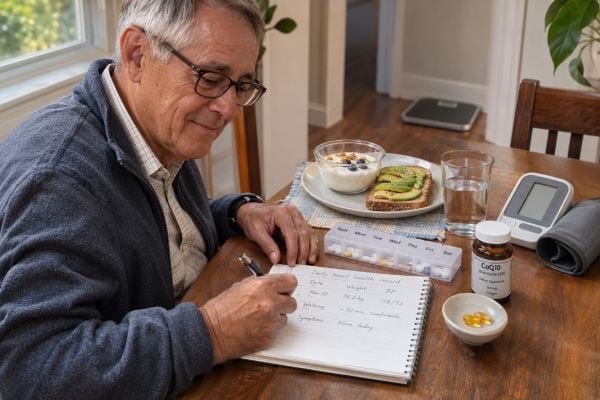
Write down the brand, form, dose, and start date. If the goal is blood pressure, use a validated home cuff and compare weekly averages rather than isolated readings. If the goal is heart-failure symptoms, track walking tolerance, breathlessness, swelling, and daily weight as your clinical team recommends. If the goal is statin-muscle relief, keep the statin regimen stable enough to judge the effect.
Do not interpret every day-to-day change as a supplement effect. Heart-failure symptoms and blood pressure naturally fluctuate with sodium intake, hydration, sleep, illness, and medication timing. A useful trial needs a stable comparison period.
Report new dizziness, unusual bruising or bleeding, worsening shortness of breath, or major glucose changes. CoQ10 should make a treatment plan clearer, not create another variable that no one is tracking.
References
- Efficacy and safety of coenzyme Q10 in heart failure: a meta-analysis of randomized controlled trials 2024 (Meta-Analysis)
- Coenzyme Q10 for heart failure 2022 (Systematic Review)
- Dose-Response Effect of Coenzyme Q10 Supplementation on Blood Pressure among Patients with Cardiometabolic Disorders: A Grading of Recommendations Assessment, Development, and Evaluation (GRADE)-Assessed Systematic Review and Meta-Analysis of Randomized Controlled Trials 2022 (Systematic Review)
- Effect of Coenzyme Q10 Supplementation on Vascular Endothelial Function: A Systematic Review and Meta-Analysis of Randomized Controlled Trials 2024 (Systematic Review)
- Effect of Coenzyme Q10 Supplementation on Cardiac Function and Quality of Life in Patients with Heart Failure: A Randomized Controlled Trial 2025 (RCT)
- Coenzyme Q10 2025 (Official Health Resource)
Disclaimer
This article is for general education and does not replace individualized medical care. Do not use CoQ10 to replace prescribed heart-failure, cholesterol, blood-pressure, or anticoagulant treatment. Ask a clinician or pharmacist before using it if you take warfarin, diabetes medication, multiple blood-pressure drugs, or cancer therapy.