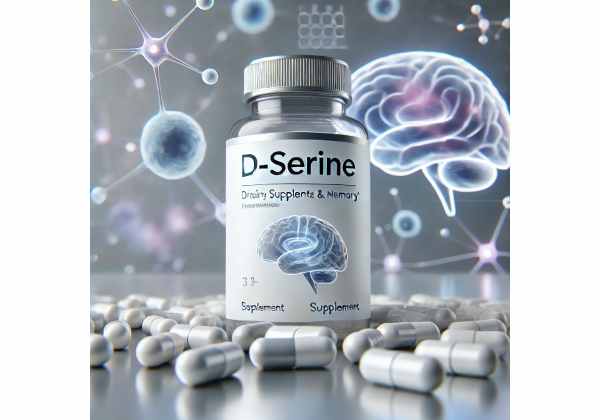
D-serine is one of those brain-health supplements that sounds simple until you look closely. It is a naturally occurring amino acid in the body, and it plays an unusually important role in signaling at NMDA receptors, which help govern learning, memory, and synaptic plasticity. That biology makes it fascinating. It also makes it easy to overstate. D-serine has genuine scientific relevance to cognition and psychiatric research, especially in schizophrenia, but that does not automatically make it a practical everyday supplement for focus, mood, or mental clarity. The gap between mechanism and real-world use is where most confusion begins. This article takes a careful look at what D-serine does in the brain, what the human evidence actually supports, where its potential appears strongest, how research doses are used, and why safety deserves more attention here than it does with many common wellness supplements.
Table of Contents
- What D-serine actually is
- How D-serine affects the brain
- What human research really shows
- Who might consider D-serine
- Dosage and practical use
- Safety, side effects, and cautions
What D-serine actually is
D-serine is an endogenous D-amino acid, which means your body makes it rather than relying on it as a classic essential nutrient. That matters because people often approach it like a standard dietary supplement, when it is better understood as a signaling molecule with a targeted neurological role. In the brain, D-serine helps regulate NMDA receptor activity by acting at the receptor’s co-agonist site. That role places it close to some of the most important processes in higher brain function, including synaptic plasticity, learning, memory formation, and aspects of cognitive flexibility.
One of the first points worth clarifying is that D-serine is not the same thing as L-serine. L-serine is the more familiar amino acid found in nutrition discussions and basic metabolism. D-serine is a different form with a more specialized role in neural signaling. It is also not the same as phosphatidylserine, another brain-health supplement that gets discussed in memory and cognition conversations. The names sound similar enough to cause confusion, but the compounds are distinct and should not be treated as interchangeable. That distinction is especially important for readers comparing D-serine with more established consumer-facing options such as citicoline or phospholipid-based cognitive supplements.
D-serine is present in multiple tissues, but its neurological importance stands out because it helps tune excitatory neurotransmission rather than simply serving as a structural nutrient. It is synthesized from L-serine by the enzyme serine racemase and is broken down largely by D-amino acid oxidase. In practical terms, that means brain D-serine levels are tightly regulated rather than left to chance. This also helps explain why supplementing with D-serine is not the same as merely “topping off” a deficiency the way someone might with a vitamin or mineral.
Another important feature is that D-serine can reach the central nervous system, which is one reason researchers keep studying it in psychiatric and cognitive disorders. But being biologically active is not the same as being broadly useful as a supplement. Many compounds have elegant mechanisms and limited everyday value. D-serine belongs to a category where the science is real, the therapeutic interest is legitimate, and the consumer use case is narrower than marketing sometimes suggests.
A grounded way to think about it is this: D-serine is less of a general wellness nutrient and more of a research-driven neuroactive compound. That does not make it unhelpful. It simply means the right questions are different. Instead of asking whether it is “good for the brain” in a vague sense, it is better to ask what kind of brain-related problem it is meant to address, in which people, and at what dose.
How D-serine affects the brain
The main reason D-serine gets attention in brain health is its connection to the NMDA receptor. This receptor is deeply involved in synaptic plasticity, which is the brain’s ability to strengthen or weaken connections in response to experience. That process matters for learning, memory encoding, adaptation, and many forms of higher-order cognition. D-serine acts as a co-agonist at the receptor’s glycine site, meaning it helps enable receptor activation when glutamate is also present. Without that cooperation, NMDA signaling is less effective.
That might sound technical, but the practical point is straightforward. D-serine is closely tied to the machinery that allows the brain to change with use. Because of that, researchers have long been interested in whether altering D-serine levels could improve disorders marked by NMDA receptor dysfunction, impaired plasticity, or cognitive disruption. Schizophrenia has become one of the most studied examples, especially because NMDA hypofunction has been one of the more influential hypotheses in the field.
This mechanism also explains why D-serine attracts interest in memory and learning discussions. In theory, a compound that supports NMDA receptor signaling could influence how the brain acquires and consolidates information. But theory has to be separated from outcome. In neuroscience, many things that look promising at the receptor level do not produce consistent real-world gains in cognition, or they only work in narrow clinical settings. D-serine sits right in that tension between strong mechanistic plausibility and more selective human evidence.
Its relevance may extend beyond cognition alone. NMDA signaling also intersects with mood regulation, sensory processing, executive control, and the brain’s response to training or remediation. That is why D-serine appears in research on negative symptoms of schizophrenia, cognitive impairment associated with schizophrenia, and experimentally enhanced learning paradigms. It is less often discussed as a direct treatment for ordinary stress, anxiety, or low mood in otherwise healthy adults, because that evidence base is much thinner.
Another subtle but important point is that more NMDA signaling is not automatically better. Healthy brain function depends on balance. Too little NMDA activity may impair plasticity and cognition, but too much excitatory drive can be harmful. That is one reason D-serine is best viewed as a targeted modulator rather than a general “brain fuel.” It also helps explain why researchers pay close attention to dose, population, and safety monitoring when they study it.
For readers interested in mental performance, the key takeaway is that D-serine’s appeal comes from its role in neural plasticity, not from stimulant-like effects. It is not designed to work like caffeine, and it is not a shortcut around sleep, recovery, or skill practice. If the underlying issue is chronic overload, poor sleep, or fragmented attention, it may be more useful to understand mental fatigue itself than to assume an NMDA-related supplement will solve the whole problem.
What human research really shows
The human evidence on D-serine is most compelling in psychiatric research, particularly schizophrenia, and much less established for routine self-directed use in general brain health. That distinction is the center of the whole topic. D-serine is not one of those supplements where the strongest data come from healthy adults looking for better focus or memory. Instead, the main body of research looks at whether it can improve symptoms, cognition, or plasticity-related deficits in schizophrenia, often as an add-on to standard treatment.
That research is promising but mixed. Some clinical studies have reported improvements in negative symptoms and certain cognitive measures, especially when D-serine is used at higher doses than those found in many retail supplements. Reviews of NMDA-modulating treatments note that early low-dose studies sometimes showed positive findings, while larger multicenter low-dose trials were negative for cognitive outcomes. At the same time, later work suggests that higher doses may produce stronger effects in some settings. This is important because it tells you the field has not dismissed D-serine, but it also has not settled into a simple, broadly effective dosing model.
There is also a newer line of work looking at D-serine in learning and plasticity paradigms rather than only in symptom scores. In one randomized, placebo-controlled study, D-serine was linked with improvements in auditory and frontal biomarkers tied to learning-related plasticity in schizophrenia. That is scientifically interesting because it supports the idea that D-serine may help engage the very systems researchers think are impaired. But it is still a specialized clinical context, not proof that the average person taking a capsule at home will feel sharper or calmer.
For depression, anxiety, everyday stress, and general mental wellness, the evidence is much more limited. There is not a strong clinical foundation for presenting D-serine as a standard over-the-counter mood supplement. It may matter biologically in those domains, but the leap from plausible mechanism to dependable benefit has not been made. This is where readers should be careful with broad supplement claims that borrow credibility from schizophrenia research and then apply it to every form of brain fog, low motivation, or distraction.
A useful way to summarize the evidence is by separating three levels of confidence:
- High confidence that D-serine is biologically relevant to brain signaling and plasticity.
- Moderate confidence that it may have therapeutic value in selected psychiatric research settings, especially schizophrenia-related cognition and negative symptoms.
- Low confidence that it is a proven general-use supplement for healthy adults seeking better memory, focus, or mood.
That last point matters most for practical use. D-serine is fascinating and clinically important, but it does not currently belong in the same evidence category as a simple, broadly supported consumer supplement for everyday cognition. Anyone exploring it should keep that perspective, especially if they are already tempted by broad claims about nootropics and focus.
Who might consider D-serine
D-serine is not a supplement that makes equal sense for everyone. The best candidates are usually people whose interest is tied to a very specific clinical or research-informed question, not people who simply want a general brain booster. In practice, that means the most rational discussions about D-serine often happen in the context of psychiatric care, particularly around schizophrenia-spectrum conditions, negative symptoms, or cognitive impairment associated with those disorders.
For someone under specialist care, D-serine may come up as an adjunctive option because of its NMDA-related mechanism and the research base built around that use. Even then, it is not routine, and it is not a substitute for established psychiatric treatment. It is better viewed as a targeted compound that may have a role in carefully selected cases rather than as a first-line mental wellness supplement.
It makes much less sense for the healthy adult who is looking for stronger concentration, better test performance, or more mental energy. The evidence does not support D-serine as a simple productivity enhancer. If a person’s main issue is poor sleep, overwork, anxious rumination, or scattered habits, there are usually more direct explanations and better-supported interventions. Sometimes what feels like a neurotransmitter problem is really the result of chronic stress load, inconsistent sleep timing, or persistent overstimulation. In that situation, looking at sleep and brain function is often more useful than experimenting with a specialized amino acid.
There is also a category of people who should approach D-serine cautiously or avoid unsupervised use altogether. Anyone with kidney disease belongs on that list because renal safety has been one of the central concerns in the D-serine literature. People with complex psychiatric illness, seizure history, pregnancy, breastfeeding, or multiple prescription medications should also avoid casual self-experimentation. This is not because D-serine is clearly dangerous in all those settings, but because the available evidence comes from monitored studies, not from broad, low-risk wellness use.
Another group to consider carefully is people already taking large supplement stacks. D-serine is often most attractive to readers who have already tried several compounds and want something more advanced. But the more layered the stack becomes, the harder it is to understand cause and effect. New symptoms, sleep changes, irritability, headaches, or digestive issues can become difficult to trace.
The most grounded rule is simple: D-serine may be worth discussing when there is a specific therapeutic rationale, but it is a poor choice for vague, unsupervised biohacking. It is much more of a precision discussion than a casual add-on. That is exactly why it deserves more caution than a typical “brain support” supplement.
Dosage and practical use
D-serine dosing is one of the clearest examples of why a research compound can be hard to translate into ordinary supplement use. There is no simple, universally accepted daily dose for general brain health or mental wellness. Instead, most clinically meaningful dosing information comes from psychiatric studies, especially schizophrenia research, where dosing is often based on body weight rather than a fixed retail-style serving size.
Lower-dose trials have often used around 30 mg per kilogram per day, which for many adults lands near 2 g daily. Higher-dose studies have gone to 60 mg per kilogram or above, and some research exploring target engagement or plasticity has used doses up to 100 or 120 mg per kilogram in controlled settings. Those are serious doses. They are far removed from the casual expectation many people bring to over-the-counter supplementation, and they help explain why D-serine should not be treated like a typical wellness amino acid.
That does not mean everyone interested in D-serine should think only in terms of high-dose psychiatric protocols. It means the most relevant human data do not support a neat consumer narrative. If someone is using a low retail dose for vague cognitive support, they may be operating below the range where the most interesting clinical effects were studied. On the other hand, trying to match research doses without medical supervision is not a sensible solution because the monitoring and patient selection in trials are part of the safety picture.
Timing is also less straightforward than with stimulant-like supplements. D-serine is not generally used as an acute alertness aid. In research, it has been studied both as repeated daily dosing and in more targeted designs around learning or remediation sessions. That supports the idea that its value may depend more on plasticity-related context than on quick subjective effects. Someone waiting to “feel” it the way they feel caffeine may conclude either too quickly that it does nothing or too confidently that it is working based on expectation alone.
For practical use, the most honest consumer guidance is cautious:
- Do not assume there is a standard everyday dose for healthy adults.
- Recognize that the strongest research doses are medical-research doses, not casual supplement norms.
- Avoid combining D-serine with multiple other experimental compounds at the same time.
- Treat kidney function and overall health status as part of the decision, not as an afterthought.
- Reconsider whether your goal is actually better matched to a different supplement category, such as L-theanine for focus and calm.
In short, D-serine dosing is not impossible to understand, but it is easy to misuse. The absence of a simple consumer dose is not a gap in marketing. It is a reflection of the real evidence.
Safety, side effects, and cautions
Safety is where D-serine becomes clearly different from many mainstream brain supplements. The major issue is renal safety. Animal work, especially in rats, raised concerns about nephrotoxicity at high doses, and that history strongly shaped how human studies were designed. Later reviews have pointed out an important nuance: the kidney toxicity seen in rats has not translated cleanly to humans. In fact, human trials have generally shown a better safety profile than early animal concern might have suggested. But that does not eliminate caution. It means the safety story is more reassuring than feared, while still serious enough to require respect.
Human studies have reported that nephrotoxicity has not generally been observed, aside from isolated concern such as mildly abnormal renal values in a participant at a very high dose. That is encouraging, but it is not the same as saying D-serine is carefree. The clinical literature still treats kidney monitoring as relevant, especially at higher doses. That alone should tell readers that this is not a supplement to take casually for marginal gains in concentration.
Side effects outside the kidney question appear less dramatic, but the available data are still more specialized than what people are used to with standard wellness products. Because D-serine is studied mostly in psychiatric settings, tolerability is often assessed in structured trials rather than in broad community use. That means the safety picture is informative but narrower than it would be for something commonly used by the general public.
Several groups should be especially cautious:
- People with kidney disease or a history of renal problems.
- People taking multiple psychiatric medications or complex drug regimens.
- Pregnant or breastfeeding individuals.
- Children and adolescents outside specialist care.
- Anyone trying to self-treat serious psychiatric or cognitive symptoms.
There is also a broader caution that matters just as much: self-misdiagnosis. A person dealing with memory lapses, attention problems, emotional blunting, or mental slowing may assume they need a neurotransmitter-targeting supplement when the real issue is depression, sleep apnea, burnout, medication effects, or another medical condition. That is one reason D-serine is poorly suited to guesswork. The more advanced the compound, the less forgiving casual use tends to be.
A good rule is that D-serine belongs closer to clinician-guided experimentation than to wellness trial-and-error. If someone is interested in it because of persistent brain fog, worsening memory, or significant emotional symptoms, they should not use supplementation to delay a proper evaluation. Often the better next step is understanding common causes of brain fog before moving toward a targeted NMDA-related compound.
The final safety takeaway is balanced: D-serine is not automatically unsafe, and the human data are more reassuring than the earliest animal concerns suggested. Still, it remains a supplement where dose, population, and monitoring matter enough that unsupervised use should be the exception, not the rule.
References
- D-Serine: A Cross Species Review of Safety 2021 (Review)
- The Role of D-Serine and D-Aspartate in the Pathogenesis and Therapy of Treatment-Resistant Schizophrenia 2022 (Review)
- Cross species review of the physiological role of d-serine in translationally relevant behaviors 2023 (Review)
- Augmentation of learning in schizophrenia by D-serine is related to auditory and frontally-generated biomarkers: A randomized, double-blind, placebo-controlled study 2023 (RCT)
- Finding the right dose: NMDAR modulating treatments for cognitive and plasticity deficits in schizophrenia and the role of pharmacodynamic target engagement 2024 (Review)
Disclaimer
This article is for educational purposes only and is not medical advice. D-serine is a neuroactive compound with research uses that differ from routine supplement use, and it may not be appropriate for people with kidney disease, pregnancy, breastfeeding, psychiatric instability, or complex medication regimens. Supplements should not replace diagnosis, prescribed treatment, psychotherapy, or urgent medical care. Speak with a qualified clinician before using D-serine if you have ongoing cognitive symptoms, mood changes, psychotic symptoms, or any chronic medical condition.
If you found this article useful, please share it on Facebook, X, or your preferred platform.