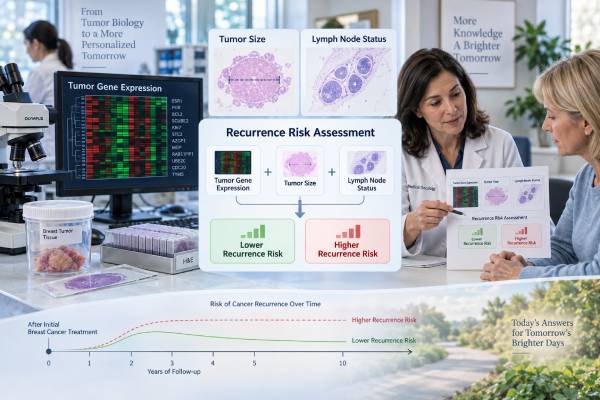
EndoPredict is a gene-expression test used in selected estrogen receptor-positive, HER2-negative early breast cancers to estimate the risk of distant recurrence. It measures expression of a 12-gene panel in stored tumor tissue and produces a molecular score; the commonly used EPclin result combines that molecular information with tumor size and lymph-node status. EPclin classifies patients into low- or high-risk groups using a validated cutoff and can provide a 10-year distant-recurrence estimate in the appropriate clinical setting. The test is primarily prognostic: it helps define how likely recurrence is, especially when deciding whether endocrine therapy alone is a reasonable strategy. A high EndoPredict result is not direct proof that chemotherapy will help, and a low result does not make recurrence impossible. The assay should therefore be interpreted with age or menopausal status, nodal burden, grade, treatment history, and the specific decision the oncology team is trying to make.
- EndoPredict is performed on formalin-fixed breast tumor tissue and usually does not require a new biopsy.
- The molecular EP score uses expression of 12 genes; EPclin adds tumor size and lymph-node status.
- An EPclin score below 3.3 is classified as low risk and 3.3 or higher as high risk in the validated model.
- EndoPredict is mainly used in ER-positive, HER2-negative early breast cancer to refine distant-recurrence prognosis.
- EndoPredict is prognostic and can support chemotherapy decisions in selected patients, but a high score is not a direct measurement of chemotherapy benefit.
Table of Contents
- What EndoPredict Measures
- Who May Benefit From EndoPredict Testing
- EP and EPclin Scores: What the Numbers Mean
- Prognostic Value, Including Later Recurrence
- Does EndoPredict Predict Chemotherapy Benefit?
- How EndoPredict Fits With Grade, Ki-67, and Other Genomic Tests
- Questions and Next Steps After an EndoPredict Result
What EndoPredict Measures
EndoPredict is a multigene expression assay designed for hormone receptor-positive, HER2-negative early breast cancer. The laboratory extracts RNA from formalin-fixed, paraffin-embedded tumor tissue and measures expression of genes involved in tumor proliferation and estrogen-receptor signaling, along with reference genes used for normalization and quality control.
The first output is the molecular EP score. The more commonly used clinical output is EPclin, which mathematically combines the molecular score with two established clinical risk factors: tumor size and lymph-node status. This integration is intentional. Gene expression captures biology, while tumor size and nodal involvement capture how far the cancer has already progressed anatomically.
EPclin therefore differs from a pure molecular test. Two tumors with similar gene expression can receive different EPclin results if one is larger or node-positive. That is not a flaw; it reflects evidence that combining molecular and clinical information improves prognostic discrimination.
EndoPredict is most often discussed alongside assays such as Oncotype DX, MammaPrint, Prosigna, and Breast Cancer Index. These tests all use tumor biology to refine risk, but they use different genes, scoring systems, validation cohorts, and clinical endpoints. A numerical EndoPredict score cannot be converted into an Oncotype DX Recurrence Score or a Prosigna ROR score.
The test does not measure whether cancer is currently present after surgery and does not monitor disease in real time. It is a prognostic assay applied to the primary tumor to estimate future distant-recurrence risk under specified treatment assumptions.
Who May Benefit From EndoPredict Testing
EndoPredict is used in a defined clinical niche: early-stage ER-positive, HER2-negative invasive breast cancer in which the value of adjuvant chemotherapy is uncertain after standard pathology and staging are known. Guidelines generally discuss multigene assays for node-negative disease and selected patients with one to three positive nodes, with age and menopausal status influencing how each assay should be used.
ASCO’s 2022 guideline states that EndoPredict may be used with other validated genomic assays in postmenopausal patients or those older than 50 with ER-positive/HER2-negative early breast cancer that is node-negative or has one to three positive nodes. It does not recommend simply applying all assays to every patient. Premenopausal patients and patients with more extensive nodal disease require different evidence considerations.
A test is most useful when it can change a decision. If chemotherapy is clearly indicated because of very high clinical risk, or clearly inappropriate because of major comorbidity or patient preference, EndoPredict may add little. Its value is greater when clinicopathologic features leave a credible choice between endocrine therapy alone and endocrine therapy plus chemotherapy.
The tumor must also have adequate tissue. Most tests can use archived surgical specimens, and some cases can use biopsy material if it meets technical requirements. The pathologist identifies invasive tumor and ensures that enough representative material is available.
EndoPredict should not be ordered to decide whether a tumor is ER positive, HER2 positive, or metastatic. Those questions require other tests. A complete breast cancer biomarker profile is established first; the genomic assay is an additional decision tool, not a substitute for receptor testing or stage.
EP and EPclin Scores: What the Numbers Mean
The molecular EP score and the integrated EPclin score are related but not identical. EPclin combines the molecular signal with tumor size and nodal status and is therefore usually the more clinically relevant number. In the validated EPclin model, a score below 3.3 is classified as low risk and a score of 3.3 or higher as high risk.
That 3.3 threshold should not be read as a percentage. An EPclin of 3.8 does not mean a 3.8% chance of recurrence. The report may separately provide an estimated 10-year distant-recurrence risk, which is the percentage patients usually want to understand. Always distinguish the score from the modeled risk estimate.
A low-risk result means the patient belongs to a group with relatively favorable distant-recurrence outcomes under the treatments represented in validation studies. A high-risk result means recurrence risk is greater. Neither category guarantees an outcome. Some low-risk patients recur, and many high-risk patients remain cancer-free.
The score is continuous even though the report creates two categories. A result just below 3.3 and a result far below 3.3 both receive the low label, but their underlying risk estimates may differ. The same is true on the high side. This is why discussing the actual modeled risk can be more informative than focusing only on the binary label.
The patient should also ask what treatment the reported risk assumes. Prognostic models are derived from cohorts receiving particular combinations of surgery, radiation, endocrine therapy, and sometimes chemotherapy. The report and clinician should explain whether the displayed estimate most closely represents endocrine therapy alone or another treatment context.
Prognostic Value, Including Later Recurrence
EndoPredict has been validated in multiple cohorts as an independent prognostic marker for distant recurrence in ER-positive/HER2-negative breast cancer. Studies have shown that EPclin can add information beyond conventional tumor size, nodal status, grade, and proliferation measures.
One reason clinicians consider EndoPredict is that hormone receptor-positive disease retains recurrence risk beyond five years. Gene-expression signatures differ in how well they separate late-risk groups. Reviews of multigene assays have found that EndoPredict and several other second-generation assays provide prognostic information that extends into the later follow-up period.
A 2024 analysis of patients screened for the UNIRAD phase III trial found that EPclin remained independently associated with disease-free and distant-metastasis-free survival after adjustment for tumor size, number of positive nodes, and grade. In that cohort, the 60-month relapse rate was 0% in the EPclin-low group and 7% in the EPclin-high group, although the population was selected for a clinical trial and should not be treated as a universal absolute-risk estimate.
Other real-world and prospective studies have shown that EndoPredict results can change treatment recommendations. That is clinical utility in a practical sense: a test can move a patient from chemotherapy to no chemotherapy, or the reverse, when clinicians believe the genomic information changes the risk-benefit balance.
Still, prognosis is not destiny. The final recurrence risk after treatment depends on therapy received and completed, tumor biology not captured by the assay, competing health risks, and chance. EndoPredict refines uncertainty; it does not remove it.
Does EndoPredict Predict Chemotherapy Benefit?
This is the most important interpretation question. EndoPredict is well established as a prognostic assay. A high EPclin result identifies a group with higher distant-recurrence risk. That can make chemotherapy more reasonable because the potential absolute benefit of an effective systemic treatment rises as baseline recurrence risk rises.
However, prognostic risk is not the same as a validated predictive interaction showing that chemotherapy works better in one EndoPredict group than another. Earlier evidence and practice guidelines have been more cautious about describing EndoPredict as directly predictive of chemotherapy benefit than they are for assays with randomized prospective treatment-interaction evidence.
This distinction protects against overstatement. A high EPclin result should not be translated as “chemotherapy will reduce my risk by X%” unless that estimate comes from an appropriate validated model and the clinician explains its assumptions. Likewise, a low EPclin result can support a decision to omit chemotherapy in an appropriate patient, but it should be integrated with menopausal status, nodal burden, grade, tumor size, and other high-risk features.
ASCO and Ontario Health guidelines allow EndoPredict to contribute to adjuvant systemic-therapy decisions in selected early-stage ER-positive/HER2-negative patients. The strongest use is therefore risk stratification that informs a treatment decision, not a stand-alone laboratory measurement of drug sensitivity.
When comparing assays, ask whether the evidence needed is prognostic, predictive, or both. That question is more useful than asking which commercial test is “best” in the abstract.
How EndoPredict Fits With Grade, Ki-67, and Other Genomic Tests
Traditional pathology and genomic assays overlap but are not redundant. Tumor grade captures differentiation, mitoses, and architecture. Ki-67 estimates proliferation. ER and PR measure hormone-receptor expression. HER2 identifies a separate treatment-driving pathway. EndoPredict samples a set of gene-expression programs and then adds tumor size and nodal status through EPclin.
Because these tools measure related biology, they often point in the same direction. A small, node-negative, strongly ER-positive, low-grade tumor with low Ki-67 often has a favorable genomic score. But discordance is common enough to matter. A clinically intermediate tumor can have a low EPclin result, or an apparently favorable pathology profile can have a higher molecular risk.
The International Ki67 Working Group has noted that Ki-67 is most reliable at low and high extremes in selected settings, with less certainty in the broad middle range. A validated genomic assay can therefore be particularly helpful when Ki-67 and grade do not yield a clear decision.
Choosing among genomic tests depends on the patient population and decision. MammaPrint uses a binary genomic risk framework supported by MINDACT data. Prosigna provides PAM50 intrinsic subtype and risk of recurrence. Oncotype DX has extensive chemotherapy-benefit evidence in specific groups. BCI adds a distinct extended-endocrine-therapy prediction. EndoPredict’s strength is integrated molecular-clinical prognosis.
Ordering multiple assays on the same tumor is usually not necessary. Differences between commercial scores can create more confusion than clarity because each assay was validated in its own framework. One well-chosen test that addresses the actual treatment decision is generally preferable.
Questions and Next Steps After an EndoPredict Result
Ask first whether you are looking at the EP molecular score or EPclin. If EPclin is reported, confirm whether it is below or above the 3.3 cutoff and ask for the corresponding estimated distant-recurrence risk. Do not assume the score itself is a percentage.
Then ask how much the result changes the treatment recommendation. A useful conversation compares two realistic plans—for example, endocrine therapy alone versus chemotherapy followed by endocrine therapy—and explains why the EPclin result shifts the balance.
If the result is low, ask whether any clinical feature still argues strongly for chemotherapy. If it is high, ask how much absolute benefit chemotherapy is expected to provide and where that estimate comes from. The answer should distinguish the assay’s prognostic information from evidence about treatment effect.
Review the basics as well: tumor size, number of positive lymph nodes, grade, ER/PR status, HER2 status, menopausal status, and the planned endocrine regimen. Genomic testing is most interpretable when those facts are already clear.
For long-term follow-up, remember that EndoPredict does not monitor recurrence. New symptoms are evaluated based on clinical assessment and appropriate imaging or tests, not by repeating EPclin. The assay analyzes the original tumor and remains a baseline prognostic tool.
Finally, keep the report. If treatment decisions are revisited years later, the exact assay, score, risk category, and date can provide useful context. The most valuable EndoPredict result is one that is translated into a documented treatment rationale rather than left as an isolated number in the medical record.
Example interpretations in real treatment discussions
Consider two patients with hormone receptor-positive, HER2-negative early breast cancer. One has a small node-negative, low-grade tumor and an EPclin result below 3.3. The assay supports a low-risk prognosis when combined with the clinical factors already built into EPclin. That result may strengthen a plan to use endocrine therapy without chemotherapy if the patient otherwise fits the assay’s validated population. It does not mean recurrence risk is zero or that endocrine therapy can be skipped.
A second patient has a larger tumor with involved lymph nodes and an EPclin result at or above 3.3. That is a high-risk classification. It signals a higher estimated distant-recurrence risk on endocrine therapy alone and can support a discussion about additional systemic treatment. However, the high category is not direct proof that chemotherapy will provide a specific absolute benefit. Chemotherapy decisions still require age, menopausal status, nodal burden, comorbidities, preferences, and guideline context.
The same caution applies when comparing EndoPredict with other genomic assays. Oncotype DX, MammaPrint, Prosigna, and Breast Cancer Index were developed and validated with different genes, endpoints, populations, and clinical questions. Their numeric scales are not interchangeable. An EPclin score of 4 cannot be converted into an Oncotype Recurrence Score, and a cutoff from one test should never be applied to another.
The most useful way to read EndoPredict is therefore as a validated prognostic layer added to standard pathology, not as an isolated verdict. Ask which specimen was tested, whether the patient matches the validated clinical setting, what distant-recurrence time horizon the report uses, and exactly which treatment decision the result is intended to inform.
Another common source of confusion is the relationship between molecular risk and clinical risk. EPclin intentionally combines both because a tumor’s biology and anatomic burden contribute independent information. A small node-negative cancer with unfavorable gene expression may not carry the same absolute distant-recurrence risk as a larger node-positive cancer with a similar molecular signal. That integration is a strength of the test, but it also means the final score should not be described as a pure gene-expression result.
If treatment has already started or the disease is metastatic, ask whether EndoPredict is still answering a validated question. It was developed for prognosis in early hormone receptor-positive/HER2-negative disease, not for monitoring response, detecting recurrence in blood, or selecting therapy after metastatic progression.
EndoPredict also should not be used to compare the aggressiveness of two people’s cancers from the score alone. EPclin contains clinical variables, so differences may reflect tumor size or nodal status as well as gene expression. A patient should compare the report with the validation population and treatment question, not with another person’s number. When the result changes a chemotherapy discussion, asking for the estimated absolute recurrence risk with endocrine therapy and the expected absolute benefit of each treatment option is more useful than focusing on whether the label says “low” or “high.”
References
- Biomarkers for Adjuvant Endocrine and Chemotherapy in Early-Stage Breast Cancer: ASCO Guideline Update 2022 (Guideline)
- Clinical Utility of Multigene Profiling Assays in Early-Stage Invasive Breast Cancer: An Ontario Health (Cancer Care Ontario) Clinical Practice Guideline 2022 (Guideline)
- Prognostic value of EndoPredict test in patients with hormone receptor-positive, human epidermal growth factor receptor 2-negative primary breast cancer screened for the randomized, double-blind, phase III UNIRAD trial 2024
- Selecting postoperative adjuvant systemic therapy for early-stage breast cancer: An updated assessment and systematic review of leading commercially available gene expression assays 2024 (Systematic Review)
- Early breast cancer: ESMO Clinical Practice Guideline for diagnosis, treatment and follow-up 2024 (Guideline)
- Treatment Outcomes according to the EndoPredict Score in ER-Positive, HER2-Negative Early Breast Cancer 2023
Disclaimer
This article is educational and does not provide an individual recurrence estimate or chemotherapy recommendation. EndoPredict results should be interpreted by the oncology team together with tumor stage, nodal status, receptor status, menopausal status, overall health, and current guidelines.