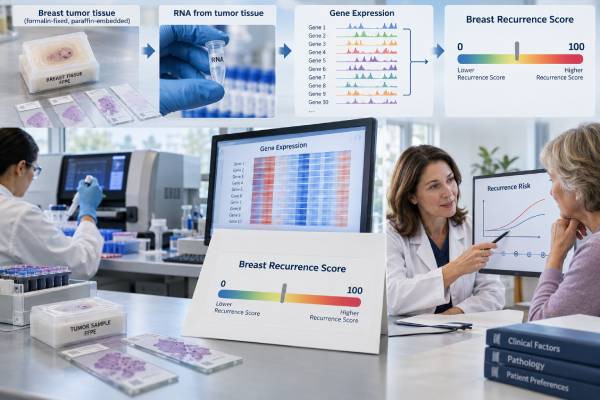
The Oncotype DX Breast Recurrence Score test is a tumor gene-expression assay used mainly in early-stage, hormone receptor-positive, HER2-negative invasive breast cancer. It analyzes activity from 21 genes in a preserved tumor sample and reports a Recurrence Score from 0 to 100. The score helps estimate how likely distant recurrence may be after endocrine therapy and, in specific groups, how much adjuvant chemotherapy may add to treatment. A higher number generally reflects more aggressive tumor biology and a greater likelihood that chemotherapy could provide benefit, but the score is not interpreted by itself. Age or menopausal status, lymph-node involvement, tumor size, grade, overall health, and treatment preferences remain important. The test is not a hereditary cancer test, does not measure whether cancer is already elsewhere in the body, and is not intended to replace standard pathology. Its strongest evidence comes from large prospective trials in hormone receptor-positive, HER2-negative early breast cancer.
- Oncotype DX measures gene expression in the breast tumor, not inherited cancer risk.
- The Breast Recurrence Score ranges from 0 to 100; higher scores generally indicate greater recurrence risk and chemotherapy benefit.
- Node status and menopausal status can substantially change how the same score is used.
- A score is one part of an adjuvant treatment decision, not a stand-alone treatment order.
- Results are most useful when chemotherapy benefit is uncertain after routine pathology is reviewed.
Table of Contents
- What the Oncotype DX test measures
- What the Recurrence Score means
- How results are used in node-negative breast cancer
- How results are used with positive lymph nodes
- How the test is performed and reported
- What the score can and cannot tell you
- Questions to ask after receiving a result
What the Oncotype DX test measures
Oncotype DX is a genomic tumor test. “Genomic” in this setting means it measures the activity, or expression, of genes inside the cancer tissue. It does not mean the test is looking for an inherited mutation in blood or saliva.
The assay measures expression of 21 genes using RNA extracted from formalin-fixed, paraffin-embedded breast tumor tissue. Sixteen genes are related to cancer biology, including pathways involving estrogen signaling, proliferation, HER2 signaling, invasion, and other tumor functions. Five additional genes serve as reference genes used to normalize the measurements. An algorithm combines those expression levels into the Breast Recurrence Score result.
The test is used after the basic breast cancer profile is already known. Standard pathology still determines features such as tumor type, size, grade, lymph-node status, and receptor results. The estrogen receptor test, progesterone receptor test, and HER2 testing establish whether the cancer fits the biologic setting in which the assay has been studied.
Most evidence supporting the test applies to invasive, hormone receptor-positive, HER2-negative early breast cancer. It is most often considered when surgery has removed the tumor and the main unresolved question is whether chemotherapy should be added to endocrine therapy. It is not generally used to guide chemotherapy decisions for HER2-positive or triple-negative breast cancer, because those diseases have different treatment pathways and were not the populations that established the assay’s clinical usefulness.
Oncotype DX also has a separate assay for ductal carcinoma in situ (DCIS). A DCIS score is not the same product or evidence base as the Breast Recurrence Score for invasive cancer. When reading a report, confirm which test was performed and whether the sample came from invasive disease.
What the Recurrence Score means
The Breast Recurrence Score is reported on a scale from 0 to 100. In general, lower scores indicate tumor biology associated with a lower risk of distant recurrence and less expected benefit from chemotherapy. Higher scores indicate a greater recurrence risk and a greater chance that chemotherapy will add meaningful benefit.
The number is not a direct percentage chance that cancer will recur. For example, a Recurrence Score of 18 does not mean an 18% recurrence risk. The report may provide separate estimates of distant recurrence risk and treatment benefit for the clinical setting to which the patient belongs. Those estimates are derived from outcome data, not simply from converting the score number into a percentage.
Modern interpretation also does not rely on the old low, intermediate, and high categories alone. Large prospective trials changed how the score is used, especially for scores in the middle of the range. The same score can lead to different treatment discussions depending on age, menopausal status, and lymph-node involvement.
A useful way to think about the result is:
| Result feature | What it generally suggests | What still matters |
|---|---|---|
| Lower Recurrence Score | Lower genomic recurrence risk and smaller expected chemotherapy benefit | Age, nodes, tumor size, grade, endocrine therapy plan |
| Middle-range score | Benefit depends strongly on clinical setting | Especially age or menopausal status and node status |
| Higher Recurrence Score | Higher genomic risk and greater expected chemotherapy benefit | Fitness for treatment, comorbidities, preferences, full pathology |
A high score is not proof that recurrence will occur, and a low score is not a guarantee that recurrence cannot occur. Endocrine therapy remains important for hormone receptor-positive disease even when chemotherapy is omitted. The score is designed to refine risk and treatment benefit, not to replace effective systemic therapy.
Clinical factors add information that gene expression does not fully capture. Research on tools such as RSClin has shown that combining the Recurrence Score with tumor size, grade, and age can improve individualized estimates of distant recurrence risk. This is why two people with the same score may still receive different recommendations.
How results are used in node-negative breast cancer
For hormone receptor-positive, HER2-negative breast cancer with no involved axillary lymph nodes, the TAILORx trial established much of the modern evidence for using the 21-gene score to guide chemotherapy.
TAILORx enrolled more than 10,000 women. Those with a Recurrence Score of 11 to 25 formed the key randomized group. Overall, endocrine therapy alone was not inferior to chemotherapy plus endocrine therapy for this middle-range group. This supported avoiding chemotherapy for many patients whose routine clinical features might previously have made the choice uncertain.
Age modified the result. In women older than 50 with node-negative disease, scores through 25 generally did not show a meaningful chemotherapy benefit in TAILORx. Women age 50 or younger with scores of 16 to 25 showed evidence of some chemotherapy benefit, with the signal becoming more important toward the upper part of that range. The reason is not necessarily a pure tumor-killing effect from chemotherapy; chemotherapy can also suppress ovarian function, which may contribute to benefit in premenopausal patients.
This distinction is important because treatment decisions for a younger person should not be reduced to “score below 26 means no chemotherapy.” Endocrine treatment choices, ovarian-function suppression, tumor size, grade, and the individual’s values all belong in the discussion.
At the higher end, a Recurrence Score of 26 or above in node-negative hormone receptor-positive, HER2-negative disease generally supports discussing adjuvant chemotherapy when the person is medically able to receive it. Higher genomic risk does not automatically dictate one chemotherapy regimen, and the absolute expected benefit still depends on baseline clinical risk.
At the low end, many patients can safely avoid chemotherapy and receive endocrine therapy alone. This can spare short- and long-term chemotherapy toxicities without giving up a meaningful treatment benefit. That treatment-sparing role is one of the main reasons the assay is ordered.
The decision is strongest when the test addresses a real uncertainty. If standard clinical features already make chemotherapy clearly indicated or clearly unnecessary, a genomic assay may add less value. Current biomarker guidance recommends using assays in the populations where they have demonstrated clinical utility rather than ordering them as routine add-ons to every breast cancer diagnosis.
How results are used with positive lymph nodes
The meaning of a Recurrence Score changes when one to three axillary lymph nodes contain cancer. The RxPONDER trial directly studied hormone receptor-positive, HER2-negative breast cancer with one to three positive nodes and a Recurrence Score of 25 or lower.
The trial found a major difference by menopausal status. Postmenopausal women with scores of 0 to 25 did not gain a meaningful invasive disease-free survival benefit from adding chemotherapy to endocrine therapy. This supports use of the assay to identify many postmenopausal patients with limited node-positive disease who can avoid chemotherapy.
Premenopausal women in the same score range did benefit from chemotherapy in RxPONDER. Five-year invasive disease-free survival was higher with chemotherapy plus endocrine therapy than with endocrine therapy alone. Therefore, a Recurrence Score of 25 or lower should not be interpreted as evidence that chemotherapy has no benefit in a premenopausal patient with one to three positive nodes.
The biologic reason for that difference remains clinically important. Some benefit may come from chemotherapy-induced ovarian suppression rather than chemotherapy’s direct cytotoxic effect alone. Trials did not establish that ovarian suppression plus optimized endocrine therapy is always equivalent to chemotherapy in this exact setting, so clinicians should not assume the treatments are interchangeable. The discussion may include age, ovarian function, recurrence risk, chemotherapy toxicity, and the planned endocrine strategy.
For cancers with four or more positive lymph nodes, evidence is not sufficient to use the 21-gene assay to withhold chemotherapy. ASCO biomarker guidance notes that genomic tests do not have data supporting chemotherapy omission in patients with four or more involved nodes. A person with extensive nodal disease therefore should not interpret a low score as overriding the clinical risk created by nodal burden.
Guidelines can differ in the exact populations for which testing is recommended or funded. For example, current NICE guidance supports Oncotype DX as one option alongside clinical risk factors for certain postmenopausal patients with one to three positive nodes, while advising against using it to guide chemotherapy decisions in premenopausal women with one to three positive nodes. Local coverage rules may therefore be narrower than a test’s laboratory indication.
How the test is performed and reported
Oncotype DX usually does not require another surgery or blood draw. The laboratory uses tissue that has already been removed during a core biopsy or breast operation, provided the specimen is adequate. RNA is extracted from selected invasive tumor tissue, and reverse-transcription polymerase chain reaction methods quantify gene expression.
Before sending the specimen, the clinical team confirms that the diagnosis and receptor profile make the test relevant. A breast cancer biomarker panel provides the conventional pathology context, and HER2 status should be established with validated HER2 testing rather than inferred from a genomic recurrence assay alone.
A typical report includes the Recurrence Score and may include estimated distant-recurrence risk and average chemotherapy-benefit information appropriate to the clinical group. The oncology team then interprets the report with:
- menopausal status or age;
- number of positive lymph nodes;
- tumor size and histologic grade;
- ER and PR findings;
- HER2 status;
- planned endocrine treatment;
- other health conditions that affect chemotherapy risk; and
- the patient’s priorities about benefit versus toxicity.
Turnaround time varies by health system, shipping, pathology review, and whether the sample needs additional preparation. Treatment planning usually waits for the result only when the result could genuinely change the chemotherapy decision.
Occasionally, a sample cannot be tested because there is too little invasive tumor, RNA quality is inadequate, or the specimen does not meet laboratory requirements. An unsuccessful test does not itself imply anything about tumor aggressiveness. The oncology and pathology teams can determine whether another tumor block is available or whether treatment should proceed using the clinical and pathologic information already known.
A biopsy and surgical specimen can contain somewhat different tumor areas, but the assay is not generally ordered repeatedly just to look for a different score. The goal is to test a representative invasive tumor specimen under validated laboratory procedures. Repeating the assay should have a specific clinical reason rather than an expectation that a more favorable number can be found.
What the score can and cannot tell you
The Breast Recurrence Score is both prognostic and, in defined populations, predictive. Prognostic means it provides information about the chance of a future outcome such as distant recurrence. Predictive means it can help estimate whether one treatment—in this case adjuvant chemotherapy—adds benefit compared with another treatment strategy.
Those roles have limits. The test cannot:
- diagnose breast cancer;
- show whether cancer is currently present elsewhere in the body;
- replace tumor stage, grade, lymph-node evaluation, ER, PR, or HER2 testing;
- determine inherited breast cancer risk for relatives;
- guarantee that chemotherapy will or will not work for one individual; or
- predict every possible late recurrence after many years.
Because the assay analyzes tumor expression rather than inherited DNA, it should not be confused with hereditary testing for genes such as BRCA1, BRCA2, or PALB2. When family history, age at diagnosis, ancestry, bilateral disease, or other features suggest inherited risk, a breast cancer germline gene panel answers a different question.
The score also should not be used as a substitute for receptor testing. A tumor that is HER2-positive follows a different systemic treatment pathway, while triple-negative breast cancer does not fit the hormone receptor-positive population in which Oncotype DX guides endocrine-versus-chemotherapy decisions.
Long-term risk deserves separate attention. Hormone receptor-positive breast cancer can recur many years after diagnosis. Newer analyses show that combining the Recurrence Score with clinical factors can improve estimates of later distant recurrence, but no genomic score eliminates late risk. Decisions about extended endocrine therapy are separate from the original chemotherapy decision and may involve clinical factors or other validated tools.
A result can also become less relevant if the clinical situation changes. If cancer recurs years later or becomes metastatic, treatment is based on the current disease setting. Re-biopsy and updated receptor or molecular testing may be appropriate because metastatic treatment decisions involve different biomarkers. The original Recurrence Score remains part of the medical history, but it is not a universal molecular profile for all future treatment choices.
Questions to ask after receiving a result
The most useful conversation begins with the exact clinical setting rather than the number alone. Ask the oncology team to explain what the score changes compared with the recommendation based on pathology before the assay was available.
Helpful questions include:
- Is my cancer node-negative, or are one to three lymph nodes involved?
- How do my age and menopausal status affect interpretation of this score?
- What is my estimated distant-recurrence risk with endocrine therapy?
- What absolute benefit from chemotherapy is expected for someone in my clinical group?
- How do tumor size and grade change the risk estimate?
- If I am premenopausal, how do chemotherapy and ovarian suppression fit into the decision?
- What short- and long-term chemotherapy risks matter most for my health?
- Which endocrine therapy is planned, and for how long?
- Is there any reason I need hereditary genetic testing in addition to this tumor assay?
- Would the treatment recommendation be the same if this test had not been performed?
The last question can clarify whether the assay is truly decision-changing. A small expected chemotherapy benefit may be worthwhile to one person and not to another, especially when side effects, fertility, work, caregiving responsibilities, heart health, neuropathy risk, and personal tolerance for uncertainty differ.
The Oncotype DX result is most valuable when it turns a broad risk discussion into a more individualized one. It should support shared decision-making, not replace it. A low score can provide evidence for safely avoiding unnecessary chemotherapy in the right population; a high score can strengthen the case for chemotherapy; and a middle score often requires the most careful integration of age, menopause, lymph nodes, pathology, and treatment preferences.
References
- Biomarkers for Adjuvant Endocrine and Chemotherapy in Early-Stage Breast Cancer: ASCO Guideline Update 2022 (Guideline)
- Tumour profiling tests to guide adjuvant chemotherapy decisions in early breast cancer 2024 (Guideline)
- Adjuvant Chemotherapy Guided by a 21-Gene Expression Assay in Breast Cancer 2018 (Randomized Trial)
- 21-Gene Assay to Inform Chemotherapy Benefit in Node-Positive Breast Cancer 2021 (Randomized Trial)
- Clinical and Genomic Risk for Late Breast Cancer Recurrence and Survival 2024
- Development and Validation of the RSClinN+ Tool to Predict Prognosis and Chemotherapy Benefit for Hormone Receptor-Positive, Node-Positive Breast Cancer 2025
Disclaimer
This article is for general education and does not replace advice from a breast oncologist who has reviewed the complete pathology and medical history. Oncotype DX results should be interpreted with lymph-node status, age or menopausal status, tumor features, endocrine treatment plans, and individual health risks. Do not start, stop, or decline chemotherapy based on the Recurrence Score alone without discussing the expected absolute benefits and harms with the treating team.