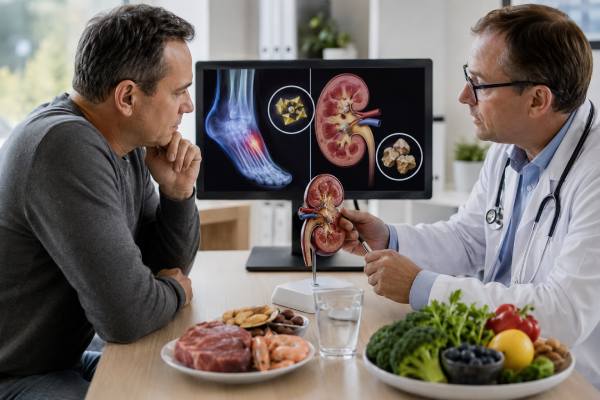
Gout and kidney stones often look like separate problems because one causes hot, swollen joints and the other causes urinary pain. The link is uric acid. When uric acid builds up in the blood, it forms sharp crystals in joints and triggers gout. When the urine stays too acidic or too concentrated, uric acid forms crystals in the urinary tract and grows into stones.
This connection matters because the same person has a higher chance of dealing with both problems, especially with obesity, diabetes, high blood pressure, high animal-protein intake, frequent dehydration, or chronic kidney disease. The good news is that uric acid stone prevention is usually practical and measurable. Urine volume, urine pH, diet pattern, and the right medication plan make a real difference.
This guide explains how gout and uric acid stones overlap, what test results matter, which prevention steps help most, and what to ask your clinician if you have both joint flares and kidney stone symptoms.
Table of Contents
- How Gout and Kidney Stones Connect
- Why Urine pH Matters More Than Blood Uric Acid
- Who Is Most Likely to Get Both
- Symptoms That Point to a Stone, Not a Gout Flare
- Tests That Show the Real Risk
- Prevention That Targets Uric Acid Stones
- Medicines Used for Gout and Uric Acid Stones
- What to Do If You Have Gout and a History of Stones
How Gout and Kidney Stones Connect
Gout and uric acid kidney stones share the same chemical starting point: uric acid. Your body makes uric acid when it breaks down purines, natural compounds found in your own cells and in many foods. The kidneys filter uric acid from the blood and send much of it into the urine. Problems start when uric acid levels stay high, urine becomes too acidic, or urine becomes too concentrated.
In gout, uric acid crystals collect in joints and surrounding tissues. The classic attack is sudden pain, redness, heat, and swelling in the big toe, ankle, knee, wrist, or finger. In kidney stones, crystals form in the kidney or urinary tract. They stay silent while small and still, then cause severe pain when they move or block urine flow.
The overlap is not just a coincidence. People with gout often have urine chemistry that favors uric acid crystals. They also commonly share stone risk factors, including insulin resistance, higher body weight, high blood pressure, and diets heavy in meat, seafood, alcohol, or sugary drinks. A person does not need every risk factor to form a stone. One strong driver, such as persistently acidic urine, is enough.
Uric acid stones are one of several stone types. Calcium oxalate stones are more common overall, but uric acid stones are especially tied to gout, metabolic syndrome, diabetes, and low urine pH. If you have never had a stone analyzed, do not assume every stone is uric acid just because you have gout. A stone analysis or urine testing gives a clearer answer. A broader guide to kidney stone types helps explain why prevention changes by stone chemistry.
The practical takeaway is simple: treating gout alone does not automatically prevent every uric acid stone. Gout treatment focuses on lowering uric acid in the blood. Uric acid stone prevention focuses heavily on changing urine chemistry, especially urine pH and urine concentration.
Why Urine pH Matters More Than Blood Uric Acid
For uric acid stones, acidic urine is often the biggest issue. Uric acid dissolves poorly in acidic urine. When urine pH stays low, uric acid is more likely to leave solution, form crystals, and grow into stones. When urine pH rises into a safer range, uric acid stays dissolved more easily.
Urine pH is a measure of how acidic or alkaline the urine is. A lower number means more acidic. Uric acid stones tend to form when urine stays persistently acidic, especially around the mid-5 range or lower. Many prevention plans aim for a urine pH around 6.0 to 6.5, though the exact goal should come from a clinician because pushing pH too high raises the risk of other stone types, especially calcium phosphate stones.
This is why two people with the same blood uric acid level can have different stone risks. One person produces plenty of dilute urine with a safer pH and never forms a stone. Another person produces small amounts of acidic urine overnight and repeatedly forms uric acid crystals.
Blood uric acid still matters. High blood uric acid drives gout and sometimes reflects a higher uric acid load overall. But blood uric acid does not tell the whole stone story. The kidney stone question is: what happens to uric acid inside the urine?
A useful way to think about it:
| Problem | Main place crystals form | Most important measurement | Practical focus |
|---|---|---|---|
| Gout | Joints and soft tissues | Blood uric acid | Lower and maintain serum urate with the right long-term plan |
| Uric acid kidney stones | Kidney or urinary tract | Urine pH, urine volume, and urine uric acid | Dilute urine and keep urine pH in a safer range |
Urine pH changes throughout the day. It is often lower overnight and early in the morning because you are not drinking while asleep and urine becomes more concentrated. That is one reason people with uric acid stones often need a full-day strategy, not just a large glass of water at dinner. A deeper explanation of acidic and alkaline urine pH is useful if your lab report lists a pH number and you are not sure what it means.
Who Is Most Likely to Get Both
The gout-stone link becomes stronger when uric acid problems combine with low urine volume, acidic urine, or metabolic risk factors. The pattern is especially common in adults with central weight gain, prediabetes or diabetes, high blood pressure, fatty liver, sleep apnea, or chronic kidney disease.
Insulin resistance is a major reason. When the body becomes less responsive to insulin, the kidneys handle acid differently. Urine tends to become more acidic, which creates the right environment for uric acid stones. This explains why uric acid stones are common in people with diabetes or metabolic syndrome, even when urine uric acid is not extremely high.
Diet can add pressure. Large portions of red meat, organ meats, shellfish, sardines, anchovies, and some other seafood raise purine load. Alcohol, especially beer and spirits, raises gout risk and also worsens dehydration in some settings. Sugary drinks are another problem because fructose increases uric acid production and is linked with metabolic risk. If your meals are built around large meat portions and sweet drinks, the body gets more uric acid input while the urine becomes more stone-friendly.
Hydration habits matter just as much. Stone risk rises when urine is concentrated. A person who drinks little during work, exercises heavily, sweats in hot weather, or wakes up with dark morning urine has a higher crystal risk. The issue is not only total fluid intake. Timing matters because long dry stretches allow uric acid to concentrate.
Family history also counts. Some people inherit a tendency toward gout, high uric acid, or stone-forming urine chemistry. Family history does not make stones unavoidable, but it lowers the margin for error. A person with gout, a parent with stones, and repeated dark urine after workouts should treat prevention as a daily routine rather than a short-term fix.
Common risk combinations
You are more likely to deal with both gout and uric acid stones when several of these apply:
- Gout flares plus a history of kidney stones or gravel-like crystals in urine
- Persistently acidic urine on testing
- Low urine volume on a 24-hour urine collection
- Diabetes, prediabetes, obesity, or metabolic syndrome
- High intake of red meat, organ meats, shellfish, beer, or sugary drinks
- Frequent dehydration from heat, exercise, travel, fasting, or shift work
- Chronic kidney disease or reduced kidney function
- Use of certain diuretics or other medicines that affect uric acid balance
A common mistake is focusing only on purines. Purines matter, but they are not the whole story. A person who eats moderate protein but drinks too little and has acidic urine still forms uric acid stones. Prevention works best when it addresses the full pattern: fluid, urine pH, diet, weight, blood sugar, and medications.
Symptoms That Point to a Stone, Not a Gout Flare
A gout flare causes joint pain. A kidney stone causes urinary tract pain. That sounds obvious, but the pain can be confusing when it starts in the side, lower back, groin, or lower abdomen. Some people first think they pulled a muscle. Others think they have a bladder infection.
Stone pain often comes in waves. It can start in the flank, which is the side of the back below the ribs, then travel toward the lower abdomen, groin, or testicle as the stone moves. People often feel restless because no position fully relieves the pain. Nausea and vomiting are common during a severe stone attack.
Urinary symptoms also provide clues. Blood in the urine, pink or tea-colored urine, burning, urgency, frequent small urinations, or cloudy urine can happen with a stone. Fever, chills, or feeling very ill with stone symptoms is more serious because it can signal infection behind a blockage.
Gout pain behaves differently. It usually centers on a joint, becomes tender to touch, and often makes shoes, socks, bedsheets, or walking unbearable. The skin over the joint can look red or shiny. Gout does not usually cause blood in the urine, flank pain, or waves of pain moving toward the groin.
| Feature | More like gout | More like a kidney stone |
|---|---|---|
| Main pain location | Big toe, ankle, knee, wrist, finger | Flank, lower back, lower abdomen, groin |
| Pain pattern | Severe joint tenderness, often constant during flare | Waves of severe pain, restlessness, shifting location |
| Urine changes | Usually absent | Blood, burning, urgency, frequent small urinations |
| Common extras | Red, hot, swollen joint | Nausea, vomiting, sweating, groin pain |
| Urgent warning | Fever with a swollen joint needs prompt care | Fever, chills, vomiting, one kidney, pregnancy, or no urine needs urgent care |
Get urgent medical care for stone-like pain with fever, chills, repeated vomiting, confusion, inability to urinate, severe weakness, pregnancy, a single kidney, or known kidney disease. These situations need quick evaluation because an infected or obstructed kidney can become dangerous. For pain-pattern details, a guide to kidney stone pain and ER warning signs can help you decide how urgent the symptoms are.
Tests That Show the Real Risk
The best prevention plan starts with the stone type and the urine pattern. Guessing leads to common errors, such as treating every stone like a calcium oxalate stone or using gout medication while ignoring urine pH.
Stone analysis
If you pass a stone, try to save it. A lab can identify whether it is uric acid, calcium oxalate, calcium phosphate, struvite, cystine, or a mixture. Mixed stones are common enough that a person with gout still needs proof. Uric acid can also mix with calcium oxalate, which changes the prevention plan.
A stone strainer makes collection easier. The stone can look like a grain, pebble, or small jagged fragment. Even tiny pieces are worth testing.
Urinalysis and urine pH
A routine urinalysis checks blood, protein, infection clues, crystals, and pH. A single urine pH result is useful but limited because pH changes during the day. Still, repeated acidic values support the case for uric acid stone risk.
Home urine pH strips are sometimes used during treatment, especially when someone is taking alkalinizing medicine. They should not replace professional testing. Strip technique matters: old strips, poor lighting, and reading the color too late can give misleading results.
24-hour urine test
A 24-hour urine collection is one of the most useful tests after recurrent stones, high-risk stones, uric acid stones, or stones plus gout. It measures the chemistry of all urine produced in a full day. Important results include total urine volume, pH, uric acid, citrate, calcium, oxalate, sodium, and sometimes other markers.
For uric acid stones, three results deserve close attention: low volume, low pH, and high uric acid. Low citrate can also matter because citrate helps reduce some types of crystal formation and is tied to acid-base balance. A detailed explanation of the 24-hour urine test for kidney stones is helpful before you collect, because missed urine or unusual eating during the test can distort the results.
Blood tests
Blood work often includes creatinine or eGFR for kidney function, serum uric acid, calcium, electrolytes, bicarbonate, and sometimes parathyroid hormone if calcium results are abnormal. If gout is already diagnosed, serum urate helps guide urate-lowering therapy. If kidney function is reduced, medication choices and doses need closer supervision.
Testing turns prevention from vague advice into a targeted plan. “Drink more water and eat better” is not specific enough for someone with recurrent stones. “Your urine volume is low, your pH is 5.3, and your sodium is high” gives clear targets.
Prevention That Targets Uric Acid Stones
Uric acid stone prevention has two main goals: make more urine and make the urine less acidic. Diet helps, but the biggest wins usually come from steady hydration, urine alkalinization when prescribed, and reducing the diet patterns that push uric acid higher.
Build fluid intake around urine output
The usual prevention target after stones is enough fluid to produce about 2.5 liters of urine per day, unless a clinician gives a different limit because of heart failure, kidney failure, or another condition. That often requires more than 2.5 liters of fluid intake because you lose water through sweat, breathing, and stool.
The easiest home check is urine color and timing. Pale yellow urine through most of the day is a good sign. Dark morning urine, long gaps without urinating, or a strong odor often means the urine is too concentrated. People who sweat at work, exercise outdoors, use saunas, travel often, or sleep in hot rooms usually need a more deliberate plan.
Spread fluids through the day. Drinking a large amount at night does not fully protect the long dry stretch from morning to afternoon. A useful rhythm is water after waking, with each meal, between meals, after exercise, and in the evening. Some people with uric acid stones also benefit from a small bedtime drink, as long as it does not worsen nighttime urination or sleep.
Water is the default. Citrus drinks without heavy sugar can help some stone formers because citrate is useful, but sweet lemonade, soda, and fruit punches can work against the goal if they add a large fructose load. If you want a broader prevention framework, kidney stone prevention strategies explain how hydration fits with diet and medication.
Use food to reduce acid load and purine pressure
A uric acid stone diet is not a starvation diet and not a no-protein diet. The goal is to reduce the heaviest purine and acid-load patterns while keeping meals satisfying and nutritionally balanced.
The biggest changes usually come from limiting large portions of red meat, organ meats, processed meats, and high-purine seafood. That does not mean every bite of animal protein is forbidden. Portion size and frequency matter. A plate with a modest serving of chicken or fish, vegetables, whole grains, and fruit is very different from a plate built around a large steak plus beer.
Plant-forward meals are useful because many fruits and vegetables provide alkali precursors that make urine less acidic. Beans and lentils contain purines, but they do not carry the same gout and stone pattern as organ meats and certain seafood. For most people, replacing some animal protein with plant protein is more practical than avoiding legumes.
Helpful swaps include:
- Smaller meat portions instead of meat-centered meals
- Beans, lentils, tofu, or yogurt-based meals instead of frequent red meat
- Fruit, unsweetened yogurt, or nuts in modest portions instead of sweet drinks and desserts
- Water or unsweetened sparkling water instead of soda or sweet tea
- Vegetable-heavy dinners instead of low-carb meals built mostly around meat and cheese
Alcohol deserves special attention. Beer contains purines and alcohol can raise uric acid. Spirits also raise gout risk. Wine is not risk-free, especially in larger amounts, but beer is often the most obvious gout trigger. If alcohol repeatedly precedes gout attacks or dehydration, cutting back is not a minor detail; it is part of treatment.
If you want more specific serving guidance, animal protein and kidney stone risk explains how purines, portion size, and acid load fit together. Sugary drinks are another major lever; the link between fructose and uric acid stone risk is especially relevant for people who drink soda, sweet tea, energy drinks, or large amounts of juice.
Do not overcorrect urine pH on your own
Because low urine pH drives uric acid stones, it is tempting to self-treat with baking soda, alkaline water, or large amounts of supplements. That approach can backfire. Too much alkali can push urine pH high enough to favor calcium phosphate stones. Sodium-based alkali can also add a heavy sodium load, which is a problem for blood pressure and some stone risks.
The safer path is testing first, then targeted treatment. If your clinician prescribes potassium citrate or another alkalinizing medicine, urine pH monitoring helps confirm that the dose is doing enough without overshooting.
Medicines Used for Gout and Uric Acid Stones
Medication choices depend on whether the main problem is gout flares, uric acid stones, or both. The overlap is real, but the treatment targets are not identical.
For gout, long-term urate-lowering therapy lowers serum urate so crystals in joints stop forming and existing deposits gradually shrink. Allopurinol is commonly used first. Febuxostat is another xanthine oxidase inhibitor used in selected patients. Probenecid and other uricosuric strategies increase uric acid removal through urine, but they are not ideal for everyone and can be a poor fit in some stone formers because they raise urinary uric acid.
For uric acid stones, alkalinizing the urine is often the central medication strategy. Potassium citrate is commonly used because it raises urine pH and provides citrate. It is especially useful when testing shows low urine pH, low citrate, or recurrent uric acid stones. Dosing and monitoring matter because potassium citrate is not appropriate for everyone, especially some people with reduced kidney function, high potassium, or certain medications that raise potassium.
Allopurinol can help uric acid stone formers when urine uric acid is high, especially if gout is also present. But allopurinol is not a substitute for correcting acidic urine. If a person forms uric acid stones mainly because urine pH stays low, lowering uric acid production without raising urine pH leaves the main stone environment in place.
This distinction is one of the most common treatment misunderstandings:
| Medicine or strategy | Main purpose | Key caution |
|---|---|---|
| Allopurinol | Lowers uric acid production; used for gout and selected stone formers with high urine uric acid | Needs dose planning and monitoring, especially with kidney disease |
| Febuxostat | Lowers uric acid production; used when appropriate for gout or hyperuricemia | Requires individual cardiovascular and medication review |
| Potassium citrate | Raises urine pH and citrate; often central for uric acid stone prevention | Can raise potassium; urine pH and blood tests need monitoring |
| Sodium bicarbonate or sodium citrate | Raises urine pH in selected cases | Adds sodium, which can be a problem for blood pressure and some stone risks |
| Probenecid and other uricosuric drugs | Increase uric acid excretion through urine | Often avoided or used carefully in people with kidney stones |
During a gout flare, pain-relief medicines such as colchicine, NSAIDs, or corticosteroids are used depending on the person’s kidney function, stomach bleeding risk, diabetes, blood pressure, and other health issues. NSAIDs such as ibuprofen or naproxen are not safe for every person with kidney disease or dehydration, and stone attacks often involve dehydration from vomiting. This is one reason self-treating both gout and stone pain with repeated NSAID doses can be risky.
A clinician should coordinate the plan if you have recurrent gout plus stones. The goal is not simply to “lower uric acid” in one place. The goal is to lower gout flare risk, protect kidney function, prevent stones, and avoid medication side effects. A focused review of potassium citrate for kidney stones is useful if your urine pH is low or your clinician has suggested alkalinizing therapy.
What to Do If You Have Gout and a History of Stones
If you have gout and have passed a kidney stone, treat that combination as a reason for a more complete prevention plan. Do not wait for the next attack to learn the stone type or urine pattern.
Start with records. Ask for copies of prior CT, ultrasound, urinalysis, stone analysis, blood uric acid, creatinine, eGFR, and 24-hour urine results. Many people are told “you had a stone” but never learn the stone composition. Without that information, prevention becomes guesswork.
Next, ask whether you need a stone analysis or 24-hour urine test. These are especially relevant if you have had more than one stone, a uric acid stone, gout, kidney disease, a single kidney, stones at a young age, or a strong family history. If testing shows low urine pH, ask what target range you should aim for and how it will be monitored.
Then review your gout plan. If you have two or more flares a year, tophi, joint damage from gout, kidney disease, or a history of uric acid stones, long-term urate-lowering therapy often deserves discussion. If you are already taking allopurinol or febuxostat, ask whether your serum urate is at goal and whether urine testing shows ongoing stone risk.
Bring your medication list to the visit. Include diuretics, aspirin, supplements, vitamin C, protein powders, creatine, antacids, blood pressure pills, diabetes medicines, and over-the-counter pain relievers. Some products affect uric acid, kidney function, urine chemistry, or hydration.
A practical checklist for your next appointment
- What type of stone did I have, and was it confirmed by stone analysis?
- Is my urine pH low enough to raise uric acid stone risk?
- What urine pH range should I aim for if I use alkalinizing treatment?
- What was my 24-hour urine volume, and how much fluid should I drink to improve it?
- Is my urine uric acid high, or is low pH the main issue?
- What is my serum urate goal for gout?
- Are my gout medicines safe with my kidney function and stone history?
- Should I avoid uricosuric medicines because of stones?
- How often should I repeat blood tests, urine tests, or imaging?
Daily prevention works best when it is boring and repeatable. Keep water visible. Pair drinks with routine moments. Build meals around vegetables, fruit, whole grains, and moderate protein. Reduce beer, sugary drinks, and oversized meat portions. Track gout flares, stone symptoms, and triggers in the same note so patterns become obvious.
Seek specialist help when the pattern is recurrent or complicated. A urologist focuses on stones, obstruction, imaging, procedures, and stone prevention. A rheumatologist focuses on gout control and urate-lowering therapy. A nephrologist is helpful when kidney function is reduced, urine chemistry is complex, potassium is high, or multiple conditions overlap. A guide on when to see a urologist can help if you are unsure whether stone symptoms need specialty evaluation.
The uric acid link is manageable once it is measured. Gout tells you that uric acid metabolism needs attention. A uric acid stone tells you that urine chemistry needs attention. Address both, and prevention becomes much more precise.
References
- 2020 American College of Rheumatology Guideline for the Management of Gout 2020 (Guideline)
- Medical treatment of uric acid kidney stones 2024 (Clinical Study)
- Urological Guidelines for Kidney Stones: Overview and Comprehensive Update 2024 (Guideline Review)
- Impact of diet on renal stone formation 2024 (Review)
- Metabolic evaluation of urolithiasis: a narrative review 2025 (Review)
- Eating, Diet, & Nutrition for Kidney Stones 2026 (Patient Guidance)
Disclaimer
This article is for education about gout, uric acid, and kidney stone prevention. It cannot diagnose the cause of joint pain, flank pain, blood in urine, or abnormal lab results. People with recurrent stones, gout, kidney disease, high potassium, pregnancy, fever with urinary symptoms, or severe pain should get medical guidance before changing medicines, supplements, fluid targets, or urine pH treatment.