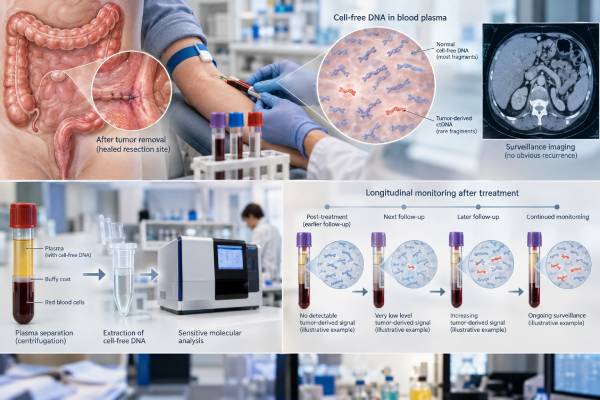
Guardant Reveal is a blood-based circulating tumor DNA test designed to detect molecular residual disease after treatment for colorectal cancer. Unlike tumor-informed assays that first build a personalized panel from the patient’s tumor tissue, the current Guardant Reveal approach is tissue-free and uses epigenomic methylation signals to identify tumor-derived DNA in plasma. A positive result after curative-intent treatment is a strong adverse prognostic sign because it indicates that molecular evidence of cancer remains even when scans may still be negative. A negative result lowers estimated recurrence risk but does not prove that no cancer remains; sensitivity varies with timing, repeated testing, stage, and the site of eventual recurrence. The test is best understood as a risk-stratification and monitoring tool. Whether changing chemotherapy solely because of a ctDNA result improves survival is still being tested in prospective trials, so results should be integrated with stage, pathology, imaging, and standard surveillance.
- Guardant Reveal is a tissue-free blood test for colorectal cancer molecular residual disease (MRD).
- A positive postoperative ctDNA result is associated with a substantially higher risk of recurrence.
- A negative result reduces risk but cannot rule out microscopic disease, especially with lung or peritoneal recurrence patterns.
- Serial testing improves sensitivity compared with a single blood draw.
- The assay is clinically available as a laboratory-developed test; availability or coverage should not be confused with FDA clearance or approval.
Table of Contents
- What Guardant Reveal measures
- When testing is done and why timing matters
- What a positive Guardant Reveal result means
- What a negative result can and cannot rule out
- Test performance and important limitations
- How clinicians use the result today
- Practical next steps after a Guardant Reveal result
What Guardant Reveal measures
Circulating tumor DNA is the fraction of cell-free DNA in blood that comes from cancer cells. After surgery or other curative-intent treatment, the amount may be far below the threshold of imaging. MRD assays try to detect that molecular signal. Guardant Reveal analyzes plasma and uses epigenomic patterns—DNA methylation signatures associated with colorectal cancer—to call ctDNA detected or not detected.
The tissue-free design avoids waiting for tumor tissue and can make testing possible when the surgical specimen is unavailable or inadequate. It also means the assay is not simply looking for one known mutation such as KRAS. The result is intended to answer whether a colorectal-cancer-associated DNA signal is present in blood at that time, not to localize a lesion or replace a diagnostic biopsy.
When testing is done and why timing matters
Common clinical time points include several weeks after surgery, after completion of adjuvant chemotherapy, and during surveillance. Testing too soon after surgery can be complicated by a surge of normal cell-free DNA from tissue injury, while testing too late can miss an opportunity to use prognostic information during adjuvant decision-making. The exact window should follow the treating center’s protocol.
Serial testing matters because ctDNA shedding is intermittent and may be very low. In published tissue-free studies, repeated samples improved longitudinal sensitivity. A patient can therefore move from undetectable to detectable before recurrence becomes visible on standard imaging. The reverse can also occur after effective treatment. Trends are informative, but every change should be interpreted in clinical context rather than as a stand-alone command to start or stop therapy.
What a positive Guardant Reveal result means
A detected result after curative-intent therapy indicates molecular evidence associated with residual colorectal cancer and predicts a high risk of future clinical recurrence. It is a prognostic result: it tells the team that the patient’s risk is substantially above that of a comparable patient with undetectable ctDNA. It does not show where disease is located, how large it is, or whether a specific drug will eradicate it.
A positive result usually triggers careful review of timing, pathology, and surveillance. Depending on stage and treatment history, clinicians may repeat ctDNA, obtain or advance imaging, discuss adjuvant therapy within established standards, or consider a clinical trial that uses MRD to guide escalation. The key distinction is between using ctDNA to estimate risk—which is well supported—and assuming that any particular ctDNA-directed intervention is proven to improve overall survival—which remains an active research question.
What a negative result can and cannot rule out
Undetectable ctDNA is reassuring because recurrence rates are lower in ctDNA-negative groups, but the result is not a guarantee. Assay sensitivity is not 100%, and some tumors release very little DNA into blood. Published Guardant Reveal data show particularly lower sensitivity for some lung and peritoneal recurrences than for liver recurrence. Small-volume disease and sampling variation also matter.
A negative result therefore does not replace scheduled CT imaging, colonoscopy, CEA testing when appropriate, or clinical follow-up. It should modify risk perception, not cancel surveillance. Repeated negative tests over time generally provide more reassurance than one negative sample. If symptoms or imaging are concerning, clinicians should investigate them even when ctDNA is undetectable.
Test performance and important limitations
No biomarker works in isolation. A technically accurate result can still be clinically misleading if it is applied to the wrong cancer type, disease stage, specimen, or treatment question. Cutoffs may also differ by assay, drug label, guideline, and country. For that reason, the laboratory’s own interpretive criteria and the treating team’s current guideline should take priority over a generic internet threshold.
Tumors are heterogeneous, meaning different areas can carry different alterations or levels of protein expression. A small biopsy may miss a positive clone, while a blood-based assay can miss disease that sheds little DNA into the circulation. Conversely, a detectable alteration may be real but not be the main driver of the current disease. Pre-analytic issues such as delayed fixation, decalcification, low tumor content, recent transfusion, or poor plasma handling can also affect some assays.
The safest interpretation separates three questions: analytical validity—did the assay measure what it claims to measure; clinical validity—does the result correlate with the cancer feature of interest; and clinical utility—does acting on the result improve a meaningful decision for this patient. A result can be strong in one category and limited in another.
For MRD assays, performance also depends on the surveillance interval and definition of the reference standard. Sensitivity measured at one postoperative time point is different from longitudinal sensitivity across serial draws. Lead time—the interval between ctDNA detection and radiographic recurrence—varies widely and should not be interpreted as a guaranteed window for curative intervention.
How clinicians use the result today
The most defensible use today is to add ctDNA to standard clinicopathologic risk. In stage II colon cancer, where adjuvant chemotherapy decisions can be finely balanced, a postoperative positive result identifies unusually high risk. In stage III disease, ctDNA can further stratify risk after surgery and after chemotherapy. During surveillance, conversion to positive can prompt closer evaluation.
However, major unanswered questions remain: which drug or duration best clears MRD, whether escalation based on positivity improves survival, and whether de-escalation based on negativity is safe for every risk group. Prospective randomized trials are addressing these questions. Patients should ask whether a proposed management change is standard care, guideline-supported risk assessment, or participation in an MRD-guided study.
Practical next steps after a Guardant Reveal result
A biomarker result should be read beside the pathology report, stage, imaging, treatment history, and the exact specimen tested. A useful question for the oncology team is not simply “is this positive?” but “what decision does this result change now?” That keeps the result tied to a concrete action such as confirming a diagnosis, choosing a drug, deciding whether hereditary evaluation is needed, or setting a surveillance plan.
If a result seems inconsistent with the clinical picture, ask whether the sample had enough viable tumor, whether the method covered the relevant alteration, and whether a newer metastatic or recurrent specimen would be more representative. Repeating a test is most useful when there is a specific reason to think the original specimen was inadequate, old, or biologically different from the disease being treated today.
Patients should also keep a copy of the complete molecular or pathology report, not only a portal summary. The full report usually lists the method, specimen, tumor percentage, assay limitations, exact variant or staining score, and interpretive comments. Those details matter when seeking a second opinion, transferring care, or checking eligibility for a targeted therapy or clinical trial.
One practical way to avoid overreading Guardant Reveal Test is to separate the laboratory finding from the clinical decision. The report may be analytically clear while the next step remains conditional on stage, prior therapy, other biomarkers, and patient goals. For example, a result that is highly relevant in metastatic disease may have no established treatment role after curative surgery. Likewise, a biomarker that predicts drug resistance is not necessarily a marker of worse overall prognosis. Keeping those categories separate makes the report easier to use and prevents a single word such as “positive” from carrying more meaning than the evidence supports.
The specimen date deserves attention. Cancer evolves under treatment, and the sample used for Guardant Reveal Test may have been collected months or years before the current decision. Early driver alterations often remain stable, but protein expression, copy number, and acquired resistance mechanisms can change. Retesting is most valuable when there is a plausible biological reason for change and when a new result could alter management. Repeating testing merely because a value is available is less useful than choosing the specimen that best represents the disease being treated now.
Laboratory reports also vary in how much interpretation they provide. Some give only a final category; others show raw staining percentages, copy-number estimates, variant allele fractions, quality metrics, and assay limitations. For Guardant Reveal Test, the detailed version is preferable because treatment criteria can evolve. A result that was not actionable when the tissue was first tested may become relevant later, and the original numerical or molecular detail may allow the oncology team to reassess eligibility without immediately repeating a biopsy.
Finally, biomarker testing works best as part of multidisciplinary care. Pathologists judge specimen quality and assay interpretation; medical oncologists connect the finding to treatment; surgeons and gastroenterologists provide disease context; genetic counselors address possible inherited risk when appropriate. Patients do not need to master every technical detail, but they benefit from knowing the purpose of the test, the exact result, what uncertainty remains, and what concrete decision follows. Those four questions turn a complex biomarker report into a usable plan.
One practical way to avoid overreading Guardant Reveal Test is to separate the laboratory finding from the clinical decision. The report may be analytically clear while the next step remains conditional on stage, prior therapy, other biomarkers, and patient goals. For example, a result that is highly relevant in metastatic disease may have no established treatment role after curative surgery. Likewise, a biomarker that predicts drug resistance is not necessarily a marker of worse overall prognosis. Keeping those categories separate makes the report easier to use and prevents a single word such as “positive” from carrying more meaning than the evidence supports.
The specimen date deserves attention. Cancer evolves under treatment, and the sample used for Guardant Reveal Test may have been collected months or years before the current decision. Early driver alterations often remain stable, but protein expression, copy number, and acquired resistance mechanisms can change. Retesting is most valuable when there is a plausible biological reason for change and when a new result could alter management. Repeating testing merely because a value is available is less useful than choosing the specimen that best represents the disease being treated now.
Laboratory reports also vary in how much interpretation they provide. Some give only a final category; others show raw staining percentages, copy-number estimates, variant allele fractions, quality metrics, and assay limitations. For Guardant Reveal Test, the detailed version is preferable because treatment criteria can evolve. A result that was not actionable when the tissue was first tested may become relevant later, and the original numerical or molecular detail may allow the oncology team to reassess eligibility without immediately repeating a biopsy.
Finally, biomarker testing works best as part of multidisciplinary care. Pathologists judge specimen quality and assay interpretation; medical oncologists connect the finding to treatment; surgeons and gastroenterologists provide disease context; genetic counselors address possible inherited risk when appropriate. Patients do not need to master every technical detail, but they benefit from knowing the purpose of the test, the exact result, what uncertainty remains, and what concrete decision follows. Those four questions turn a complex biomarker report into a usable plan.
One practical way to avoid overreading Guardant Reveal Test is to separate the laboratory finding from the clinical decision. The report may be analytically clear while the next step remains conditional on stage, prior therapy, other biomarkers, and patient goals. For example, a result that is highly relevant in metastatic disease may have no established treatment role after curative surgery. Likewise, a biomarker that predicts drug resistance is not necessarily a marker of worse overall prognosis. Keeping those categories separate makes the report easier to use and prevents a single word such as “positive” from carrying more meaning than the evidence supports.
The specimen date deserves attention. Cancer evolves under treatment, and the sample used for Guardant Reveal Test may have been collected months or years before the current decision. Early driver alterations often remain stable, but protein expression, copy number, and acquired resistance mechanisms can change. Retesting is most valuable when there is a plausible biological reason for change and when a new result could alter management. Repeating testing merely because a value is available is less useful than choosing the specimen that best represents the disease being treated now.
Laboratory reports also vary in how much interpretation they provide. Some give only a final category; others show raw staining percentages, copy-number estimates, variant allele fractions, quality metrics, and assay limitations. For Guardant Reveal Test, the detailed version is preferable because treatment criteria can evolve. A result that was not actionable when the tissue was first tested may become relevant later, and the original numerical or molecular detail may allow the oncology team to reassess eligibility without immediately repeating a biopsy.
Finally, biomarker testing works best as part of multidisciplinary care. Pathologists judge specimen quality and assay interpretation; medical oncologists connect the finding to treatment; surgeons and gastroenterologists provide disease context; genetic counselors address possible inherited risk when appropriate. Patients do not need to master every technical detail, but they benefit from knowing the purpose of the test, the exact result, what uncertainty remains, and what concrete decision follows. Those four questions turn a complex biomarker report into a usable plan.
One practical way to avoid overreading Guardant Reveal Test is to separate the laboratory finding from the clinical decision. The report may be analytically clear while the next step remains conditional on stage, prior therapy, other biomarkers, and patient goals. For example, a result that is highly relevant in metastatic disease may have no established treatment role after curative surgery. Likewise, a biomarker that predicts drug resistance is not necessarily a marker of worse overall prognosis. Keeping those categories separate makes the report easier to use and prevents a single word such as “positive” from carrying more meaning than the evidence supports.
The specimen date deserves attention. Cancer evolves under treatment, and the sample used for Guardant Reveal Test may have been collected months or years before the current decision. Early driver alterations often remain stable, but protein expression, copy number, and acquired resistance mechanisms can change. Retesting is most valuable when there is a plausible biological reason for change and when a new result could alter management. Repeating testing merely because a value is available is less useful than choosing the specimen that best represents the disease being treated now.
References
- Colorectal Cancer Recurrence Prediction Using a Tissue-Free Epigenomic Minimal Residual Disease Assay 2024 (Study)
- Tissue-Free Liquid Biopsies Combining Genomic and Methylation Signals for Minimal Residual Disease Detection in Patients with Early Colorectal Cancer from the UK TRACC Part B Study 2024 (Study)
- Utilization of tissue-free minimal residual disease testing in colorectal cancer patients from Asia and Middle East 2024 (Study)
- Largest Published Study of Molecular Residual Disease (MRD) in Stage III Colon Cancer Shows Guardant Reveal Blood Test More Precisely Identifies Risk of Recurrence After Surgery to Support Timely Treatment Decisions 2026 (Report)
- Our Early-Stage Cancer Clinical Studies 2026 (Official)
Disclaimer
This article explains biomarker testing for educational purposes and is not a diagnosis or treatment plan. Cancer testing and treatment should be interpreted by the oncology and pathology teams using the complete medical record, current guidelines, and the specific laboratory method. Seek prompt medical care for new or rapidly worsening symptoms rather than relying on a biomarker result alone.