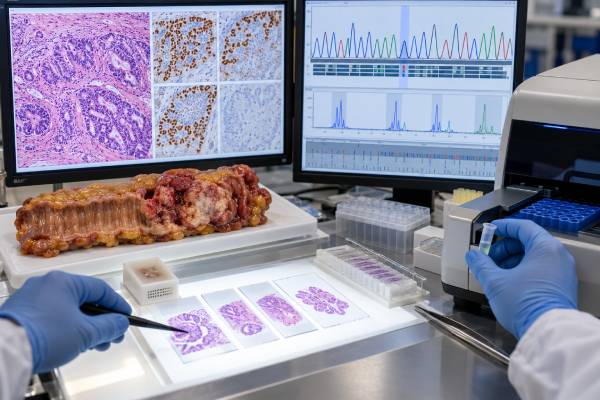
The BRAF V600E test looks for a specific activating mutation in the BRAF gene that is clinically important in colorectal cancer. In metastatic disease, a positive BRAF V600E result identifies a biologically distinct subgroup with a poorer average prognosis than BRAF-wild-type colorectal cancer and can open the door to BRAF-targeted treatment. The same result also has a separate role in Lynch syndrome evaluation. When a colon tumor shows mismatch repair deficiency with loss of MLH1 and PMS2, finding BRAF V600E strongly favors a sporadic, non-Lynch pathway, usually associated with acquired MLH1 promoter methylation. A negative BRAF test does not prove Lynch syndrome, so MLH1 methylation testing and/or germline evaluation may still be needed. BRAF testing is performed on tumor tissue or as part of broader next-generation sequencing, and results should be interpreted together with RAS status, MSI/MMR findings, tumor sidedness, stage, and the exact clinical question.
- BRAF V600E is an activating tumor mutation found in a minority of colorectal cancers and is most relevant in metastatic treatment planning and MLH1-deficient Lynch workup.
- A positive BRAF V600E result generally indicates worse prognosis in metastatic colorectal cancer compared with BRAF-wild-type disease.
- BRAF V600E is directly actionable in metastatic colorectal cancer; current U.S. treatment options include encorafenib plus cetuximab with fluorouracil-based chemotherapy, including first-line treatment.
- BRAF V600E in an MLH1/PMS2-deficient colon tumor strongly favors sporadic MLH1 methylation rather than Lynch syndrome.
- A negative BRAF V600E result cannot rule in Lynch syndrome and should not stop the workup when hereditary risk remains possible.
Table of Contents
- What BRAF V600E Means
- How BRAF Testing Is Done
- Prognosis and Tumor Behavior
- Treatment Meaning in Metastatic Disease
- BRAF in Lynch Syndrome Workup
- How BRAF Fits With Other Biomarkers
- Common Result Questions
What BRAF V600E Means
BRAF is part of the RAS–RAF–MEK–ERK signaling pathway, which carries growth signals from the cell surface to the nucleus. The V600E mutation replaces the amino acid valine with glutamic acid at position 600. This change keeps BRAF signaling abnormally active even when an upstream growth signal is absent.
In colorectal cancer, BRAF V600E is usually a somatic tumor mutation, meaning it developed in the cancer and is not an inherited BRCA-like mutation passed through the family. It occurs in roughly 8%–12% of colorectal cancers overall, with variation by stage and population. It is seen more often in right-sided colon cancers, older patients, women, tumors with mucinous features, and tumors with microsatellite instability caused by MLH1 promoter methylation.
A report may state BRAF V600E detected, positive, or mutant. A negative result may be written as BRAF V600E not detected or wild type. Some broad next-generation sequencing panels can detect non-V600 BRAF mutations as well. Those less common mutations do not have the same biology or treatment meaning as V600E, so the exact variant matters.
BRAF testing is often performed as part of a colorectal cancer biomarker panel rather than as an isolated test, because RAS, MSI/MMR, HER2, and other findings can alter treatment choices.
How BRAF Testing Is Done
The preferred sample is usually formalin-fixed, paraffin-embedded tumor tissue from the primary colon cancer or a metastasis. A pathologist reviews the specimen to confirm that enough viable tumor is present. Testing can then use allele-specific PCR, real-time PCR, pyrosequencing, digital PCR, or next-generation sequencing.
Broad NGS has an advantage when multiple biomarkers are needed at once. It can assess BRAF together with KRAS, NRAS, HER2-related copy-number changes, and other potentially actionable alterations. However, a focused BRAF V600E assay can be faster or more practical when the immediate question is Lynch syndrome triage in an MLH1-deficient tumor.
Liquid-biopsy testing of circulating tumor DNA can sometimes identify BRAF V600E in advanced disease when tissue is unavailable or inadequate. A negative plasma result is less definitive if very little tumor DNA is being shed, so tissue testing may still be needed.
Preanalytic quality matters. Poor fixation, very low tumor content, decalcified tissue, or severely degraded DNA can cause an indeterminate or false-negative result. A report that says “insufficient tumor,” “quantity not sufficient,” or “failed quality control” is not the same as a true negative.
Testing is generally performed once because BRAF V600E is usually an early clonal event, but repeat or broader profiling may be considered if the original assay was limited, the tissue quality was poor, or resistance biology becomes clinically relevant.
Prognosis and Tumor Behavior
In metastatic colorectal cancer, BRAF V600E is a negative prognostic marker on average. Patients as a group tend to have more aggressive disease and shorter survival than patients with BRAF-wild-type metastatic cancer treated with comparable older regimens. Patterns such as peritoneal and nodal spread are relatively common.
Prognosis is not determined by BRAF alone. MSI status, tumor burden, performance status, treatment access, sidedness, surgical options, and response to therapy all matter. Modern targeted and immunotherapy strategies have also improved outcomes for molecularly selected patients, so historical survival estimates should not be used as an individual prediction.
The prognostic impact differs by stage. In localized stage II or III colon cancer, BRAF V600E can be associated with recurrence risk, but its meaning depends strongly on MSI/MMR status. MSI-high tumors can have more favorable stage-specific biology than microsatellite-stable tumors, creating a mixed molecular picture.
This is why a BRAF result should be read beside the MSI test or MMR immunohistochemistry result rather than in isolation.
A positive BRAF result also does not mean that anti-EGFR therapy alone will work. BRAF activation sits downstream of EGFR, and pathway feedback makes single-agent BRAF inhibition ineffective in colorectal cancer. Effective targeting requires combination strategies.
Treatment Meaning in Metastatic Disease
The treatment importance of BRAF V600E is clearest in metastatic colorectal cancer. The mutation identifies a pathway that can be targeted by combining BRAF inhibition with EGFR inhibition. As of February 2026, the U.S. Food and Drug Administration has granted traditional approval to encorafenib plus cetuximab with fluorouracil-based chemotherapy for adults with BRAF V600E metastatic colorectal cancer. This includes a first-line option and reflects the BREAKWATER phase 3 evidence showing better progression-free and overall survival with encorafenib, cetuximab, and mFOLFOX6 than with standard-care chemotherapy-based treatment in previously untreated patients.
Encorafenib plus cetuximab without chemotherapy also has an established later-line role based on earlier evidence, but the exact sequence depends on what treatment a patient has already received, performance status, MSI/MMR status, comorbidities, and the current regulatory label or guideline used in that country. The oncology team should therefore interpret a positive BRAF result against current treatment recommendations rather than an older assumption that BRAF-targeted therapy is only a post-progression strategy.
MSI/MMR status is especially important. A BRAF V600E tumor can also be MSI-high/dMMR. When metastatic disease is MSI-high or dMMR, immune checkpoint therapy can be highly effective and may take priority in the treatment sequence. The same tumor can therefore carry both a negative prognostic marker and a strong predictive immunotherapy marker.
RAS status also matters. BRAF V600E is usually mutually exclusive with the common activating KRAS and NRAS mutations, but comprehensive testing confirms the entire pathway. Anti-EGFR antibodies are not generally effective in RAS-mutant tumors.
BRAF-directed therapy is a predictive use of the biomarker: the mutation identifies a treatment vulnerability. That is distinct from its prognostic use, which describes the average natural history of the disease.
BRAF in Lynch Syndrome Workup
BRAF V600E has a second, very different role in colon cancer: helping determine why a tumor is mismatch repair deficient.
Universal or broad tumor screening for Lynch syndrome commonly starts with MMR immunohistochemistry or MSI testing. When IHC shows loss of MLH1 and PMS2, there are two major possibilities:
- an inherited pathogenic variant affecting MLH1, consistent with Lynch syndrome; or
- acquired silencing of MLH1 through promoter methylation, which is much more commonly sporadic.
BRAF V600E is strongly associated with the sporadic MLH1-methylated pathway and is extremely uncommon in classic Lynch-associated colorectal cancer. Therefore, a BRAF V600E-positive, MLH1/PMS2-deficient colon tumor strongly favors a sporadic origin.
The result is not an absolute hereditary exclusion in every rare circumstance. Clinical genetics teams still consider young age, multiple cancers, family history, unusual pathology, and the possibility of exceptional cases.
A negative BRAF result does not prove Lynch syndrome. Many sporadic MLH1-methylated tumors are BRAF wild type. For this reason, direct MLH1 promoter methylation testing can provide more direct evidence of acquired MLH1 silencing.
If BRAF is negative and MLH1 methylation is absent, germline genetic counseling and testing become more important. If IHC shows loss of MSH2/MSH6, isolated MSH6, or isolated PMS2, BRAF testing is generally not the relevant reflex test because those patterns point to different mismatch repair genes.
How BRAF Fits With Other Biomarkers
Modern colorectal cancer management is molecularly layered. BRAF answers only one part of the treatment question.
KRAS and NRAS determine whether common activating RAS mutations are present. RAS mutations predict resistance to standard anti-EGFR monoclonal antibody strategies. A KRAS test and NRAS testing are therefore foundational in metastatic disease.
MSI/MMR identifies mismatch repair deficiency, which matters for Lynch syndrome screening and predicts benefit from immune checkpoint inhibitors in advanced disease.
HER2 amplification or overexpression can define another targetable subgroup, especially among RAS/BRAF-wild-type tumors.
NTRK fusions are rare but can qualify a patient for tumor-agnostic TRK inhibitors.
CEA is not a genomic biomarker at all. It is a serum protein used mainly for monitoring and recurrence surveillance rather than treatment selection.
The panel should be timed early enough that results are available before a treatment decision depends on them. In metastatic colorectal cancer, broad molecular profiling at diagnosis reduces the risk of discovering an actionable marker only after the relevant treatment window has passed.
Common Result Questions
Does BRAF V600E mean the cancer is inherited?
Usually no. In colorectal cancer, BRAF V600E is typically an acquired tumor mutation. Its hereditary value is indirect: in an MLH1/PMS2-deficient tumor, it actually makes Lynch syndrome less likely.
Can a BRAF-negative tumor still be aggressive?
Yes. BRAF is only one prognostic factor. Stage, metastasis sites, RAS status, MSI, tumor biology, and treatment response remain important.
Does a positive result mean targeted therapy should start immediately?
Not necessarily. The optimal sequence depends on line of therapy, MSI/MMR status, prior treatment, symptoms, and current guidelines. The mutation creates an option; it does not dictate treatment without context.
Can blood testing replace tumor testing?
Circulating tumor DNA can be useful in advanced disease, but a negative plasma result may reflect low tumor shedding. Tissue remains preferred when a definitive tumor result is needed and adequate tissue is available.
What if the pathology report says “BRAF wild type” but does not mention V600E?
Ask what method and genomic region were tested. Some assays evaluate only V600E, while broader sequencing can detect other BRAF variants. The clinical interpretation depends on the exact alteration.
The most useful way to read a BRAF report is to identify the question it is answering. In metastatic disease, it helps define prognosis and targeted treatment. In an MLH1-deficient tumor, it helps sort sporadic mismatch repair deficiency from possible Lynch syndrome. Those are separate clinical uses of the same molecular result.
Localized versus metastatic disease: the same mutation, different decisions
BRAF V600E can appear in both localized and metastatic colorectal cancer, but the clinical question changes with stage. In stage II or III disease, the mutation contributes prognostic context and interacts with MSI/MMR status. It does not automatically create an indication for metastatic-style BRAF-targeted therapy after curative surgery.
In metastatic disease, the mutation becomes directly predictive because it can guide a BRAF-plus-EGFR treatment strategy. This stage-specific difference is important when patients compare their report with another person’s. A positive molecular result does not always lead to the same treatment at every stage of cancer.
The same principle applies to adjuvant decisions. Stage, lymph-node involvement, high-risk pathology, MSI/MMR, performance status, and guideline-defined chemotherapy benefit are weighed together. BRAF positivity alone should not be used as a shortcut for “high-risk therefore more treatment.”
What happens when BRAF V600E and MSI-H occur together
BRAF V600E and MSI-H frequently coexist in sporadic right-sided colon cancers with MLH1 promoter methylation. That combination can seem contradictory because BRAF V600E is generally a negative prognostic marker while MSI-H can confer favorable biology in some localized settings and strong immunotherapy sensitivity in metastatic disease.
The correct interpretation is that biomarkers describe different dimensions of the tumor. BRAF describes MAPK-pathway activation and a targetable dependency. MSI-H describes mismatch repair failure and an immune-responsive phenotype. In metastatic cancer, MSI-H/dMMR can strongly influence first-line treatment even when BRAF is also positive.
For Lynch syndrome workup, the same combination—MLH1/PMS2 loss with BRAF V600E—strongly favors a sporadic methylated tumor. If the patient is unusually young or has a striking family history, genetics professionals may still review the case rather than relying on one reflex test mechanically.
Non-V600 BRAF mutations are a different category
Broad sequencing sometimes identifies BRAF mutations other than V600E. These can fall into biological classes with different signaling behavior, prevalence, prognosis, and treatment sensitivity. A report that simply says “BRAF mutation detected” is therefore incomplete for clinical interpretation.
The oncologist should verify the exact amino-acid change. Non-V600 variants should not automatically trigger the same encorafenib-plus-cetuximab pathway used for V600E. Some non-V600 tumors may remain sensitive to EGFR-directed approaches or may be better managed through clinical trials, depending on the specific variant class and coexisting RAS status.
This is one advantage of comprehensive NGS over a binary V600E-only assay in metastatic disease: it can reveal unusual biology. For Lynch triage, however, the clinically relevant reflex signal is specifically BRAF V600E, not any BRAF alteration.
Practical questions for a pathology or oncology visit
Patients can clarify a BRAF report by asking whether the assay tested only V600E or the full BRAF gene, whether KRAS and NRAS were tested at the same time, and what the MSI/MMR result shows. If MLH1 and PMS2 are absent, ask whether MLH1 promoter methylation was performed or whether BRAF was used as the reflex test.
In metastatic disease, ask whether the mutation is actionable now or later in the treatment sequence, and whether MSI-H/dMMR changes that sequence. If the result came from plasma rather than tissue, ask whether the negative or positive finding needs confirmation.
These questions help separate three distinct uses of BRAF—prognosis, treatment prediction, and hereditary triage—so one molecular result is not given more authority than it deserves.
What to do if the BRAF result conflicts with another report
Occasionally, an older single-gene assay and a newer NGS panel appear to disagree. Before assuming the tumor changed, the team should compare specimen sites, tumor content, assay sensitivity, and whether both tests actually evaluated the same variant. A very low tumor fraction can make one assay negative while a more sensitive method detects V600E.
True biologic heterogeneity is possible, but BRAF V600E is usually an early driver and is commonly shared across major tumor sites. When the discrepancy would change treatment or Lynch syndrome workup, molecular-pathology review or repeat testing on a better specimen can resolve the question. The goal is to establish a confident result rather than averaging conflicting reports.
References
- FDA grants traditional approval to encorafenib for metastatic colorectal cancer with a BRAF V600E mutation 2026 (Official Page)
- Encorafenib, Cetuximab, and mFOLFOX6 in BRAF-Mutated Colorectal Cancer 2025 (RCT)
- Pan-Asian adapted ESMO Clinical Practice Guidelines for the diagnosis, treatment and follow-up of patients with metastatic colorectal cancer 2023 (Guideline)
- Tumor Biomarker Testing for Metastatic Colorectal Cancer: a Canadian Consensus Practice Guideline 2022 (Guideline)
- Canadian consensus for the assessment and testing of Lynch syndrome 2025 (Position Statement)
- Japanese society for cancer of the colon and rectum (JSCCR) guidelines 2024 for the clinical practice of hereditary colorectal cancer 2025 (Guideline)
Disclaimer
BRAF V600E testing is one part of colorectal cancer molecular evaluation and cannot determine prognosis, hereditary risk, or treatment by itself. Results should be interpreted with stage, MSI/MMR, RAS status, MLH1 methylation when relevant, pathology, and current oncology guidelines. Genetic counseling is appropriate when tumor findings or family history raise concern for Lynch syndrome.