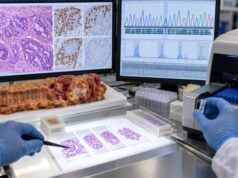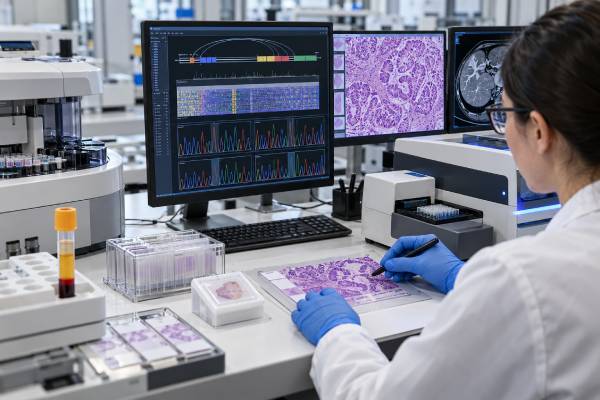
A cholangiocarcinoma biomarker panel combines a serum marker such as CA 19-9 with tumor molecular testing that can uncover actionable alterations. The distinction is important: CA 19-9 helps reflect disease burden but is strongly affected by bile duct obstruction and inflammation, while FGFR2, IDH1/2, BRAF, HER2, MSI/MMR, NTRK, and other genomic tests can guide targeted or immune therapy. Molecular profiles differ by tumor location. Intrahepatic cholangiocarcinoma is enriched for FGFR2 fusions/rearrangements and IDH1 mutations, whereas HER2 alterations are more common in extrahepatic biliary cancers and gallbladder cancer. Current guidance supports broad molecular profiling early in advanced disease so results are available before later-line treatment is needed. A panel should use adequate tumor tissue and, when possible, include RNA-capable fusion detection. CA 19-9 should be interpreted after considering bilirubin, cholangitis, biliary drainage, and Lewis-antigen secretor status. No single marker confirms or excludes cholangiocarcinoma.
- CA 19-9 is a blood marker for monitoring and supportive assessment; it is not specific enough to diagnose cholangiocarcinoma.
- FGFR2 fusions/rearrangements occur mainly in intrahepatic cholangiocarcinoma and can identify candidates for FGFR inhibitors.
- IDH1 mutations are also enriched in intrahepatic cholangiocarcinoma and can support IDH1-targeted therapy after prior treatment.
- A modern panel should also consider BRAF V600E, HER2, MSI/MMR, NTRK, RET, BRCA1/2, PALB2, and other actionable alterations.
- Molecular profiling should be ordered early enough that results are available before a treatment decision depends on them.
Table of Contents
- What the Panel Measures
- CA 19-9 and Biliary Obstruction
- FGFR2 Fusions and Rearrangements
- IDH1 and IDH2 Mutations
- Other Actionable Biomarkers
- Testing Methods and Timing
- How to Interpret the Full Profile
What the Panel Measures
Cholangiocarcinoma is cancer of the bile duct epithelium and is divided anatomically into intrahepatic, perihilar, and distal disease. These locations share a name but have different molecular patterns. A useful biomarker panel therefore combines anatomic context with multiple test types.
CA 19-9 is a serum glycan marker. It can be measured repeatedly and is useful for trends, but it is not a tumor-genotyping test.
Genomic biomarkers are usually assessed on tumor tissue by next-generation sequencing. They identify DNA mutations, copy-number changes, and—with the right assay—gene fusions. RNA sequencing can add sensitivity for expressed fusions such as FGFR2.
Immunohistochemistry or in situ hybridization may be used for selected biomarkers. HER2 can be evaluated by IHC and amplification testing. MMR proteins can be assessed by IHC, while MSI can be tested by PCR or NGS.
The reason to test broadly is practical: advanced cholangiocarcinoma has several molecularly defined treatment options. A limited panel that checks only one or two genes can miss a rare but highly actionable target.
The profile should be ordered while sufficient tissue is still available. Repeated small biopsies can exhaust the specimen, so early coordination between oncology, pathology, and molecular laboratories is valuable.
CA 19-9 and Biliary Obstruction
CA 19-9 is frequently elevated in cholangiocarcinoma, but its interpretation is especially difficult in bile duct cancer because the disease itself often causes obstruction.
A common upper reference limit is around 37 U/mL, although laboratory ranges vary. High values can occur with cancer, but cholangitis, gallstones, benign strictures, pancreatitis, and obstructive jaundice can also produce major elevations.
When bilirubin is high because bile cannot drain, the most informative CA 19-9 may be the value obtained after biliary decompression and treatment of infection, once cholestasis has improved. A sharp fall after stenting or drainage suggests that obstruction contributed substantially.
Some people are Lewis-antigen negative and produce little or no CA 19-9. A very low value therefore cannot rule out cholangiocarcinoma.
CA 19-9 is most useful for monitoring a patient whose baseline was elevated under interpretable conditions. A sustained decline during treatment can support response, while a sustained rise can prompt imaging review. It cannot determine whether an FGFR2 or IDH1-targeted drug will work.
For pancreatic-head cancers, the same biliary confounding principle applies to the CA 19-9 blood test, but cholangiocarcinoma has its own genomic treatment landscape.
FGFR2 Fusions and Rearrangements
FGFR2 encodes fibroblast growth factor receptor 2, a receptor tyrosine kinase. In roughly 10%–15% of intrahepatic cholangiocarcinomas, the 3′ portion of FGFR2 becomes fused or rearranged with another gene. The resulting protein can dimerize abnormally and drive continuous growth signaling.
These alterations are much less common in extrahepatic cholangiocarcinoma. Knowing the anatomic subtype therefore helps set expectations, but testing should follow clinical guidelines rather than assumptions based only on prevalence.
A positive clinically relevant FGFR2 fusion or rearrangement can qualify a patient with previously treated advanced intrahepatic cholangiocarcinoma for an FGFR inhibitor, depending on the exact drug approval and region. Available agents include pemigatinib and futibatinib in defined settings.
Fusion detection deserves special technical attention. DNA-only sequencing can miss rearrangements when breakpoints lie in large or poorly covered introns. Partner-agnostic RNA-based NGS directly detects the expressed fusion transcript and is often preferred when tissue quality allows.
A dedicated FGFR2 fusion test report should identify the partner gene when known, whether the fusion is in-frame, the assay type, and whether the alteration meets criteria for an approved therapy.
IDH1 and IDH2 Mutations
IDH1 and IDH2 encode isocitrate dehydrogenase enzymes involved in cellular metabolism. Mutant enzymes can produce the oncometabolite 2-hydroxyglutarate, which changes DNA and histone methylation and interferes with normal cell differentiation.
IDH1 mutations occur in roughly 10%–20% of intrahepatic cholangiocarcinomas in many series. IDH2 mutations are less common. Most clinically relevant IDH1 alterations occur at codon R132.
A positive IDH1 result can have direct treatment implications. Ivosidenib has demonstrated benefit in previously treated advanced IDH1-mutated cholangiocarcinoma and is an established targeted option in appropriate patients.
IDH2 is biologically related but should not be assumed to have the same approved treatment pathway. A molecular report should distinguish IDH1 from IDH2 and name the exact variant.
IDH mutations can coexist with other tumor features but are generally considered distinct drivers from FGFR2 fusions. A broad panel allows the oncologist to see the whole molecular landscape rather than ordering sequential single-gene tests that consume time and tissue.
Readers reviewing these findings separately can use an IDH1 and IDH2 cholangiocarcinoma test interpretation for the mutation-specific details.
Other Actionable Biomarkers
A modern cholangiocarcinoma panel should extend beyond CA 19-9, FGFR2, and IDH1/2 because several lower-frequency alterations have strong treatment implications.
BRAF V600E occurs in a small subset, particularly intrahepatic disease. Combined BRAF and MEK inhibition can be effective in appropriately selected patients.
HER2 amplification or overexpression is enriched in extrahepatic cholangiocarcinoma and gallbladder cancer. HER2-directed therapies are increasingly relevant, and the testing method may include IHC, in situ hybridization, or NGS copy-number analysis.
MSI-high/dMMR is uncommon but important because it predicts sensitivity to immune checkpoint inhibitors. MSI/MMR can also raise hereditary questions in selected patients.
NTRK fusions are rare but tumor-agnostic TRK inhibitors can produce durable responses when a true fusion is present.
RET fusions, BRCA1/2, PALB2, and other homologous recombination genes may be included depending on the panel and current treatment options. Some alterations are actionable only through clinical trials, but identifying them can still expand choices.
The list of meaningful targets changes faster than the anatomy of the disease. This is one reason broad NGS is favored over a fixed series of single-gene assays in advanced cholangiocarcinoma.
Testing Methods and Timing
Current biliary-tract guidance recommends molecular profiling when systemic treatment begins or early in the course of locally advanced or metastatic disease. Waiting until second-line therapy is needed can create a treatment gap if sequencing takes several weeks or tissue must be reacquired.
A strong assay strategy often combines DNA and RNA. DNA sequencing detects point mutations such as IDH1 and BRAF, small insertions/deletions, copy-number changes, and many rearrangements. RNA sequencing confirms expressed fusions and can find rearrangements that DNA panels miss.
When tissue is scarce, hybrid-capture panels can maximize information from a limited sample. The pathologist may macrodissect the block to enrich tumor cells before extraction.
Liquid-biopsy ctDNA can be useful when tissue is inadequate or a new biopsy is unsafe. It may detect actionable mutations and resistance alterations, but a negative plasma test cannot exclude a target because some tumors shed little DNA into the bloodstream.
The report should state the specimen, tumor percentage, genes covered, variant allele fraction, fusion method, and assay limitations. “No actionable alteration detected” is only as complete as the panel that was actually performed.
How to Interpret the Full Profile
The most useful way to read the panel is to separate monitoring markers from predictive biomarkers.
| Marker | Main role | Typical clinical implication |
|---|---|---|
| CA 19-9 | Serum monitoring/supportive marker | Trend disease burden; interpret with bilirubin and obstruction |
| FGFR2 fusion/rearrangement | Predictive genomic biomarker | Potential FGFR inhibitor in advanced iCCA |
| IDH1 mutation | Predictive genomic biomarker | Potential IDH1 inhibitor after prior therapy |
| BRAF V600E | Predictive genomic biomarker | Potential BRAF/MEK targeted therapy |
| HER2 | Predictive protein/genomic biomarker | Potential HER2-directed treatment |
| MSI-H/dMMR | Predictive immune biomarker | Potential checkpoint-inhibitor therapy |
A patient can have a high CA 19-9 and no actionable genomic alteration, or a normal CA 19-9 and an FGFR2 fusion. One result does not predict the other.
Treatment sequencing also depends on prior therapy, disease location, symptoms, liver function, performance status, and drug availability. A molecular target creates an option but does not automatically override urgent clinical needs such as biliary drainage or infection control.
When the panel is negative, ask whether RNA fusion testing was included, whether tumor content was adequate, and whether plasma profiling could add information. When a rare variant is found, ask whether it is clearly oncogenic and whether the evidence applies to that exact variant rather than merely to the gene name.
The best panel is therefore not the one with the longest gene list. It is the one that provides accurate, timely, technically appropriate results that can change management for the specific type of cholangiocarcinoma.
How tumor location changes the expected molecular profile
“Intrahepatic” and “extrahepatic” cholangiocarcinoma are not merely different addresses for the same cancer. They arise in different parts of the biliary tree and show different frequencies of actionable alterations. Intrahepatic tumors are particularly enriched for FGFR2 fusions and IDH1 mutations, while extrahepatic tumors more often show HER2 alterations and other molecular patterns.
This does not mean testing should be skipped because a target is statistically uncommon. Prevalence guides expectations, but a rare actionable result can be highly important for the individual patient. Broad profiling is useful precisely because it avoids relying on probability alone.
Pathology subtype can add another clue. Small-duct type intrahepatic cholangiocarcinoma is enriched for FGFR2 and IDH alterations compared with large-duct type disease. These associations can help prioritize testing but do not replace sequencing.
Why “IDH1/2 negative” and “FGFR2 negative” may not mean the panel is complete
A report that covers the most common intrahepatic targets can still miss important treatment options. Current panels may include BRAF V600E, HER2, MSI/MMR, NTRK, RET, BRCA1/2, PALB2, and other alterations. New targets continue to enter clinical trials and guidelines.
The phrase “no actionable alterations” should therefore be interpreted by checking what the assay actually covered. If RNA fusion testing was absent, rare fusions may have been missed. If copy-number analysis was weak, HER2 amplification may not have been assessed adequately. If MSI was not calculated, immunotherapy-relevant mismatch repair biology may still need separate testing.
A broad report should also distinguish a pathogenic driver from a VUS. A variant in an important cancer gene is not automatically a treatment target unless evidence supports that exact alteration.
How biliary drainage can affect both biomarker interpretation and treatment readiness
Biliary obstruction is not only a CA 19-9 confounder. It can also delay systemic therapy because severe jaundice and cholangitis affect liver function, performance status, and drug metabolism. Effective drainage may therefore be necessary before both the serum marker and the treatment plan become easier to interpret.
When CA 19-9 falls after drainage, clinicians may establish a new baseline once bilirubin stabilizes. If the marker remains elevated and imaging shows known disease, future trends can be more meaningful. If CA 19-9 was never elevated after drainage, it may not be a useful personal monitoring marker.
The molecular profile, by contrast, is not expected to normalize after stenting. FGFR2 or IDH1 results reflect tumor genetics and remain relevant even when serum markers fluctuate because of obstruction.
What to ask when tissue is limited
Cholangiocarcinoma biopsies can be small, and repeated immunostains plus molecular assays can quickly exhaust tissue. Before ordering sequential tests, the oncology and pathology teams may decide whether a comprehensive DNA/RNA panel is more efficient.
If tissue is insufficient, ask whether another block contains more tumor, whether a repeat biopsy is clinically safe, and whether plasma ctDNA can answer part of the question. A plasma-positive actionable mutation can be useful, but a plasma-negative result may need tissue confirmation because low-shedding tumors can produce false negatives.
The most valuable test strategy preserves enough material for the biomarkers that are most likely to change therapy. Good coordination can be as important as the sequencing technology itself.
How molecular results are prioritized when several targets appear
Broad sequencing sometimes finds more than one potentially relevant alteration. Not every finding has equal evidence. An oncogenic FGFR2 fusion or canonical IDH1 R132 mutation in intrahepatic cholangiocarcinoma has a more established treatment pathway than an uncommon variant with only preclinical evidence. Molecular tumor boards can help rank findings by level of evidence, disease setting, and available drugs or trials.
The panel should also be interpreted in the context of first-line therapy. Molecular targets often become most important after progression on standard systemic treatment, although recommendations continue to evolve. Ordering the profile early does not mean every targeted drug should be used immediately; it means the information is ready when the appropriate treatment point arrives.
Why a baseline molecular report should be kept for the full course of care
Patients may move between hospitals, and later clinicians may not have access to the original sequencing portal. Keeping the full PDF or printed report preserves the exact variant, specimen date, assay, and coverage. This can prevent unnecessary repeat biopsies and makes it easier to determine whether a later ctDNA result represents the original driver or a new resistance alteration.
A concise oncology note may say only “FGFR2 negative” or “IDH1 positive,” but the original report contains the details needed to verify actionability. Molecular information has long-term value even when treatment does not change on the day the test is ordered.
Bottom-line interpretation
The panel should answer two separate questions at the same time: how the cancer can be followed and how it might be targeted. CA 19-9 mainly serves the first purpose, while genomic and immune biomarkers serve the second. Keeping those roles separate prevents a changing blood marker from being mistaken for a change in molecular eligibility and prevents a stable mutation result from being mistaken for evidence that tumor burden is stable.
References
- SEOM-GEMCAD-TTD clinical guidelines for biliary tract cancer (2025) 2025 (Guideline)
- ESMO Clinical Practice Guideline interim update on the management of biliary tract cancer 2025 (Guideline)
- FGFR2 testing in cholangiocarcinoma: translating molecular studies into clinical practice 2023 (Review)
- Molecular Testing for Intrahepatic Cholangiocarcinoma: What, When, How? 2026 (Review)
- FGFR2 fusion/rearrangement analysis in intrahepatic cholangiocarcinoma using DNA/RNA-based NGS and FISH 2025 (Review)
Disclaimer
Cholangiocarcinoma biomarkers must be interpreted with tumor location, pathology, bile duct obstruction, assay method, treatment history, and current drug indications. CA 19-9 cannot diagnose cancer by itself, and genomic alterations do not guarantee response to targeted therapy. Fever or chills with jaundice can indicate acute cholangitis and requires urgent medical evaluation.