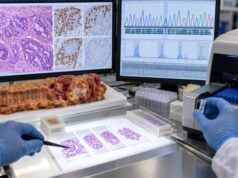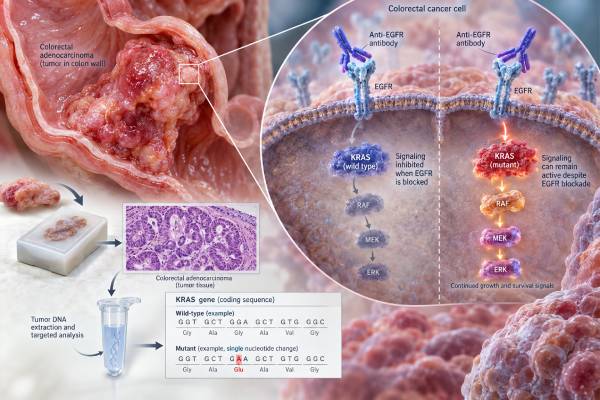
KRAS testing in colorectal cancer determines whether the tumor carries an activating RAS-pathway mutation that predicts resistance to standard anti-EGFR antibodies. The clinically relevant test is broader than a single KRAS codon: metastatic colorectal cancer should be assessed for extended RAS alterations, including KRAS and NRAS exons 2, 3, and 4, before cetuximab or panitumumab is considered. A RAS mutation usually means those drugs are not expected to help in the standard setting. A RAS wild-type result does not guarantee response because tumor sidedness, BRAF V600E, HER2 amplification, and other resistance mechanisms also matter. KRAS mutation subtype can also open separate targeted options; KRAS G12C is the clearest example, although the treatment landscape changes rapidly. The test is usually performed by PCR or next-generation sequencing on tumor tissue, with plasma ctDNA as an alternative in selected patients. Results should be read with the exact variant, assay coverage, and current treatment label.
- For anti-EGFR decisions, “KRAS wild type” is not enough unless NRAS and the relevant exons were also assessed.
- Any activating RAS mutation generally predicts lack of benefit from cetuximab or panitumumab in metastatic colorectal cancer.
- KRAS G12C is a distinct, targetable subtype with treatment options that differ from other KRAS variants.
- A negative plasma KRAS result can be false negative when ctDNA shedding is low; tissue may be needed for confirmation.
- RAS status is one part of the profile and should be interpreted with BRAF, MSI/dMMR, HER2, tumor sidedness, and prior therapy.
Table of Contents
- What the KRAS test measures
- How KRAS and extended RAS testing is performed
- Why RAS mutations predict anti-EGFR resistance
- KRAS mutation-specific treatment options
- What a RAS wild-type result does and does not mean
- Limitations and common interpretation errors
- Practical next steps after KRAS testing
What the KRAS test measures
KRAS encodes a signaling protein that switches between active and inactive states downstream of growth-factor receptors. Activating mutations lock the pathway toward growth signaling. In colorectal cancer, the most important alterations occur in codons across exons 2, 3, and 4, and NRAS must be tested as well for a complete anti-EGFR eligibility assessment.
A mutation is a tumor-genomic result, not a blood “level.” Reports should state the exact DNA or protein change, such as KRAS G12D or G13D. Variant allele fraction can provide technical context but is not a direct measure of the percentage of cancer in the body.
How KRAS and extended RAS testing is performed
Targeted PCR assays can rapidly identify common hotspot mutations. Next-generation sequencing covers many KRAS and NRAS variants at once and can simultaneously assess BRAF, HER2, and other genes. The preferred specimen is usually formalin-fixed tumor tissue with sufficient viable tumor. Primary tumors and metastases are generally concordant for early RAS drivers, although acquired resistance clones can appear after targeted therapy.
Plasma ctDNA is useful when tissue is unavailable or when the goal is to detect acquired resistance before anti-EGFR rechallenge. A detected RAS mutation in plasma is highly informative. An undetectable result needs caution if tumor fraction is low or disease is confined to sites that shed little DNA.
Why RAS mutations predict anti-EGFR resistance
Cetuximab and panitumumab block the epidermal growth factor receptor at the cell surface. If KRAS or NRAS is constitutively activated downstream, the growth signal continues even when EGFR is blocked. That is why activating RAS mutations are negative predictive biomarkers for these antibodies.
For a patient to be considered RAS wild type, the relevant KRAS and NRAS exons should be negative. Even then, response is not guaranteed. Left-sided primary tumors generally derive more benefit from first-line anti-EGFR strategies than right-sided tumors, and BRAF V600E or HER2 amplification can identify biologically resistant subgroups.
KRAS mutation-specific treatment options
KRAS is no longer simply an “undruggable” resistance marker. KRAS G12C inhibitors combined with EGFR blockade have established activity in previously treated metastatic colorectal cancer, although specific approvals and availability can change. Importantly, not all KRAS mutations behave like G12C. G12D, G12V, G13D, and other variants require different strategies and are the focus of active drug development.
Current treatment should be based on the exact variant and current regulatory status. In September 2026, the prior U.S. colorectal cancer accelerated approval for adagrasib plus cetuximab was withdrawn, illustrating why old summaries can quickly become inaccurate. Other KRAS G12C-directed options may remain available under current labels or trials.
What a RAS wild-type result does and does not mean
RAS wild type removes one major mechanism of anti-EGFR resistance, but it is not a universal favorable-prognosis label. The treatment implication depends on metastatic setting, primary-tumor sidedness, BRAF status, HER2 status, MSI/dMMR, disease burden, and prior therapies. A wild-type call also depends on assay coverage and sensitivity.
If a report tested only KRAS exon 2, it is incomplete by modern standards for anti-EGFR selection. If plasma is wild type after prior anti-EGFR therapy, clinicians may look for clearance of acquired resistance clones as part of a rechallenge strategy, but this use should follow current evidence and guidelines.
Limitations and common interpretation errors
No biomarker works in isolation. A technically accurate result can still be clinically misleading if it is applied to the wrong cancer type, disease stage, specimen, or treatment question. Cutoffs may also differ by assay, drug label, guideline, and country. For that reason, the laboratory’s own interpretive criteria and the treating team’s current guideline should take priority over a generic internet threshold.
Tumors are heterogeneous, meaning different areas can carry different alterations or levels of protein expression. A small biopsy may miss a positive clone, while a blood-based assay can miss disease that sheds little DNA into the circulation. Conversely, a detectable alteration may be real but not be the main driver of the current disease. Pre-analytic issues such as delayed fixation, decalcification, low tumor content, recent transfusion, or poor plasma handling can also affect some assays.
The safest interpretation separates three questions: analytical validity—did the assay measure what it claims to measure; clinical validity—does the result correlate with the cancer feature of interest; and clinical utility—does acting on the result improve a meaningful decision for this patient. A result can be strong in one category and limited in another.
Practical next steps after KRAS testing
A biomarker result should be read beside the pathology report, stage, imaging, treatment history, and the exact specimen tested. A useful question for the oncology team is not simply “is this positive?” but “what decision does this result change now?” That keeps the result tied to a concrete action such as confirming a diagnosis, choosing a drug, deciding whether hereditary evaluation is needed, or setting a surveillance plan.
If a result seems inconsistent with the clinical picture, ask whether the sample had enough viable tumor, whether the method covered the relevant alteration, and whether a newer metastatic or recurrent specimen would be more representative. Repeating a test is most useful when there is a specific reason to think the original specimen was inadequate, old, or biologically different from the disease being treated today.
Patients should also keep a copy of the complete molecular or pathology report, not only a portal summary. The full report usually lists the method, specimen, tumor percentage, assay limitations, exact variant or staining score, and interpretive comments. Those details matter when seeking a second opinion, transferring care, or checking eligibility for a targeted therapy or clinical trial.
One practical way to avoid overreading KRAS Test for Colon Cancer is to separate the laboratory finding from the clinical decision. The report may be analytically clear while the next step remains conditional on stage, prior therapy, other biomarkers, and patient goals. For example, a result that is highly relevant in metastatic disease may have no established treatment role after curative surgery. Likewise, a biomarker that predicts drug resistance is not necessarily a marker of worse overall prognosis. Keeping those categories separate makes the report easier to use and prevents a single word such as “positive” from carrying more meaning than the evidence supports.
The specimen date deserves attention. Cancer evolves under treatment, and the sample used for KRAS Test for Colon Cancer may have been collected months or years before the current decision. Early driver alterations often remain stable, but protein expression, copy number, and acquired resistance mechanisms can change. Retesting is most valuable when there is a plausible biological reason for change and when a new result could alter management. Repeating testing merely because a value is available is less useful than choosing the specimen that best represents the disease being treated now.
Laboratory reports also vary in how much interpretation they provide. Some give only a final category; others show raw staining percentages, copy-number estimates, variant allele fractions, quality metrics, and assay limitations. For KRAS Test for Colon Cancer, the detailed version is preferable because treatment criteria can evolve. A result that was not actionable when the tissue was first tested may become relevant later, and the original numerical or molecular detail may allow the oncology team to reassess eligibility without immediately repeating a biopsy.
Finally, biomarker testing works best as part of multidisciplinary care. Pathologists judge specimen quality and assay interpretation; medical oncologists connect the finding to treatment; surgeons and gastroenterologists provide disease context; genetic counselors address possible inherited risk when appropriate. Patients do not need to master every technical detail, but they benefit from knowing the purpose of the test, the exact result, what uncertainty remains, and what concrete decision follows. Those four questions turn a complex biomarker report into a usable plan.
One practical way to avoid overreading KRAS Test for Colon Cancer is to separate the laboratory finding from the clinical decision. The report may be analytically clear while the next step remains conditional on stage, prior therapy, other biomarkers, and patient goals. For example, a result that is highly relevant in metastatic disease may have no established treatment role after curative surgery. Likewise, a biomarker that predicts drug resistance is not necessarily a marker of worse overall prognosis. Keeping those categories separate makes the report easier to use and prevents a single word such as “positive” from carrying more meaning than the evidence supports.
The specimen date deserves attention. Cancer evolves under treatment, and the sample used for KRAS Test for Colon Cancer may have been collected months or years before the current decision. Early driver alterations often remain stable, but protein expression, copy number, and acquired resistance mechanisms can change. Retesting is most valuable when there is a plausible biological reason for change and when a new result could alter management. Repeating testing merely because a value is available is less useful than choosing the specimen that best represents the disease being treated now.
Laboratory reports also vary in how much interpretation they provide. Some give only a final category; others show raw staining percentages, copy-number estimates, variant allele fractions, quality metrics, and assay limitations. For KRAS Test for Colon Cancer, the detailed version is preferable because treatment criteria can evolve. A result that was not actionable when the tissue was first tested may become relevant later, and the original numerical or molecular detail may allow the oncology team to reassess eligibility without immediately repeating a biopsy.
Finally, biomarker testing works best as part of multidisciplinary care. Pathologists judge specimen quality and assay interpretation; medical oncologists connect the finding to treatment; surgeons and gastroenterologists provide disease context; genetic counselors address possible inherited risk when appropriate. Patients do not need to master every technical detail, but they benefit from knowing the purpose of the test, the exact result, what uncertainty remains, and what concrete decision follows. Those four questions turn a complex biomarker report into a usable plan.
One practical way to avoid overreading KRAS Test for Colon Cancer is to separate the laboratory finding from the clinical decision. The report may be analytically clear while the next step remains conditional on stage, prior therapy, other biomarkers, and patient goals. For example, a result that is highly relevant in metastatic disease may have no established treatment role after curative surgery. Likewise, a biomarker that predicts drug resistance is not necessarily a marker of worse overall prognosis. Keeping those categories separate makes the report easier to use and prevents a single word such as “positive” from carrying more meaning than the evidence supports.
The specimen date deserves attention. Cancer evolves under treatment, and the sample used for KRAS Test for Colon Cancer may have been collected months or years before the current decision. Early driver alterations often remain stable, but protein expression, copy number, and acquired resistance mechanisms can change. Retesting is most valuable when there is a plausible biological reason for change and when a new result could alter management. Repeating testing merely because a value is available is less useful than choosing the specimen that best represents the disease being treated now.
Laboratory reports also vary in how much interpretation they provide. Some give only a final category; others show raw staining percentages, copy-number estimates, variant allele fractions, quality metrics, and assay limitations. For KRAS Test for Colon Cancer, the detailed version is preferable because treatment criteria can evolve. A result that was not actionable when the tissue was first tested may become relevant later, and the original numerical or molecular detail may allow the oncology team to reassess eligibility without immediately repeating a biopsy.
Finally, biomarker testing works best as part of multidisciplinary care. Pathologists judge specimen quality and assay interpretation; medical oncologists connect the finding to treatment; surgeons and gastroenterologists provide disease context; genetic counselors address possible inherited risk when appropriate. Patients do not need to master every technical detail, but they benefit from knowing the purpose of the test, the exact result, what uncertainty remains, and what concrete decision follows. Those four questions turn a complex biomarker report into a usable plan.
One practical way to avoid overreading KRAS Test for Colon Cancer is to separate the laboratory finding from the clinical decision. The report may be analytically clear while the next step remains conditional on stage, prior therapy, other biomarkers, and patient goals. For example, a result that is highly relevant in metastatic disease may have no established treatment role after curative surgery. Likewise, a biomarker that predicts drug resistance is not necessarily a marker of worse overall prognosis. Keeping those categories separate makes the report easier to use and prevents a single word such as “positive” from carrying more meaning than the evidence supports.
The specimen date deserves attention. Cancer evolves under treatment, and the sample used for KRAS Test for Colon Cancer may have been collected months or years before the current decision. Early driver alterations often remain stable, but protein expression, copy number, and acquired resistance mechanisms can change. Retesting is most valuable when there is a plausible biological reason for change and when a new result could alter management. Repeating testing merely because a value is available is less useful than choosing the specimen that best represents the disease being treated now.
Laboratory reports also vary in how much interpretation they provide. Some give only a final category; others show raw staining percentages, copy-number estimates, variant allele fractions, quality metrics, and assay limitations. For KRAS Test for Colon Cancer, the detailed version is preferable because treatment criteria can evolve. A result that was not actionable when the tissue was first tested may become relevant later, and the original numerical or molecular detail may allow the oncology team to reassess eligibility without immediately repeating a biopsy.
References
- SEOM-GEMCAD-TTD clinical guidelines for the systemic treatment of metastatic colorectal cancer (2022) 2023 (Guideline)
- Molecular Biomarkers for the Evaluation of Colorectal Cancer: Guideline From the American Society for Clinical Pathology, College of American Pathologists, Association for Molecular Pathology, and American Society of Clinical Oncology 2017 (Guideline)
- HER2-targeted therapy in colorectal cancer: a comprehensive review 2025 (Review)
- FDA grants accelerated approval to tucatinib with trastuzumab for colorectal cancer 2023 (Official)
- Japanese society for cancer of the colon and rectum (JSCCR) guidelines 2024 for the clinical practice of hereditary colorectal cancer 2025 (Guideline)
Disclaimer
This article explains biomarker testing for educational purposes and is not a diagnosis or treatment plan. Cancer testing and treatment should be interpreted by the oncology and pathology teams using the complete medical record, current guidelines, and the specific laboratory method. Seek prompt medical care for new or rapidly worsening symptoms rather than relying on a biomarker result alone.