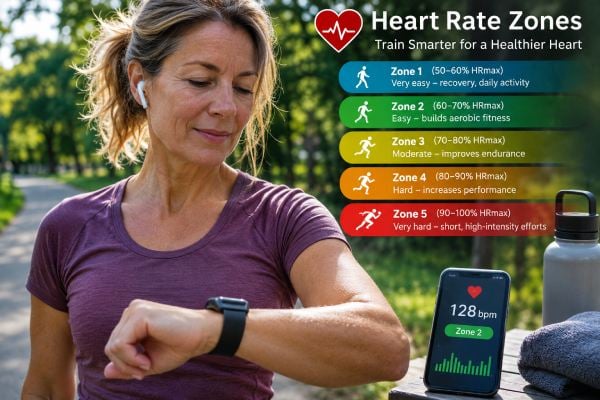
Heart rate zones are intensity ranges that help you judge how hard your cardiovascular system is working during exercise. They can make training more structured, but the familiar five-zone chart is only an estimate—not a precise map of what is happening inside your body. Age-based formulas for maximum heart rate can be off by many beats per minute for an individual, and medications, fitness level, heat, dehydration, illness, and the type of exercise can all shift your heart-rate response.
For heart health, you do not need to spend every workout in a perfect zone. The bigger priorities are regular aerobic activity, a sensible mix of moderate and vigorous effort, gradual progression, and enough recovery. Heart rate works best when you combine it with the talk test and perceived exertion. If a watch says you are in an “easy” zone but you are breathless and dizzy, trust the symptom—not the label. Used thoughtfully, zones can help beginners pace themselves, help experienced exercisers organize training, and reduce the tendency to make every workout unnecessarily hard.
Table of Contents
- What Heart Rate Zones Are
- How to Estimate Your Zones
- What Each Zone Feels Like
- Which Zones Support Heart Health
- Why Heart Rate Formulas Can Be Wrong
- How to Train Safely
- A Simple Weekly Zone Plan
What Heart Rate Zones Are
Heart rate zones divide exercise intensity into ranges, usually expressed as a percentage of maximum heart rate or heart rate reserve. As effort rises, heart rate generally rises to deliver more oxygen to working muscles. Zones are a practical way to turn that continuous response into training categories.
The common five-zone model looks tidy, but physiology is not divided into five exact compartments. Your breathing, lactate production, fuel use, and muscle recruitment change gradually. More individualized exercise testing often uses physiological thresholds—especially ventilatory thresholds—rather than generic percentages because thresholds better reflect how a specific person responds.
Still, zone models are useful when you understand what they can and cannot tell you. A beginner can use them to avoid turning an easy walk into a near-maximal effort. A runner can separate recovery days from harder intervals. A person returning to exercise can use a zone range together with symptoms and perceived effort to build confidence.
Zones are also relative. A pace that puts a trained runner in Zone 1 may put a beginner near the top of a moderate range. That is why prescribing exercise by speed alone can fail. Walking at 4 miles per hour, for example, might be easy for one person and unsustainably hard for another. Heart rate and the talk test help translate the external workload into an internal effort.
Heart-rate zones are different from a target heart rate used during a medical stress test. Diagnostic exercise testing asks clinical questions and may use measured maximum heart rate, ECG changes, blood pressure, symptoms, and workload. Do not use a consumer training zone as a substitute for a clinician-prescribed limit.
How to Estimate Your Zones
There are two common approaches: percentage of maximum heart rate and percentage of heart rate reserve.
Method 1: Percentage of maximum heart rate
A widely used estimate is:
Estimated maximum heart rate = 220 − age
A 50-year-old would therefore have an estimated maximum of 170 bpm. A zone defined as 60%–70% of maximum would be about 102–119 bpm.
The arithmetic is simple, but the estimate can be inaccurate for an individual. “220 minus age” was never designed to predict every person’s true maximum heart rate precisely. If your actual maximum is 15 bpm above or below the estimate, every zone built from it shifts too.
Other age-based equations exist, but none eliminates individual variation. For a more complete explanation, see how target heart rate by age is estimated.
Method 2: Heart rate reserve
Heart rate reserve accounts for resting heart rate:
Heart rate reserve = maximum heart rate − resting heart rate
Then:
Target heart rate = resting heart rate + (heart rate reserve × desired intensity)
For example, imagine a 50-year-old with an estimated maximum heart rate of 170 bpm and a resting heart rate of 60 bpm. Heart rate reserve is 110 bpm. At 60% of reserve:
60 + (110 × 0.60) = 126 bpm
At 70%:
60 + (110 × 0.70) = 137 bpm
That 126–137 bpm range is substantially higher than the 102–119 bpm obtained from 60%–70% of maximum heart rate. This is why you must know which method a chart or app is using.
Heart rate reserve often tracks relative exercise intensity better than straight percentages of estimated maximum, but it still depends on the quality of the maximum-heart-rate estimate. If you have a measured maximum from a properly performed exercise test, that value is generally more informative than an age formula.
What Each Zone Feels Like
Many platforms use five zones. Exact percentage boundaries vary by brand and method, so the table below is a practical guide rather than a universal standard.
| Zone | Approximate effort | Talk test | Typical use |
|---|---|---|---|
| Zone 1 | Very easy | Full conversation is effortless | Warm-up, cooldown, active recovery |
| Zone 2 | Easy to moderate | Comfortable sentences | Aerobic base, longer sessions |
| Zone 3 | Moderate to hard | Shorter sentences | Steady aerobic work |
| Zone 4 | Hard | A few words at a time | Threshold-style intervals |
| Zone 5 | Very hard | Talking is difficult | Short high-intensity efforts |
The talk test is valuable because it reflects your actual response that day. If you can speak comfortably in full sentences, you are usually below the intensity where ventilation rises sharply. As speaking becomes difficult, you are moving toward or above a ventilatory threshold. Research supports the talk test as a practical way to guide aerobic intensity in healthy adults and people in cardiac rehabilitation settings.
You do not need to recite a formal script during an ordinary workout. Try saying a full sentence of about 10–15 words. If you can do so comfortably, the intensity is likely easy to moderate. If you can manage only short phrases, you are working harder. If a few words are difficult, the effort is vigorous and probably not where most beginners should spend long periods.
Perceived exertion adds another layer. On a simple 0–10 effort scale, easy-to-moderate exercise may feel like about 2–4, while vigorous work may feel like 5–7. A hard interval may reach 8–9, but most heart-health exercise does not need to live there.
If your watch zone conflicts with your breathing and effort, investigate why. Heat, hills, fatigue, caffeine, dehydration, altitude, or an inaccurate maximum-heart-rate setting may explain the mismatch.
Which Zones Support Heart Health
Heart benefits come from regular physical activity across a range of intensities, not from one magical zone. Moderate-intensity aerobic activity improves blood pressure, cardiorespiratory fitness, glucose regulation, and overall cardiovascular risk. Vigorous exercise can provide additional fitness gains in less time for people who can perform it safely.
For many adults, the most sustainable approach is to make most aerobic exercise comfortable to moderately challenging and add smaller amounts of harder work. That often means spending a large share of training around a conversational pace—what many devices call Zone 2—with occasional sessions that move into Zones 3–4.
The popularity of Zone 2 has created some confusion. “Zone 2” in a five-zone watch model is not necessarily identical to a laboratory-defined intensity below the first ventilatory or lactate threshold. The idea behind low-intensity aerobic training is useful, but the exact number on a watch can be approximate. For a deeper look, see what Zone 2 cardio is and why it is popular.
Walking is an excellent example of useful moderate exercise. A brisk pace that raises heart rate while still allowing conversation can produce meaningful cardiovascular benefits without requiring high-intensity intervals. Walking for heart health can be a strong starting point if you are inactive or rebuilding fitness.
Harder training has a place too. Intervals can raise cardiorespiratory fitness efficiently, but they create more fatigue and require more recovery. A beginner does not need repeated Zone 5 sessions to improve heart health. Building consistency first is safer and usually more effective.
The weekly total matters more than any single workout. Public-health exercise guidance is commonly framed in minutes of moderate or vigorous activity because cardiovascular benefit accumulates across the week. You can reach that volume through brisk walking, cycling, swimming, dancing, or other activities that raise breathing and heart rate. Strength training should complement aerobic work because muscular fitness, glucose control, and daily function also contribute to long-term cardiovascular health.
Why Heart Rate Formulas Can Be Wrong
Predicted maximum heart rate is one of the biggest sources of error in zone training. Age explains some of the population-level decline in maximum heart rate, but people of the same age can have very different true maximums. A formula that is reasonably accurate on average can still be substantially wrong for you.
Medication makes this even more important. Beta blockers lower heart rate and blunt the rise during exercise. Research in cardiac rehabilitation shows that target zones calculated from predicted maximum heart rate may poorly match zones based on a measured exercise test in people taking beta blockers. In that setting, perceived exertion, the talk test, and clinician-directed targets may be more appropriate.
Other factors that can shift heart rate include:
- Heat and humidity.
- Dehydration.
- Fever or illness.
- Caffeine and stimulant medications.
- Altitude.
- Poor sleep and accumulated fatigue.
- Emotional stress.
- Pregnancy.
- Anemia or thyroid disease.
- The exercise mode itself.
Cycling heart rate is often somewhat lower than running heart rate at a similar perceived intensity for people who are more accustomed to running. Swimming can differ again. A single set of zones may therefore fit one activity better than another.
Wrist optical sensors can also lag or lose accuracy during rapid changes in intensity. A chest strap is often better for intervals because it detects the heart’s electrical signal and responds more quickly. Whatever device you use, do not assume every spike is real. A sudden jump that does not match your effort may be sensor error.
Another common error is setting zones from the highest heart rate you happened to see in a normal workout. Unless the session truly brought you near maximum effort, that value may underestimate your actual maximum and make every zone too low. On the other hand, a brief sensor spike can make the zones too high. A supervised maximal or symptom-limited test is more reliable when precise prescription matters.
How to Train Safely
The safest training zone is one that matches your health status, conditioning, and symptoms. If you are healthy but inactive, start below the level you think you “should” be able to handle. Fitness improves from repeated tolerable sessions, not from proving how high you can drive your heart rate.
A gradual progression might look like this:
- Build duration first. Start with 10–20 minutes at a comfortable conversational pace.
- Add minutes gradually. Increase toward 30–45 minutes on several days per week.
- Then add intensity. Introduce short brisk segments once the easier work feels routine.
- Keep easy days easy. Recovery sessions should not drift upward just because your watch rewards more zone minutes.
- Use symptoms as a safety override. Stop and seek appropriate care for warning signs.
Warm up for at least several minutes before harder work. A warm-up allows heart rate, blood flow, and breathing to rise progressively. Cool down after vigorous exercise rather than stopping abruptly, especially if you tend to feel lightheaded. During the first few weeks of a new program, leave at least one easy day between demanding sessions so you can distinguish normal training fatigue from a pattern of poor recovery.
Environmental conditions can require temporary adjustments. On a hot day, your heart rate may be higher at the same pace because more blood is directed toward the skin for cooling. In that setting, slowing down to keep the effort conversational is smarter than forcing your usual pace just to match a zone target. Similar adjustments may be needed at altitude or during recovery from an illness.
Stop exercise and seek urgent medical evaluation for chest pressure, fainting, severe shortness of breath, or a sustained abnormal heartbeat. New exercise-related dizziness or a major unexplained loss of exercise capacity also deserves medical attention.
If you have known coronary artery disease, heart failure, cardiomyopathy, significant valve disease, an arrhythmia, uncontrolled hypertension, or a recent cardiovascular event, ask your healthcare team for an individualized exercise plan. Cardiac rehabilitation programs can use exercise testing, blood pressure, ECG monitoring, and perceived exertion to prescribe intensity more precisely.
Do not chase an age-predicted maximum heart rate as a goal. Maximum heart rate is not a score to improve. Training aims to improve what you can do at submaximal effort, your cardiorespiratory fitness, and your cardiovascular risk profile.
A Simple Weekly Zone Plan
For a generally healthy beginner who has no exercise restrictions, a simple week can emphasize conversational aerobic work with a small amount of higher intensity after a base is established.
| Day | Example session | Intensity guide |
|---|---|---|
| Monday | 30-minute brisk walk | Zone 2-ish, full sentences |
| Tuesday | Strength training + easy walk | Easy aerobic effort |
| Wednesday | 35-minute walk or cycle | Zone 2-ish |
| Thursday | Rest or mobility | Recovery |
| Friday | 30 minutes with 4 × 2-minute brisk segments | Brief Zone 3–4 effort |
| Saturday | 45-minute comfortable walk, bike, or swim | Mostly easy to moderate |
| Sunday | Rest or easy activity | Recovery |
The harder session should feel controlled, not maximal. During a two-minute brisk segment, speaking may become limited to short phrases, but you should recover between efforts. If you are new to exercise, spend several weeks building the easier sessions before adding intervals.
As fitness improves, you may notice that the same walking pace produces a lower heart rate or that you can move faster at the same heart rate. That is a more meaningful sign of adaptation than simply spending more time in a higher zone. You can also monitor how quickly your heart rate recovers after exercise as another trend, while remembering that recovery measurements depend on the protocol.
Recheck your zones when the assumptions behind them change. A new medication that slows heart rate, a formal exercise test, a major change in fitness, or a long break from training can make an old target less useful. You do not need to recalculate zones every week, but it is reasonable to revisit them after a few months of consistent training or after a clinician gives you a measured peak heart rate or threshold. Keep the same calculation method when comparing workouts over time; switching formulas can make apparent progress or decline that is only a math difference.
For steady aerobic sessions, consistency matters more than precision to the beat. If your target band is 120–135 bpm and you briefly see 137 bpm on a hill while effort remains controlled, there is usually no need to stop solely to satisfy the display. Slow slightly, check how you feel, and let heart rate settle. Zones are ranges for pacing decisions, not rigid medical boundaries.
A heart-rate zone should guide, not dictate. The best program is one you can repeat safely, that leaves room for recovery, and that improves real-world capacity over time. Use the numbers to support that goal rather than turning every workout into a test.
References
- Exercise intensity prescription in cardiovascular rehabilitation: bridging the gap between best evidence and clinical practice 2024 (Review)
- Target Heart Rate Formulas for Exercise Stress Testing: What Is the Evidence? 2024 (Review)
- A Clinical Guide for Assessment and Prescription of Exercise and Physical Activity in Cardiac Rehabilitation. A CSANZ Position Statement 2023 (Position Statement)
- Among Patients Taking Beta-Adrenergic Blockade Therapy, Use Measured (Not Predicted) Maximal Heart Rate to Calculate a Target Heart Rate for Cardiac Rehabilitation 2023
- The talk test as a useful tool to monitor aerobic exercise intensity in healthy population 2023
- Physical activity, cardiorespiratory fitness, and cardiovascular health: A clinical practice statement of the American Society for Preventive Cardiology Part II: Physical activity, cardiorespiratory fitness, minimum and goal intensities for exercise training, prescriptive methods, and special patient populations 2022 (Position Statement)
Disclaimer
This article is for general education and is not an individualized exercise prescription or medical clearance. Heart-rate targets can be inaccurate in people taking heart-rate-altering medications or living with cardiovascular disease. Stop exercise and seek medical care for chest pain, fainting, severe shortness of breath, or a sustained abnormal heartbeat.