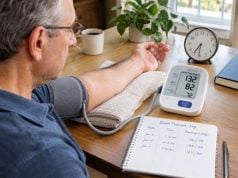
A target heart rate zone is a practical estimate of how hard your cardiovascular system is working during aerobic exercise. For many adults, moderate exercise falls around 50%–70% of estimated maximum heart rate, while vigorous exercise is roughly 70%–85%. These ranges can help you pace walking, cycling, swimming, running, and other cardio without guessing entirely from speed or distance.
The important word is estimate. Formulas such as “220 minus your age” describe population averages, not your exact personal maximum. Real maximum heart rate can differ by 10 beats per minute or more from an age-based prediction, and medications, fitness level, temperature, illness, and heart conditions can change the number you see during exercise. That means heart rate works best when combined with the talk test and perceived effort. Use the calculator-style methods below as a starting point, then adjust based on how you feel and any exercise guidance your clinician has given you.
Table of Contents
- Target Heart Rate Chart by Age
- How to Estimate Maximum Heart Rate
- How to Calculate Your Training Zone
- Using Heart Rate Reserve for a More Personal Estimate
- When Heart Rate Zones Can Be Misleading
- Which Zone Should You Train In?
- When to Get Medical Guidance
Target Heart Rate Chart by Age
The simplest target-heart-rate chart starts with the traditional estimate:
Estimated maximum heart rate = 220 − age
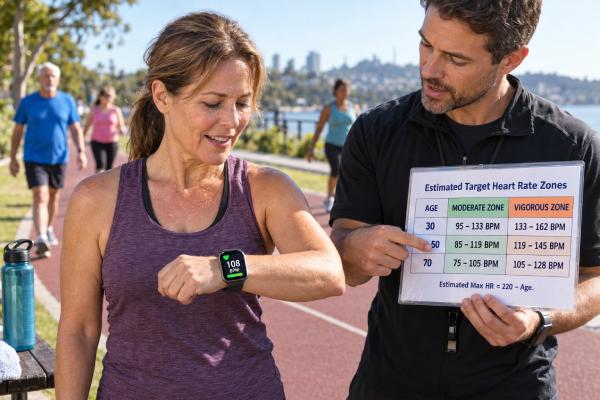
Then multiply that maximum by the desired intensity. The American Heart Association describes moderate activity as roughly 50%–70% of maximum heart rate and vigorous activity as roughly 70%–85%.
| Age | Estimated max HR | Moderate zone 50%–70% | Vigorous zone 70%–85% |
|---|---|---|---|
| 20 | 200 bpm | 100–140 bpm | 140–170 bpm |
| 30 | 190 bpm | 95–133 bpm | 133–162 bpm |
| 40 | 180 bpm | 90–126 bpm | 126–153 bpm |
| 50 | 170 bpm | 85–119 bpm | 119–145 bpm |
| 60 | 160 bpm | 80–112 bpm | 112–136 bpm |
| 70 | 150 bpm | 75–105 bpm | 105–128 bpm |
| 80 | 140 bpm | 70–98 bpm | 98–119 bpm |
These are not “normal” heart rates that everyone must reach. They are training estimates. A healthy 50-year-old might comfortably exercise at 125 bpm, while another person of the same age may be working very hard at that rate because of medication, deconditioning, heat, illness, or individual physiology.
The chart also assumes that the activity produces a fairly steady heart-rate response. That works reasonably well for continuous walking, jogging, cycling, or similar cardio. It is less useful during strength training, stop-and-go sports, short sprints, or very brief intervals because heart rate lags behind sudden changes in workload. During those activities, breathing, technique, power output, and perceived effort may tell you more than the instantaneous pulse.
If you are between the ages shown, you can calculate your own estimate rather than rounding to the nearest decade. For example, at age 47, 220 − 47 gives a maximum of 173 bpm. Half of that is about 87 bpm, 70% is about 121 bpm, and 85% is about 147 bpm. A practical moderate range would therefore be roughly 87–121 bpm, with vigorous work around 121–147 bpm. There is no need to calculate to the exact decimal; these are broad training bands.
If you are new to exercise, start near the lower end of the moderate range and let your fitness build gradually. If you already train regularly, heart-rate zones can help separate easy sessions from harder ones, but a measured maximum from a properly performed exercise test is more individualized than an age equation.
Resting heart rate is a separate number. For context on what you may see before exercise, review normal resting and exercise heart-rate ranges.
How to Estimate Maximum Heart Rate
Maximum heart rate, often written as HRmax, is the highest rate your heart reaches during maximal effort. It usually declines with age, which is why age appears in prediction formulas.
The best-known equation is:
220 − age
For a 40-year-old:
220 − 40 = 180 bpm estimated maximum
This formula is easy, which explains why it appears on exercise machines and fitness charts. Its weakness is that it can be substantially wrong for an individual.
Another widely studied equation is the Tanaka formula:
208 − (0.7 × age)
For a 40-year-old:
208 − 28 = 180 bpm
The two formulas happen to give the same estimate at age 40, but they diverge at other ages. At age 70, 220 − age gives 150 bpm, while the Tanaka equation gives about 159 bpm.
The Tanaka equation came from a large analysis of healthy adults and tends to perform better than 220 − age in some groups, especially older adults. Still, neither equation can tell you your exact maximum. Studies comparing predicted and measured maximum heart rates consistently show meaningful person-to-person error.
That error is not necessarily a problem for everyday fitness. If a formula misses your true maximum by 8–12 bpm, the resulting training zone may still put you in a useful general intensity range when combined with the talk test. The problem comes when people treat the estimate as precise—for example, assuming that 154 bpm is “safe” but 156 bpm is “too high,” or deciding that a workout failed because they never reached a predicted percentage. Exercise intensity exists on a continuum, and your symptoms and overall response matter more than a one-beat threshold.
That is why a predicted maximum should not become a hard ceiling that you fear crossing by one or two beats. Nor should you force yourself to reach a predicted number if the effort feels extreme. The formula is a pacing tool, not a diagnosis.
A cardiopulmonary exercise test or maximal graded exercise test can measure peak exercise heart rate more directly. Testing may be useful for athletes seeking precision and for people with cardiovascular disease who need an individualized exercise prescription. If you have had formal testing, use the limits and zones provided from that test rather than defaulting to 220 − age.
How to Calculate Your Training Zone
Once you have an estimated maximum, the simplest method is to multiply it by your target percentage.
For a 50-year-old using 220 − age:
- Estimated maximum: 170 bpm
- 50% of maximum: 85 bpm
- 70% of maximum: 119 bpm
- 85% of maximum: 145 bpm
So the approximate ranges are:
- Moderate: 85–119 bpm
- Vigorous: 119–145 bpm
Do not worry about the exact beat where “moderate” becomes “vigorous.” Exercise physiology does not change at a single magic number. The boundaries are convenient ranges that help organize training intensity.
The talk test is a valuable cross-check. According to current CDC guidance:
- At moderate intensity, you can usually talk but not sing.
- At vigorous intensity, you generally cannot say more than a few words without pausing for breath.
Perceived effort also works well. On a 0–10 scale, moderate activity is commonly around 5–6, while vigorous activity is around 7–8. If your watch says you are at 80% of maximum but you can speak comfortably in full sentences and feel relaxed, the predicted maximum may be too low for you. If the watch says 60% but you are gasping, the formula may be too high, your fitness may be low, or another factor may be raising effort.
Wearable devices make heart-rate tracking convenient, but optical wrist sensors are not perfect. Accuracy can change with motion, device fit, skin contact, exercise type, and rapid intensity changes. Treat a sudden implausible spike or drop as something to verify rather than immediately changing your workout. For broader context on what wrist devices can estimate from exercise data, see how wearables estimate cardio fitness.
Using Heart Rate Reserve for a More Personal Estimate
The heart rate reserve method includes your resting heart rate, so it can reflect individual fitness better than using only a percentage of estimated maximum heart rate.
The formula is:
Heart rate reserve = maximum heart rate − resting heart rate
Then:
Target heart rate = resting heart rate + (heart rate reserve × target intensity)
Suppose you are 50 years old, your resting heart rate is 70 bpm, and you use 220 − age for a maximum of 170 bpm.
- Heart rate reserve = 170 − 70 = 100 bpm
- At 50% intensity: 70 + (100 × 0.50) = 120 bpm
- At 70% intensity: 70 + (100 × 0.70) = 140 bpm
Using heart rate reserve, a 50%–70% range would be 120–140 bpm. Notice that this is higher than 50%–70% of maximum heart rate alone, which produced 85–119 bpm. The percentages from these two methods are not interchangeable because they define intensity differently.
This distinction is easy to miss. If a training plan says “60% heart rate reserve,” do not calculate 60% of maximum heart rate. Use the full reserve formula.
For a useful resting value, measure your pulse after several minutes of quiet rest, ideally under similar conditions on multiple mornings. A single unusually high reading after poor sleep, dehydration, fever, stress, or heavy caffeine intake may not represent your baseline.
Heart rate reserve is still limited by the accuracy of the maximum-heart-rate estimate. If the estimated maximum is wrong by 15 bpm, the calculated reserve and zones will also shift. In clinical settings, exercise testing can improve this by supplying a measured peak heart rate and information about symptoms, blood pressure, rhythm, and exercise capacity.
Resting heart rate can change as fitness improves, which means heart-rate-reserve zones can shift over time even if your age-predicted maximum barely changes. Suppose the same 50-year-old lowers resting heart rate from 70 to 60 bpm after several months of training. With a 170 bpm maximum, heart-rate reserve rises from 100 to 110 bpm. A 60% HRR target would move from 130 bpm to 126 bpm because the lower resting value changes the calculation. Recheck resting heart rate periodically rather than using an old number indefinitely.
When Heart Rate Zones Can Be Misleading
Heart-rate zones work best when heart rate rises normally with exercise. Several common situations can make standard age-based zones unreliable.
Beta blockers and other heart-rate-slowing medications
Beta blockers such as metoprolol, atenolol, carvedilol, and propranolol blunt the heart-rate response to exercise. Some calcium channel blockers and other rhythm-control drugs can also reduce heart rate. A standard age-based target may therefore be unrealistic or inappropriate.
The American Heart Association recommends discussing an adjusted target with a health professional; an exercise stress test may be used when a precise prescription is needed. Otherwise, the talk test and perceived exertion are often more useful than chasing a watch number.
Heart rhythm conditions
Atrial fibrillation, frequent ectopic beats, pacemakers, conduction disease, and other rhythm conditions can complicate pulse interpretation. A wrist device may also misread irregular rhythms. Follow your cardiology team’s exercise guidance rather than using a generic chart.
Heat, dehydration, altitude, and illness
Heart rate can drift upward even when your pace stays the same. Heat sends more blood to the skin for cooling, dehydration reduces plasma volume, and altitude increases cardiovascular demand. Fever and illness can also raise heart rate. On these days, slowing down to maintain the same heart-rate zone may be sensible.
Caffeine, stress, and poor sleep
Stimulants, anxiety, and inadequate sleep can increase heart rate and perceived effort. A workout that normally sits at 130 bpm may be 140 bpm at the same pace after a stressful, sleepless night.
Individual maximum heart rate
The biggest limitation is simple biological variation. The review literature on target heart-rate formulas emphasizes that age-predicted maximum heart rate is an approximation, and the common 85%-of-predicted-max threshold used in some exercise testing contexts should not be treated as an absolute measure of adequate effort or prognosis.
If your heart rate often spikes during easy activities, do not assume the solution is simply to train harder or lower your target. unexpected heart-rate spikes during simple activities may deserve a closer look when they are persistent or symptomatic.
Which Zone Should You Train In?
For general cardiovascular fitness, most people benefit from doing the majority of aerobic exercise at a sustainable moderate intensity and adding vigorous work as fitness, goals, and health status allow.
A practical week might include:
- Easy-to-moderate sessions: longer walks, cycling, swimming, or jogging where breathing is controlled
- Moderate sessions: purposeful aerobic work near the middle or upper part of a sustainable range
- Short vigorous intervals: optional faster efforts separated by recovery for people who are ready for them
- Recovery days: light movement that does not add much fatigue
You do not need to spend every workout at 80%–85% of maximum heart rate to improve. In fact, repeatedly making every session hard can limit recovery and consistency. Lower-intensity aerobic work can build endurance and training volume with less fatigue. This is one reason beginner Zone 2 training plans have become popular, even though exact “Zone 2” definitions vary among systems.
A useful rule for beginners is to finish most sessions feeling as though you could have continued a little longer. After several weeks of regular moderate exercise, you can add brief vigorous intervals if you want more challenge. For example, after a 10-minute warm-up, alternate one minute of harder work with two minutes of easy recovery for four to six rounds. Heart rate may continue rising for part of the recovery interval, so do not chase the watch by making the hard interval longer than planned.
Endurance athletes may use five-zone systems, lactate threshold, ventilatory threshold, running pace, or cycling power. Those systems can be valuable, but their zone labels are not standardized. “Zone 2” in one app may not equal Zone 2 in another. When comparing plans, look at the actual definition—percentage of max HR, percentage of heart-rate reserve, threshold heart rate, or perceived effort—rather than assuming the same zone number means the same intensity.
The weekly amount of activity matters too. U.S. physical activity guidance recommends 150–300 minutes of moderate-intensity aerobic activity per week, 75–150 minutes of vigorous activity, or an equivalent combination, plus muscle-strengthening activity on at least two days.
If improving performance is the goal, pace, power, ventilatory thresholds, and measured exercise-test data can be more informative than a generic age zone. VO2 max and cardiovascular fitness explains one of the main measures used to assess aerobic capacity.
When to Get Medical Guidance
A target heart rate chart is designed for exercise planning, not for deciding whether symptoms are safe. Stop exercising and seek urgent medical care for chest pressure, fainting, severe shortness of breath, new neurologic symptoms, or a sustained very fast or very slow heart rate accompanied by weakness, dizziness, or feeling unwell.
Get individualized exercise advice before vigorous training if you have known coronary artery disease, heart failure, significant valve disease, a cardiomyopathy, a serious arrhythmia, an implanted cardiac device, uncontrolled high blood pressure, or a recent heart procedure or cardiovascular event.
An exercise stress test can sometimes clarify how your heart rate, blood pressure, rhythm, and symptoms respond as workload rises. Test interpretation involves more than reaching a percentage of predicted maximum heart rate. If you have already been tested, understanding cardiac stress-test results can help put the heart-rate number in context.
For everyone else, target zones are best treated as flexible guardrails. Estimate your maximum, choose an appropriate range, and compare the number with breathing and perceived effort. Over several weeks, you will learn what moderate and vigorous exercise feel like for your body. That skill is more useful than trying to hit an exact bpm every minute of every workout.
References
- Target Heart Rates Chart 2024 (Official Guidance)
- How to Measure Physical Activity Intensity 2025 (Official Guidance)
- How Do Beta Blocker Drugs Affect Exercise? 2024 (Official Guidance)
- Target Heart Rate Formulas for Exercise Stress Testing: What Is the Evidence? 2024 (Review)
- Accurate prediction equations for ventilatory thresholds in cardiometabolic disease when gas exchange analysis is unavailable: development and validation 2024 (Validation Study)
- Age-predicted maximal heart rate revisited 2001 (Original Study)
Disclaimer
This article provides general exercise education and is not a personalized heart-rate prescription. Medications and cardiovascular conditions can substantially change your exercise heart rate, so follow your clinician’s or cardiac rehabilitation team’s targets when they differ from age-based formulas. Seek urgent care for chest pain, fainting, severe shortness of breath, or a dangerous-feeling rhythm change during exercise.