VO2 max is the highest rate at which your body can take in, transport, and use oxygen during intense exercise. It is one of the clearest measures of cardiorespiratory fitness because it reflects how well the lungs, heart, blood, circulation, and working muscles function together. A higher VO2 max generally means you can sustain more aerobic work before fatigue, and population studies consistently link better cardiorespiratory fitness with lower risks of cardiovascular disease and premature death. Your number is not a fixed score, though. Age, sex, genetics, body size, training history, altitude, illness, and testing method all affect it. Laboratory cardiopulmonary exercise testing is the most accurate way to measure VO2 max or VO2 peak, while watches and fitness apps provide estimates that can be useful for tracking trends but should not be treated as diagnostic results. Most adults can improve cardiorespiratory fitness with regular aerobic exercise, and the safest plan combines consistent moderate training with gradually introduced harder efforts.
Table of Contents
- What VO2 Max Measures
- How VO2 Max Is Tested and Estimated
- What Is a Good VO2 Max?
- Why VO2 Max Matters for Heart Health
- How to Improve VO2 Max
- Safe Training and Warning Signs
- How to Track Progress Without Chasing One Number
What VO2 Max Measures
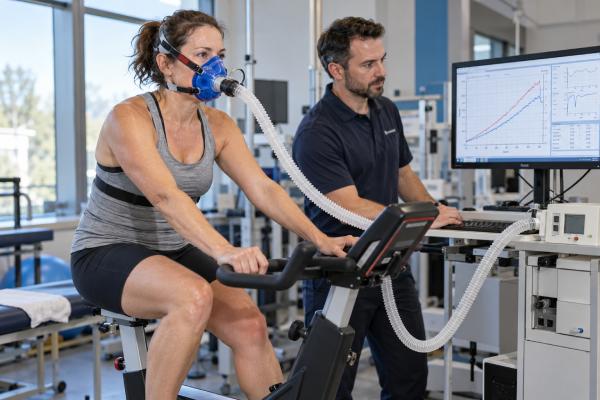
VO2 means oxygen consumption. The “max” refers to the highest oxygen uptake reached during progressively harder exercise. In a laboratory, you typically wear a mask or mouthpiece that measures the oxygen you inhale and the carbon dioxide you exhale while workload rises on a treadmill or stationary bike.
VO2 max is commonly expressed in milliliters of oxygen per kilogram of body weight per minute, written as mL/kg/min. It can also be reported as an absolute value in liters per minute.
Relative VO2 max is useful because it adjusts for body mass. For example, a person who consumes 3.0 liters of oxygen per minute at maximum effort and weighs 75 kg has a relative oxygen uptake of about 40 mL/kg/min.
One metabolic equivalent, or MET, is conventionally defined as 3.5 mL/kg/min. A VO2 max of 35 mL/kg/min therefore corresponds to roughly 10 METs of maximal aerobic capacity. The conversion is helpful, but real resting metabolic rate varies between people, so a MET is a practical convention rather than a perfect biological constant.
VO2 max reflects an entire oxygen-delivery system
A high value requires several systems to work together:
- The lungs must move oxygen into the blood.
- The heart must pump enough oxygenated blood each minute.
- Blood vessels must deliver it to active muscle.
- Hemoglobin must carry oxygen effectively.
- Muscle mitochondria must use oxygen to produce energy.
Training can improve several links in this chain, especially stroke volume, blood-vessel function, muscle capillary density, mitochondrial function, and the muscles’ ability to extract oxygen.
VO2 max is related to endurance performance, but it is not the only factor that determines how fast you can run, cycle, or row. Lactate threshold, movement economy, strength, technique, fuel availability, and fatigue resistance also matter.
How VO2 Max Is Tested and Estimated
The gold-standard assessment is cardiopulmonary exercise testing, often abbreviated CPET. During CPET, workload rises in stages or as a continuous ramp while respiratory gases, heart rate, blood pressure, and usually an electrocardiogram are monitored.
A true VO2 max is traditionally identified when oxygen consumption reaches a plateau despite increasing workload. In many people, especially patients or less-experienced exercisers, a clear plateau does not occur. Clinicians may then report VO2 peak, the highest oxygen uptake achieved during the test. In everyday fitness discussions, the terms are often used loosely, but they are not technically identical.
Submaximal fitness tests
You do not always need a maximal laboratory test. Submaximal treadmill, cycle, step, or walking tests can estimate cardiorespiratory fitness from heart rate and workload. These are cheaper and easier to perform but introduce more error because they rely on assumptions about heart-rate response and exercise efficiency.
The six-minute walk test is useful in many clinical populations, but it is a functional capacity test rather than a direct VO2 max measurement.
Smartwatch estimates
Many watches estimate VO2 max from the relationship between heart rate and speed or power during walking, running, or cycling. The exact algorithm varies by device. Estimates can be reasonably useful for trend tracking, but a single reading may be off because of:
- Heat, humidity, or altitude.
- Inaccurate wrist heart-rate readings.
- Fatigue, illness, dehydration, or poor sleep.
- Hills, wind, or stop-and-go routes.
- Medications that change heart rate, such as beta blockers.
- Limited data from steady outdoor sessions.
For more context on what wearables are actually estimating, see cardio fitness age and wearable estimates.
The best way to use a wearable is to compare your own trend under similar conditions over several weeks, not to compete with another person’s score.
What Is a Good VO2 Max?
There is no single “good” VO2 max for everyone. Values differ substantially by age and sex and also vary with genetics and training status. A number that is average for a 60-year-old may be low for a 25-year-old endurance athlete.
Instead of relying on a universal cutoff, compare a measured value with age- and sex-specific reference data from the testing laboratory or a validated registry. Clinical interpretation may use percentiles, predicted values, or MET capacity.
Broadly, VO2 max tends to peak in young adulthood and decline with age, especially when physical activity drops. Training can slow that decline and can move a person to a higher fitness category even if age-related changes continue.
Body weight can change the relative number
Because relative VO2 max divides oxygen use by body mass, losing excess body weight can raise the mL/kg/min value even if absolute oxygen consumption changes little. Conversely, gaining muscle can sometimes lower relative VO2 max while functional performance improves.
This is why body composition matters when interpreting changes. A rising VO2 max accompanied by better pace, lower submaximal heart rate, and improved endurance is more convincing than a change caused only by rapid weight loss.
Low fitness matters more than becoming elite
Health benefits are not limited to people with athlete-level values. Large studies show that moving from very low cardiorespiratory fitness to a modestly higher level is associated with meaningful reductions in health risk. You do not need a VO2 max in the 50s or 60s to gain cardiovascular benefit.
The most useful question is usually: Can you safely improve from your current baseline?
What can lower VO2 max besides deconditioning?
A low result does not automatically mean someone “has a weak heart.” Cardiorespiratory fitness can fall for many reasons. Anemia reduces the blood’s oxygen-carrying capacity. Lung disease can limit oxygen exchange. Heart failure, valve disease, or rhythm problems can restrict cardiac output. Peripheral artery disease, muscle disease, and severe deconditioning can all reduce exercise capacity as well.
Acute illness matters too. A viral infection, fever, dehydration, several nights of poor sleep, or recent time off training can temporarily depress performance. Altitude lowers the amount of oxygen available in each breath and commonly reduces VO2 max until acclimatization occurs.
Medications can change test interpretation. Beta blockers blunt heart-rate rise, while some blood-pressure drugs alter exercise responses. A laboratory CPET is especially useful when a clinician needs to separate cardiac, pulmonary, circulatory, and muscular limitations rather than simply assign a fitness score.
Genetics sets part of the range
Training response varies. Some people start with a high VO2 max and improve modestly; others begin lower and gain substantially with structured exercise. Genetics influences heart size, blood volume, muscle fiber characteristics, mitochondrial function, and response to endurance training.
This is another reason not to judge health from a single comparison chart. A person who improves from 24 to 30 mL/kg/min may have achieved a major physiological gain even if the final number remains below average for their age. Relative improvement and functional capacity both matter.
Why VO2 Max Matters for Heart Health
Cardiorespiratory fitness is one of the strongest predictors of long-term health outcomes. Recent large reviews involving millions of observations show a consistent inverse relationship between fitness and all-cause and cardiovascular mortality.
In one large meta-analysis, each 1-MET higher level of cardiorespiratory fitness was associated with a substantially lower risk of all-cause and cardiovascular mortality. That does not prove that adding exactly 1 MET through training will produce the same risk reduction for every individual, but it illustrates how strongly fitness tracks with health.
Higher fitness is associated with lower risks of heart failure, hypertension, type 2 diabetes, and several other chronic conditions. It also provides more physiological reserve. Everyday tasks such as climbing stairs or carrying groceries require a smaller fraction of maximal capacity when your aerobic ceiling is higher.
Fitness and body weight are related but not interchangeable
A person can improve fitness without losing much weight, and those gains still matter. Exercise can improve blood pressure, insulin sensitivity, endothelial function, and cardiac performance even when the scale changes little.
Weight management may still be valuable when excess body fat is contributing to metabolic risk. The question of fitness versus weight loss for heart risk is therefore not an either-or choice. Improving both is ideal when appropriate, but better fitness has independent value.
How to Improve VO2 Max
The best program combines enough weekly aerobic volume to build a base with some training near the upper end of your aerobic capacity. Beginners should first become consistent with moderate exercise before adding demanding intervals.
1. Build a moderate-intensity base
Start with walking, cycling, swimming, rowing, or another rhythmic activity you can repeat comfortably. A common health target is at least 150 minutes per week of moderate-intensity aerobic activity, spread across several days.
Moderate intensity can be judged with the talk test: breathing is clearly faster, but you can still speak in sentences. If you use heart rate, the appropriate zone depends on age, medication use, and individual physiology. Generic age-predicted formulas can be useful estimates but are not precise for everyone.
Consistent moderate work increases training volume with relatively low fatigue. It also prepares joints, tendons, and muscles for harder sessions.
A Zone 2 cardio approach can be useful as part of this base, but do not become overly attached to a precise wearable zone. The physiological boundaries vary by person and testing method.
2. Add intervals once the base feels comfortable
High-intensity interval training, or HIIT, can be particularly effective for improving VO2 max. Interval training alternates hard work with easier recovery so you can accumulate more time at a high aerobic demand than you could sustain continuously.
A beginner-friendly example after an adequate warm-up is:
- Exercise hard for 1 minute at an effort around 7 to 8 out of 10.
- Recover easily for 2 minutes.
- Repeat 4 to 6 times.
- Cool down for 5 to 10 minutes.
A more experienced exerciser might use longer intervals of 2 to 4 minutes, which can produce substantial time near high oxygen uptake. These sessions are demanding, so one or two per week is enough for many people.
Do not perform every workout hard. VO2 max improves from the combination of stimulus and recovery, not from repeated exhaustion.
If hard intervals are new to you, start conservatively. The final repetition should feel challenging but controlled rather than like an emergency sprint. You should be able to recover enough during the easy periods to repeat the planned effort with similar form and pace. If each interval collapses dramatically, the work bout is probably too hard or the recovery too short.
3. Progress one variable at a time
Increase duration before aggressively increasing intensity. A reasonable progression might be to add 5 to 10 minutes to one or two weekly sessions, then later introduce intervals.
Avoid simultaneously adding more days, longer sessions, steeper hills, and hard intervals. Sudden training spikes raise injury and fatigue risk even if the cardiovascular system feels capable.
4. Include strength training
Resistance training does not usually raise VO2 max as much as dedicated aerobic training, but it supports movement economy, muscle mass, bone health, and long-term function. Aim for at least two days per week of major muscle-group work if possible.
5. Recover well enough to adapt
Sleep, nutrition, and easy days matter. Persistent fatigue, worsening performance, elevated resting heart rate, poor sleep, and irritability can indicate that training load is outpacing recovery.
Safe Training and Warning Signs
For most healthy people, gradually increasing physical activity is safe and beneficial. The need for medical evaluation depends on current activity level, symptoms, known cardiovascular or metabolic disease, and the intensity you plan to perform.
Talk with a healthcare professional before maximal testing or vigorous training if you have known heart disease, significant lung disease, uncontrolled high blood pressure, serious kidney disease, or a history of concerning exercise symptoms.
Stop exercise and seek prompt medical evaluation for:
- Chest pressure, squeezing, or pain with exertion.
- Fainting or near-fainting.
- Severe or unusual shortness of breath.
- A sustained rapid or irregular heartbeat with dizziness or weakness.
- New neurologic symptoms.
Call emergency services for symptoms that could represent a heart attack, stroke, or another acute emergency.
Maximal effort is not required for every workout
A common mistake is trying to “train VO2 max” by going all-out repeatedly. True sprint work can be useful for some athletes, but it is not necessary for general cardiovascular fitness and carries more musculoskeletal and cardiovascular stress.
Most adults improve with a large amount of moderate training plus a small dose of vigorous work. A target heart rate zone can provide structure, but perceived exertion and the talk test remain useful when medications or individual variation make formulas less accurate.
How to Track Progress Without Chasing One Number
VO2 max is useful, but it should sit inside a broader fitness picture. The most meaningful progress is often visible in daily function before a device updates its score.
Track signs such as:
- Walking or running faster at the same heart rate.
- Climbing stairs with less breathlessness.
- Completing a familiar cycling route with less effort.
- Recovering faster after harder intervals.
- Lower heart rate during the same submaximal workload.
- Better consistency and weekly exercise volume.
If you use a wearable, compare rolling trends over four to eight weeks rather than reacting to daily changes. Heat, fatigue, travel, illness, and sensor errors can move the estimate temporarily.
Laboratory testing is most useful when the exact number will influence training, clinical decisions, or evaluation of unexplained exercise intolerance. It can also provide ventilatory thresholds and other data that are more useful than VO2 max alone.
Retesting too often is unnecessary. For a structured training program, eight to twelve weeks is usually enough time to see a meaningful change if the training stimulus is appropriate, although the size of improvement varies. People who begin with low fitness often improve more quickly than already well-trained athletes.
Finally, remember that genetics influence the ceiling and training response. Two people following the same program may improve by different amounts. The goal is not to reach someone else’s number; it is to build enough aerobic capacity that daily life feels easier and long-term cardiovascular risk is lower.
References
- Cardiorespiratory fitness is a strong and consistent predictor of morbidity and mortality among adults: an overview of meta-analyses representing over 20.9 million observations from 199 unique cohort studies 2024 (Review)
- Comparison of objectively measured and estimated cardiorespiratory fitness to predict all-cause and cardiovascular disease mortality in adults: A systematic review and meta-analysis of 42 studies representing 35 cohorts and 3.8 million observations 2025 (Systematic Review)
- 2023 update: The importance of cardiorespiratory fitness in the United States 2024 (Review)
- Evaluating current assessment techniques of cardiorespiratory fitness 2024 (Review)
- Effect of Interval Training on the Factors Influencing Maximal Oxygen Consumption: A Systematic Review and Meta-Analysis 2022 (Systematic Review)
Disclaimer
This article is for general education and does not replace medical evaluation or individualized exercise prescription. People with known cardiovascular disease, major medical conditions, or concerning exercise symptoms should seek professional guidance before maximal testing or vigorous interval training. Stop exercise and seek urgent care for chest pain, fainting, severe breathlessness, or stroke-like symptoms.