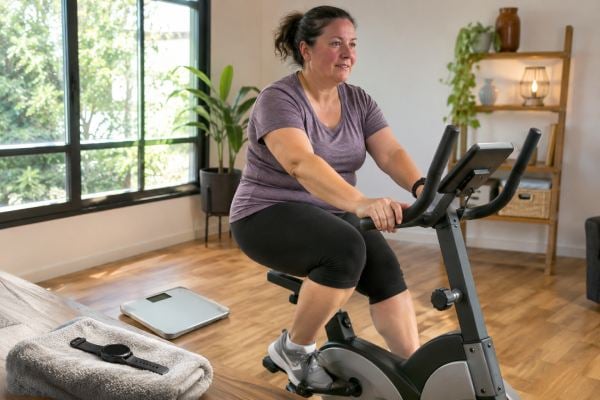
Cardiorespiratory fitness and body weight both matter for heart risk, but fitness often gives you a powerful benefit even before the scale changes. Large studies consistently show that people with higher cardiorespiratory fitness have lower risks of cardiovascular disease and premature death across different body sizes. Weight loss can also improve blood pressure, blood sugar, triglycerides, sleep apnea, and other risk factors, particularly when someone has excess body fat. The important point is that these are not competing goals. You do not need to wait for weight loss before improving your heart health, and becoming fitter does not make every weight-related risk disappear. If weight loss is appropriate for you, a modest reduction of roughly 5% to 10% of body weight can produce meaningful metabolic improvements. But if the scale is slow to move, improving walking pace, exercise capacity, strength, and weekly activity still counts. For most people, the best strategy is to train fitness now and pursue sustainable weight loss only if it adds health benefit.
Table of Contents
- Which matters more: fitness or weight loss?
- Why cardiorespiratory fitness is such a strong risk marker
- What weight loss can improve for the heart
- Can you be fit at a higher weight?
- How to decide what to prioritize first
- A practical plan to improve fitness with or without weight loss
- How to measure progress beyond the scale
Which matters more: fitness or weight loss?
If you force the question into a single choice, improving cardiorespiratory fitness is often the better first action because it can lower risk whether or not weight changes. Fitness is strongly associated with lower cardiovascular and all-cause mortality, and it improves with regular aerobic activity over weeks to months.
Weight loss matters too, especially when excess body fat is contributing to high blood pressure, insulin resistance, high triglycerides, fatty liver disease, sleep apnea, or limited mobility. But weight loss is not required to start receiving benefits from exercise. In fact, a person can improve blood pressure, glucose control, fitness, mood, sleep, and physical function while losing little or no weight.
This is useful because the scale is influenced by many things besides fat loss: water, glycogen, bowel contents, menstrual-cycle changes, and muscle gain. If exercise is judged only by body weight, real cardiovascular progress can be missed.
A better framework is to treat fitness as a behavior-linked target and weight as one possible outcome or secondary target. You can directly control whether you walk, cycle, swim, or train this week. You cannot directly control exactly how many pounds the scale drops.
For someone with obesity-related health problems, sustainable weight loss can add important benefit. For someone at a stable weight with good metabolic health but low fitness, training capacity may be the more valuable focus. Many people benefit from doing both without making weight loss a prerequisite for movement.
If you want to understand the broader effects of body-weight change, weight loss can improve some heart-risk factors quickly while others take longer.
Why cardiorespiratory fitness is such a strong risk marker
Cardiorespiratory fitness describes how well your heart, lungs, blood vessels, and muscles work together to deliver and use oxygen during sustained activity. VO2 max is the best-known laboratory measure, but fitness can also be estimated from exercise tests and some wearable devices.
A 2024 overview of meta-analyses representing more than 20 million observations found that high cardiorespiratory fitness was strongly and consistently associated with lower risks of cardiovascular disease and death. Across the included evidence, each increase of 1 metabolic equivalent, or MET, in fitness was linked with a meaningful reduction in mortality risk.
That does not mean fitness is a magic shield. Observational studies can be influenced by underlying health, genetics, smoking, diet, and access to exercise. But the association is unusually consistent, and randomized exercise trials show that fitness can be improved through training.
Fitness matters because it reflects several physiological systems at once. Regular aerobic training can increase stroke volume, improve blood-vessel function, increase mitochondrial capacity in muscle, improve insulin sensitivity, and reduce the effort required for everyday tasks. The same staircase that once pushed you close to your limit may become a mild challenge after months of training.
Higher fitness also gives you more reserve during illness, surgery, heat, physical work, and aging. It is therefore both a marker of current health and a practical capacity that can be trained.
The good news is that the largest relative benefits often occur when someone moves from very low fitness to a moderately fit range. You do not need elite endurance performance. Brisk walking, cycling, swimming, and similar activities can build meaningful capacity. If you want to train that specifically, VO2 max explains what cardiorespiratory fitness measures and how to improve it safely.
Fitness and physical activity are related but not identical. Activity is what you do; fitness is one adaptation that develops from repeated activity along with genetics, age, health status, and training history. Two people can complete the same walking program and improve by different amounts. This is another reason to compare yourself with your own baseline rather than with someone else’s pace or wearable score.
Everyday movement also matters even when it is not intense enough to produce a large VO2 max change. Walking to errands, taking stairs, standing up regularly, gardening, and doing household work reduce sedentary time and increase total energy expenditure. A formal workout can improve fitness, while a more active day helps you accumulate cardiovascular benefit outside the workout. The strongest long-term routine usually includes both: planned exercise plus less sitting. If you work at a desk, brief walking breaks every hour can increase daily movement without adding another formal workout. Those minutes are especially useful on days when a longer session is not possible, and they can help make an active routine feel normal rather than exceptional across the entire busy week.
What weight loss can improve for the heart
Weight loss can improve several cardiovascular risk factors when a person has excess adiposity. The benefits are not limited to the number on the scale. Losing visceral and liver fat can improve insulin sensitivity, triglycerides, blood pressure, and glucose regulation.
A modest loss of about 5% of starting body weight can be enough to produce measurable metabolic change. Larger losses may provide additional benefit, particularly for blood pressure, diabetes control, sleep apnea, and mobility, although the ideal goal varies by person.
Weight loss can also reduce the workload associated with movement. Walking, climbing stairs, and exercising may feel easier after losing weight, which can make it easier to accumulate more activity. That creates a positive cycle: movement gets easier, fitness improves, and daily energy expenditure can increase.
However, weight loss is not automatically equivalent to better cardiovascular health. Losing weight through smoking, severe illness, dehydration, or an extreme diet is not a health goal. A good weight-loss plan should preserve muscle, provide adequate nutrition, and improve or maintain the rest of the risk profile.
Long-term maintenance is another consideration. A 2023 systematic review found that cardiometabolic improvements from behavioral weight-management programs can persist for years, although benefits tend to diminish as weight is regained. That is a reason to focus on sustainable routines rather than rapid loss.
Also remember that BMI is an imperfect proxy for body fat and fat distribution. Waist circumference, blood pressure, glucose, lipids, fitness, and medical history provide important information that BMI alone cannot. A muscular person and a sedentary person can have the same BMI but very different risk profiles.
If blood pressure is one reason you are considering weight loss, even modest weight loss can lower blood pressure in many people, though the exact response varies.
Can you be fit at a higher weight?
Yes. Fitness and body size are related, but they are not the same thing. Some people in larger bodies have good cardiorespiratory fitness, while some people at a “normal” BMI have very low fitness and high cardiometabolic risk.
A recent systematic review and meta-analysis examined cardiorespiratory fitness, BMI, and mortality together. People classified as fit had much lower mortality risk than unfit people across BMI categories, and fit participants with overweight or obesity often had risk estimates closer to fit normal-weight participants than to unfit people of the same BMI.
That finding is important, but it is easy to overinterpret. It does not prove that excess adiposity is harmless if you exercise. Obesity can still contribute to hypertension, diabetes, sleep apnea, atrial fibrillation, osteoarthritis, and other conditions. The studies also classify “fit” and “unfit” using thresholds that differ across research populations.
The safer conclusion is that low fitness is an important and modifiable risk factor regardless of body size. If you are at a higher weight, improving fitness is valuable even before weight loss occurs. If you are lean, low body weight does not excuse inactivity.
This also explains why two people with the same BMI can have very different exercise capacity and risk. One may regularly walk, cycle, or train and have good blood pressure and glucose. The other may be sedentary, lose muscle with age, and become breathless with ordinary activity.
Fitness should therefore be treated as its own vital sign rather than as something inferred from appearance. Your ability to sustain activity, recover from effort, and improve over time tells you information the scale cannot.
How to decide what to prioritize first
Start with the problem you are actually trying to solve. If you get winded walking up one flight of stairs, low fitness is an immediate functional target. If your blood pressure, glucose, triglycerides, or sleep apnea are strongly linked to excess weight, gradual weight loss may deserve equal priority.
For many people, the best first priority is to build activity without waiting for a calorie deficit. This reduces the feeling that exercise is simply a tool to “burn off” food and makes training more sustainable. Once a walking or exercise routine is established, nutrition changes can be added without trying to overhaul everything at once.
Consider fitness first when:
- You are currently sedentary or easily winded.
- Your weight has been stable but your activity level is low.
- Previous weight-loss attempts led to repeated regain or loss of muscle.
- You need a goal that is not dependent on the scale.
Consider deliberate weight loss alongside fitness when:
- You have overweight or obesity plus hypertension, prediabetes, type 2 diabetes, high triglycerides, fatty liver disease, or sleep apnea.
- Excess weight limits mobility or makes exercise substantially harder.
- Your clinician has identified weight reduction as part of treatment for a medical condition.
The two goals should reinforce each other. Resistance training can help preserve muscle during weight loss, while aerobic training improves fitness. Adequate protein, fiber-rich foods, and a modest calorie deficit are generally easier to sustain than aggressive restriction.
If you are uncertain how hard to train, target heart rate zones can provide a rough starting point, although medication and individual fitness can make perceived exertion more useful than a formula.
A practical plan to improve fitness with or without weight loss
Begin with a baseline you can repeat. Choose a familiar walk, cycle route, or treadmill session and record the duration, distance, pace, and how hard it feels. Do not turn it into an all-out test if you are not used to exercise.
For the first two weeks, aim for consistency. Try 20 to 30 minutes of moderate aerobic activity on 4 or 5 days per week, or divide it into shorter bouts. If that is too much, start with 10 minutes. If it is easy, extend one or two sessions rather than making every session intense.
During weeks 3 and 4, add or stabilize two strength sessions. Train the major muscle groups with movements such as sit-to-stands or squats, rows, presses, hip hinges, calf raises, and core exercises. Strength work helps maintain lean mass whether or not you are losing weight.
During weeks 5 through 8, gradually increase aerobic volume toward at least 150 minutes per week. You can keep most sessions at a comfortable moderate intensity. If you enjoy intervals and have no medical reason to avoid them, one shorter session with brief harder efforts can provide variety.
| Goal | Fitness-focused approach | Fitness plus weight-loss approach |
|---|---|---|
| Aerobic exercise | 150+ minutes per week, progress by pace or duration | Same target; use extra walking to support energy balance |
| Strength | 2–3 sessions per week | 2–3 sessions per week to preserve muscle |
| Nutrition | Heart-healthy maintenance intake | Heart-healthy pattern with a modest calorie deficit |
| Primary metric | Pace, duration, recovery, fitness estimate | Fitness metrics plus weight or waist trend |
| Success | Better capacity even at stable weight | Better capacity plus sustainable fat loss |
If walking is your main exercise, gradually increasing pace is often more useful than chasing very high step counts immediately. a brisk walking plan can improve cardiovascular fitness without specialized equipment.
For weight loss, keep the calorie deficit moderate enough that workouts remain productive and hunger is manageable. Rapid loss can increase fatigue and lean-mass loss. A slower pace paired with strength training is often easier to maintain.
How to measure progress beyond the scale
Use several measures so one noisy number does not define success. Resting blood pressure, waist circumference, blood lipids, glucose or A1C when relevant, and fitness all provide different information.
For fitness, repeat the same submaximal route or workout every 4 to 8 weeks. If you cover the distance faster at the same effort, go farther in the same time, or finish with a lower heart rate and easier breathing, your fitness is improving. Some wearables also estimate VO2 max, but use those values mainly for trends because individual accuracy can be limited.
For weight, look at the trend rather than a single morning. Daily fluctuations of several pounds can occur from water and glycogen. A weekly average is more informative. Waist circumference can provide an additional clue about central fat loss.
For blood pressure, use a validated upper-arm monitor and average multiple resting readings. For cholesterol and glucose, follow your clinician’s recommended testing interval rather than checking too frequently.
Most importantly, notice whether your life is becoming physically easier. Can you carry groceries, climb stairs, walk farther, travel, or play with children or grandchildren with less fatigue? Those outcomes matter for long-term independence as well as heart health.
If your weight does not change but your fitness rises, blood pressure falls, and glucose improves, the program is working. If you lose weight but become weaker, exhausted, and less active, the strategy needs adjustment.
The best heart-risk plan is therefore not “fitness instead of weight loss” or “weight loss instead of fitness.” Build cardiorespiratory fitness because it is valuable at any body size. Add sustainable weight loss when excess body fat is contributing to medical risk. Treat both as long-term health tools rather than as a competition between the treadmill and the scale.
References
– Cardiorespiratory fitness, body mass index and mortality: a systematic review and meta-analysis 2025. Systematic review and meta-analysis. – Cardiorespiratory fitness is a strong and consistent predictor of morbidity and mortality among adults: an overview of meta-analyses representing over 20.9 million observations from 199 unique cohort studies 2024. Overview of meta-analyses. – Long-Term Effect of Weight Regain Following Behavioral Weight Management Programs on Cardiometabolic Disease Incidence and Risk: Systematic Review and Meta-Analysis 2023. Systematic review and meta-analysis. – Effects of weight control interventions on cardiovascular outcomes: an umbrella review of systematic reviews and meta-analyses 2025. Umbrella review.
Disclaimer
This article provides general education about fitness, weight, and cardiovascular risk and is not a personalized exercise or weight-management prescription. People with known heart disease, uncontrolled blood pressure, severe exercise symptoms, major mobility limitations, or complex medical conditions should ask a healthcare professional how to begin safely. Weight loss is not appropriate for everyone, and medications should not be changed based on exercise or weight changes without medical guidance.