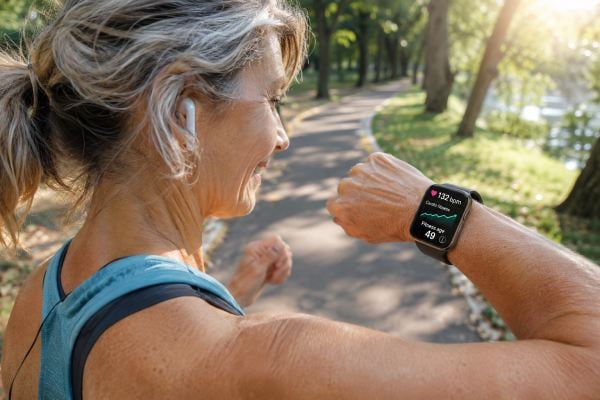
Cardio fitness age is a simplified way some wearables translate your estimated cardiorespiratory fitness into an age-like score. In general, the device estimates aerobic capacity—often VO2 max or a related fitness value—from heart rate, pace, movement, and personal information, then compares that estimate with reference data or a proprietary model. A “fitness age” younger than your chronological age usually means your estimated fitness is better than expected for your age group; an older fitness age suggests lower estimated fitness. It is not a literal measure of biological age, and different brands can produce different numbers because algorithms, required activities, and reference populations differ. Wearable VO2 max estimates can be useful for tracking trends, but individual error can be substantial compared with laboratory testing. The best way to use fitness age is therefore as a directional metric: train consistently, watch the trend over several weeks or months, and pay more attention to your actual exercise capacity than to a single score. Regular aerobic training, occasional higher-intensity work, and strength training can all help.
Table of Contents
- What cardio fitness age actually means
- How wearables estimate cardiorespiratory fitness
- How accurate are wearable VO2 max estimates?
- Why your fitness age can change suddenly
- How to improve cardio fitness age
- A practical 8-week fitness plan
- When to trust the trend and when to get a lab test
What cardio fitness age actually means
Cardio fitness age is a communication tool, not a standard medical measurement. The underlying concept is cardiorespiratory fitness: how effectively your cardiovascular and respiratory systems deliver oxygen to working muscles and how well those muscles use it.
VO2 max is the most common measure. It is usually expressed as milliliters of oxygen per kilogram of body weight per minute. In a laboratory, VO2 max is measured during a progressively harder exercise test while you breathe through equipment that analyzes oxygen and carbon dioxide.
Wearables generally do not measure oxygen consumption directly. Instead, they estimate it from signals they can collect, such as heart rate, speed, distance, elevation, and movement. Some devices then compare the estimate with age- and sex-based reference values or apply a proprietary formula to create a “fitness age.”
Because there is no universal formula, a fitness age of 42 on one device is not guaranteed to mean the same thing as 42 on another. Even software updates can change the result if the manufacturer changes its algorithm.
The number is therefore best interpreted as a prompt: is your aerobic capacity improving, stable, or declining? If your device shows a younger fitness age over several months while your walking or running pace improves at the same effort, that is more convincing than a one-day change in the score.
Cardiorespiratory fitness itself is clinically meaningful. Large evidence reviews consistently link higher fitness with lower risks of cardiovascular disease and premature death. If you want to understand the underlying metric rather than the age label, VO2 max explains what aerobic capacity measures and why it matters.
How wearables estimate cardiorespiratory fitness
Most consumer wearables estimate aerobic fitness during or after activities where heart rate can be paired with external workload. Outdoor walking and running are common because GPS can estimate speed and distance while the optical heart-rate sensor tracks cardiovascular response.
The basic idea is intuitive: if two people move at the same pace but one requires a much higher heart rate, their estimated aerobic fitness may differ. Likewise, if you can run faster at the same heart rate after several months of training, the algorithm may interpret that as improved fitness.
The actual models are more complex. Depending on the device, they may consider age, sex, body size, resting heart rate, heart-rate response during exercise, pace, elevation, and the consistency or quality of recorded data. Some manufacturers require several qualifying workouts before updating the estimate.
This is why your watch may not update after every gym session. Indoor cycling without a power meter gives the device less information about external workload than GPS running. Strength training is excellent for health, but it is usually not a good activity for estimating VO2 max because heart rate and workload do not have the same steady relationship as in continuous aerobic exercise.
Environmental conditions can also complicate the estimate. Heat, humidity, hills, altitude, fatigue, dehydration, and poor sleep can raise heart rate at a given pace. The device may interpret some of that as lower fitness unless its model accounts for the condition.
Medications matter too. Beta blockers can blunt heart-rate response during exercise. If an algorithm expects heart rate to rise normally with workload, the estimate may be less reliable. Do not change medication to improve a wearable score.
For training intensity, target heart rate zones can be a rough guide, but perceived exertion and the talk test may be more useful when medications or individual physiology alter heart-rate response.
How accurate are wearable VO2 max estimates?
Wearable estimates can be reasonably useful at the group level and still be wrong for a specific person. That distinction is important.
A 2022 systematic review and meta-analysis from the INTERLIVE network evaluated consumer wearable estimates of VO2 max. Exercise-based estimates showed relatively small average bias across groups, but the limits of agreement were wide enough that an individual estimate could differ meaningfully from laboratory measurement.
A 2024 umbrella review of wearable validation studies reached a similar conclusion: accuracy varies by device, metric, activity, and user context. For aerobic capacity, wearable estimates showed substantial error, and only a minority of commercial devices had been independently validated for even one health metric.
Individual validation studies also show this problem. A 2024 study comparing Apple Watch Series 7 estimates with laboratory VO2 max testing in 19 adults found a mean absolute percentage error of about 16% and poor reliability by one statistical measure. That small study should not be generalized to every device or user, but it illustrates why a wearable value should not be treated as a lab result.
Newer research continues to find mixed performance. A 2025 systematic review of wearable VO2 max and lactate-threshold estimates found that some devices and protocols showed acceptable validity while others did not. Accuracy may improve after multiple qualifying workouts, but that depends on the device and algorithm.
For everyday use, the trend is usually more valuable than the absolute number. If your watch consistently estimates 38 mL/kg/min and later estimates 42 under similar conditions while your real-world performance improves, the direction is probably informative even if the true laboratory value is 40 rather than 42.
Avoid comparing scores across brands as if they came from the same instrument. A change from one watch to another can create an apparent fitness gain or loss that is really an algorithm change.
The same caution applies to online “fitness age calculators.” Some use resting heart rate, waist circumference, activity level, or self-reported exercise instead of measured performance. They can be useful for motivation, but they are not interchangeable with a wearable VO2 max estimate or a laboratory test. Before comparing numbers, check what inputs each method actually uses. A score that changes because you updated your body weight is fundamentally different from one that changes because your pace improved at the same heart rate during repeated comparable workouts outdoors over time.
Why your fitness age can change suddenly
True cardiorespiratory fitness usually changes over weeks, not overnight. If your fitness age moves dramatically after one workout, look for measurement or context changes before assuming your physiology transformed.
Common causes include a new device, software update, different wrist fit, poor heart-rate sensor contact, unusual heat, altitude, dehydration, illness, poor sleep, or a route with more hills than usual. An inaccurate body weight in the app can also affect a VO2 max expressed relative to kilograms of body mass.
Training fatigue can temporarily lower performance. After a hard week, heart rate may be higher at a familiar pace and your wearable may reduce its estimate. That does not necessarily mean you lost fitness. Recovery can restore the previous pattern.
The opposite can happen after a cool, flat, well-rested run. You may move faster at a lower heart rate and receive a sudden increase in estimated fitness. Treat that as one data point until it is repeated.
Weight loss can change relative VO2 max even if absolute oxygen-processing capacity changes less, because the value is divided by body mass. This can make the wearable score improve as body weight falls. That is mathematically valid, but it is not the same as the heart and muscles gaining all of the improvement through training.
Use a simple quality-control checklist before reacting to a change:
- Was the workout type one the device uses for fitness estimation?
- Was heart-rate data complete and believable?
- Was the route or workload similar to previous sessions?
- Were heat, altitude, illness, or dehydration different?
- Did your body weight or device settings change?
- Does the new score persist across several workouts?
A stable 4- to 8-week trend is much more useful than daily fluctuations. The same principle applies to resting heart rate and blood pressure: context and repeated measurement matter.
How to improve cardio fitness age
To improve the score, improve the underlying fitness. The core ingredients are enough aerobic volume, progressive overload, recovery, and consistency.
Start with moderate aerobic training. Brisk walking, easy jogging, cycling, swimming, rowing, and elliptical training can all build aerobic capacity. For many adults, at least 150 minutes per week of moderate activity is a useful target. If you are currently inactive, begin with much less and build gradually.
Steady moderate sessions create the base. You should be breathing faster but still able to speak in short sentences. This intensity is sustainable enough to accumulate meaningful weekly minutes without excessive fatigue. Zone 2 cardio is one structured way to think about this type of training, although exact zone definitions vary.
Once you have a base, higher-intensity intervals can improve VO2 max efficiently. A 2024 umbrella review found that high-intensity interval training improves cardiorespiratory fitness across adult populations. Intervals do not have to be maximal sprints. For example, you might alternate 1 to 4 minutes of hard but controlled effort with easier recovery.
Strength training is also useful, even though it may not directly drive the wearable estimate. Two full-body sessions per week support muscle, power, insulin sensitivity, and injury resistance. Stronger legs can make walking, running, and climbing easier and help you tolerate more aerobic training.
Recovery is part of the program. Fitness improves when the body adapts between sessions. Too much hard training can increase fatigue, disrupt sleep, and make performance decline. Keep most sessions easy to moderate and limit truly hard days.
If walking is your main activity, walking faster or farther over time can improve cardiovascular fitness. You do not need to become a runner to improve a fitness-age trend.
A practical 8-week fitness plan
The plan below is a general example for an adult who is already able to walk briskly for about 20 minutes without concerning symptoms. Adjust it downward if you are less active or have medical limitations.
| Weeks | Aerobic training | Strength | Main goal |
|---|---|---|---|
| 1–2 | 4 × 20–30 min moderate sessions | 2 light full-body sessions | Build consistency |
| 3–4 | 4 × 30 min, with one session slightly longer | 2 full-body sessions | Increase weekly volume |
| 5–6 | 3 moderate sessions plus 1 controlled interval session | 2 full-body sessions | Add an intensity stimulus |
| 7–8 | 3 moderate sessions, 1 interval session, optional easy recovery walk | 2 full-body sessions | Consolidate and retest |
For the interval session, warm up for at least 10 minutes. Then perform 4 to 6 harder efforts lasting about 1 to 3 minutes, separated by enough easy movement to regain control of breathing. Finish with a cooldown. The hard portions should feel challenging but not like an all-out sprint.
Progress by changing one variable at a time. Add 5 to 10 minutes to a session before adding another hard day. If you increase interval intensity, keep the rest of the week easy. This reduces injury risk and makes it easier to identify what your body tolerates.
Use the same wearable and, when possible, similar routes for trend tracking. A flat outdoor walk or run in comparable conditions is more useful for comparing estimates than switching between treadmill, trail, cycling, and different devices every week.
At the end of 8 weeks, compare more than fitness age. Look at pace at a familiar heart rate, time to complete a route, perceived exertion, heart-rate recovery, and how you feel climbing stairs. If several measures improve, your aerobic fitness probably improved even if the wearable score changed only modestly.
For people who want to combine lifting and aerobic training more deliberately, a weekly Zone 2 and strength schedule can help balance volume and recovery.
When to trust the trend and when to get a lab test
For general wellness, a wearable trend is often enough. If your estimate rises gradually and your real-world exercise performance improves, you do not need laboratory testing simply to confirm that training is working.
A formal cardiopulmonary exercise test can be useful when precision matters. Athletes may use it to set training zones. Clinicians may use it to investigate unexplained exercise intolerance, shortness of breath, or complex heart or lung disease. It directly measures respiratory gases during graded exercise and can provide information that a consumer watch cannot.
Do not use fitness age to diagnose disease. A suddenly “older” fitness age does not prove heart disease, and a “younger” score does not rule it out. Symptoms always take priority over the app.
Seek medical evaluation for chest pressure, fainting, severe or unusual shortness of breath, a sustained abnormal heart rhythm, or a major unexplained decline in exercise capacity. If you have known cardiovascular disease, uncontrolled hypertension, or significant lung disease, ask a healthcare professional before adding vigorous intervals.
Also remember that aging itself changes reference values. VO2 max tends to decline with age, so maintaining a stable fitness level can be a meaningful achievement. The goal is not to force a device to display the youngest possible age. It is to preserve enough aerobic capacity for health, independence, and the activities you value.
The most useful mindset is to treat fitness age as a dashboard light, not a verdict. Keep the device consistent, collect enough qualifying workouts, train progressively, and evaluate the trend alongside actual performance. If your watch says your fitness age improved but you are also walking faster, recovering better, and feeling stronger, the number is supporting a real change rather than creating one.
References
– Validity of Estimating the Maximal Oxygen Consumption by Consumer Wearables: A Systematic Review with Meta-analysis and Expert Statement of the INTERLIVE Network 2022. Systematic review and meta-analysis. – Keeping Pace with Wearables: A Living Umbrella Review of Systematic Reviews Evaluating the Accuracy of Consumer Wearable Technologies in Health Measurement 2024. Umbrella review. – Accuracy of wearables for determining the maximal oxygen uptake and lactate threshold: a qualitative systematic review 2025. Systematic review. – Assessing the Accuracy of Smartwatch-Based Estimation of Maximum Oxygen Uptake Using the Apple Watch Series 7: Validation Study 2024. Validation study. – High-intensity interval training and cardiorespiratory fitness in adults: An umbrella review of systematic reviews and meta-analyses 2024. Umbrella review. – Cardiorespiratory fitness is a strong and consistent predictor of morbidity and mortality among adults: an overview of meta-analyses representing over 20.9 million observations from 199 unique cohort studies 2024. Overview of meta-analyses.
Disclaimer
This article provides general information about wearable fitness estimates and exercise training and is not a medical diagnosis or individualized training prescription. People with known heart or lung disease, uncontrolled blood pressure, concerning exercise symptoms, or major functional limitations should ask a qualified healthcare professional how to train safely. Do not change medication or ignore symptoms because a wearable reports a favorable fitness age.