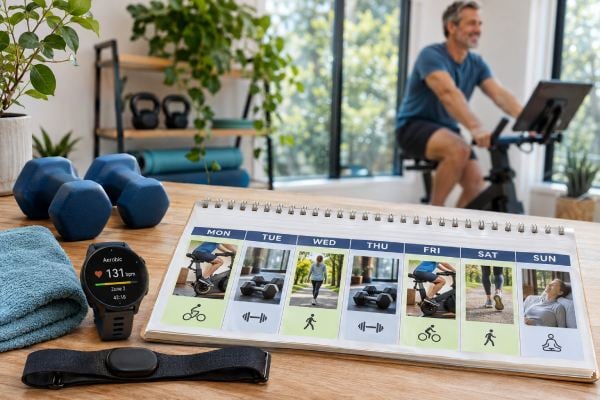
You can combine Zone 2 cardio and strength training in the same week without choosing one over the other. For general heart health, a practical target is 3 to 5 moderate aerobic sessions plus at least 2 strength sessions each week, adjusted to your fitness, schedule, and medical needs. The simplest version is to alternate cardio and lifting days, keep most cardio comfortably moderate, and leave at least one easier day each week.
Zone 2 is useful because it lets you accumulate aerobic volume without the fatigue of repeated hard intervals. Strength training adds benefits that steady cardio does not fully provide, including muscle, bone strength, glucose control, and functional capacity. Research on combined training also shows meaningful improvements in blood pressure and other cardiovascular risk factors.
You do not need a perfectly calculated heart-rate zone or an athlete-style program. Use the talk test, build volume gradually, and organize the week so that both types of training remain repeatable rather than constantly competing for recovery.
Table of Contents
- What Zone 2 and Strength Training Each Do
- A Simple Weekly Heart-Healthy Schedule
- How Much Zone 2 Cardio to Do
- How Much Strength Training to Do
- Can You Do Zone 2 and Strength on the Same Day?
- How to Progress Without Overtraining
- Safety, Medications, and When to Adjust the Plan
What Zone 2 and Strength Training Each Do
Zone 2 and strength training overlap in their cardiovascular benefits, but they create different adaptations. That is why combining them is usually more useful than relying on only one style of exercise.
Zone 2 cardio is commonly described as steady aerobic work performed just below the first ventilatory or lactate threshold. In everyday language, it is a pace that feels purposeful but sustainable. You are breathing more deeply than at rest, yet you can usually speak in full or nearly full sentences. Brisk walking, cycling, easy jogging, rowing, swimming, and elliptical training can all fit.
Experts do not use one universal definition of “Zone 2,” and heart-rate formulas can differ substantially. For heart health, the exact label matters less than consistently accumulating moderate aerobic work. If you want a deeper explanation of the intensity concept, see Zone 2 cardio for heart health.
Strength training challenges muscles against resistance. It helps maintain or build lean mass, improves glucose handling, strengthens bones and connective tissues, and can lower resting blood pressure. A full-body program can include squats or sit-to-stands, hinges, rows, presses, step-ups, carries, and core work.
Combined exercise is well supported. Systematic reviews in people with hypertension show that programs combining aerobic and resistance work can lower both systolic and diastolic blood pressure. Other evidence shows combined training can improve lipids, fitness, and metabolic health.
The goal is not to maximize two sports at once. For cardiovascular health, the goal is to get enough of each stimulus while preserving recovery and long-term consistency.
A Simple Weekly Heart-Healthy Schedule
For many adults, this is a balanced starting template:
| Day | Main session | Example |
|---|---|---|
| Monday | Strength | Full-body lifting, 35–50 minutes |
| Tuesday | Zone 2 | 30–45 minutes brisk walking or cycling |
| Wednesday | Easy movement | 20–30 minutes walking, mobility, or rest |
| Thursday | Strength | Full-body lifting, 35–50 minutes |
| Friday | Zone 2 | 30–45 minutes steady cardio |
| Saturday | Longer Zone 2 | 45–75 minutes easy cycling, hiking, or walking |
| Sunday | Rest or easy activity | Comfortable walk, stretching, or full rest |
This schedule gives you three aerobic sessions and two strength sessions while leaving space for recovery. Depending on session length, it can reach or approach the widely recommended target of at least 150 minutes of moderate aerobic activity per week.
If your schedule is tighter, you can use a four-day version:
- Monday: full-body strength plus 15–20 minutes easy cardio.
- Wednesday: 40–50 minutes Zone 2.
- Friday: full-body strength plus 15–20 minutes easy cardio.
- Sunday: 60 minutes Zone 2.
The total pattern matters more than whether your week matches a particular calendar. Shift days as needed while avoiding several hard sessions in a row.
You can also match the template to your current level. A beginner might use two 25-minute Zone 2 sessions, one 40-minute session, and two short full-body strength days. Someone already active might use four Zone 2 sessions totaling 180 to 220 minutes with two or three strength sessions. An older adult may prefer shorter sessions spread more frequently across the week to reduce soreness and maintain balance and mobility work.
The schedule should also fit your life. If weekends are busy, place the longer cardio session midweek. If workdays are unpredictable, protect two strength appointments and accumulate the rest of your aerobic minutes with walking, cycling for transportation, or shorter sessions. Cardiovascular guidelines count accumulated activity; a 20-minute morning walk and a 20-minute evening ride can both contribute to the weekly total.
What matters most is that the plan survives ordinary weeks, not only ideal ones.
If you are new to aerobic training, a beginner Zone 2 training plan may be more appropriate than starting with long sessions immediately.
How Much Zone 2 Cardio to Do
General cardiovascular guidance recommends at least 150 minutes of moderate-intensity aerobic activity per week, or 75 minutes of vigorous activity, or a combination. Zone 2 is one practical way to accumulate much of the moderate-intensity portion.
For a beginner, 90 to 120 minutes per week may be a useful first step if 150 feels unrealistic. You can build toward 150 minutes gradually. More active people may benefit from 200 to 300 minutes per week, especially when the intensity remains moderate and recovery is good.
A simple progression is:
- Weeks 1–2: 3 sessions of 20–30 minutes.
- Weeks 3–4: 3 sessions of 30–35 minutes.
- Weeks 5–8: 3 to 4 sessions totaling about 120–150 minutes.
- After week 8: maintain 150 minutes or add time gradually if you enjoy it and recover well.
Use the talk test before chasing a heart-rate number
For most people, Zone 2 should feel steady and controlled. You should be able to talk in sentences without gasping. If conversation is easy enough that the activity feels like a stroll, you may be below your useful training range. If you can only say a few words, you are probably working above moderate intensity.
Heart-rate zones can help, but formulas based on age are estimates. Fitness level, temperature, dehydration, stress, caffeine, and medications can all change your heart rate. Beta blockers are especially important because they blunt heart-rate response to exercise.
If you want to use heart rate as an additional guide, learn how to interpret target heart rate by age, but pair the number with how the effort actually feels.
Do all cardio sessions need to be Zone 2?
No. Zone 2 can make up most of your cardio, but some people enjoy occasional faster work. A short interval session, hill walk, sport, or vigorous class can improve fitness and variety. For general heart health, there is no requirement to perform high-intensity intervals if you dislike them or have a medical reason to avoid them.
A useful default is to keep most weekly aerobic minutes easy to moderate and add harder work only when your base fitness and recovery are solid.
If you are using Zone 2 mainly for heart health rather than endurance performance, there is no need to turn every session into a long workout. Thirty to 45 minutes is enough to build a useful weekly volume. Longer sessions can be enjoyable and effective, but they are optional. When time is limited, frequency and consistency usually matter more than having one “perfect” 90-minute session.
You can also rotate modalities to reduce overuse. For example, walk one day, cycle another, and use an elliptical or swim on the third. The cardiovascular system still receives an aerobic stimulus, while your joints and muscles experience different loading patterns.
How Much Strength Training to Do
At least two strength-training days per week is a strong baseline for cardiovascular and overall health. Two well-designed full-body sessions are enough for many adults, particularly when the main goal is health rather than maximizing muscle size or strength.
A simple session can include:
- A squat or sit-to-stand pattern.
- A hip hinge or bridge.
- A horizontal pull such as a row.
- A push such as a chest press or push-up.
- A step-up or split-squat pattern.
- A shoulder or vertical pull movement if appropriate.
- A carry or core exercise.
Beginners can often start with one to two sets of 8 to 15 controlled repetitions per exercise. Use a resistance that feels challenging near the end of the set but does not require breath-holding or maximal effort. As technique improves, gradually add resistance, repetitions, or an additional set.
For heart health, there is little reason to test one-repetition maximums frequently. Moderate, repeatable strength work can improve blood pressure and metabolic health while producing less fatigue and lower injury risk.
A more detailed guide to strength training for blood pressure and heart health can help with exercise selection and technique.
Do you need a third lifting day?
Not necessarily. A third day can be useful if you enjoy lifting, want more strength or muscle, or prefer shorter sessions. But adding a third lifting day means you may need to reduce cardio volume or organize the week more carefully.
For example, a three-day strength schedule could be Monday, Wednesday, and Friday, with Zone 2 on Tuesday, Thursday, and Saturday. Keep at least one day easy. If your legs feel constantly heavy or your Zone 2 pace starts drifting downward at the same effort, total training load may be too high.
Can You Do Zone 2 and Strength on the Same Day?
Yes. For general heart health, combining them on the same day is often practical and does not automatically “cancel out” strength gains. Concerns about the so-called interference effect are more relevant when athletes perform large volumes of endurance training while also trying to maximize strength, power, or muscle growth.
A 2026 umbrella review of concurrent training research found that the effects of combining endurance and resistance work depend on variables such as training volume, intensity, modality, and goals. For most recreational exercisers, the benefit of getting both types of training usually outweighs small optimization concerns.
If you do both in one session, choose the order based on priority:
- Strength first if maintaining or improving lifting performance matters most.
- Zone 2 first if aerobic training is your main priority and the cardio session is easy.
- Separate them by several hours if you want better quality in both and your schedule allows.
For heart health, a common solution is strength first followed by 15 to 30 minutes of easy Zone 2 cardio. Because Zone 2 is not highly taxing, it usually pairs better with lifting than hard intervals do.
If the same-day combination leaves you too tired to lift with good form or makes your cardio feel unusually difficult, shorten the second session rather than forcing it. Another option is to keep combined days for upper-body strength and cardio, then give lower-body lifting its own day. Small scheduling changes can preserve training quality without reducing the overall weekly dose.
Fueling matters more as sessions get longer. Most recreational workouts under about an hour do not require special sports products, but arriving dehydrated or underfed can make heart rate drift upward and perceived effort feel harder. Water and normal meals are usually enough for moderate sessions.
Avoid turning the post-lifting cardio into an unplanned race. After a demanding leg session, your heart rate may be higher at a slower pace, so use perceived effort and the talk test rather than forcing the usual speed.
How to Progress Without Overtraining
The most common mistake is increasing cardio duration, strength volume, and intensity at the same time. Progress one variable at a time.
A good sequence is:
- Establish the weekly frequency.
- Build Zone 2 duration toward your target.
- Improve strength technique and consistency.
- Add load to lifting gradually.
- Only then consider more cardio volume or occasional higher-intensity work.
Signs that training load may be too high include persistent fatigue, unusually poor sleep, loss of motivation, declining performance, excessive soreness, repeated minor injuries, or a resting heart rate that remains noticeably above your normal baseline for several days.
Your normal resting pulse can also become a useful trend marker. See resting heart rate and fitness for context on what changes can and cannot tell you.
Recovery does not mean complete inactivity
An easy walk, gentle mobility session, or relaxed bike ride can help you stay active without adding much training stress. The important distinction is between movement and training. Not every walk needs to hit a heart-rate target.
Sleep and nutrition also affect how well concurrent training works. If you chronically sleep five hours, under-eat, or train through pain, a technically perfect schedule will still be hard to sustain.
Deload when your body asks for it
Every few weeks, or whenever fatigue accumulates, reduce total training volume for several days. You might shorten Zone 2 sessions by 20% to 30% and perform fewer strength sets. You do not need a rigid deload calendar if your training is moderate, but planned easier periods can prevent small aches and fatigue from becoming bigger problems.
Safety, Medications, and When to Adjust the Plan
Most adults can safely combine moderate cardio and strength training, but medical conditions can change how the plan should look.
Talk with a healthcare professional before increasing intensity if you have known cardiovascular disease, unexplained chest pressure, fainting, severe shortness of breath, a significant arrhythmia, uncontrolled hypertension, or recent cardiac procedures. Cardiac rehabilitation may be more appropriate than a self-directed program after certain events.
During strength training, avoid prolonged breath-holding. Exhale through the harder part of a repetition and use loads you can control. During cardio, stop and seek medical attention for chest pain, fainting, new neurological symptoms, or severe breathlessness that is out of proportion to the effort.
Medication can alter training responses. Beta blockers may keep heart rate lower than expected. Diuretics can affect hydration and electrolytes. Insulin and some diabetes medications can change blood glucose during longer sessions. If your heart-rate zone suddenly stops matching your perceived effort after a medication change, use symptoms and clinician guidance rather than forcing a formula.
A simple monthly check can help you decide whether the mix is working. Ask whether your Zone 2 pace or power has improved at a similar effort, whether daily activities feel easier, whether strength is stable or rising, and whether blood pressure, resting heart rate, or waist circumference are moving in a favorable direction. You do not need all of these to improve at once, but the overall trend should support better health rather than chronic fatigue.
The best weekly schedule is the one that you can repeat. For many people, three Zone 2 sessions and two full-body strength sessions provide a strong cardiovascular foundation. Build toward at least 150 minutes of moderate aerobic activity, train major muscle groups twice weekly, and keep enough recovery in the plan that your next session still feels productive.
References
- What Is “Zone 2 Training”?: Experts’ Viewpoint on Definition, Training Methods, and Expected Adaptations 2025 (Review)
- Exercise characteristics and blood pressure reduction after combined aerobic and resistance training: a systematic review with meta-analysis and meta-regression. 2023 (Systematic Review)
- Differential effects of exercise training protocols on blood pressures and lipid profiles in older adults patients with hypertension: A systematic review and meta-analysis 2025 (Systematic Review)
- Maximizing Adaptations in Concurrent Training: An Umbrella Review of Meta-analyses 2026 (Systematic Review)
- Be More Active – Life’s Essential 8 Health Behavior 2025 (Position Statement)
Disclaimer
This article provides general exercise education and is not an individualized training or medical plan. People with cardiovascular disease, uncontrolled blood pressure, significant arrhythmias, recent surgery, diabetes treated with glucose-lowering medication, or other medical conditions may need specific exercise limits. Seek professional guidance if symptoms occur or if you are unsure what intensity is safe for you.