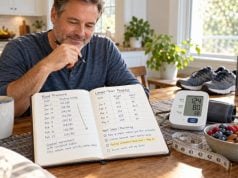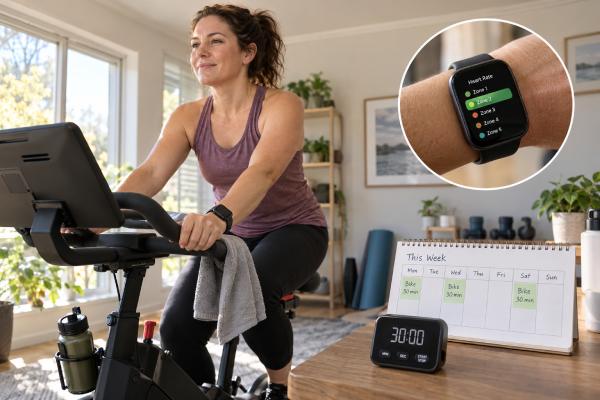
A beginner Zone 2 plan does not need long daily workouts. For most people, a practical starting point is 3 days per week for 20 to 30 minutes at an easy-to-moderate aerobic effort, then gradually building toward about 150 minutes of moderate aerobic activity per week. If you are very deconditioned, even 10 to 15 minutes at a time can be useful. The goal is to finish feeling as though you could have done a little more, not to prove how hard you can train.
Zone 2 is popular because it is sustainable, repeatable, and easy to combine with walking, cycling, strength training, and normal life. But “Zone 2” is not a perfectly standardized heart-rate number, and it is not the only intensity that improves cardiovascular fitness. A good beginner plan uses breathing, the talk test, perceived effort, and heart rate together. It also increases weekly time slowly enough that your legs, joints, and recovery can keep up with your heart and lungs.
Table of Contents
- Beginner Zone 2 Plan at a Glance
- How to Find Your Zone 2 Effort
- How Many Days per Week?
- How Long Should Each Session Be?
- An 8-Week Zone 2 Training Plan
- How to Progress Without Overdoing It
- Safety, Recovery, and When to Get Help
Beginner Zone 2 Plan at a Glance
For most healthy beginners, 3 to 4 Zone 2 sessions per week is a useful target. Start with 20 to 30 minutes of Zone 2 work per session, plus a short warm-up and cool-down. Over 6 to 10 weeks, increase total aerobic time toward roughly 120 to 150 minutes per week, and continue toward 150 minutes or more if your schedule, health, and recovery allow.
A simple progression looks like this:
- Starting point: 3 days × 20 minutes = 60 Zone 2 minutes per week.
- Early build: 3 days × 30 minutes = 90 minutes per week.
- Middle build: 4 days × 30 minutes = 120 minutes per week.
- Established routine: 4 days × 35 to 40 minutes = 140 to 160 minutes per week.
Those numbers are a framework, not a test you have to pass. Current public-health recommendations call for at least 150 minutes of moderate-intensity aerobic activity per week, or 75 minutes of vigorous activity, or an equivalent combination. More activity can provide additional benefit, but the biggest early win for an inactive person is usually becoming consistently active.
Zone 2 is only one way to accumulate moderate aerobic work. Brisk walking, easy cycling, an elliptical, rowing, swimming, or gentle uphill hiking can all work if the effort stays controlled. If walking is your easiest option, a heart-healthy walking routine can be a perfectly legitimate Zone 2 program.
Do not feel obligated to hit exactly 150 minutes of Zone 2. The weekly guideline covers moderate aerobic activity broadly, not a special physiological zone. A mix of moderate cardio, daily movement, and eventually some higher-intensity work can all contribute to cardiovascular health.
How to Find Your Zone 2 Effort
The best beginner method is to combine the talk test, perceived effort, and heart rate rather than trusting a watch-generated zone by itself.
In exercise physiology, Zone 2 is often described as work below the first lactate or ventilatory threshold. Consumer watches may instead divide heart rate into five zones using a percentage of maximum heart rate, heart-rate reserve, or a proprietary algorithm. Those methods can place the same person in different “zones,” so there is no universal Zone 2 heart rate that is correct for everyone.
For practical training, look for these signs:
- Breathing: deeper and faster than at rest, but controlled.
- Conversation: you can speak in complete sentences, although you would rather not deliver a long speech.
- Perceived effort: about 3 to 4 on a 0-to-10 effort scale for many people.
- Muscle feeling: steady work without a strong burning sensation in the legs.
- Finish: you feel exercised, but you are not wiped out.
Heart rate can add useful context. A common rough estimate for moderate work is around 50% to 70% of maximum heart rate, but individual thresholds vary. Age-based formulas such as 220 minus age are population estimates, not precise personal measurements. Fitness, temperature, dehydration, caffeine, stress, illness, medications, and the exercise mode can all change your heart rate at a given workload. A target heart-rate estimate is best treated as a starting range rather than a hard boundary.
If your watch says Zone 3 but you are breathing comfortably and speaking full sentences, the device may simply be using different zone definitions. Likewise, if the screen says Zone 2 but you are gasping and can only say a few words, slow down. Your actual effort matters more than the label.
Expect heart rate to drift during longer sessions
Your heart rate may rise gradually even when your speed or cycling power stays the same. Heat, dehydration, accumulated fatigue, and normal cardiovascular drift can all contribute. A small rise does not mean the workout suddenly failed. If breathing and perceived effort remain controlled, reduce the pace slightly and keep the session comfortable. On hot days, you may need a much slower pace than usual to produce the same internal effort.
This is also why comparing pace from one day to the next can be misleading. A well-rested morning walk in cool weather and an afternoon walk after poor sleep may produce very different heart rates. Track trends over several weeks instead of judging fitness from one workout. As you adapt, you may notice that a familiar route requires a lower heart rate, or that you can move faster at the same conversational effort. Both are useful signs of improving aerobic efficiency.
How Many Days per Week?
Three days per week is enough to begin, and four days often becomes the sweet spot once 20- to 30-minute sessions feel routine. You do not need to train every day.
Frequency matters mainly because it determines how comfortably you can accumulate weekly volume. Ninety minutes is usually easier to fit and recover from as three 30-minute sessions than as one 90-minute session. Spreading activity through the week also gives beginners repeated practice with pacing and movement technique.
There is no evidence that a specific number of Zone 2 days is uniquely best for heart health. In a small 2025 training study, two weekly sessions produced cardiorespiratory-fitness gains that were not inferior to four sessions when total training intensity and volume were matched. That does not prove two days is ideal, but it reinforces an important point: weekly work and consistency can matter more than forcing a particular schedule.
Use this guide to choose your frequency:
- 2 days per week: reasonable if you are very busy, returning after a long break, or already doing other aerobic activity. Keep sessions manageable rather than cramming the entire week into two very long workouts.
- 3 days per week: a strong starting schedule for most beginners.
- 4 days per week: useful when you want more weekly minutes without making any one session long.
- 5 days per week: can work well for people who enjoy shorter daily sessions and recover easily.
- 6 to 7 days per week: usually unnecessary for a beginner and leaves less room to notice fatigue, soreness, or overuse problems.
If you also lift weights, avoid treating cardio and strength as competing goals. Two weekly strength sessions are recommended for general health, and easy aerobic work can fit around them. A combined Zone 2 and strength schedule can help you distribute the work without stacking every hard session together.
How Long Should Each Session Be?
Begin with 20 to 30 minutes in Zone 2 if that feels comfortable. If it does not, begin with 10 to 15 minutes and build from there. You can also split activity into shorter bouts during the day.
The American Heart Association specifically notes that people returning from inactivity can start with 10 to 15 minutes at a time and build gradually. That is useful because beginners often make the mistake of choosing a duration based on what seems “optimal” rather than what they can repeat next week.
A session can be structured like this:
- Warm up for 5 to 10 minutes. Start very easy and gradually raise your breathing and heart rate.
- Hold Zone 2 for 20 to 30 minutes. Keep the effort smooth enough that you can still talk.
- Cool down for about 5 minutes. Reduce speed or resistance gradually before stopping.
If you are counting precise Zone 2 minutes, count the middle steady portion. Your warm-up and cool-down are still useful physical activity, even if your heart rate is below your target range.
Longer is not automatically better. A 2026 meta-analysis found a dose-response relationship between session duration and improvements in cardiorespiratory fitness with moderate-intensity continuous training. That supports accumulating meaningful time at a moderate effort, but it does not mean every beginner needs 50- or 60-minute sessions. Training response depends on total program dose, starting fitness, intensity, and consistency.
Once 30 minutes feels easy, you can extend one or two sessions by 5 to 10 minutes. Many recreational exercisers eventually settle around 30 to 60 minutes per session because that range is long enough to build weekly volume without taking over the day. If your main goal is general cardiovascular health rather than endurance competition, there is no requirement to perform marathon-length Zone 2 workouts.
An 8-Week Zone 2 Training Plan
This plan is designed for an adult who is currently able to walk or do another easy aerobic activity for about 20 minutes without concerning symptoms. The listed time is the Zone 2 portion; add about 5 to 10 minutes of easy warm-up and 5 minutes of cool-down as needed.
| Weeks | Days per week | Zone 2 time per session | Approximate weekly Zone 2 time | Main goal |
|---|---|---|---|---|
| 1–2 | 3 | 20 minutes | 60 minutes | Learn the effort and finish fresh |
| 3–4 | 3 | 25–30 minutes | 75–90 minutes | Build consistency before speed |
| 5–6 | 4 | 30 minutes | 120 minutes | Add frequency while keeping effort easy |
| 7–8 | 4 | 35–40 minutes | 140–160 minutes | Establish a sustainable weekly routine |
A sample week during Weeks 5 and 6 could be Monday, Wednesday, Friday, and Sunday. That gives you recovery space and makes it easier to place two strength sessions on nonconsecutive days. If four training days do not fit your life, keep three and gradually make one session longer.
If 20 minutes is too much
Start with 10 minutes at the target effort, three days per week. Add 2 to 5 minutes to one or more sessions when you finish comfortably for a full week. You can also perform two 10-minute bouts separated by several hours. Shorter activity still counts; there is no need for every useful aerobic session to last 30 continuous minutes.
If the plan feels too easy
Do not immediately turn every workout into harder cardio. First make sure you can repeat the schedule for two or three weeks without accumulating fatigue. Then add time, add a fourth day, or include a small amount of higher-intensity work if appropriate for your goals and health. Zone 2 is useful, but the evidence does not show it is uniquely superior to all other training intensities. The broader comparison of interval and steady-state cardio is more nuanced than “easy is good, hard is bad.”
How to Progress Without Overdoing It
Increase one variable at a time: first consistency, then weekly minutes, then—if useful—intensity. This prevents a common beginner error: adding days, duration, hills, and speed all in the same week.
A practical progression rule is to make small changes every one or two weeks. For example, add 5 minutes to two sessions, or add one short fourth session. You do not need to follow a rigid “10% rule”; there is no universal percentage that guarantees injury prevention. Your response matters more than an exact formula.
Signs the progression is probably manageable include normal appetite and sleep, mild soreness that resolves, stable motivation, and the ability to perform the next session at a similar effort. Back off when soreness keeps worsening, your usual easy pace suddenly feels hard for several sessions, your resting heart rate is persistently higher than usual, or fatigue begins affecting daily life.
Do not chase pace. As fitness improves, the same Zone 2 effort may eventually produce a faster walk, higher cycling power, or steeper treadmill grade at a similar heart rate. That improvement is more useful than forcing the number upward every workout. If you want context for day-to-day pulse changes, review normal heart-rate ranges during exercise rather than comparing yourself with another person’s watch data.
It also helps to rotate low-impact modes. If brisk walking irritates your feet or knees, replace one session with cycling, an elliptical, swimming, or water walking. Your cardiovascular system responds to aerobic demand even when the movement pattern changes.
Finally, keep the bigger goal in view. A large 2023 dose-response meta-analysis found substantial health benefits as inactive adults moved toward the equivalent of about 150 minutes per week of moderate-to-vigorous activity, with benefits beginning below that level. The practical lesson is not that 149 minutes fails and 150 succeeds. It is that moving from very little activity to a repeatable routine is meaningful, then additional activity can build on that foundation.
Safety, Recovery, and When to Get Help
Zone 2 is relatively low stress, but “easy” exercise is not automatically safe for every person. If you have known cardiovascular disease, significant lung disease, uncontrolled high blood pressure, recent surgery, or a condition that limits exercise, ask your clinician what intensity and progression are appropriate. Some people benefit from supervised cardiac rehabilitation rather than a self-directed plan.
Medicines can also change exercise heart rate. Beta blockers, for example, can blunt the rise in pulse, making standard heart-rate zones misleading. In that situation, the talk test and perceived effort may be more useful, and your clinician can provide individualized guidance.
Stop exercising and seek urgent medical help for symptoms such as chest pressure or pain, fainting, severe or unusual shortness of breath, or a new sustained rapid or irregular heartbeat accompanied by weakness, dizziness, or chest symptoms. Do not try to “stay in Zone 2” through warning signs.
For routine recovery, sleep, hydration, footwear, and sensible scheduling matter more than elaborate recovery products. Easy days should actually feel easy. If you strength train, you can often place Zone 2 after lifting or on separate days, depending on your priorities and tolerance. For cardiovascular health, regular strength training complements aerobic work rather than replacing it.
The most effective beginner plan is the one you can maintain. Three manageable weekly sessions done for months will generally beat an ambitious six-day plan that lasts two weeks. Build enough structure to create a habit, but leave enough flexibility to adapt to work, sleep, weather, travel, and normal fluctuations in energy.
If you miss several workouts because of illness, travel, or an unusually stressful week, you do not need to make up the lost minutes. Resume at your last comfortable level, or temporarily cut session time by about 20% to 30% if the break lasted more than a week or two. After illness—especially one involving fever, chest symptoms, or marked fatigue—return more cautiously and seek medical advice if symptoms recur with activity. Consistency is built across months, not rescued by one oversized workout.
References
- Optimising Exercise Prescription: A Meta-Analysis Examining the Dose Response of Exercise Duration on Cardiorespiratory Fitness Following HIIT and MICT 2026 (Systematic Review)
- Markers of clinical and mitochondrial adaptation in response to moderate intensity continuous training: A systematic review and meta-analysis 2026 (Systematic Review)
- Much Ado About Zone 2: A Narrative Review Assessing the Efficacy of Zone 2 Training for Improving Mitochondrial Capacity and Cardiorespiratory Fitness in the General Population 2025 (Review)
- Cardiorespiratory Fitness Improvements Following Low-Frequency Training Are Not Inferior to High-Frequency Training Matched for Intensity and Volume 2025 (RCT)
- How much physical activity do you need? 2024
- Non-occupational physical activity and risk of cardiovascular disease, cancer and mortality outcomes: a dose-response meta-analysis of large prospective studies 2023 (Systematic Review)
Disclaimer
This article provides general education and is not a personal exercise prescription or medical diagnosis. If you have cardiovascular disease, concerning symptoms, major medical conditions, or take medications that affect heart rate or blood pressure, discuss a new exercise plan with a qualified healthcare professional. Seek urgent care for chest pain, fainting, severe shortness of breath, or other potentially serious symptoms during exercise.