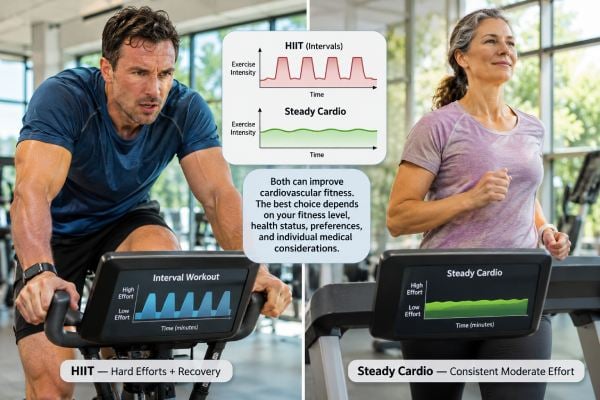
High-intensity interval training (HIIT) and steady cardio can both strengthen the cardiovascular system, but they do it with different combinations of intensity, duration, and recovery. HIIT alternates short hard efforts with easier recovery periods, while steady cardio keeps you at a more consistent moderate pace for longer. Research suggests HIIT can produce somewhat larger improvements in cardiorespiratory fitness, especially VO2peak, in some groups. Steady cardio, however, is easier to recover from, simpler to dose, and often more sustainable for beginners or people managing heart disease. For blood pressure and many other cardiovascular outcomes, the difference between the two is often smaller than fitness headlines imply. The best choice is usually not one or the other forever. It is the type you can perform safely and consistently, with enough weekly volume to improve fitness. This guide compares the evidence, safety, time efficiency, and practical use of HIIT and steady cardio for heart health.
Table of Contents
- How HIIT and Steady Cardio Differ
- Which Improves Heart Fitness More?
- Blood Pressure, Metabolic Health, and Weight
- Which Is Safer for the Heart?
- Time Efficiency, Recovery, and Adherence
- How to Choose the Right Type for You
- A Heart-Healthy Week That Combines Both
How HIIT and Steady Cardio Differ
The main difference is not the exercise machine you use. It is how hard you work and whether that effort stays constant.
Steady cardio, often called moderate-intensity continuous training (MICT), usually means continuous exercise at a pace you can maintain for 20–60 minutes or longer. Brisk walking, easy cycling, swimming, rowing, or jogging can all qualify. At a moderate intensity, breathing is clearly faster but you can usually speak in short sentences. Many people recognize this as the classic “cardio” workout.
HIIT alternates harder work intervals with periods of easy movement or rest. A session might include four 4-minute hard intervals separated by 3 minutes of easy exercise, or shorter rounds such as 30–60 seconds hard with 1–2 minutes easy. HIIT is not the same as all-out sprint interval training. The hard portions are vigorous, but a health-focused HIIT session should still be controlled enough to repeat with good form.
Both forms challenge the heart, lungs, blood vessels, and working muscles. They simply distribute the stress differently. HIIT creates repeated peaks in heart rate and oxygen demand. Steady cardio produces a lower peak but keeps the cardiovascular system working for a longer uninterrupted period.
Heart-rate zones can help describe the difference, but they are not perfectly precise because medications, temperature, fitness, and individual physiology change the response. If you are new to training, heart rate training zones for beginners can provide a starting framework. The talk test and perceived exertion are also useful, especially for people taking beta-blockers or other drugs that alter heart rate.
A practical way to think about intensity is:
| Training style | Typical effort | What it feels like | Common session |
|---|---|---|---|
| Easy steady cardio | Light | Comfortable conversation | 20–60+ minutes |
| Moderate steady cardio | Moderate | Can talk in short sentences | 30–60 minutes |
| HIIT work interval | Vigorous to very hard | Speaking more than a few words is difficult | 30 seconds to 4 minutes |
| HIIT recovery interval | Easy to moderate | Breathing settles before the next effort | 1–4 minutes |
Neither method owns a particular heart-rate number. The goal is to match the intensity to your health, fitness, and training purpose.
Which Improves Heart Fitness More?
For improving cardiorespiratory fitness, HIIT often has an edge. A 2024 umbrella review that included 24 systematic reviews and nearly 13,000 participants found that HIIT generally improved cardiorespiratory fitness more than moderate continuous training. Cardiorespiratory fitness is commonly measured with VO2peak or VO2max, which reflects how effectively the body can take in, transport, and use oxygen during hard exercise.
That difference matters because higher cardiorespiratory fitness is strongly associated with better long-term health. But the size of the advantage depends on how the programs are designed. Some HIIT studies give participants a stronger training stimulus, not merely a different format. When HIIT and steady programs are more closely matched for total exercise work or energy expenditure, the difference can become smaller.
That pattern is visible in research on coronary artery disease. A 2025 meta-analysis found a greater average improvement in VO2peak with HIIT than with moderate continuous training, but when the analysis was limited to exercise programs designed to be isocaloric, the groups had similar VO2peak results. This is an important reminder that “HIIT beats cardio” is too simple. Training dose matters.
Steady cardio can produce large fitness gains, especially if you are starting from a low baseline. A sedentary person who builds from 10-minute walks to 40 minutes of brisk walking several days per week may improve fitness substantially without doing any HIIT. Likewise, someone who already performs plenty of moderate exercise may gain more by adding a carefully dosed vigorous session.
For people who want a sustainable aerobic base, zone 2 cardio for heart health describes the role of lower-to-moderate continuous exercise. It supports longer training volume with less fatigue and can complement rather than compete with interval work.
The most useful interpretation is:
- HIIT is often more potent per minute for improving VO2peak.
- Steady cardio is highly effective when performed often enough and long enough.
- The apparent HIIT advantage shrinks in some studies when total work is matched.
- The best program is the one that provides progressive overload without creating more fatigue, pain, or risk than you can recover from.
Fitness gains come from repeated training over weeks and months, not from making one workout maximally hard.
Blood Pressure, Metabolic Health, and Weight
HIIT and steady cardio both improve several cardiovascular risk factors. Recent umbrella-review evidence suggests HIIT can lower systolic and diastolic blood pressure, reduce resting heart rate, and improve some measures of vascular and cardiac function. However, when HIIT is compared directly with other exercise types, its effects on blood pressure and resting heart rate are often comparable rather than dramatically superior.
For someone with hypertension, consistency matters more than chasing the hardest possible workout. Moderate aerobic exercise has a long track record for blood-pressure control, and it can be repeated frequently without the same recovery demand as vigorous intervals. If blood pressure is your primary concern, the best exercises for high blood pressure explains how aerobic and resistance training can fit together.
Both styles can also improve insulin sensitivity and glucose control. HIIT may be attractive because vigorous muscle contractions create a strong metabolic stimulus in a short session. Steady exercise, especially when performed for longer periods, can accumulate substantial energy expenditure and is usually easier to do on consecutive days.
For body weight and fat loss, there is no automatic HIIT advantage. Fat loss depends heavily on overall energy balance, eating patterns, sleep, and total activity. HIIT can burn a meaningful amount of energy quickly, but a 20-minute interval workout is not necessarily superior to a 45-minute brisk walk if the longer session is easier to repeat and does not increase hunger or fatigue for that person.
The often-promoted “afterburn” effect after HIIT exists, but it is usually too small to make HIIT a magic weight-loss method. A program that causes you to dread exercise, skip sessions, or compensate by becoming less active for the rest of the day can lose its theoretical time advantage.
Daily movement outside formal workouts also matters. A short walk after meals can support glucose management and adds low-stress activity without requiring another hard session; see walking after meals for heart health for a practical approach.
If your main goal is cardiovascular risk reduction, judge the program by the bigger picture: blood pressure, fitness, waist circumference when relevant, blood lipids, glucose control, sleep, smoking status, and whether you can maintain the routine.
Which Is Safer for the Heart?
Steady moderate cardio is the safer starting point for most people who are deconditioned, have uncertain exercise tolerance, or are returning after a long break. HIIT creates higher temporary demands on heart rate, blood pressure, and oxygen use. That does not make it inherently dangerous, but it means screening and progression matter more.
In supervised cardiac rehabilitation, carefully prescribed HIIT has been studied in people with coronary artery disease and heart failure and can improve exercise capacity. That evidence should not be interpreted as permission to copy a hard interval workout from social media after a heart attack or with unstable symptoms. Clinical studies typically use screened patients, structured protocols, warm-ups, monitoring, and trained staff.
People who should obtain medical guidance before starting vigorous intervals include those with known cardiovascular disease, recent heart attack or cardiac procedure, unexplained chest discomfort, fainting, uncontrolled high blood pressure, significant rhythm disorders, severe valve disease, worsening heart failure symptoms, or unexplained shortness of breath. The detailed discussion of HIIT safety and safer alternatives covers these situations more fully.
Stop a workout and seek urgent medical help for symptoms such as chest pressure or pain, fainting, severe shortness of breath that is out of proportion to exertion, or a sustained rapid or irregular heartbeat with marked weakness or dizziness.
For people without known disease, injury risk and overtraining can still be practical problems. HIIT performed too often can irritate tendons and joints, disrupt sleep, and leave the nervous system chronically fatigued. More intensity is not always more heart benefit.
A useful rule is that hard intervals should feel demanding because of the planned cardiovascular effort, not because your form is collapsing. Choose a low-impact modality such as a bike, elliptical, incline walk, or pool workout if running sprints are hard on your joints. If you are very unfit, simply walking uphill briskly may already be vigorous enough.
Heart-rate targets can help, but they should not override symptoms. Age-predicted formulas are estimates, not safety guarantees. If you use them, treat tools such as a target heart rate by age calculator as a rough guide rather than a prescription.
Time Efficiency, Recovery, and Adherence
HIIT’s strongest practical advantage is time efficiency. You can accumulate a meaningful vigorous stimulus with less total exercise time. That can be useful for someone who enjoys hard efforts and has limited time for long workouts.
But a complete HIIT session is not just the hard intervals. A safe session often includes 5–10 minutes of warm-up, the work and recovery rounds, and several minutes of cool-down. A “10-minute HIIT workout” may therefore become a 25–35 minute training session when performed properly. It may still be efficient, but not as dramatically short as advertisements suggest.
Recovery is the tradeoff. Hard intervals create greater fatigue per minute and typically require more time before the next intense session. Beginners may need 48 hours or more between vigorous workouts. Trying to make every cardio day a HIIT day can reduce quality and adherence.
Steady cardio has a different advantage: it is easier to accumulate. You can often walk, cycle, or swim moderately on most days and still feel ready to train again. Longer easy sessions can also be useful for stress relief, social exercise, and building confidence.
Adherence is difficult to compare because people respond differently to intensity. Some love intervals because the changing pace keeps them engaged. Others find repeated hard efforts unpleasant and stick with a steady routine far longer. The method that looks best in a 12-week trial is not necessarily best if you quit in week four.
Consider four questions:
- Do you enjoy it enough to repeat it? Exercise you avoid has no long-term advantage.
- Can you recover? Poor sleep, persistent soreness, declining performance, or a rising resting heart rate can signal excess training stress.
- Does it fit your schedule? Short vigorous workouts help only if you actually do them.
- Does it leave room for the rest of your health plan? Strength training, daily steps, sleep, and recovery also matter.
The healthiest program often contains a lot of manageable work and a smaller amount of hard work, rather than turning every session into a test.
How to Choose the Right Type for You
Choose steady cardio first if you are new to exercise, have been inactive for months, are recovering from illness, have significant joint limitations, or simply prefer a predictable pace. Build the ability to exercise continuously for 20–30 minutes before worrying about formal HIIT. Even short bouts can be useful while you are building that base.
Choose HIIT as an addition when you already tolerate moderate exercise well, want to improve cardiorespiratory fitness more efficiently, enjoy intervals, and have no medical reason to avoid vigorous effort. One session per week is enough to start. You do not need all-out sprints.
A beginner-friendly interval session might look like this:
- Warm up for 8–10 minutes at an easy pace.
- Perform 4 rounds of 1 minute at a vigorous but controlled effort.
- Recover for 2 minutes at an easy pace after each hard minute.
- Cool down for 5–10 minutes.
- Leave at least one easy day before another hard interval session.
Over several weeks, you can add an interval, lengthen the hard portions, or shorten recovery slightly. Change one variable at a time. You should finish feeling that you trained hard, not that you barely survived.
If you have a heart condition, do not copy generic percentages without asking how your diagnosis and medications change the plan. Beta-blockers, for example, blunt the heart-rate response, so perceived exertion and clinician-defined targets may be more useful than a standard formula.
Also consider what problem you are trying to solve. If you need more weekly activity, steady cardio may be the simplest answer. If you already meet exercise-volume goals but want to raise VO2peak, adding HIIT may be more targeted. If stress is high and sleep is poor, replacing an easy walk with another maximal session may be counterproductive.
There is no cardiovascular prize for choosing the more punishing option. Training should be hard enough to create adaptation and easy enough to continue.
A Heart-Healthy Week That Combines Both
For many healthy adults, the best answer to “HIIT or steady cardio?” is both, in different amounts. Public-health exercise targets are commonly expressed as at least 150 minutes of moderate aerobic activity per week, 75 minutes of vigorous activity, or an equivalent combination, plus muscle-strengthening work. Those totals can be adjusted for fitness, age, health conditions, and goals.
A balanced example for someone already comfortable with regular exercise could be:
- Monday: 35–45 minutes moderate steady cardio.
- Tuesday: strength training or easy activity.
- Wednesday: HIIT session with a full warm-up and cool-down.
- Thursday: 20–40 minutes easy walking or cycling.
- Friday: strength training plus optional short easy cardio.
- Saturday: 45–60 minutes steady cardio at a conversational pace.
- Sunday: rest or relaxed walking.
That plan gives the heart different stimuli without stacking hard sessions. A beginner could remove the HIIT day and make Wednesday another moderate session for several weeks. A highly trained person might eventually use two interval sessions, but there is rarely a heart-health reason for most cardio to be all-out.
Track how you respond, not just what is written on the calendar. A program is probably well matched if your exercise tolerance gradually improves, you recover between sessions, and you are not developing persistent pain, extreme fatigue, abnormal breathlessness, or concerning cardiac symptoms.
If you compare the two methods strictly on VO2peak, HIIT often wins by a modest margin. If you compare them on ease of recovery, accessibility, and ability to accumulate weekly volume, steady cardio often wins. For blood pressure and broad cardiovascular health, both can be effective.
The strongest long-term strategy is therefore not choosing a camp. Build a steady aerobic base, add vigorous intervals when appropriate, and keep the training dose sustainable. Your heart benefits from regular movement far more than from loyalty to one workout label.
References
- Effects of high-intensity interval training on cardiovascular health: An umbrella review of systematic reviews and meta-analyses 2026 (Umbrella Review)
- High-intensity interval training and cardiorespiratory fitness in adults: An umbrella review of systematic reviews and meta-analyses 2024 (Umbrella Review)
- High-intensity interval training versus moderate-intensity continuous training on exercise capacity and health-related quality of life in patients with coronary artery disease: An updated systematic review and meta-analysis 2025 (Systematic Review and Meta-Analysis)
- High-intensity interval training versus moderate-intensity continuous training on patient quality of life in cardiovascular disease: a systematic review and meta-analysis 2023 (Systematic Review and Meta-Analysis)
- The impact of high-intensity interval training on vascular function in adults: A systematic review and meta-analysis 2022 (Systematic Review and Meta-Analysis)
Disclaimer
This article is for general education and is not a personalized exercise prescription. People with known cardiovascular disease, unexplained chest pain, fainting, uncontrolled blood pressure, significant arrhythmias, or major exercise limitations should obtain individualized medical guidance before starting vigorous interval training. Stop exercise and seek urgent care for severe or concerning symptoms.