Strength training is not just for building muscle. Done regularly, it can lower resting blood pressure, improve how your body handles glucose, reduce insulin resistance, and support better long-term heart health. The benefits are especially relevant for people with high blood pressure, prediabetes, type 2 diabetes, excess abdominal fat, or age-related muscle loss.
The most useful approach is simple: train the major muscle groups at least twice per week, use loads you can control with good form, progress gradually, and combine lifting with aerobic activity. Research in people with hypertension and type 2 diabetes shows meaningful average improvements in systolic and diastolic blood pressure, fasting glucose, and A1C, although individual results vary. You do not need maximal weights or long bodybuilding workouts. Moderate, repeatable sessions are enough to improve the metabolic role of muscle and strengthen the heart-health benefits of your overall activity routine.
Table of Contents
- Why strength training helps the heart
- How lifting lowers blood pressure
- How lifting improves blood sugar
- How much benefit to expect
- A practical strength plan for heart health
- How to combine strength and cardio
- Safety with high blood pressure or diabetes
Why strength training helps the heart
Resistance exercise helps cardiovascular health through several pathways at the same time. Working muscle uses glucose, increases energy demand, stimulates blood flow, and adapts to become stronger and more metabolically active. Over weeks and months, those changes can improve blood pressure, glucose regulation, body composition, and physical function.
Muscle is especially important for blood sugar control because it is one of the body’s largest destinations for glucose. When muscle contracts, it can increase glucose uptake during and after exercise. With repeated training, insulin sensitivity often improves, which means the body can move glucose out of the bloodstream with less insulin.
Blood vessels adapt too. Regular training can improve endothelial function—the ability of the inner lining of blood vessels to regulate dilation and blood flow. Resistance exercise may also reduce arterial stiffness, improve autonomic balance, and support healthier body composition. These effects help explain why resting blood pressure can fall even though blood pressure rises temporarily while you are lifting.
Strength also has an indirect heart benefit that is easy to overlook: it makes everyday movement easier. A person who can climb stairs, carry groceries, rise from a chair, and walk with less effort is more likely to stay active. Preserving muscle becomes increasingly important with age because loss of strength can push people toward inactivity, frailty, and worsening metabolic risk.
The American Heart Association’s updated resistance-training statement recognizes strength exercise as a useful part of cardiovascular prevention and management. It is best viewed as one component of a broader activity plan, not as a replacement for aerobic exercise.
These benefits do not require a dramatic change on the scale. Muscles can become more efficient at using glucose, daily tasks can require less effort, and resting pressure can improve even when body weight changes little. For heart health, track outcomes that match the goal: repeat home blood-pressure averages, A1C or glucose when your clinician recommends them, and steady gains in strength and exercise tolerance. Those measures often reveal progress that body weight alone misses.
How lifting lowers blood pressure
Regular strength training can lower both systolic blood pressure—the top number—and diastolic blood pressure—the bottom number. The exact effect depends on baseline pressure, program design, medication use, age, and other health conditions.
A 2025 systematic review of randomized trials in people with hypertension found average reductions of about 8.6 mmHg systolic and 4.6 mmHg diastolic compared with control groups. The studies varied substantially, so those values should not be treated as a guaranteed response. Other reviews report smaller but still clinically useful reductions. Even a few millimeters of mercury can matter when the change is maintained over time.
The long-term reduction appears to come from repeated vascular and nervous-system adaptations. Training can improve how blood vessels widen, reduce resting vascular resistance, and improve the balance between sympathetic “fight-or-flight” activity and parasympathetic recovery. Better insulin sensitivity and lower visceral fat may also contribute.
Why blood pressure rises during a set
When you lift a challenging weight, contracting muscles briefly compress blood vessels and your nervous system increases cardiovascular output. That can raise blood pressure sharply for seconds. Heavy loads, grinding repetitions, and breath-holding amplify the response.
That temporary rise is different from your resting blood pressure trend. A well-designed program can cause short exercise-related spikes while still lowering average resting pressure over time. The goal is not to prevent any rise during exercise; it is to avoid unnecessary strain and use a program appropriate for your health status.
If you have hypertension, it helps to understand your usual numbers and how they are being measured. See what blood pressure readings mean and, if you monitor at home, use a consistent technique rather than judging your progress from isolated readings.
How lifting improves blood sugar
Strength training improves blood sugar mainly by making skeletal muscle a better glucose user. During exercise, muscle contractions stimulate glucose transport into muscle cells through pathways that do not depend entirely on insulin. After exercise, insulin sensitivity can remain improved for hours, and regular training creates more lasting metabolic changes.
In adults with type 2 diabetes, a 2024 meta-analysis of 46 randomized trials found that resistance training lowered A1C by about 0.5 percentage points and fasting glucose by about 12 mg/dL on average compared with control conditions. Another recent review found improvements in A1C, fasting glucose, insulin, insulin resistance, triglycerides, and HDL cholesterol.
A half-point A1C reduction can be meaningful. For example, moving from an A1C of 7.8% to 7.3% is not the same as reaching a personalized treatment goal, but it represents a real improvement from exercise alone. People with higher starting glucose values may have more room to improve than people whose glucose is already well controlled.
The benefits do not require dramatic muscle growth. Research suggests glucose control can improve even when changes in lean mass are modest. Muscle quality, enzyme activity, glucose transport, and insulin signaling can improve before a visible physique change occurs.
If you want a clearer picture of why glucose matters for cardiovascular risk, A1C and heart risk explains how long-term blood sugar control connects with blood-vessel damage and heart disease.
What happens after a workout
A single session can improve glucose uptake, but the effect fades. That is one reason frequency matters. Two or three resistance sessions per week, plus regular walking or other aerobic activity, provide repeated opportunities for muscles to use glucose efficiently.
For people taking insulin or certain glucose-lowering medications, that improved uptake can also increase the chance of low blood sugar. Medication-specific precautions are important, especially when exercise duration, intensity, or timing changes.
How much benefit to expect
Most studies showing cardiometabolic benefits use programs lasting at least 8 to 12 weeks. Some changes can begin earlier, but meaningful trends in resting blood pressure and A1C take time to assess. A1C reflects roughly the previous two to three months of glucose exposure, so it is not a useful marker for judging the effect of just a few workouts.
| Outcome | Typical direction | When change may become noticeable |
|---|---|---|
| Resting blood pressure | Often decreases | Several weeks to a few months |
| Fasting glucose | Often decreases in people with elevated glucose | Days to weeks, with variability |
| A1C | Often decreases in type 2 diabetes | About 8–12 weeks or longer |
| Insulin sensitivity | Usually improves | Can improve early and continue with training |
| Strength | Usually increases | Often within several weeks |
| Lean mass | May increase | Usually months, depending on training and diet |
Your numbers may change less—or more—than these studies suggest. Medication changes, sodium intake, sleep, alcohol, stress, body weight, and measurement technique can all affect blood pressure. Food intake, illness, sleep, stress hormones, and diabetes medication can affect glucose.
For blood pressure, look at a home average rather than one post-workout reading. For glucose, look at the pattern that matters clinically: fasting values, post-meal values when relevant, and A1C or other measures your clinician uses. A single high or low value should be interpreted in context.
Track the right measurements
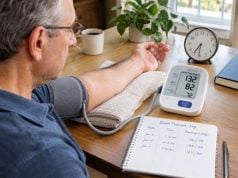
If you are using strength training as part of a blood-pressure plan, measure resting pressure under similar conditions each time. Sit quietly for about five minutes, keep your back supported and feet flat, place the cuff on a bare upper arm, and avoid checking immediately after exercise, caffeine, smoking, or a stressful rush. Taking two readings about a minute apart and following the same routine on multiple days gives a more useful trend than one isolated value. For a detailed routine, see home blood pressure monitoring.
For blood sugar, the useful measurement depends on the question. Fasting glucose shows one part of the picture. A1C estimates longer-term exposure. Continuous glucose monitors or finger-stick checks can show how a particular meal or workout affects you in the short term. An intense lifting session may occasionally cause a temporary glucose rise because adrenaline and other stress hormones tell the liver to release fuel. That does not necessarily mean the workout is harmful; the longer-term trend is more important.
Also track functional progress. If you can perform more repetitions with the same weight, climb stairs with less effort, or carry groceries more comfortably, your cardiovascular system is doing less relative work during daily tasks. That improvement may not appear directly on a laboratory report, but it is one of the practical reasons strength matters for long-term health.
A practical strength plan for heart health
For most adults, two full-body sessions per week is a strong starting point. The American Heart Association describes a program of roughly 8 to 10 exercises for major muscle groups, commonly performed for 1 to 3 sets of 8 to 12 repetitions. You can use free weights, machines, resistance bands, or body weight.
A beginner session might include:
- Chair squats or goblet squats
- Step-ups or a leg press
- Hip bridges or a light hip hinge
- Chest press or incline push-ups
- Seated row or resistance-band row
- Overhead press if comfortable and appropriate
- Calf raises
- A carry, anti-rotation press, or other simple core exercise
Start with a load you can move smoothly. The final few repetitions should feel challenging, but you should still be able to maintain form and continue breathing. You do not need to reach muscular failure on every set.
A practical effort target is to finish most sets feeling as if you could perform another one to three good repetitions. This provides enough stimulus for progress without making every session exhausting. As the same load becomes easier, increase the resistance slightly, add repetitions within the target range, or add a set.
If high blood pressure is your main concern, safe strength exercises for high blood pressure can help you choose movements and loading strategies. If you are new to all forms of exercise, a beginner exercise plan for high blood pressure may be a better starting point.
How hard should you lift?
Moderate resistance works well for most heart-health goals. Some research suggests moderate-to-vigorous loads can lower blood pressure, but heavier is not automatically better. The best intensity is one that gives you a meaningful training stimulus without unsafe straining, joint pain, or poor technique.
People with medical limitations may benefit from lighter loads and more repetitions, especially at first. Isometric exercises such as handgrips or wall sits also have evidence for lowering blood pressure, but they should be used thoughtfully because holding a contraction can raise pressure during the effort. They are an option, not a requirement.
How to combine strength and cardio
The most complete heart-health plan uses both. Adults are generally advised to get at least 150 minutes of moderate-intensity aerobic activity or 75 minutes of vigorous activity per week, along with muscle-strengthening activity on at least two days.
You can meet those targets without a complicated schedule. For example:
- Monday: Full-body strength training
- Tuesday: 30-minute brisk walk
- Wednesday: 30–45 minutes of cycling, walking, or swimming
- Thursday: Full-body strength training
- Friday: Easy walk or rest
- Saturday: 30–45 minutes of moderate aerobic activity
- Sunday: Light activity and recovery
If blood sugar is a priority, short walks after meals can add another useful stimulus without interfering much with strength recovery. The article on walking after meals explains why post-meal movement can help with glucose and triglyceride handling.
Cardio and lifting do not need to compete. If you perform them in the same session, choose the order based on your main goal and tolerance. For general health, either order can work. If strength progression is the priority, lifting first often makes sense. If aerobic performance is the priority, cardio may come first or be placed on separate days.
The most important variable is adherence. A modest plan repeated for months is more valuable than an aggressive plan abandoned after two weeks. If time is limited, keep the two strength sessions and add short bouts of walking across the week rather than trying to create a perfect schedule. Ten-minute walks still count toward total activity, and spreading movement through the day can be especially useful for people who sit for long periods. The plan should feel sustainable enough to continue when work, travel, or family demands increase.
Safety with high blood pressure or diabetes
Most people with stable hypertension or type 2 diabetes can benefit from resistance training, but some situations require individualized guidance.
With high blood pressure, avoid prolonged breath-holding and unnecessary maximal straining. Exhale through the harder part of the repetition and inhale during the easier phase. If your pressure is severely uncontrolled, or you have known heart or aortic disease, ask your clinician what intensity is appropriate before beginning heavy lifting.
Stop exercise and seek urgent medical attention for chest pressure, severe shortness of breath that is out of proportion to the effort, fainting, new neurologic symptoms, or other signs of a medical emergency.
With diabetes, pay attention to glucose-lowering medications. Insulin and drugs that increase insulin release can raise the risk of exercise-related hypoglycemia. Carry a fast-acting carbohydrate if your care plan calls for it, and learn how your glucose responds to different workouts. Resistance training can sometimes raise glucose temporarily during or immediately after intense sessions because stress hormones increase, even while long-term control improves.
Other diabetes-related complications can change exercise choices. Severe peripheral neuropathy may affect balance and foot safety. Advanced retinopathy can make heavy straining inappropriate. Kidney disease, autonomic neuropathy, and known cardiovascular disease may also require tailored programming.
Finally, do not use exercise to replace prescribed medication without medical guidance. Strength training can lower blood pressure and A1C enough that medication needs may change over time, but those decisions should be based on documented trends and a clinician’s review.
A good heart-health lifting plan is therefore neither extreme nor complicated: train the major muscle groups two or three times per week, keep breathing, progress gradually, add aerobic activity, and track the health measures that matter to you. Over time, stronger muscle becomes a tool for better blood-pressure control, better glucose handling, and more resilient cardiovascular health.
References
- The efficacy of resistance training for the management of hypertension: a systematic review and meta-analysis 2025 (Systematic Review)
- The Impact of Resistance Exercise Training on Glycemic Control Among Adults with Type 2 Diabetes: A Systematic Review and Meta-Analysis of Randomized Controlled Trials 2024 (Systematic Review)
- Effects of resistance training on cardiovascular risk factors in patients with type 2 diabetes mellitus: a systematic review and meta-analysis of randomized controlled trials 2025 (Systematic Review)
- Strength training for arterial hypertension treatment: a systematic review and meta-analysis of randomized clinical trials 2023 (Systematic Review)
- Resistance Exercise Training in Individuals With and Without Cardiovascular Disease: 2023 Update: A Scientific Statement From the American Heart Association 2023 (Position Statement)
- American Heart Association Recommendations for Physical Activity in Adults and Kids 2024 (Official Guidance)
Disclaimer
This article is for general education and does not replace individualized medical advice. If you have uncontrolled high blood pressure, diabetes treated with glucose-lowering medication, known cardiovascular disease, or exercise-related symptoms, ask a qualified healthcare professional about safe training intensity and monitoring. Do not change prescribed blood-pressure or diabetes medication based on exercise effects without medical guidance.