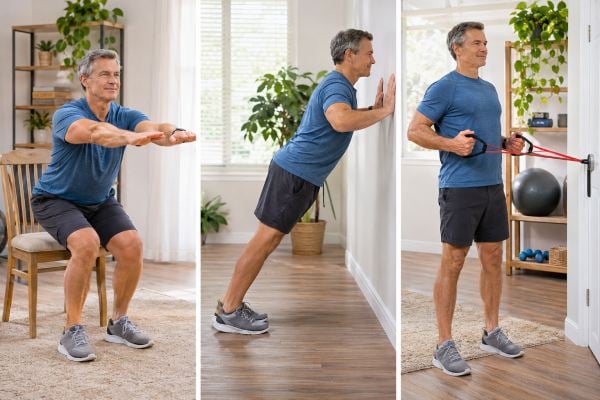
Strength training can be a useful part of a blood-pressure plan when it is done with moderate effort, steady breathing, and good technique. Research now shows that both dynamic resistance training—lifting and lowering a load—and some forms of isometric training can reduce resting blood pressure over time. You do not need maximal weights or exhausting workouts to benefit. For most people with stable high blood pressure, the best starting exercises are simple whole-body movements such as chair squats, rows, wall or counter push-ups, hip hinges, step-ups, and light carries. The goal is to train major muscle groups two or three days per week while avoiding breath-holding and repeated all-out efforts. Strength work also improves muscle, bone, glucose control, and everyday function, which makes it valuable beyond the blood-pressure number itself. If your pressure is severely elevated, you have symptoms such as chest pain or unusual shortness of breath, or you have significant heart disease, get medical guidance before starting or intensifying training.
Table of Contents
- Can strength training lower blood pressure?
- Best strength exercises for high blood pressure
- How hard should you train?
- Breathing, technique, and safety rules
- A simple weekly strength plan
- What about wall sits and handgrip training?
- When to get medical guidance before lifting
Can strength training lower blood pressure?
Yes. Regular resistance training can lower resting systolic and diastolic blood pressure, and the effect can be clinically meaningful. Large reviews of randomized trials have found reductions with dynamic resistance exercise, combined aerobic-and-resistance programs, and isometric exercise. The exact change varies widely among people because baseline blood pressure, training style, medication, age, fitness, and study design all matter.
The important distinction is between the temporary blood-pressure rise during a set and the lower resting blood pressure that can develop with repeated training. Blood pressure naturally increases while muscles work, especially with heavier loads. That acute response is one reason technique and breathing matter. Over weeks and months, however, appropriate training can improve vascular function, insulin sensitivity, body composition, and fitness in ways that support better blood-pressure control.
Strength training is not a replacement for medication when medication is indicated. It is one part of a broader plan that may also include aerobic activity, lower sodium intake, a heart-healthy diet, sleep, weight management when appropriate, and limited alcohol. If you want the broader cardiovascular context, strength training for heart health explains how resistance exercise affects blood pressure, blood sugar, and other risk factors.
For many adults, combining strength work with regular walking or other aerobic exercise is more useful than choosing one or the other. A brisk walking routine for heart health can fill the aerobic side of the plan while strength sessions preserve muscle and function.
Best strength exercises for high blood pressure
The best exercises are those that train large muscle groups, can be scaled to your current ability, and let you breathe continuously. Machines, dumbbells, resistance bands, and body-weight exercises can all work.
1. Chair squat or sit-to-stand
Sit toward the front of a sturdy chair, place your feet about hip-width apart, and stand up under control. Sit back down slowly without dropping into the seat. This trains the thighs, hips, and glutes and closely matches an everyday movement.
Start with 8 to 12 repetitions. If that becomes easy, hold a light dumbbell at chest level or lower the chair height slightly.
2. Wall, counter, or bench push-up
A standing wall push-up is easier than a floor push-up and makes it simple to control effort. Progress to a kitchen counter, sturdy bench, or lower surface as you get stronger. Keep your body in a straight line and exhale as you press away.
This movement trains the chest, shoulders, and triceps without requiring heavy loads.
3. Resistance-band or cable row
Rows strengthen the upper back and arms and balance pressing exercises. Keep your chest tall, pull the handles toward your ribs, and avoid shrugging your shoulders. A band anchored securely at chest height can work well at home.
4. Hip hinge or light Romanian deadlift
The hip hinge trains the glutes, hamstrings, and back. Practice by pushing your hips backward while keeping the spine neutral and knees softly bent. Once the movement feels natural, add light dumbbells or a kettlebell.
The goal is not a heavy deadlift. Use a load that allows smooth repetitions without grinding or holding your breath.
5. Step-up
Use a low, stable step and step up with one foot, then bring the other foot up. Step down under control. Hold a railing or sturdy support if balance is uncertain. Step-ups train the legs and can gently raise heart rate without requiring heavy external weight.
6. Supported split squat or reverse lunge
Hold a counter, rail, or chair for balance. Lower only as far as feels comfortable, then push through the front foot to stand. This helps build single-leg strength and balance. People with knee pain can use a shorter range of motion or substitute sit-to-stands.
7. Light farmer carry
Hold a manageable dumbbell or grocery-bag-style load in each hand and walk slowly for 20 to 40 seconds. Keep your shoulders relaxed and breathe normally. Carries build grip, trunk stability, and total-body strength.
If carrying makes you brace so hard that you stop breathing, the load is too heavy.
A practical six-move workout
A simple full-body session can use chair squats, counter push-ups, rows, hip hinges, step-ups, and a light carry. That covers the major movement patterns without requiring a complicated program. Beginners can do one set of each exercise; over time, build to two or three sets.
Machines, bands, or free weights?
All three can work. Machines can be helpful for beginners because the path of movement is guided and changing resistance is straightforward. Resistance bands are inexpensive, portable, and well suited to rows, presses, and assisted lower-body work. Dumbbells and kettlebells offer more freedom but demand a little more coordination. None has a special blood-pressure advantage on its own. The best tool is the one that lets you use a moderate load, move smoothly, and breathe normally.
People who feel unsteady may prefer seated machines, supported exercises, or a countertop for balance at first. People with arthritis can shorten the range of motion or choose a machine that feels comfortable. Pain is not a requirement for progress; sharp joint pain is a reason to stop and modify the movement.
How hard should you train?
Moderate effort is a good default. Choose a resistance you could lift several more times after the set ends rather than pushing every set to failure. A useful target is about 8 to 12 controlled repetitions for many exercises, although older adults or beginners may prefer 10 to 15 lighter repetitions at first.
Think of effort on a 0-to-10 scale. Most working sets can feel around 5 to 7 out of 10—challenging but controlled. You should still be able to keep your breathing moving and maintain good form. If you are straining, shaking, losing technique, or needing to hold your breath to finish, reduce the load.
For general strength and blood-pressure support:
- Train major muscle groups 2 to 3 nonconsecutive days per week.
- Start with 1 set per exercise if you are new to lifting.
- Progress toward 2 to 3 sets as tolerated.
- Rest roughly 60 to 120 seconds between sets, longer if breathing or heart rate has not settled.
- Increase resistance gradually, usually only after the current load feels comfortably manageable with good form.
Heavy lifting is not automatically unsafe for every person with hypertension, but it is unnecessary for the goal of improving blood pressure. Maximal or near-maximal efforts cause larger acute pressure responses and require more experience and medical context. For a person starting specifically because of high blood pressure, moderate loads are the sensible first choice.
Do not judge a strength session only by heart rate. Resistance exercise produces intermittent cardiovascular stress, and medications such as beta blockers can change heart-rate response. If you also do cardio, a target heart-rate zone can be one tool, but perceived effort and symptoms remain important.
Breathing, technique, and safety rules
The most important lifting rule for high blood pressure is simple: do not hold your breath while straining. Breath-holding with forceful bracing can create a large short-term rise in blood pressure.
A basic breathing pattern works for most exercises:
- Inhale during the easier phase.
- Exhale during the harder phase.
- Keep the breath flowing rather than taking one large breath and locking it in.
For a chair squat, inhale as you lower and exhale as you stand. For a row, exhale as you pull and inhale as you release. You do not need to exaggerate the breathing; just avoid a prolonged breath hold.
Other safety habits matter too:
Warm up first. Spend 5 to 10 minutes walking, cycling gently, or doing easy movement before harder sets. Then perform the first set of each exercise with a lighter load if needed.
Use smooth repetitions. Fast, jerky lifts make technique harder to control. A steady two- to three-second lowering phase is often useful.
Stop for concerning symptoms. Chest pressure, fainting, severe dizziness, unusual shortness of breath, new neurological symptoms, or a sudden severe headache are reasons to stop and seek appropriate medical care.
Avoid rapid position changes if you get dizzy. Blood-pressure medicines can contribute to lightheadedness, especially when standing up quickly after floor exercises. Rise gradually and use support when needed.
Hydrate appropriately. Dehydration can make exercise feel harder and may worsen dizziness. People with heart failure or kidney disease who have fluid restrictions should follow their prescribed plan instead of generic hydration advice.
Do not chase a post-workout blood-pressure number. Blood pressure may temporarily fall after exercise, a phenomenon called post-exercise hypotension. That can be beneficial, but it can also contribute to lightheadedness. Cool down for several minutes and stand up slowly.
If your high blood pressure is newly diagnosed, understanding whether it falls into stage 1 hypertension or a higher category can help frame how urgently you need lifestyle changes, medication, and follow-up.
A simple weekly strength plan
This plan is designed for a beginner or returning exerciser with stable blood pressure who has no exercise restriction from a clinician. Adjust exercises for joint pain, mobility limits, or equipment.
| Day | Activity | Example |
|---|---|---|
| Monday | Strength A | Chair squat, counter push-up, band row, hip hinge, carry; 1–2 sets each |
| Tuesday | Aerobic | 20–30 minutes of comfortable-to-brisk walking |
| Wednesday | Recovery | Easy walking, mobility, or normal daily activity |
| Thursday | Strength B | Step-up, wall push-up, row, supported split squat, light carry; 1–2 sets each |
| Friday | Aerobic | 20–30 minutes of walking, cycling, or swimming |
| Saturday | Optional activity | Longer easy walk, recreational activity, or a short third strength session |
| Sunday | Recovery | Rest or gentle movement |
For the first two weeks, one set per movement may be enough. In weeks three and four, add a second set to two or three exercises. After that, add a little resistance only when repetitions remain smooth and you can finish without breath-holding.
Progress one variable at a time. Do not simultaneously add weight, sets, repetitions, and a new exercise. A small change makes it easier to tell how your body responds.
A simple progression rule is to keep the same load until you can complete the top of your repetition range with steady breathing and at least two or three good repetitions still “in reserve.” Then increase the resistance by the smallest practical amount and return to the lower end of the range. This keeps progress gradual and avoids turning every workout into a test.
If fatigue is unusually high, reduce the number of sets rather than forcing the planned workload. Poor sleep, illness, heat, dehydration, and medication changes can all alter exercise tolerance. Long-term consistency matters more than completing every session exactly as written.
If you take blood-pressure medication and monitor at home, compare trends rather than single readings. Measure under standardized resting conditions rather than immediately after lifting. Exercise itself temporarily changes blood pressure, so post-workout readings do not represent your usual resting level.
How to know the plan is working
Useful signs include easier daily tasks, better exercise tolerance, improved strength, consistent attendance, and a gradual improvement in properly measured resting blood pressure. Strength gains often appear before major visible body changes. Give the routine several weeks rather than changing it after a few sessions.
What about wall sits and handgrip training?
Isometric exercise means producing muscle force without much joint movement. Wall sits and sustained handgrip contractions are common examples. Recent research has found meaningful resting blood-pressure reductions from structured isometric training, and some analyses rank it among the most effective exercise modes for lowering resting blood pressure.
That does not mean “hold a wall sit as long as possible.” Research protocols use controlled intensity, timed contractions, recovery periods, and repeated sessions. Long maximal holds can create substantial acute cardiovascular strain.
For a beginner with hypertension, dynamic whole-body strength work is usually easier to integrate into normal fitness because it improves strength through a range of motion and transfers directly to daily tasks. Isometric training can be an additional tool, especially when a clinician or qualified exercise professional helps set intensity.
If you want to try a gentle wall sit, use a shallow knee bend, keep breathing, stop well before failure, and hold for a modest period such as 15 to 30 seconds. That is a general fitness adaptation, not a replica of a clinical blood-pressure protocol. Structured isometric handgrip programs often use equipment to prescribe a percentage of maximal grip strength, so simply squeezing a random object as hard as possible is not equivalent.
When to get medical guidance before lifting
Most adults with well-managed hypertension can be physically active, but medical guidance is especially important if you are new to exercise and have known cardiovascular disease, kidney disease, diabetes with complications, a history of stroke, heart failure, significant rhythm problems, or symptoms with activity.
Check before pushing intensity if your resting blood pressure remains substantially above target despite treatment. If a repeated resting reading is higher than 180/120 mm Hg, do not start a workout. Follow your clinician’s severe-hypertension instructions; if that pressure is accompanied by chest pain, shortness of breath, weakness, numbness, vision change, difficulty speaking, or other concerning symptoms, seek emergency care.
Also discuss training with your healthcare professional if you have recently started or changed blood-pressure medication and are experiencing dizziness. Medication does not prevent you from becoming stronger, but the program may need adjustments in pace, rest periods, and position changes.
Some medications also change what exercise feels like. Beta blockers can limit the rise in heart rate, while diuretics may increase the chance of dehydration or electrolyte problems in hot conditions. Vasodilating medicines can contribute to lightheadedness after a set or when standing. These effects do not mean you should avoid exercise; they mean symptom awareness and gradual progression are more useful than trying to hit a generic heart-rate target.
The best strength plan for high blood pressure is not the hardest one. It is a program you can repeat safely: moderate resistance, major muscle groups, regular aerobic activity, continuous breathing, gradual progression, and enough recovery to keep showing up.
References
- Effects of Resistance Training on Systolic and Diastolic Blood Pressure in Hypertensive Adults: A Systematic Review and Meta-Analysis of Randomized Controlled Trials 2026 (Systematic Review)
- The efficacy of resistance training for the management of hypertension: a systematic review and meta-analysis 2025 (Systematic Review)
- Effect of Resistance Exercise on Ambulatory Blood Pressure: Systematic Review and Meta-Analysis 2026 (Systematic Review)
- Exercise training and resting blood pressure: a large-scale pairwise and network meta-analysis of randomised controlled trials. 2023 (Systematic Review)
- Resistance Exercise Training in Individuals With and Without Cardiovascular Disease: 2023 Update: A Scientific Statement From the American Heart Association. 2024 (Position Statement)
Disclaimer
This article provides general educational information and is not a personalized exercise prescription. If you have severely elevated blood pressure, cardiovascular disease, significant medical conditions, or symptoms during activity, get medical guidance before starting or intensifying strength training.