Exercise is one of the most effective lifestyle tools for high blood pressure, and you do not need intense workouts to benefit. For most adults with hypertension, the safest starting point is regular moderate aerobic activity—often walking—combined with light-to-moderate resistance training and gradual progression. Current guidelines support working toward at least 150 minutes of moderate aerobic activity per week plus strength training on two or more days. If you have been inactive, however, your first week can be much smaller than that. Ten-minute sessions count. The key is to build a routine you can repeat without causing concerning symptoms or sudden jumps in effort. Blood pressure often falls after a bout of exercise and can improve over weeks of training, but exercise does not replace prescribed medication when medication is needed. Before starting vigorous exercise, know your resting blood pressure, understand any medical restrictions, and learn the warning signs that require medical care. The four-week plan below emphasizes consistency, controlled breathing, and safe progression rather than pushing to exhaustion.
Table of Contents
- Check Your Blood Pressure and Safety First
- Choose the Right Intensity
- Follow a Four-Week Beginner Plan
- Add Strength Training Without Holding Your Breath
- Measure Progress With More Than the Scale
- Handle Medications, Heat, and Common Exercise Problems
- Know When to Stop and Get Medical Help
Check Your Blood Pressure and Safety First
Most people with controlled high blood pressure can exercise safely, and regular activity is strongly recommended. The first question is not “What is the hardest workout I can do?” but “Is there any reason I need medical review before increasing intensity?”
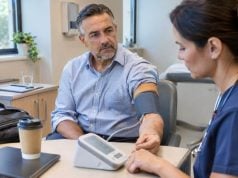
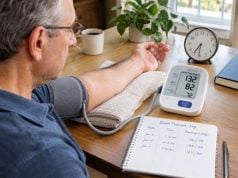
Start by knowing your usual resting blood pressure. One reading does not define your true average, so home readings taken with correct technique are helpful. Use a validated upper-arm cuff, sit quietly for about five minutes, support your back and feet, keep your arm at heart level, and take two readings about one minute apart. A correct home blood pressure technique prevents you from making exercise decisions based on a bad measurement.
Current U.S. blood pressure categories define stage 1 hypertension as an average of 130–139 mm Hg systolic or 80–89 mm Hg diastolic, and stage 2 as at least 140 systolic or 90 diastolic. If your blood pressure is persistently elevated, exercise should be part of treatment, but medication may also be needed depending on the level and your overall cardiovascular risk.
Get medical advice before starting vigorous exercise if you have known cardiovascular disease, exertional chest discomfort, unexplained fainting, severe shortness of breath, significant kidney disease, uncontrolled diabetes, pregnancy-related hypertension, or a long period of inactivity plus multiple cardiovascular risk factors.
The 2024 European hypertension guideline advises caution with high-intensity exercise when resting systolic blood pressure is above 200 mm Hg or diastolic pressure is above 110 mm Hg. That is not a target to “exercise through.” It is a reason to address blood pressure and get individualized guidance before doing hard intervals or heavy lifting.
If a reading is above 180/120 mm Hg, repeat it after at least a minute of quiet rest using correct technique. If it remains that high and you have chest pain, shortness of breath, weakness, numbness, difficulty speaking, major vision change, or another new concerning symptom, seek emergency care rather than exercising.
Choose the Right Intensity
For a beginner with high blood pressure, moderate intensity is usually the best place to start. You should feel warmer and breathe faster, but still be able to speak in short sentences. That “talk test” is often more useful than chasing a precise heart-rate target, especially if you take a beta blocker or another medicine that changes heart-rate response.
You can also use a 0–10 effort scale:
- 0–1: very easy, similar to resting or strolling slowly.
- 2–3: easy activity that can be sustained comfortably.
- 4–5: moderate effort; breathing is clearly faster but controlled.
- 6–7: hard effort; conversation becomes difficult.
- 8–10: very hard to maximal effort.
A beginner can spend most aerobic training around 3–5 out of 10. There is no need to reach breathless intensity to lower blood pressure. Large evidence reviews show that aerobic exercise, resistance training, combined training, and some isometric exercise programs can reduce resting blood pressure. Current guidelines continue to emphasize moderate aerobic activity because it has a strong evidence base and is easy to dose safely.
A proper session has three parts:
- Warm up for 5–10 minutes. Start slower than your planned pace so heart rate and blood pressure rise gradually.
- Exercise at a steady moderate effort. Begin with the duration you can tolerate comfortably.
- Cool down for 5–10 minutes. Reduce pace gradually instead of stopping abruptly.
Cooling down matters because blood pressure can drop after exercise. Stopping suddenly can contribute to lightheadedness, especially if you take blood pressure medicine or exercise in heat.
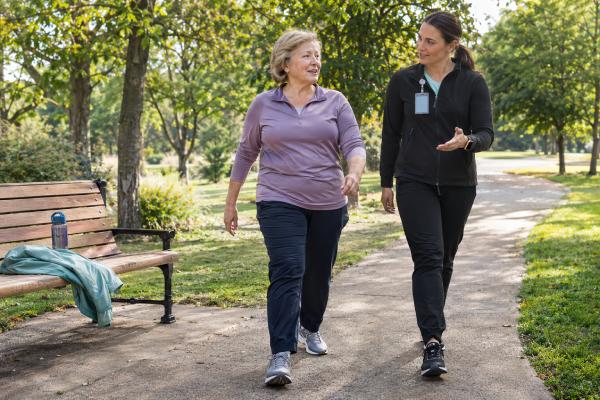
Walking is an excellent starting option because intensity is easy to control. You can adjust speed, hills, and duration without special equipment. A detailed walking plan for heart health can help once the basic routine feels comfortable.
Follow a Four-Week Beginner Plan
The goal of the first month is not to reach peak fitness. It is to teach your body and routine that exercise happens regularly. If any week feels too difficult, repeat it before progressing.
| Week | Aerobic activity | Strength | Main goal |
|---|---|---|---|
| 1 | 10–15 minutes, 5 days | 1 light session | Build consistency |
| 2 | 15–20 minutes, 5 days | 2 light sessions | Increase time, not intensity |
| 3 | 20–25 minutes, 5 days | 2 sessions | Settle into moderate effort |
| 4 | 25–30 minutes, 5 days | 2 sessions | Approach 150 minutes per week |
For aerobic activity, choose walking, a stationary bicycle, swimming, water walking, or another rhythmic activity that you can do without joint pain or unsafe balance demands. Keep most sessions comfortable enough that you could continue a little longer if necessary.
During week 1, ten minutes is enough if you have been sedentary. You can even split the daily amount into two shorter walks. During weeks 2 and 3, add minutes before adding hills or speed. By week 4, many people can approach the standard target of about 150 minutes of moderate activity per week.
Current European guidance notes that daily aerobic activity can be useful because blood pressure often falls for hours after a session, a phenomenon called post-exercise hypotension. You do not have to exercise every day, but spreading sessions through the week avoids packing all activity into one or two days.
Once you can comfortably complete 30 minutes on most days, progression can take several forms:
- Add five minutes to one or two sessions.
- Add a small hill or slightly faster segment.
- Include a longer easy session on the weekend.
- Try a second aerobic activity to reduce repetitive strain.
Do not increase duration, intensity, and frequency all at once. Change one variable, then see how you recover.
After the first month, think in terms of another six to eight weeks of steady practice rather than a sudden jump to harder workouts. Keep the same five-day rhythm if it fits your life, or combine sessions so that your weekly total gradually settles around 150 minutes or more of moderate activity. Add time first. A person who is comfortable walking 30 minutes can make one or two sessions 35 minutes before trying faster intervals. If you want more challenge, use short segments—such as one to three minutes at a slightly brisker pace—followed by an easy recovery. You should still be able to speak in short sentences and regain comfortable breathing quickly. Vigorous intervals are not required for blood-pressure benefit, and they are a poor place to start when pressure is not yet well controlled.
Recovery is part of progression. A session was probably too ambitious if unusual fatigue, lightheadedness, joint pain, or a marked drop in performance lasts into the next day. In that case, reduce the next workout rather than trying to “make up” missed minutes. Warm up for five to ten minutes by moving at an easy pace, especially if you take medication that slows heart rate. Finish with several easy minutes instead of stopping abruptly. Blood vessels can remain dilated after exercise, and a sudden stop may make some people feel dizzy. Stand up gradually after floor exercises and hold a stable surface if you are prone to lightheadedness.
Do not judge success by whether every workout feels harder than the last. The useful long-term signal is that the same walk starts to feel easier, your pace improves at the same effort, and you can accumulate more activity without symptoms. Those changes show that your cardiovascular system is adapting even when the scale does not move. Once this base is comfortable and your blood pressure is controlled, you can discuss higher-intensity training with your clinician if you want it.
A broader review of safe exercise options for high blood pressure can help you choose activities that fit your joints, schedule, and preferences.
Add Strength Training Without Holding Your Breath
Resistance training is part of modern hypertension exercise guidance. It improves strength and function and can lower resting blood pressure over time. The main beginner safety issue is not “weights are bad for blood pressure”; it is avoiding unnecessary strain, maximal efforts, and breath-holding.
Start with major movement patterns using body weight, resistance bands, machines, or light dumbbells:
- Sit-to-stand or a supported squat.
- Wall or counter push-up.
- Resistance-band or cable row.
- Hip hinge or light deadlift pattern.
- Step-up or supported split squat.
- Calf raise.
- Light carry.
For the first two weeks, one set of 10–15 controlled repetitions for five or six exercises is enough. If that feels comfortable, progress toward two sets. Current European guidance describes low-to-moderate resistance work around 40–60% of one-repetition maximum and 2–3 sets of 10–15 repetitions as a reasonable hypertension-training framework, but beginners do not need to test a one-repetition maximum to use it. Choose a load you can lift with good form while still having several repetitions “in reserve.”
Breathe continuously. Exhale through the harder part of the movement and inhale during the easier phase. Do not intentionally hold your breath and strain, because the Valsalva maneuver can create large temporary blood-pressure increases.
Heavy powerlifting-style efforts are not necessary for blood-pressure benefit. Progress by adding a small amount of resistance only after the current load feels controlled. A guide to strength exercises for high blood pressure can provide more exercise-specific options.
Isometric exercise—such as wall sits or handgrip training—has shown blood-pressure-lowering effects in research, but it can also produce a noticeable acute pressure response. Beginners should not assume that longer or harder holds are automatically better. Start with conventional aerobic and dynamic resistance training unless a clinician or qualified exercise professional gives you a specific isometric program.
Measure Progress With More Than the Scale
Blood pressure may improve before your appearance changes. In adults with hypertension, guideline summaries and meta-analyses commonly report average systolic reductions of several mm Hg with regular aerobic exercise, with some studies showing about 5–8 mm Hg reductions in people with hypertension. Individual response varies, and medication, baseline pressure, weight change, diet, sleep, and training dose all influence the result.
Track progress using a few simple measures:
- Average home blood pressure over multiple days, not a single post-workout reading.
- Weekly exercise minutes.
- Walking pace or distance at the same perceived effort.
- How quickly breathing settles after exercise.
- Strength or repetitions with good form.
- Energy, sleep, and confidence with daily tasks.
Do not measure blood pressure immediately after exercise and compare it with a resting morning value as if they are the same test. Exercise temporarily changes circulation, and post-exercise blood pressure may fall. For a useful home trend, measure under consistent resting conditions.
If your clinician changes medication, home readings become even more valuable. Some people need medication adjustment as fitness, weight, sodium intake, or other factors improve. Never stop a blood pressure medicine because one or two readings look better.
The timeline is also important. One workout can lower blood pressure temporarily, but sustained resting improvement generally requires repeated training over weeks. How exercise lowers blood pressure over time explains why consistency matters more than one unusually hard session.
Handle Medications, Heat, and Common Exercise Problems
Blood pressure medicines can change how exercise feels. Beta blockers reduce heart-rate response, which makes heart-rate zones less reliable. Diuretics can increase fluid loss and may affect electrolytes. Vasodilating medicines can contribute to lightheadedness, particularly after exercise or when standing quickly. This does not mean you should avoid activity; it means effort and recovery should be monitored intelligently.
Use the talk test and perceived effort rather than assuming a fitness watch knows your safe intensity. If you feel dizzy after exercise, cool down longer, sit or lie down safely, and discuss recurrent episodes with your clinician. Medication timing may need review, but do not change it on your own.
Heat adds cardiovascular stress because blood vessels dilate and sweating reduces fluid volume. On hot days:
- Exercise earlier or later when temperatures are lower.
- Reduce pace and duration.
- Drink fluids appropriately.
- Choose an indoor option if heat or air quality is poor.
- Stop if you develop unusual weakness, confusion, severe headache, faintness, or chest symptoms.
Muscle soreness is common after a new strength routine, but joint pain, chest pain, severe breathlessness, or fainting are not normal training goals. Increase slowly enough that soreness does not prevent you from being active for the next several days.
If you miss a week, do not restart at your previous hardest session automatically. Drop the duration or resistance somewhat and rebuild. High blood pressure benefits from months and years of activity, so there is no prize for compressing lost training into one weekend.
Know When to Stop and Get Medical Help
Stop exercising and seek urgent medical assessment if you develop chest pressure or pain, fainting, severe or unusual shortness of breath, sudden neurologic symptoms, or a rapid or irregular heartbeat accompanied by dizziness or near-fainting. These symptoms should not be “trained through.”
Very high blood pressure plus acute symptoms is also an emergency. If blood pressure is above 180/120 mm Hg and remains very high on repeat measurement while you have chest pain, shortness of breath, weakness, numbness, vision change, difficulty speaking, or another new concerning symptom, call emergency services.
Arrange non-emergency medical review if:
- Resting blood pressure remains persistently uncontrolled despite treatment.
- Exercise repeatedly triggers dizziness, unusual breathlessness, or palpitations.
- Your heart rate response seems dramatically different after a medication change.
- You want to progress to vigorous intervals, competitive sport, or heavy resistance work and have significant cardiovascular risk.
- You cannot exercise comfortably because of joint pain, balance problems, or another medical limitation.
For most beginners, the safest plan is also the plan most likely to work: walk or do another moderate aerobic activity often, lift light-to-moderate resistance twice weekly, breathe continuously, progress gradually, and keep treating the blood pressure itself. Exercise is not a test of toughness. It is a repeatable dose of cardiovascular training.
References
- 2025 AHA/ACC/AANP/AAPA/ABC/ACCP/ACPM/AGS/AMA/ASPC/NMA/PCNA/SGIM Guideline for the Prevention, Detection, Evaluation and Management of High Blood Pressure in Adults: A Report of the American College of Cardiology/American Heart Association Joint Committee on Clinical Practice Guidelines 2025 (Guideline)
- 2024 ESC Guidelines for the management of elevated blood pressure and hypertension 2024 (Guideline)
- 2023 ESH Guidelines for the management of arterial hypertension The Task Force for the management of arterial hypertension of the European Society of Hypertension: Endorsed by the International Society of Hypertension (ISH) and the European Renal Association (ERA) 2023 (Guideline)
- Exercise training and resting blood pressure: a large-scale pairwise and network meta-analysis of randomised controlled trials 2023 (Systematic Review)
- Exercise Prescription in Individuals with Prehypertension and Hypertension: Systematic Review and Meta-Analysis 2024 (Systematic Review)
Disclaimer
This beginner plan is general information, not a personalized exercise prescription. People with uncontrolled hypertension, cardiovascular disease, pregnancy-related hypertension, kidney disease, significant symptoms, or other medical conditions may need different limits or supervision. Seek emergency care for severe symptoms or very high blood pressure with signs of possible organ damage.